Every day, you make lots of choices, even when they seem small. You might choose whether to finish homework before a game, whether to reply kindly in a group chat, or whether to spend your money now or save it for later. Some choices only affect you. Other choices affect your family, friends, teammates, neighbors, or people you talk with online. Good decision-making means slowing down long enough to compare your options instead of choosing the option that seems easiest.
When you choose carefully, life usually goes more smoothly. You build trust. You stay safer. You solve problems with fewer regrets. But when you choose too fast, you may hurt someone's feelings, break a rule, waste time, or put yourself in danger. That is why strong decision-making is a life skill, not just a school skill. You can use it at home, during activities, in your neighborhood, and online.
One helpful way to compare choices is to weigh three big ideas: fairness, risk, and responsibility. These ideas help you look past what you want right now and think about what is right, safe, and wise.
Fairness means treating people in a just and honest way.
Risk means the chance that something harmful or unwanted could happen.
Responsibility means doing what you are supposed to do and taking ownership of your choices.
These three ideas work well together. A choice may seem fair but still be risky. A choice may feel easy but ignore your responsibilities. A smart decision usually respects all three as much as possible.
Fairness asks, "Is this choice kind and just?" It helps you think about other people, not just yourself. If two people both want the same game controller, a fair plan might be taking turns. If someone is left out of an online game on purpose, that is not fair.
Risk asks, "What could go wrong?" Some risks are small, like trying a new recipe and not loving the taste. Some risks are big, like sharing personal information with a stranger online or riding a scooter without safety gear. Good decision-makers notice both how likely a problem is and how serious it could be.
Responsibility asks, "What is my job here?" If you promised to feed a pet, finish a chore, or show up prepared for a practice session, responsibility matters. It also means fixing mistakes when you make them.
Good decisions are balanced decisions. You do not always get everything you want. Sometimes the best choice is the one that is a little less fun right now because it is more fair, less risky, or more responsible. Learning to balance these three ideas helps you make choices that work better in real life.
A useful way to remember this is: kind, safe, dependable. Fairness helps you be kind. Risk helps you stay safe. Responsibility helps you be dependable.
[Figure 1] When you feel stuck, use a quick compare-and-choose tool. It helps you slow down, look at your choices, and make a thoughtful decision instead of an impulsive one.
Step 1: Name the decision. Ask yourself, "What am I choosing between?" Be clear. For example: "Should I spend my $10 now on a small toy, or save it for a larger item later?"
Step 2: List your options. Try to think of at least two or three choices. Sometimes there are more choices than you first notice. Maybe your options are not just "buy" or "save." You might also "save part and spend part."
Step 3: Check each option for fairness. Who is affected? Is anyone being ignored, tricked, or treated badly?
Step 4: Check each option for risk. What could go wrong? Could someone get hurt, embarrassed, lose money, lose trust, or waste important time?
Step 5: Check each option for responsibility. Does this choice fit your job, promise, rule, or duty?
Step 6: Choose the best option and be ready to explain why. If you can explain your choice clearly, that is often a sign you thought carefully.
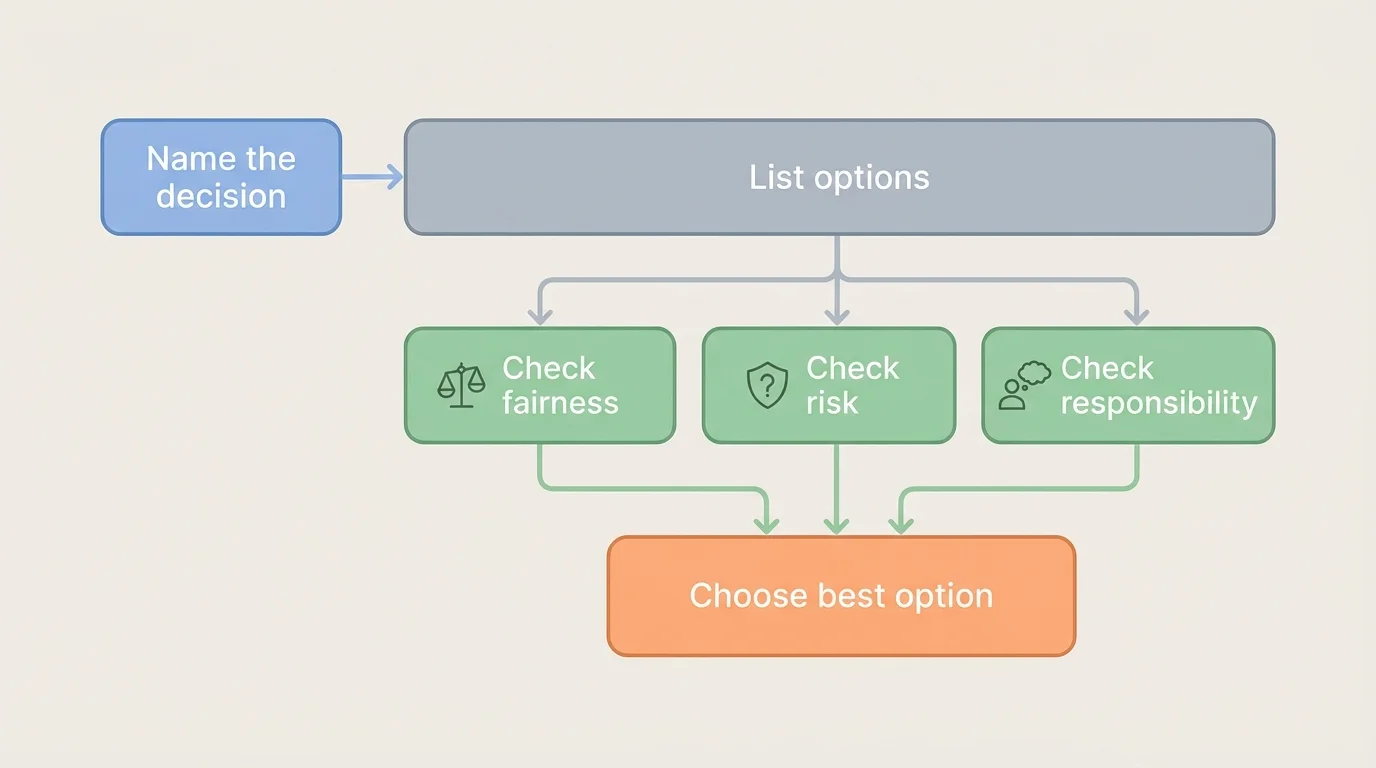
You do not need to make this tool complicated. A simple chart in your mind can help. For each option, ask three questions: "Is it fair?" "Is it safe enough?" "Is it responsible?" If an option fails badly in one of these areas, it may not be the right choice.
Example: Choosing what to do first after lunch
You want to play a game, but you also need to walk the dog before the weather gets too hot.
Step 1: Name the options.
Option A: Play first and walk the dog later. Option B: Walk the dog first and play later.
Step 2: Check fairness.
The dog depends on you. Making it wait too long is not fair.
Step 3: Check risk.
Waiting could make the walk less safe if it gets hotter outside.
Step 4: Check responsibility.
If walking the dog is your job, doing it first is more responsible.
Best choice: Walk the dog first, then play. It may not be your favorite option in the moment, but it is fairer, less risky, and more responsible.
Notice that this tool does not promise a perfect answer every time. Instead, it helps you make a stronger choice with better reasons behind it.
Fairness can look different in different situations, and [Figure 2] shows several common examples. Fair does not always mean everyone gets the exact same thing. Sometimes fair means everyone gets what they need, or each person gets a turn, or the rules are followed honestly.
To check fairness, ask questions like these: "Would I think this was fair if I were the other person?" "Am I including people kindly?" "Am I being honest?" "Am I taking more than my share?" These questions help you step outside your own feelings.
Suppose you and your sibling both want screen time. An unfair choice would be grabbing the device and refusing to share. A fairer choice might be agreeing on turns. In math, equal turns can look like this: if there are 60 minutes total, each person gets \(60 \div 2 = 30\) minutes.
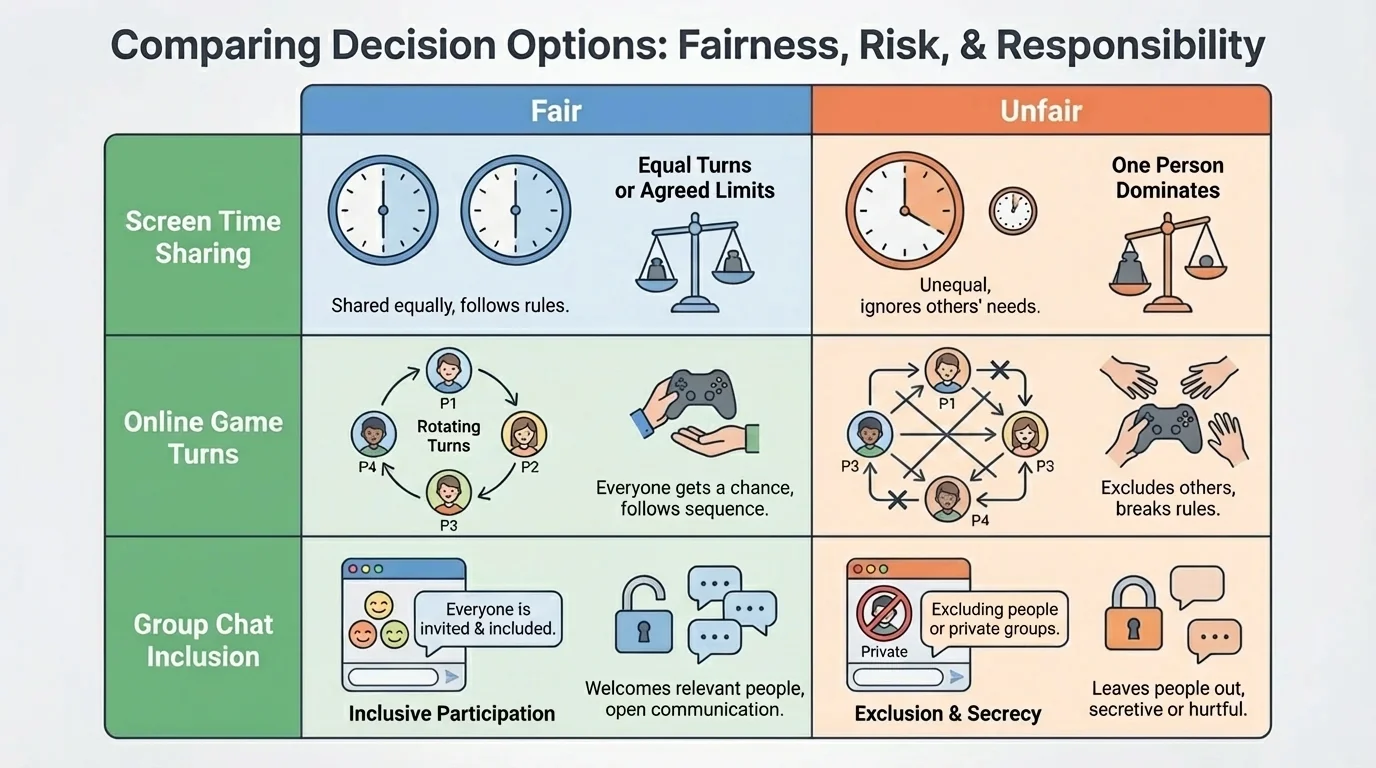
Fairness also matters online. If friends are planning a game session in a group message, it is unfair to leave someone out on purpose just to be mean. If someone made a mistake, fairness means hearing the whole story before blaming them.
Fairness does not mean letting people break rules. If a friend asks you to keep a secret about something unsafe, saying no can still be fair because it protects people. As we saw earlier in [Figure 1], a good decision uses more than one test. A choice can feel friendly but still fail the risk or responsibility check.
Your brain can jump to "what I want" faster than "what is fair." Pausing for even a few seconds can help you notice another person's point of view.
A simple fairness tip is to imagine switching places. If you would feel upset, ignored, or cheated in the other person's spot, your choice may need to change.
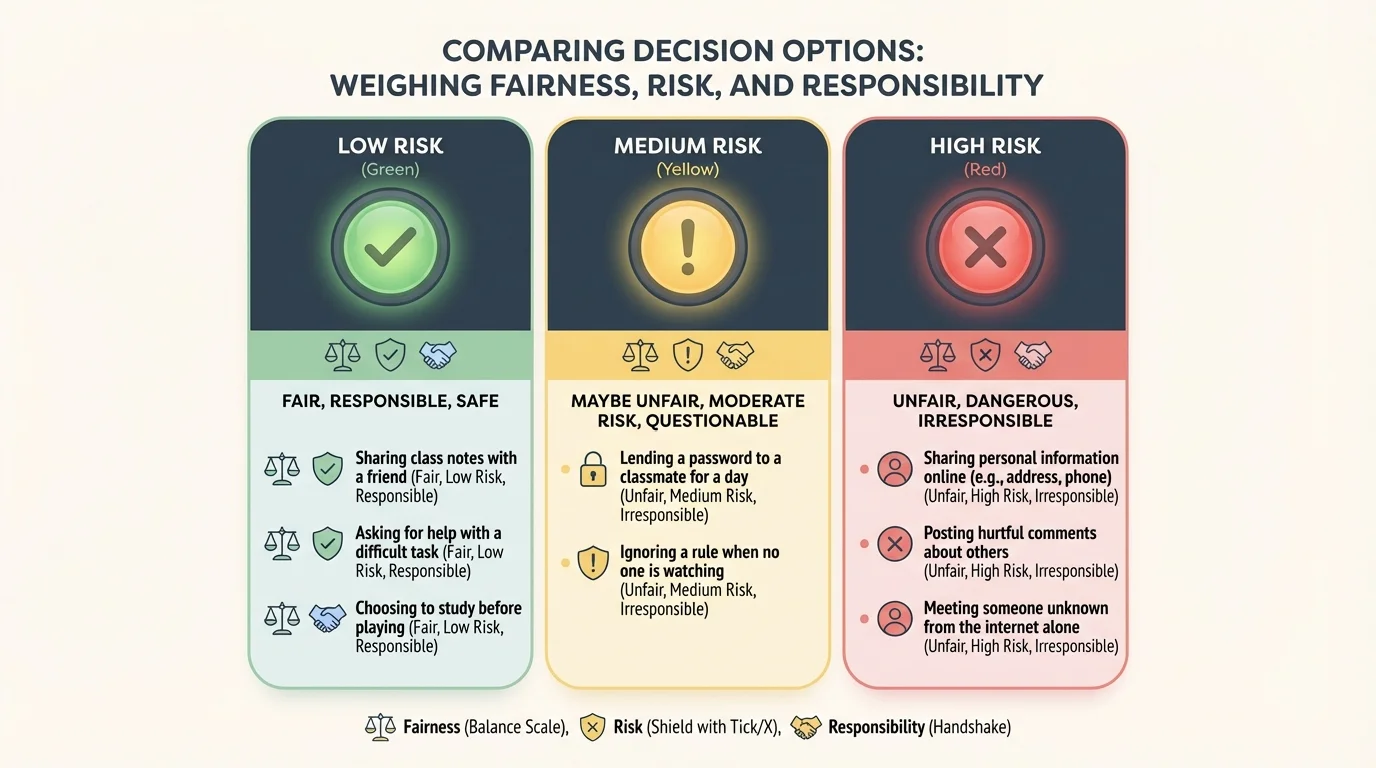
Risk is about possible danger or trouble, and sorting choices by danger level, as shown in [Figure 3], can make a decision much clearer. Some risks affect your body, like getting hurt. Others affect your feelings, privacy, money, or reputation.
When you think about risk, ask: "What might happen next?" "How serious could it be?" "How likely is it?" "Can I lower the risk?" You do not need fancy words to do this. You are simply looking ahead.
Here are a few examples. Trying a new sandwich topping is low risk. Downloading an app without checking with a trusted adult may be medium risk. Sharing your full name, address, or school information with a stranger online is high risk. Even if a bad outcome is not certain, the possible harm is serious.
Risk can be short-term or long-term. If you stay up too late watching videos, the short-term result might be extra fun. The long-term result might be being tired, cranky, and unready for the next day. Good decision-makers look beyond the next five minutes.
Risk can sometimes be lowered. For example, cooking with an adult, wearing a helmet, asking before clicking a link, and keeping passwords private all reduce risk. You do not always have to avoid every risk, but you should understand it and make it safer when possible.
Example: A message from someone you do not know
You get a message in a game asking for your username, age, and city.
Step 1: Check fairness.
The person may not be treating you honestly if they want private information.
Step 2: Check risk.
This is high risk because personal information can be misused.
Step 3: Check responsibility.
Your job is to protect your privacy and follow family safety rules.
Best choice: Do not share the information. Leave the chat, block or report if needed, and tell a trusted adult.
Later, when you compare more complicated choices, the same idea still works. As [Figure 3] illustrates, a choice in the red zone needs extra caution or should be avoided completely.
Responsibility means doing what needs to be done, even if it is not the most exciting option. It includes chores, promises, safety rules, deadlines, caring for pets, taking care of your things, and being honest when you make a mistake.
Ask yourself: "What am I supposed to do?" "Did I promise something?" "Who depends on me?" "What will happen if I ignore this?" Responsibility is about being someone others can count on.
Suppose you borrowed a library book from a local library program or community center and notice juice spilled on it. A responsible choice is to tell an adult and help fix the problem if possible. An irresponsible choice is hiding it and hoping no one notices. Hiding may feel easier, but it breaks trust.
"Doing the right thing means doing it even when nobody is watching."
Responsibility also includes managing your time. If you join an online club meeting at \(4{:}00\), being ready on time matters. If you agree to help cook dinner by washing vegetables, your family is counting on you. Small responsible actions build a strong reputation over time.
Sometimes responsibility means saying no. If friends want you to join a prank call or post something mean, responsibility helps you step away. You are in charge of your choices, even if someone else suggested them.
Now let's put the three ideas together in everyday situations. This is where decision-making becomes really useful.
Situation 1: Spending money. You have \(\$12\). Option A is spending all \(\$12\) on candy today. Option B is saving all \(\$12\) for a craft kit that costs \(\$20\). Option C is spending \(\$4\) now and saving \(\$8\). To compare, you might notice that all three are fair if the money is yours to use, but the risks and responsibilities are different. Spending all of it now may leave you disappointed later. Saving part may be the most balanced choice.
If you want to think with numbers, Option C leaves you with \(12 - 4 = 8\) dollars saved. That may better support your goal than spending everything right away. Even simple math can help you compare options clearly.
Example: Choosing how to use free time
You have \(90\) minutes before dinner.
Step 1: List options.
Option A: Watch videos for \(90\) minutes. Option B: Finish chores for \(30\) minutes, practice piano for \(20\) minutes, and play outside for \(40\) minutes.
Step 2: Compare fairness, risk, and responsibility.
Option A may be okay for fun, but it may ignore responsibilities. Option B takes care of jobs and still includes play.
Step 3: Check the time total.
\[30 + 20 + 40 = 90\]
Best choice: Option B is more balanced because it includes responsibilities and enjoyment.
Situation 2: Group chat problem. Someone posts an embarrassing photo of another kid. Option A is liking it. Option B is sharing it. Option C is not joining in and telling a trusted adult if needed. Option C is the best choice because it is fairer to the person in the photo, lowers harm, and shows responsibility.
Situation 3: Helping at home. You are supposed to clean your room, but a friend invites you to a video call. Option A is ignoring the job. Option B is doing a quick clean-up first, then joining. Option C is rescheduling the call if needed. Comparing options helps you find a solution instead of feeling trapped.
Sometimes decisions are hard because the three ideas do not line up perfectly. For example, sharing a snack equally may seem fair, but if someone has a food allergy, responsibility and safety matter more than making every plate look the same. Or maybe letting a younger child do something "just like everyone else" may seem fair, but if it is unsafe, risk must come first.
When this happens, ask which concern is biggest. A helpful rule is this: if a choice is dangerous or deeply unfair, stop there. Do not keep talking yourself into it just because it seems fun or convenient. Safety and strong responsibility often need to lead.
Trade-offs are part of real decisions. A trade-off happens when you give up one thing to gain another. You may give up extra play time to finish a job. You may give up getting your way so everyone gets a fair turn. Strong decision-makers understand that a good choice is not always the easiest or fastest choice.
If you are unsure, talk it out with a trusted adult. Explain your options and your thinking. Saying, "I chose this because it seemed most fair, had the lowest risk, and matched my responsibility," is a powerful habit.
This same thinking connects back to the decision tool in [Figure 1]. The tool helps when emotions are big, time feels short, or different values are pulling you in different directions.
Before you act, pause and ask yourself these five quick questions:
You can use this check for a tiny choice or a big one. It works when choosing what to post, how to spend money, how to solve an argument, whether to try something new, or how to use your time.
You do not have to make every decision alone. Asking for help is not weakness. It is a responsible choice when the situation feels unsafe, confusing, or too important to handle by yourself.
Try This: The next time you have to choose between two options today, say the three words quietly to yourself: fairness, risk, responsibility. Then give each option a quick check before you decide.
Try This: If you feel rushed, count slowly to \(5\) before answering, clicking, posting, or agreeing. That short pause can protect you from a poor decision.
Try This: When you make a good choice, notice what helped. Maybe you remembered a rule, thought about another person, or looked ahead to what might happen. Noticing your process helps you do it again.
