Being on time is a little like solving a real-life puzzle. If soccer practice starts at a certain time, you cannot just think about the practice itself. You also need to think about how you will get there, how long the trip takes, what you need to bring, and what to do if something changes. These are everyday life skills that people use regularly, and you can start learning them now.
Transportation, schedules, and planning are connected. If you know how to get somewhere but do not check the time, you might arrive late. If you know the time but do not plan what to bring, you might forget your library card, water bottle, or jacket. When you put these skills together, life feels calmer and easier.
Planning means thinking ahead. It helps you know what you are doing, when you are doing it, and how you will do it. Good planning does not mean everything has to be perfect. It means you are prepared enough to handle the day.
Transportation is the way a person gets from one place to another.
Schedule is a plan that shows times for events, trips, or tasks.
Planning is thinking ahead about the steps, time, and supplies needed to do something.
Here is why this matters in everyday life: when people plan well, they are more likely to arrive on time, feel less rushed, and remember what they need. When people do not plan, they may miss events, feel stressed, or need someone else to help solve the problem. For example, if you have an online club video call at 4:00 and you remember at 3:59 that your tablet is not charged, the problem is not just the battery. The real problem is that the plan left out an important step.
Different trips need different transportation choices, as [Figure 1] shows. A short trip to a nearby park might be easy on foot. A longer trip to a music lesson might need a car ride or bus. Choosing the best option depends on distance, weather, safety, cost, time, and who is available to help.
One common option is walking. Walking is simple, healthy, and free. It works best when the place is close and there are safe sidewalks or paths. Biking can also be a good choice for somewhat longer trips, but it requires a helmet, safe roads or paths, and permission from a trusted adult.
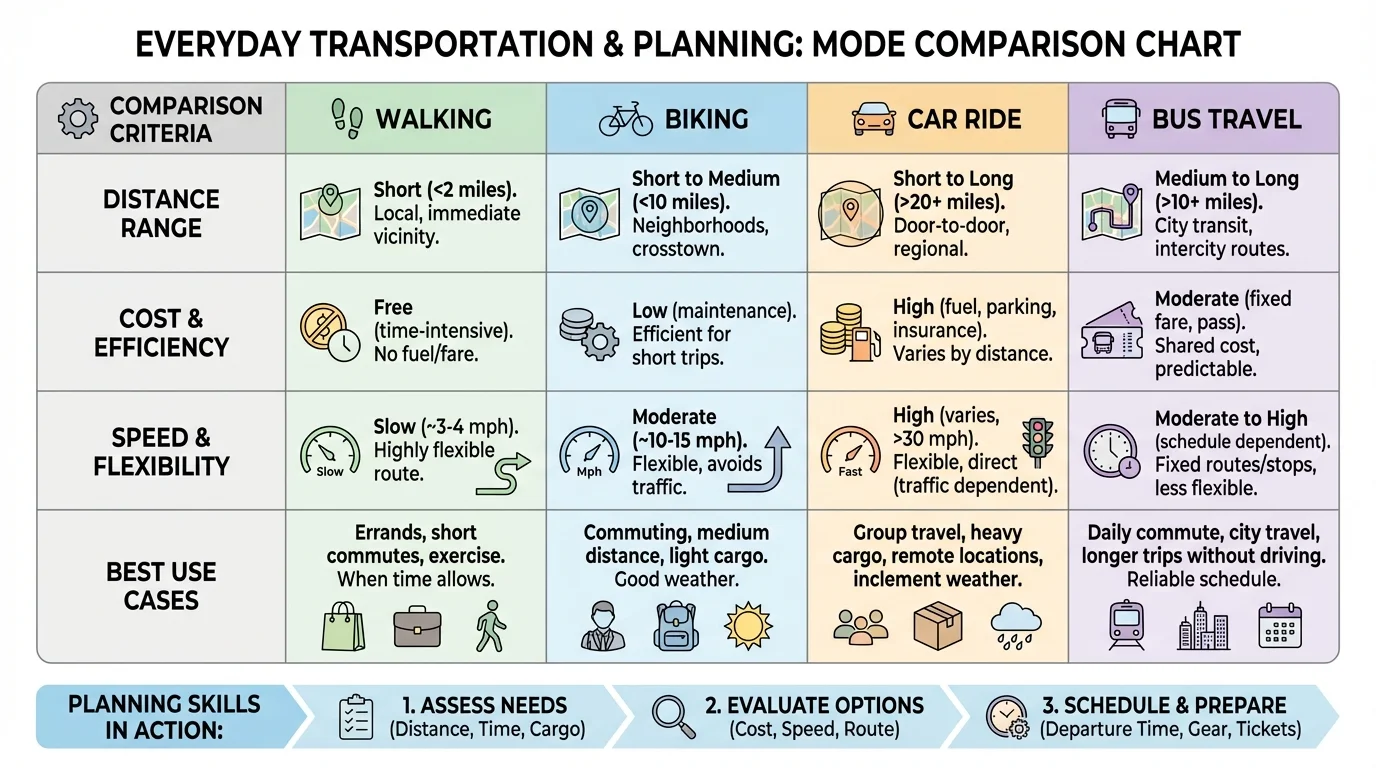
Some families use car rides. A car can be helpful when a place is far away, when the weather is bad, or when you need to carry things. Public transportation, such as a city bus or train, can also help people get where they need to go. Public transportation follows a set route and a set time, so it is useful only if you know the schedule and the stop location.
Another transportation choice is a ride from a trusted adult, family member, coach, or activity leader. In some communities, people may also use ride services, but that is a decision for adults, not children. Your job is to understand the plan, know who is taking you, and know what time you need to be ready.
When you compare transportation choices, ask yourself simple questions: Is it safe? Is it on time? Does it cost money? Do I need special gear? What happens if it rains? These questions help you make smart choices instead of last-minute guesses.
| Transportation choice | Best for | Things to check |
|---|---|---|
| Walking | Short trips nearby | Sidewalks, weather, safe crossing areas |
| Biking | Short to medium trips | Helmet, route safety, bike condition |
| Car ride | Longer trips or bad weather | Driver availability, leave time, traffic |
| Bus or train | Set routes in the community | Stop location, ticket or pass, exact schedule |
Table 1. Common transportation choices and what to check before using them.
You may not make all transportation decisions by yourself yet, but understanding the choices helps you become more independent. Later, when you need to get to activities, appointments, or community events, these skills will matter even more.
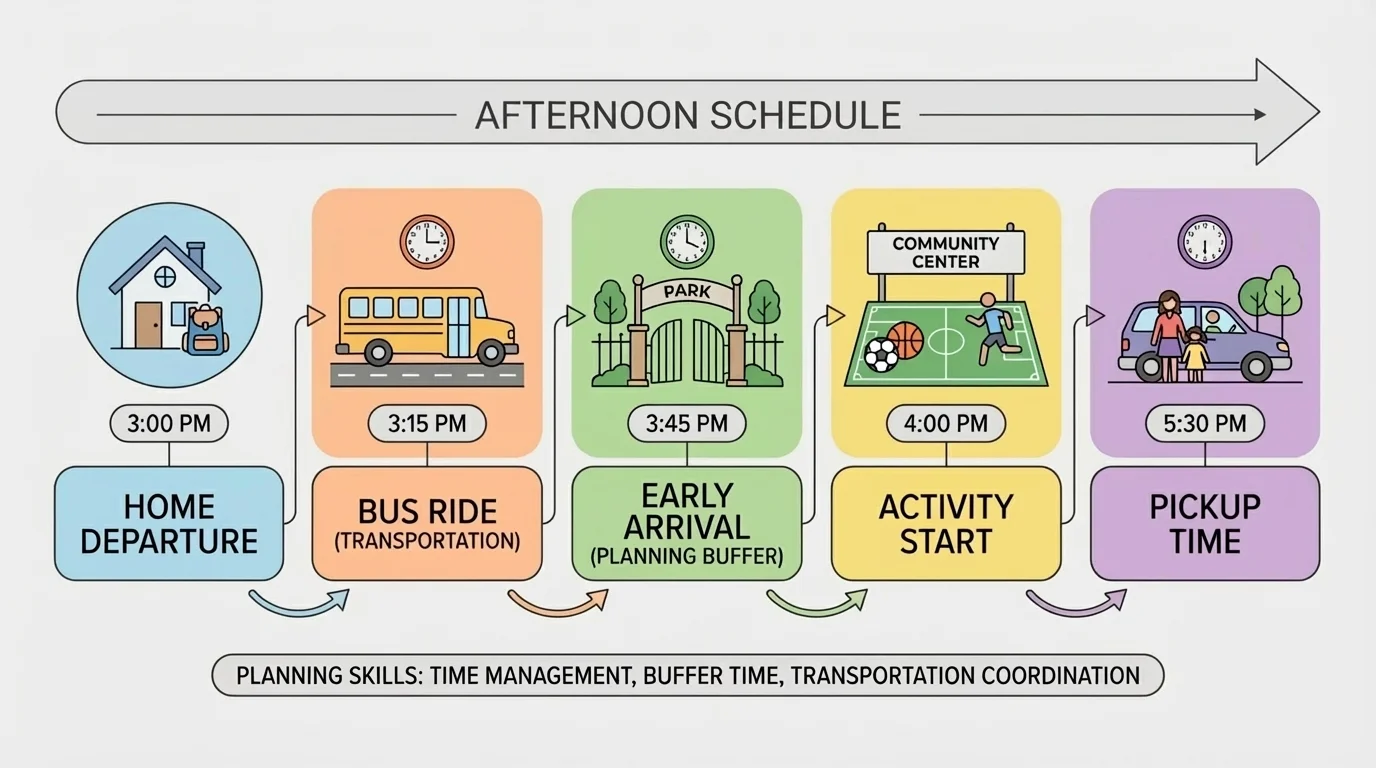
A schedule helps you break time into parts, and [Figure 2] illustrates how one event can include several smaller time pieces. You might have a leave time, travel time, waiting time, start time, end time, and return time. If you only look at the start time, you are missing most of the picture.
Suppose an art class begins at 3:30. If the trip takes 20 minutes, you cannot leave at 3:30. You need to leave earlier. If you want to arrive 10 minutes early, you need to count backward. Start with 3:30, go back 10 minutes to 3:20, then go back 20 more minutes to 3:00. That means the leave time is 3:00.
In math, you can think of it like this: class starts at 3:30, travel time is 20 minutes, and early-arrival time is 10 minutes. The total time needed before class is 30 minutes because \(20 + 10 = 30\). So, 3:30 minus 30 minutes equals 3:00.
Schedules can be written in different ways. Some are on paper calendars. Some are in phone apps. Some are posted online. Some are simple family plans written on a whiteboard at home. No matter what the schedule looks like, the main job is the same: read the time carefully and match your actions to it.
It also helps to notice whether a schedule is fixed or flexible. A doctor appointment at 2:00 is usually fixed. Free reading time in the afternoon is more flexible. Fixed times need stronger planning because being late can cause bigger problems. You may miss your appointment, hold other people up, or need to reschedule.
Example: figuring out when to leave
You have a community soccer practice at 5:15. The ride takes 25 minutes, and you want to arrive 5 minutes early.
Step 1: Add the travel and early-arrival times.
The total time needed before practice is \(25 + 5 = 30\) minutes.
Step 2: Count backward from the start time.
Start at 5:15. Go back 30 minutes. That gives you 4:45.
Step 3: Choose your ready time.
If you want time to put on shoes and fill a water bottle, you may decide to be ready by 4:35.
The leave time is 4:45, but your ready time is even earlier.
That ready time is important. Many people are not late because the trip itself is too long. They are late because they forgot to include getting dressed, packing items, or finding shoes. Small steps still take time.
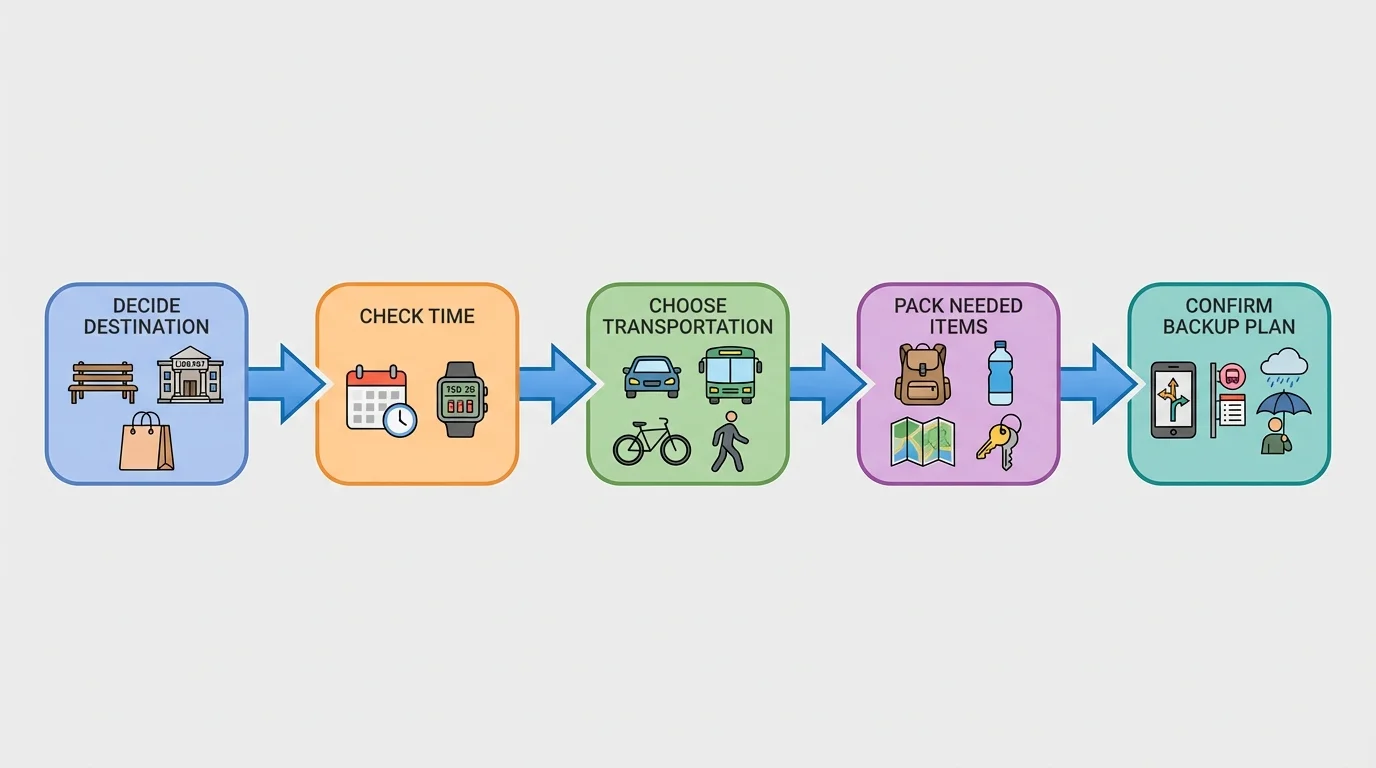
A good plan is not complicated. It is a clear list of what needs to happen, and [Figure 3] shows a useful order for doing it. When you use the same order again and again, planning gets easier.
Step 1: Know the goal. Ask, "Where am I going?" and "What am I doing there?" A trip to the library, a dentist appointment, and a friend's birthday party all need different supplies and timing.
Step 2: Check the time. What time does the event start? What time should you leave? Is there a time you should be ready before leaving?
Step 3: Choose the transportation. Will you walk, bike, ride in a car, or take a bus? Who is helping with the trip? Where do you meet?
Step 4: Gather what you need. This may include a jacket, snack, water bottle, notebook, permission form, library card, sports gear, or charger.
Step 5: Make a backup plan. What if it rains? What if traffic is slow? What if the event time changes? A backup plan might be leaving earlier, packing an umbrella, or knowing how to contact a trusted adult.
When you miss one of these steps, problems can grow quickly. If you know the start time but forget transportation, you may not get there. If you know the transportation but forget your shoes, you may get there but still not be ready.
Planning works best when you write things down. Your brain is good at thinking, but it is not perfect at remembering every detail. A short checklist can save time and stress.
The power of backward planning
Backward planning means starting with the event time and working backward to figure out what needs to happen first. If an event begins at 6:00, and travel takes 15 minutes, and getting ready takes 20 minutes, then you need 35 minutes before the event because \(15 + 20 = 35\). That means getting ready should begin at 5:25. This method helps you avoid rushing.
You can use this skill for online life too. If you have a video call at 7:00, your plan might include checking your device at 6:45, logging in at 6:55, and keeping your headphones nearby. Transportation planning is about moving your body from place to place, but schedule planning also helps you move smoothly from one activity to another at home.
Helpful tools make planning easier. A calendar helps you see what is happening on different days. An alarm reminds you when it is time to start getting ready. A checklist keeps track of what to bring. A map helps you understand where a place is and how to get there.
A route is the path you take to get somewhere. A route could be as simple as "walk to the corner, turn right, and go to the library," or as detailed as "leave home, drive to the community center, then continue to the park." Choosing a route matters because some ways are faster, safer, or easier than others.
A map app can estimate travel time, but estimates are not perfect. Cars may get stuck in traffic. Weather can slow a trip down. A bus might be delayed. That is why many people leave a little extra time, often called a buffer time. Buffer time is extra time added just in case something takes longer than expected.
For example, if a trip usually takes 15 minutes, adding 10 minutes of buffer time means planning for 25 minutes total because \(15 + 10 = 25\). That extra time can make the difference between arriving calmly and arriving late.
Some adults plan their whole week by checking calendars every morning and every evening. Small daily check-ins help prevent big surprises later.
You do not need fancy tools to be organized. A sticky note, a paper list, or a family wall calendar can work very well. The best tool is the one you actually use.
Safe travel habits matter just as much as timing, and [Figure 4] highlights several smart choices people use in the community. Before going somewhere, make sure a trusted adult knows the plan. Know who is taking you, where you are going, and when you are expected back.
If you are walking, use sidewalks and cross at safe places. If you are biking, wear a helmet and follow local safety rules. If you are riding in a car, wear a seat belt. If you are using public transportation with an adult, stay close and pay attention to stops and timing.
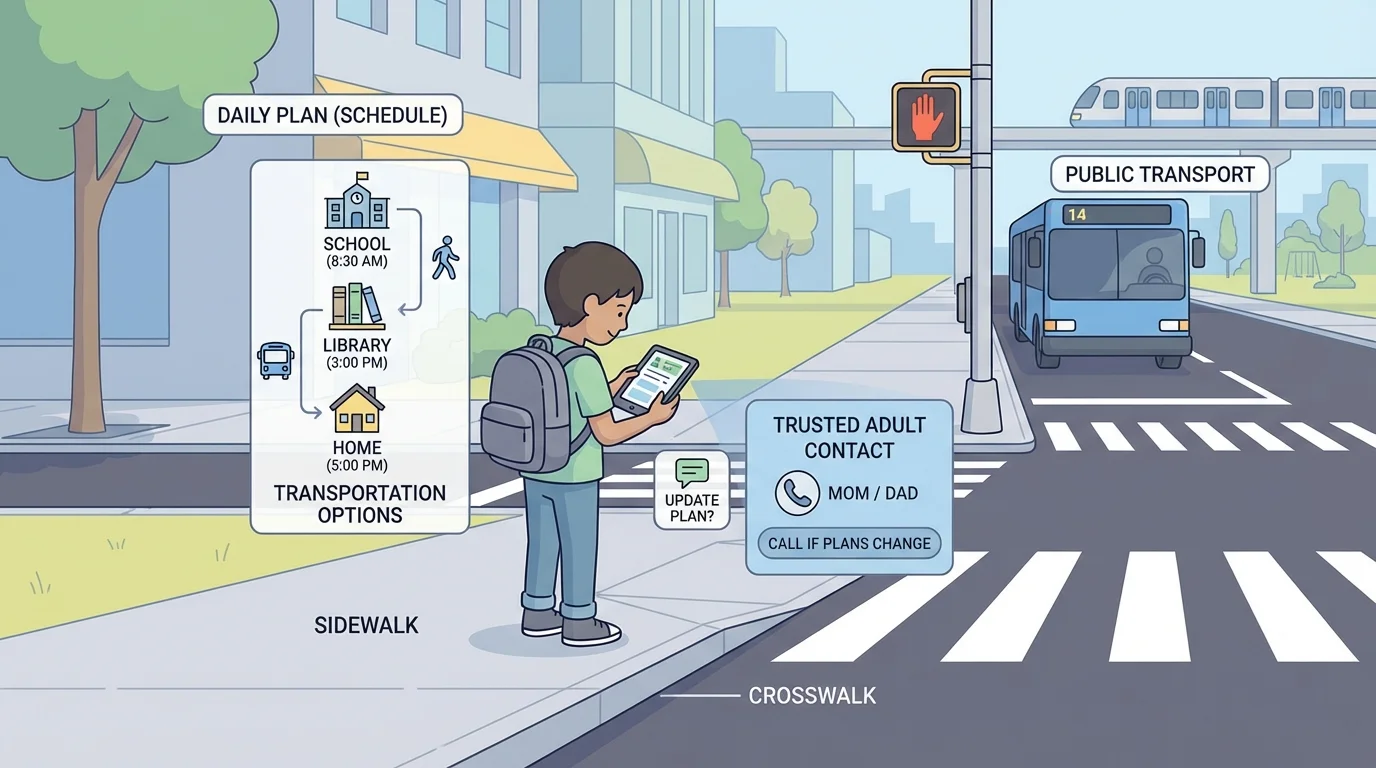
Another safety skill is knowing what to do when plans change. Maybe the event is canceled. Maybe the ride is late. Maybe weather makes the trip unsafe. In those moments, stop and think. Do not guess. Contact a trusted adult, explain what changed, and wait for directions.
You should also carry or know important information when needed, such as a trusted adult's phone number, the name of the place you are going, and any special instructions. This is part of being prepared, not part of being scared.
Later, when you look again at the travel habits in [Figure 4], you can see that safety is built from many small actions: noticing your surroundings, following the plan, and asking for help when something changes.
These skills show up in many ordinary situations. Maybe you are going to the library after lunch. You check the opening time, choose a ride with a parent, put your library books in a bag, and leave early enough to return the books before a reading event starts.
Maybe you have piano lessons at 4:30 every Thursday. Because that is a repeating event, you can build a routine. At 4:00, you pack your music book. At 4:05, you put on your shoes. At 4:10, you leave. Routines save energy because you do not have to create a brand-new plan every time.
Example: planning for a weekend activity
Talia is going to a community art workshop that starts at 1:00. The drive takes 18 minutes. She wants to arrive 12 minutes early, and packing her supplies takes 10 minutes.
Step 1: Add travel time and early-arrival time.
The time before the workshop is \(18 + 12 = 30\) minutes.
Step 2: Count backward from the start time.
1:00 minus 30 minutes is 12:30. That is the leave time.
Step 3: Include packing time.
12:30 minus 10 minutes is 12:20. That is when Talia should start packing.
Talia should start packing at 12:20 and leave at 12:30.
Or maybe your family is running errands. Even if you are not in charge, you can notice how adults group trips together. Going to the pharmacy, grocery store, and post office in one area may save time and gas compared with driving back and forth across town. That is planning too.
The transportation chart from earlier, shown in [Figure 1], still matters here because not every errand or activity needs the same kind of travel. The best choice changes depending on the day and the goal.
You do not become organized all at once. Independence grows through practice. You might begin by checking a family calendar, helping pack for an activity, or setting your own reminder alarm. Later, you might help figure out when to leave for an event.
A transportation option and a time plan often work together. If the bus comes only once every 30 minutes, being even a few minutes late matters a lot. If you are getting a car ride, there may be more flexibility, but you still should be respectful of the driver's time.
The timeline in [Figure 2] makes this clear: one event is really a chain of smaller times and actions. When one part changes, other parts may need to change too.
If planning feels hard at first, that is normal. Start small. Plan one simple trip. Make one short checklist. Set one alarm. Over time, these small habits become strong life skills.
"Being prepared is a quiet kind of confidence."
When you know where you are going, how you will get there, and what time you need to be ready, you feel more in control. That confidence helps at home, in the community, during activities, and in future jobs and responsibilities too.
