Some adults change careers more than once in their lives. That means the choice you make after high school matters, but it does not lock you into one path forever. You can start in one place, learn new skills, and change direction later. Knowing that can make the future feel less scary and more exciting.
Right now, you are in middle school, not high school. But this is actually a great time to start noticing what you enjoy, what you are good at, and what kind of life you want to build. Future planning is not about having your whole life figured out. It is about paying attention and learning how choices connect.
Pathway means a route you can take toward your future. A pathway after high school might include college, job training, an apprenticeship, military service, or going straight to work. Post-secondary means education or training that happens after high school.
When you think ahead, you can make better choices now. For example, if you discover that you love fixing things, building things, or working with your hands, you might want to learn about technical training or a skilled trade. If you enjoy studying a subject deeply and want a career that usually needs a degree, college might fit you well. If you want to start earning money quickly and gaining experience, work might be your first step.
Planning ahead helps you make your present choices more useful. The habits you build now, like finishing tasks, showing up on time for online meetings, speaking respectfully, and staying organized, matter in every pathway. These are life skills, not just school skills.
It also helps you notice your interests. Interests are things you like to learn about or do. Maybe you enjoy coding, cooking, helping younger kids, drawing, caring for animals, organizing events, or solving problems. Those clues can point toward future jobs and training options.
Your strengths matter too. A strength is something you do well or can learn quickly with practice. You may be a strong communicator, careful planner, creative designer, patient helper, or hands-on builder. A future pathway is often the best fit when it matches both your interests and your strengths.
Many successful adults did not follow exactly the path they expected at age 18. Some started working and went to college later. Some went to college first and later learned a trade or earned a certificate for a different job.
If you do not think ahead, you might choose based only on what sounds popular or what other people are doing. That can lead to frustration. If you do think ahead, you are more likely to choose a path that fits your real goals.
After high school, people can follow several main routes, and those routes can connect to each other. The big idea, shown in [Figure 1], is that there is not just one "right" way to build a future.
One pathway is college. This usually means continuing your education at a community college or a four-year college or university. Another pathway is a training program, such as a career school, certification course, or trade program. A third pathway is going straight into work, often through an entry-level job. Some people also join the military, which can provide training, work experience, and education benefits.
These pathways are not separate boxes with locked doors. A person might go to work first, save money, and attend college later. Another person might finish a training program, get a job, and then take more classes to move into a leadership role. Someone else might attend community college and then transfer to a four-year school.
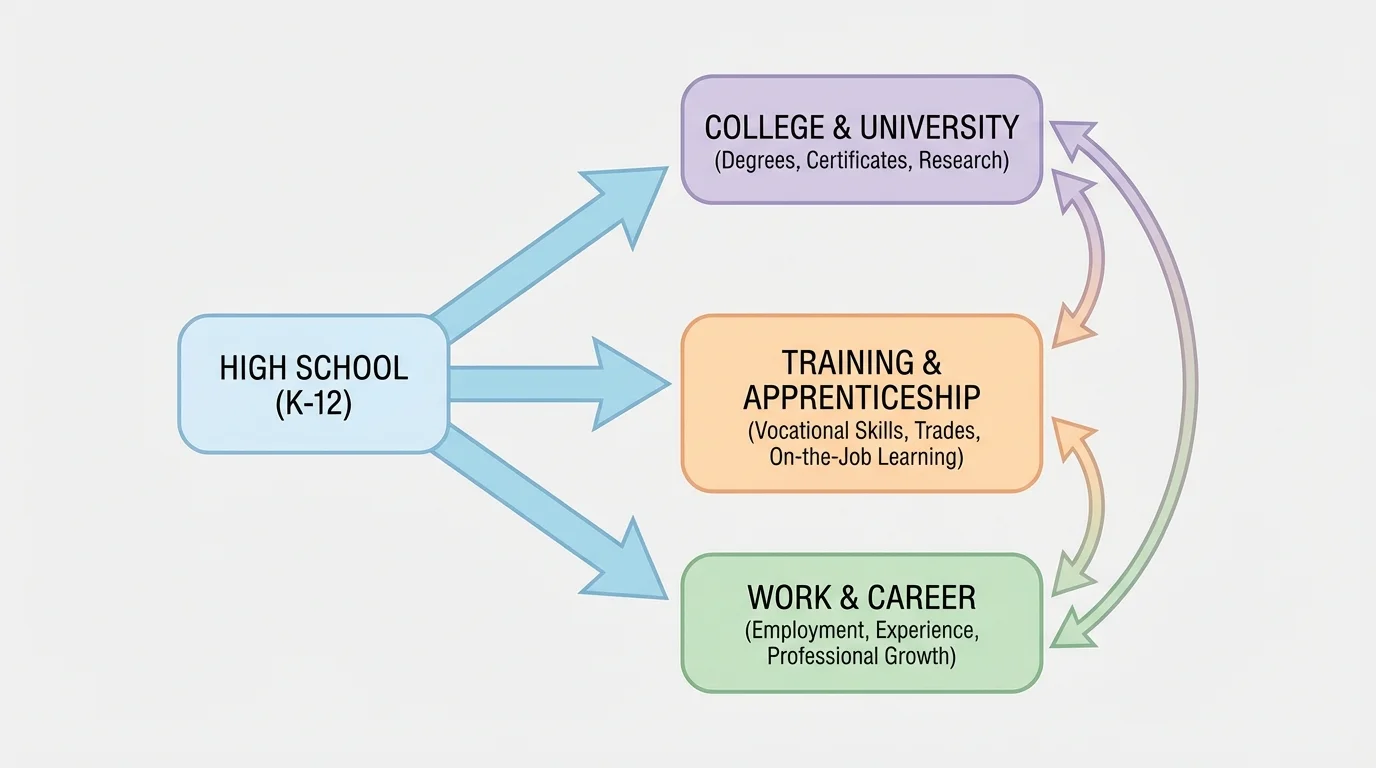
The smart question is not "Which path is best for everyone?" The smart question is "Which path fits your goals, needs, and situation right now?" That question helps you think clearly instead of following pressure from others.
College can be a strong choice if your future job usually needs a degree or if you want more time to study a subject in depth. Careers such as teacher, engineer, nurse, scientist, and many business jobs may require college education. There are different types of colleges, and they are not all the same.
A community college often costs less and may take about two years for many programs. A four-year college or university usually takes longer and may offer a wider range of majors and campus programs. Some students begin at a community college and later transfer to a four-year school.
College can help you build knowledge, meet mentors, and prepare for certain careers. It can also cost a lot of money, so it is important to ask questions about tuition, books, housing, transportation, and financial aid. If two schools offer similar programs, a lower-cost choice may be a smart option.
| Option | Typical Length | Common Benefits | Things to Consider |
|---|---|---|---|
| Community college | 2 years | Lower cost, flexible schedules, transfer options | May not offer every major |
| Four-year college | 4 years | More majors, campus programs, degree pathways | Higher cost, bigger time commitment |
Table 1. Comparison of two common college options after high school.
Suppose one program costs $4,000 each year for two years. The total cost would be $8,000 because \(4,000 + 4,000 = 8,000\). If another option costs $12,000 each year for four years, the total would be $48,000 because \(12,000 \times 4 = 48,000\). You do not need to memorize these numbers. The point is to see why comparing cost matters.
Real-life example: Comparing two education choices
Jordan wants to become a physical therapist assistant, and Sam wants to become an architect. They need different plans.
Step 1: Jordan checks what the job requires.
Jordan learns the job usually needs a specific two-year college program and licensing.
Step 2: Sam checks what the job requires.
Sam learns that architecture usually needs a longer college path and more advanced study.
Step 3: They match the pathway to the goal.
Jordan chooses a shorter college program. Sam plans for a longer degree path.
The same option is not the best choice for both students because their goals are different.
College is not better than other pathways. It is simply one pathway that works well for some goals. As you saw in [Figure 1], it is one branch in a larger set of choices.
Another strong pathway is technical training. This can include certificate programs, career schools, apprenticeships, and trade programs. These options often focus on specific job skills you can use quickly.
An apprenticeship is a program where you learn a skilled job by doing real work while also receiving instruction. For example, someone training to become an electrician, plumber, or mechanic may learn from experienced workers while earning money.
This pathway can be a great fit if you like hands-on work, solving practical problems, using tools, building, repairing, or working in active settings instead of sitting for long periods. Skilled trade jobs are important in every community because people always need safe buildings, working water systems, vehicles, heating, and repairs.
Why training programs can be powerful
Training programs are often more focused than college. Instead of studying many different subjects, you spend more time learning the skills needed for a certain kind of job. This can save time and help you start working sooner, especially if your chosen field does not require a four-year degree.
These programs still require responsibility. You may need to arrive on time, follow safety rules, learn carefully, and communicate well with customers or coworkers. If a person ignores instructions or acts carelessly, the results can be serious, especially in jobs involving tools, machines, or people's homes.
A challenge is that some careers in this area can be physically demanding. It is also important to choose a trustworthy program with real job training, not one that promises a lot but delivers little. Ask what skills are taught, how long the program lasts, and whether students usually get jobs after finishing.
Some people choose to start working right after high school. This can make sense if they want immediate income, need to support themselves or family, or want real experience before deciding on more school or training.
An career is not just a single job. It is the longer path of work you build over time. A first job may be simple, but it can teach useful habits such as customer service, teamwork, punctuality, and problem-solving.
Going straight to work does not mean learning stops. Good workers keep learning all the time. They may receive job training, take classes later, earn certifications, or move into better positions after proving themselves.
The risk is that some jobs do not pay enough to support long-term goals or do not offer much room to grow. That is why it helps to think beyond the first paycheck. Ask yourself whether the job teaches useful skills, offers advancement, or connects to something bigger you want later.
Real-life example: Starting with work and building upward
Maria gets a part-time job at a local repair shop after high school.
Step 1: She learns basic workplace habits.
She shows up on time, listens carefully, and treats customers with respect.
Step 2: She notices what interests her.
She enjoys learning how machines work and asking technicians questions.
Step 3: She takes the next step.
After saving money and gaining confidence, she enters a technical training program.
Work became her starting point, not her final stop.
That kind of flexible path is common. A person can begin with work, then later add training or college when they have a clearer goal.
One of the best ways to compare pathways is to look at several factors side by side. [Figure 2] shows how this comparison can help you see what fits your real life, instead of focusing only on what sounds impressive.
Start with your interests. What do you enjoy enough to keep learning about? Then think about your strengths. What kinds of tasks feel natural to you? After that, consider your values. Do you care a lot about helping people, creating things, solving technical problems, earning money quickly, having flexible time, or working indoors or outdoors?
Next, think about time and cost. Some pathways take longer and cost more. Others let you start earning sooner. Also think about daily life. Would you rather spend more time reading and studying, practicing hands-on skills, or learning by working in a real job?
Another useful question is: what does this path lead to? If your dream job requires a degree, skipping college may not be the best route. If your goal requires certification or hands-on training, a focused technical program may fit better than a long academic path.
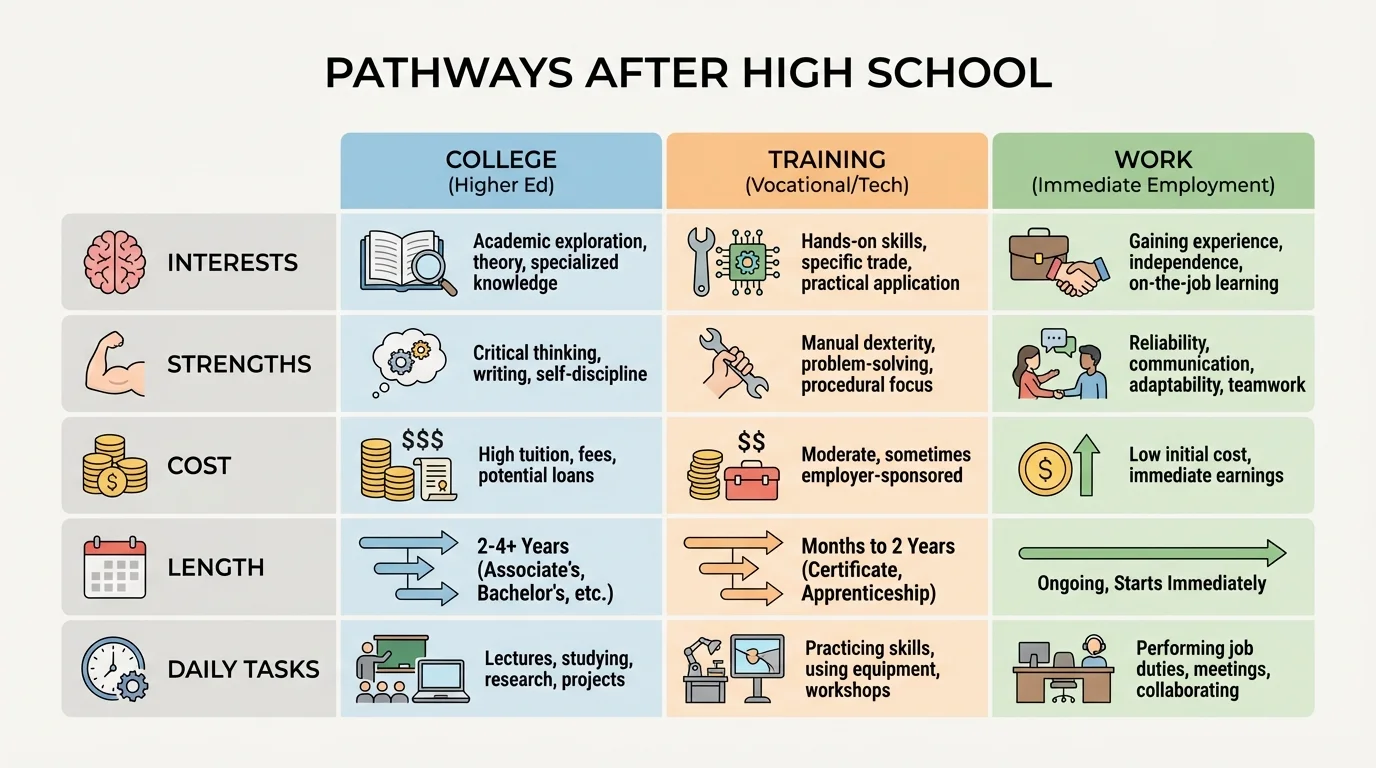
You do not have to know your final answer right away. It is okay to say, "I am still exploring." Good decision-making means gathering information, not pretending to know everything already.
| Question to Ask | Why It Matters |
|---|---|
| What jobs interest me? | Helps connect pathways to real goals |
| What am I good at? | Shows where you may succeed |
| How much time will this take? | Helps you plan realistically |
| What will it cost? | Prepares you for financial decisions |
| Can I change direction later? | Reminds you that paths can connect |
Table 2. Helpful questions to ask when comparing future pathways.
When people skip these questions, they may choose based on pressure, trend, or fear. When they ask these questions, they are more likely to choose wisely. This kind of comparison keeps the decision focused on what truly fits.
Money is not the only factor, but it is an important one. Some pathways cost more at the beginning. Some allow you to earn money earlier. Some offer scholarships, paid training, or employer support.
A scholarship is money given to help pay for education. Unlike a loan, scholarship money usually does not need to be paid back. Scholarships can come from schools, community groups, companies, and organizations.
Suppose you save $15 each month for future career exploration costs, such as transportation, supplies, or application fees. After one year, you would have $180 because \(15 \times 12 = 180\). Small planning steps can grow over time.
You already use planning skills in daily life when you save up for something, schedule your week, or compare two choices before spending money. Future planning uses those same habits on a bigger scale.
It also helps to ask smart questions before joining a program or accepting a job. What will I learn? How long will it take? What does it cost? Will this help me move toward the future I want? Clear questions protect you from rushed decisions.
You do not need to figure out the future alone. Helpful adults may include parents or guardians, relatives, family friends, coaches, club leaders, neighbors, mentors, employers, or community members who work in jobs that interest you.
Since you learn online, many of your future-planning conversations may happen through video calls, messages, phone calls, or community activities outside school. You can still ask thoughtful questions and learn a lot. For safety, always involve a trusted adult when contacting people online or arranging visits.
You can ask adults questions like: What do you do each day? What do you enjoy about your job? What training did you need? What is hard about it? If you were my age, what would you start practicing now?
"The future depends on what you do today."
— Mahatma Gandhi
That quote matters because future readiness is built little by little. One conversation, one skill, one habit, and one smart question can move you forward.
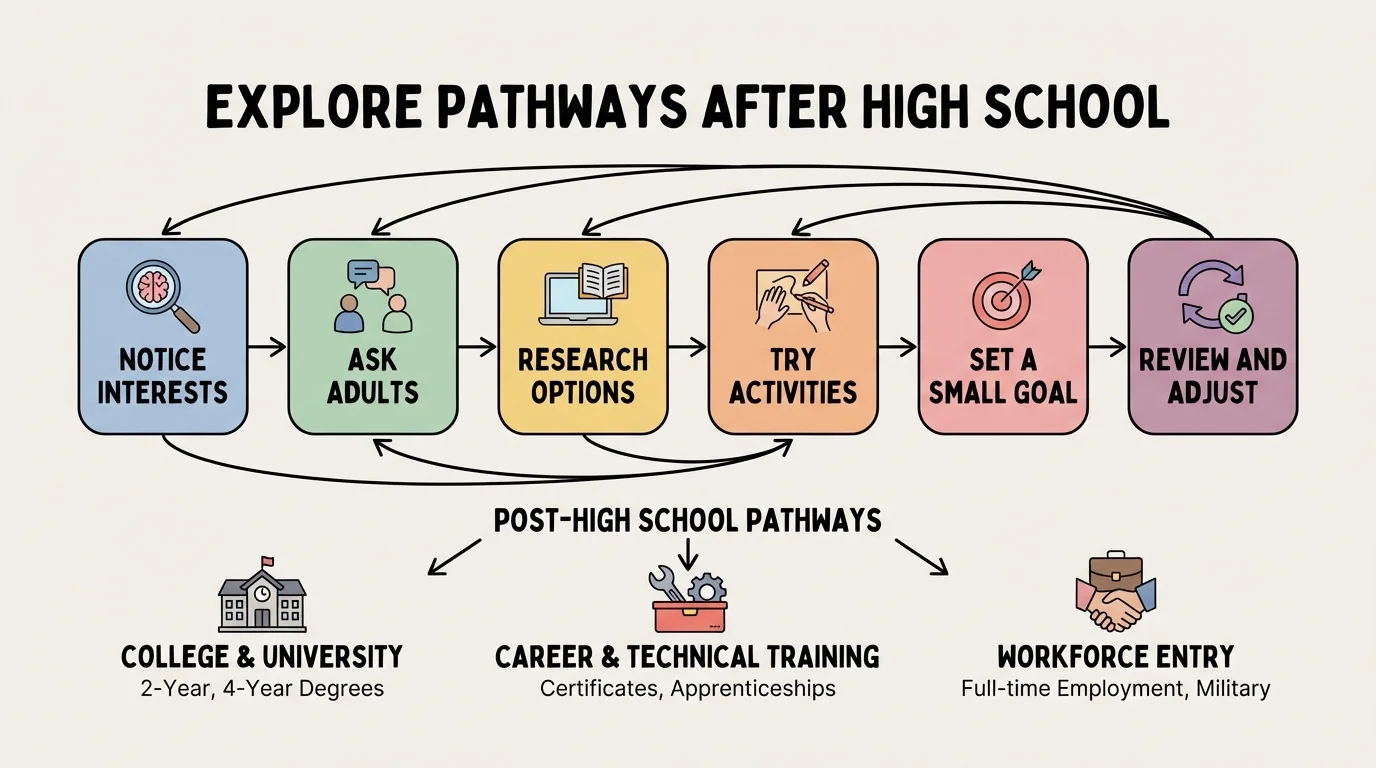
You do not need to wait until high school to begin. [Figure 3] shows a simple process that can help you start exploring in a calm and practical way.
Step 1: Notice what you enjoy. Pay attention to activities that make you curious, focused, or proud.
Step 2: Notice what you do well. Ask trusted adults what strengths they see in you.
Step 3: Explore careers connected to those patterns. Read, watch interviews, or talk to adults in those fields.
Step 4: Try small experiences. Join a club, volunteer, build a project, help with a family task, or practice a useful skill at home.
Step 5: Set one small goal. For example, you might decide to learn basic coding, improve communication, or practice staying organized for one month.
Step 6: Review and adjust. If your interests change, that is normal. Update your plan.
This kind of action plan works because it is realistic. You are not trying to solve your whole future in one day. You are collecting clues and building readiness.
Try This: Keep a simple future notebook or digital document. Make three lists: "Things I enjoy," "Things I do well," and "Jobs or pathways I want to learn more about." Add to it whenever you notice something new.
Try This: Interview one trusted adult about their work. Ask what they do, how they learned it, and what skills matter most.
Try This: Practice one habit that helps in every pathway: being on time, communicating clearly, finishing what you start, or staying organized.
Mini case study: Three students, three good choices
Each student wants a different kind of future, so each one explores a different path.
Step 1: Eli loves computers and wants to design software.
He learns that many software jobs value advanced coding skills, so he explores college and coding programs.
Step 2: Tasha likes fixing bikes and working with tools.
She explores technical training and apprenticeships connected to mechanical work.
Step 3: Devin wants to start earning money quickly and gain experience.
He explores entry-level jobs while planning to take classes later if needed.
All three are planning responsibly because each choice connects to a real goal.
Future readiness is a process of noticing, exploring, trying, and adjusting. You do not need a perfect answer. You need a thoughtful next step.
