Two countries can be in the same hemisphere, use money, have stores, schools, and jobs, and still run their economies in very different ways. In one place, most businesses are privately owned and compete with each other. In another, the government plays a much bigger role in deciding what is produced, how much things cost, or what services people receive. Across the Western Hemisphere, which includes North America, Central America, the Caribbean, and South America, systems of government and economic systems are closely connected.
When we compare countries, we are not just asking, "Who is in charge?" We are also asking, "Who owns businesses? Who collects taxes? Who pays for schools and roads? How much freedom do people have to start a business or choose a job?" These questions help us understand how governments relate to their citizens through economic decisions, as [Figure 1] illustrates.
A system of government is the way a country organizes political power and makes decisions. An economy is the system a society uses to produce, distribute, and use goods and services. These two parts of a country are linked, because governments make laws, collect taxes, protect property, and provide services that shape economic life.
If a government allows people to open businesses freely, the economy may become more competitive. If a government controls many industries itself, the economy may depend more on state planning. Governments also decide how much money to spend on healthcare, education, transportation, and aid for people in need. Citizens feel these choices in everyday life when they buy food, pay bills, go to school, or look for work.
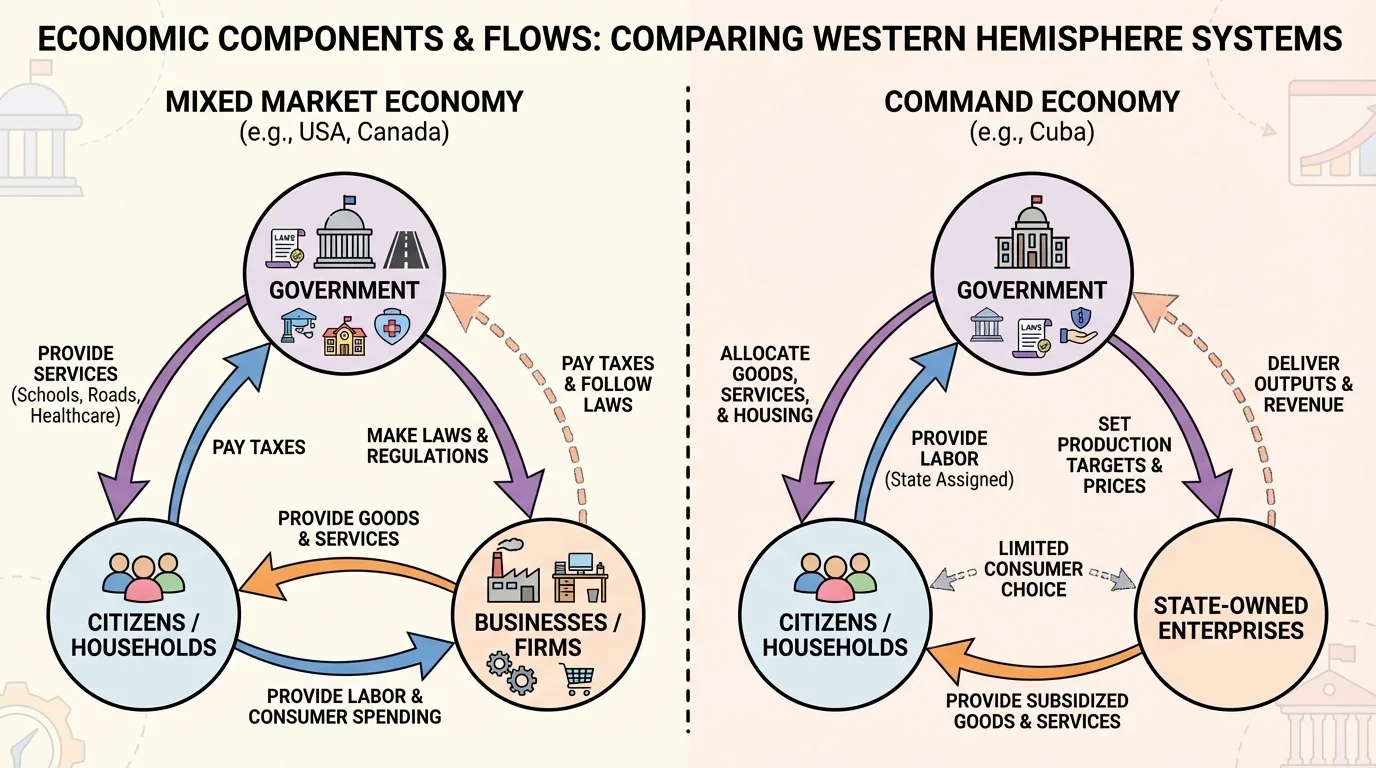
Market economy is an economic system in which most businesses and property are privately owned, and prices are mostly set by buyers and sellers.
Command economy is an economic system in which the government controls major parts of production, prices, and resources.
Mixed economy is an economic system that combines private business with government regulation and public services.
In real life, very few countries are purely one type. Most countries in the Western Hemisphere have mixed economies. That means they mix private business with some government control, rules, and public programs. The big question is not whether government is involved at all, but how much and in what ways.
To compare economic components clearly, we need a few key ideas. Private ownership means individuals or companies own businesses or property. Public sector refers to parts of the economy run by the government, such as public schools, police, and many roads. Taxes are money collected by governments to pay for services.
Another important term is regulation, which means rules the government sets for businesses and workers. Regulations can cover safety, wages, the environment, and fair competition. Some countries regulate businesses lightly, while others regulate them more closely.
Property rights are the legal rights to own and use land, homes, or businesses. Strong property rights often encourage people to invest money and start companies because they believe what they own will be protected by law. Trade is also important. Countries in the Western Hemisphere buy and sell goods with each other, so government policies about trade can affect jobs and prices.
Some of the world's largest trading partnerships are in the Western Hemisphere. A decision made by one government about imports or exports can affect factories, farms, and stores in several countries at once.
Economic components are easier to compare when we ask the same questions about each country, as [Figure 2] suggests: Who owns businesses? How are prices set? How much does the government tax and spend? What public services are provided? How free are citizens to choose jobs, start businesses, and buy or sell goods?
Countries in the Western Hemisphere do not all have the same political structure. Many are democracies, where citizens vote for leaders and have rights protected by law. Democracies can still have different economic policies. Some favor more private business freedom, while others place more emphasis on public programs and government support.
The United States, Brazil, Mexico, and many other countries are presidential republics with elected leaders. Canada is a democracy with a constitutional monarchy and a parliamentary system. These systems differ in how leaders are chosen and how laws are made, but all of them connect political decision-making to economic choices such as taxes, spending, and regulation.
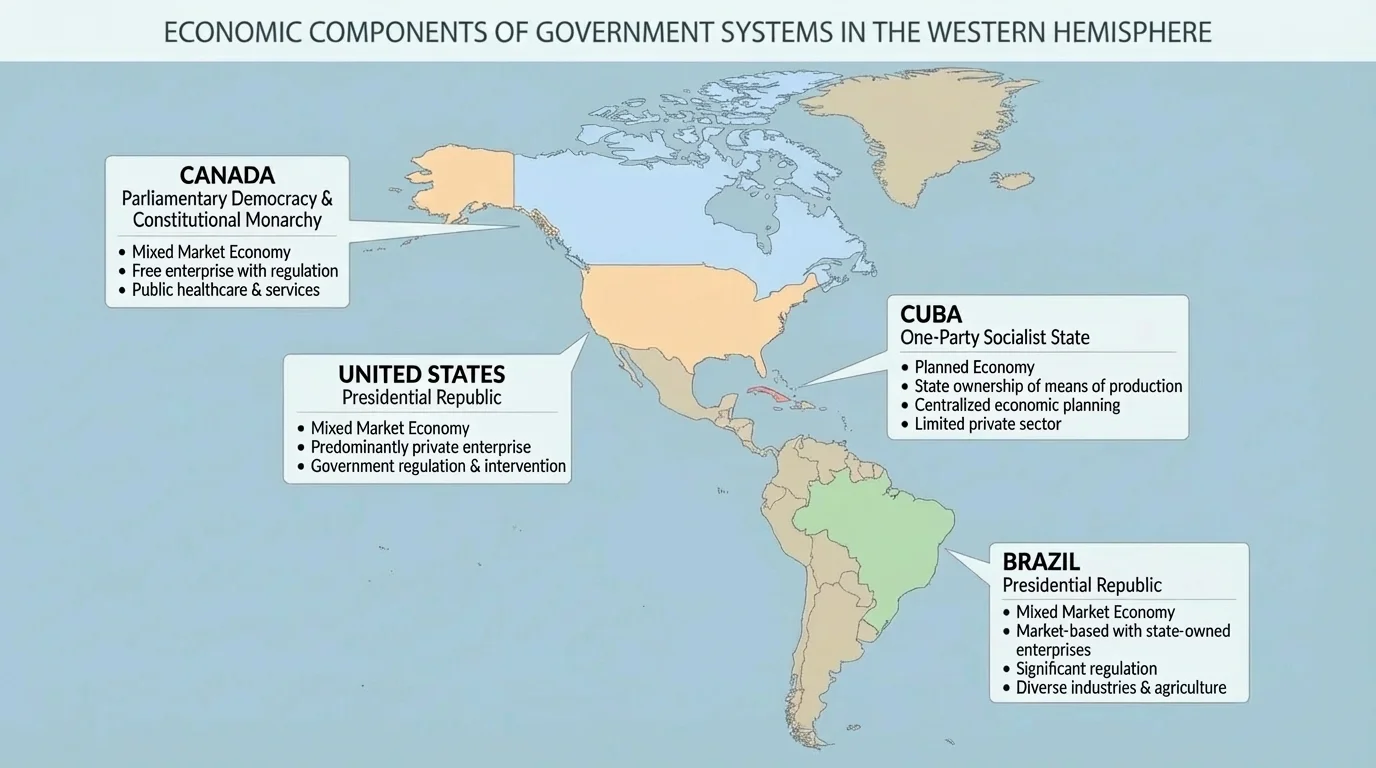
Not every government in the hemisphere gives citizens the same level of political choice. Cuba, for example, is a one-party state with a socialist system in which the government has historically played a much larger role in the economy than in most other countries in the region. This affects how businesses operate, how goods are distributed, and how much economic freedom citizens have.
Even among democracies, there is no single model. A democratic country may strongly support free markets, or it may collect higher taxes to fund broad public services. This is why it is important to compare both the government system and the economic components together, as [Figure 3] shows.
One major difference is ownership. In more market-based systems, many farms, stores, factories, and companies are privately owned. In systems with stronger government control, the state may own important industries such as energy, transportation, or healthcare. Most countries combine these approaches in some way, and the balance among them matters.
A second difference is how prices are set. In a market economy, prices usually change based on supply and demand. If many people want a product and there is not enough of it, the price may rise. In a command economy, the government may decide prices instead. This can make some goods more affordable, but it can also lead to shortages if prices do not match real demand.
A third difference is taxation and public spending. Some governments collect more taxes and use that money for public healthcare, education, pensions, or transportation. Others collect lower taxes and leave more services to private businesses or individuals. Citizens may pay less in taxes in one country, but more directly for medical care or college. In another country, taxes may be higher, but the government may provide more services.
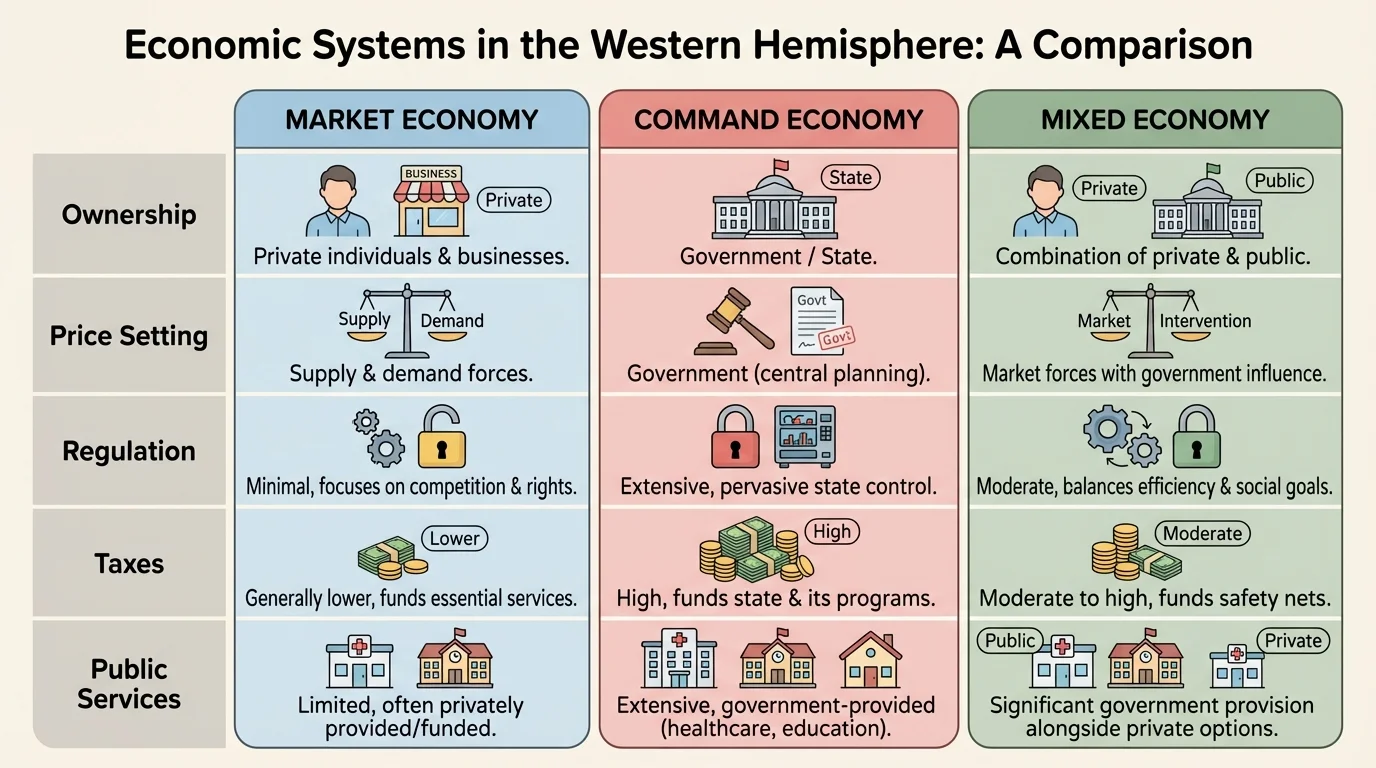
A fourth difference is regulation. Governments may set a minimum wage, workplace safety laws, pollution limits, and consumer protections. Stronger regulation can protect citizens, but too many rules may make it harder for businesses to grow quickly. Lighter regulation can encourage business activity, but it may also create risks for workers or the environment.
A fifth difference is social programs. These include government support such as public housing, food assistance, unemployment aid, and healthcare systems. Countries differ in how much help they provide and who qualifies. Citizens often judge economic systems by how well these programs meet basic needs.
| Economic Component | More Market-Based Approach | More Government-Controlled Approach |
|---|---|---|
| Business ownership | Mostly private individuals and companies | More state ownership |
| Prices | Set mostly by supply and demand | Set or strongly guided by government |
| Taxes | Often lower overall | Often higher to fund services |
| Public services | More private options | More government-provided services |
| Regulation | Usually lighter | Usually stronger |
| Citizen economic freedom | Usually broader business choice | Usually more limits |
Table 1. Comparison of common economic components in more market-based and more government-controlled systems.
Why most countries are mixed
Pure market and pure command systems are rare. Most governments use a mixture because they want both economic growth and public protection. They may allow private businesses to create jobs while also using taxes to build roads, fund schools, and help citizens during hard times.
That is why comparison matters. Two democracies may both hold elections, but one may rely more on private healthcare while another uses tax money to provide public healthcare. Their governments are both elected, yet their economic components are not the same.
Everyday life reveals the effects of economic systems. Looking at examples helps us move from general ideas to real places.
The United States has a democratic system and a mostly market-based mixed economy. Most businesses are privately owned. Citizens have broad freedom to start businesses, invest, and choose jobs. At the same time, the government collects taxes, regulates industries, runs public schools, and supports programs such as Social Security and public roads. As [Figure 4] highlights, healthcare includes both private and public parts.
Canada is also a democracy, but its mixed economy includes a stronger role for government in some public services, especially healthcare. Many businesses are privately owned, and citizens enjoy economic freedom, but taxes support national and provincial programs. Compared with the United States, Canada generally provides more services directly through the government, while still maintaining a mixed economy.
Cuba has a one-party socialist state with much greater state involvement in the economy. The government has historically controlled large parts of production and distribution. Healthcare and education are major public services there, but citizens have less economic freedom than in most democracies of the hemisphere. Private business exists in some areas, but with more limits.
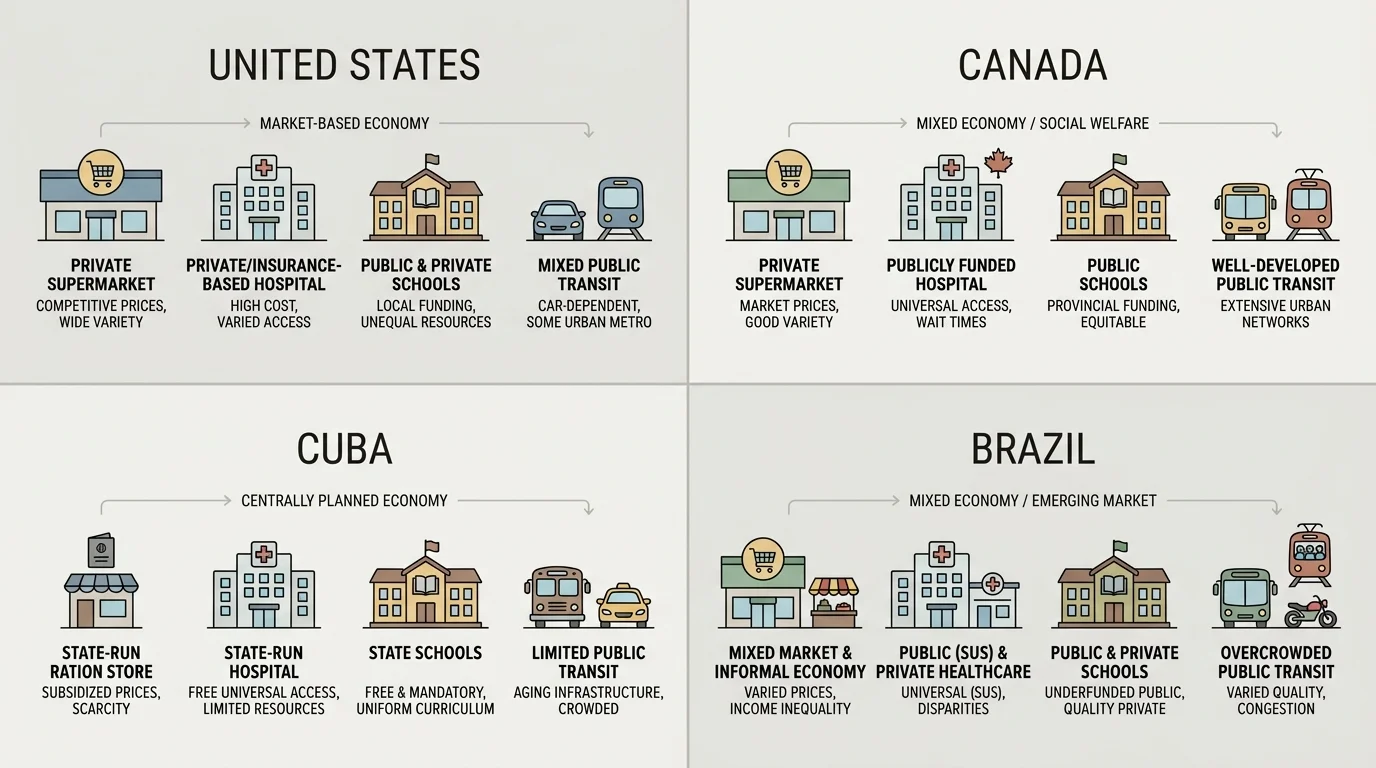
Brazil is a democratic republic with a mixed economy. It has large private industries, farming, and trade, but the government also plays a major role through regulations, public banks, and social programs. Brazil shows that a country can be democratic and market-oriented while still having significant government action to reduce poverty or guide development.
Chile offers another example of a mixed economy with strong market features. It has encouraged private investment and international trade, but the government still provides public services and regulates the economy. Over time, Chile has adjusted its policies as citizens debated inequality, education, and pensions.
Case study comparison: healthcare and taxes
Compare how two democratic countries can both support citizens but use different economic approaches.
Step 1: Identify the government systems.
The United States and Canada are both democracies in the Western Hemisphere.
Step 2: Compare economic components.
Both allow private business and private property, but Canada uses taxes to fund a broader public healthcare system.
Step 3: Think about effects on citizens.
Citizens in both countries can vote and own property, but the way they pay for and receive healthcare is different.
This shows that similar political freedoms do not always lead to identical economic systems.
These examples remind us that no country fits perfectly into a single category. As we saw earlier in [Figure 3], countries are often placed along a range rather than into completely separate boxes.
Economic components matter because they shape real lives. If food prices rise, families notice quickly. If schools are underfunded, students feel the impact. If healthcare is expensive or hard to reach, citizens may struggle. Government decisions about taxes, regulation, wages, and public services affect daily choices and opportunities.
In more market-based systems, people may have more choices among products and businesses. Competition can lead to innovation, new technology, and more variety. However, some citizens may face unequal access to healthcare, education, or housing if they cannot afford private options.
In systems with stronger government roles, citizens may receive more public services, but they may also face fewer choices in the marketplace or more restrictions on private business. This can make some basic needs easier to meet while also limiting personal economic freedom.
"Economic decisions are never just about money. They are also about fairness, freedom, and responsibility."
Citizens often debate what balance is best. Should the government spend more to help people in need? Should taxes be lower so people and businesses keep more of their own money? Should healthcare be mostly public, mostly private, or a mix? These are economic questions, but they are also civic questions because they involve the relationship between governments and citizens.
The map in [Figure 2] reminds us that neighbors in the same hemisphere can answer these questions differently. Geography does not force one economic model. History, culture, leadership, and citizen choices all matter.
Economic systems are not frozen forever. Countries reform laws, change leaders, join trade agreements, or respond to crises. Many countries in the Western Hemisphere have shifted over time between stronger state control and stronger market policies, as [Figure 5] shows.
For example, some Latin American countries increased privatization in the late twentieth century, meaning more businesses moved from government ownership to private ownership. Other periods brought stronger social programs or greater regulation in response to inequality, unemployment, or public protest. Cuba also changed parts of its economy over time by allowing some limited private activity while keeping major state control.
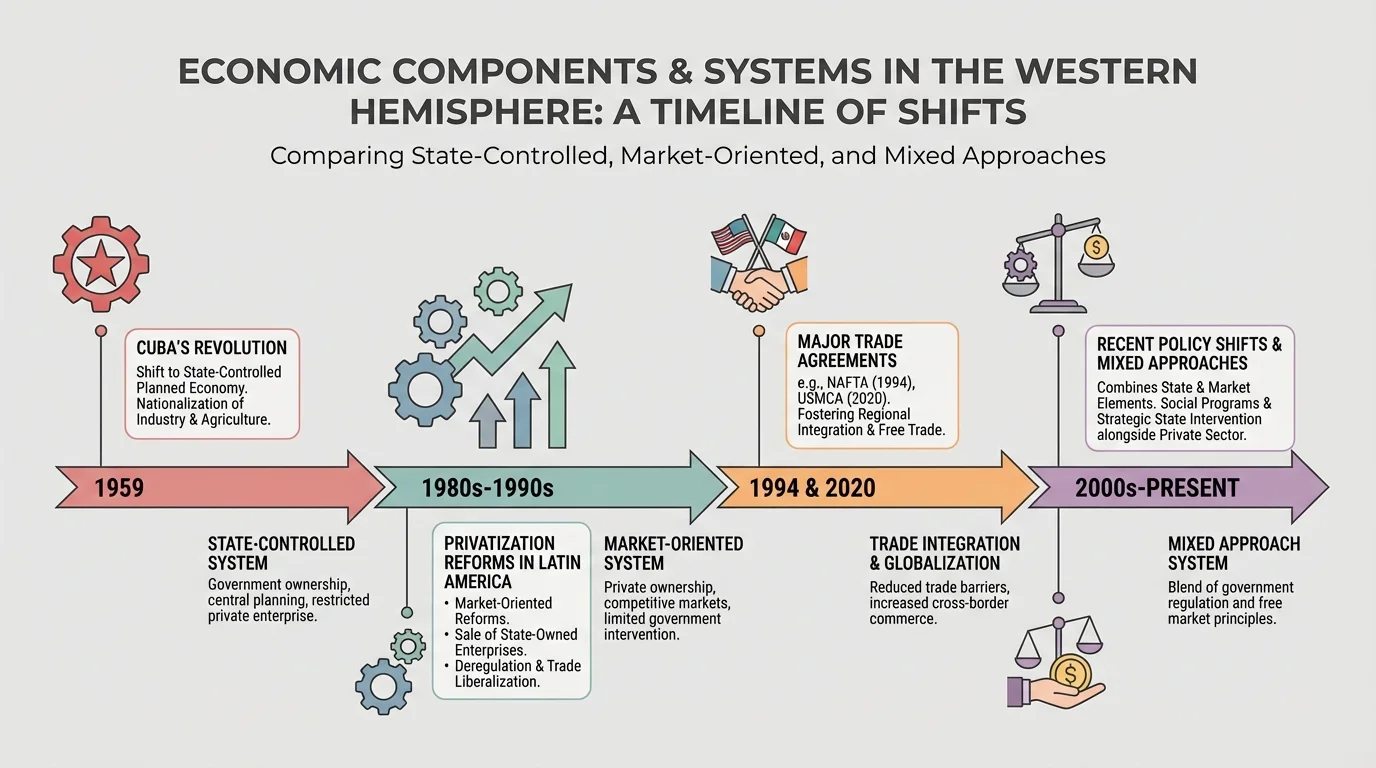
Trade agreements have also changed economic life. Countries that lower trade barriers may gain new export markets and access to cheaper goods. But increased trade can also create competition that hurts some local industries. Governments must decide how to balance growth, jobs, and protection for workers.
Natural disasters, pandemics, and inflation can push governments to act quickly. They may increase spending, regulate prices, or support businesses and workers. These events reveal how strongly governments can shape the economy when citizens face urgent problems.
Citizens in democracies can often influence economic policy through voting, protests, campaigns, and public debate. In less democratic systems, citizens usually have fewer ways to shape those choices.
Because systems change, it is better to think of countries as moving along a spectrum instead of staying permanently in one place. A country may keep the same political structure but change its tax policy, trade policy, or level of public spending.
Across the Western Hemisphere, most countries share some basic economic components: they need workers, businesses, resources, taxes, and public services. Most also use a mixed economy in some form. Yet the amount of government control, the size of the public sector, and the level of economic freedom can vary a great deal.
One strong similarity is that governments everywhere must make decisions about limited resources. They have to choose how to spend money and what services to provide. Another similarity is that citizens are affected by these choices whether they are buying groceries, attending school, or looking for a job.
The main differences appear in how much power the government uses in the economy. Democracies such as the United States, Canada, Brazil, and Chile generally allow broad private ownership and business activity, though they differ in taxes and social programs. Cuba stands out because the government has traditionally exercised much stronger economic control. This difference changes the relationship between citizens and the state.
When students compare systems of government in the Western Hemisphere, they should look at both politics and economics together. A government is not only a set of leaders and laws. It is also a force that shapes work, trade, services, opportunity, and daily life. Comparing these economic components helps us understand why life can be so different from one country to another, even within the same hemisphere.
