Why does a simple cup of coffee cost money? It is not just because of the beans. Land provides the natural resources and farmland needed to grow the coffee, labor plants and harvests it, capital includes machines, trucks, and the coffee shop premises, and someone has to coordinate all of it to create the final product. A modern economy works because millions of decisions constantly bring scarce resources together. Every burger sold, ride completed through a ride-sharing service, surgery performed, and video streamed depends on combining productive resources in ways that are efficient enough to meet people's wants.
Economics begins with scarcity, the basic fact that resources are limited while human wants are unlimited. A society cannot produce everything people might want, so choices must be made. If a government spends more on highways, it may spend less on schools. If a business uses its factory to make laptops, it cannot use the same machines at the same time to make tablets. If a student works more hours at a job, that student has less time for studying or rest.
Because resources are scarce, every choice has an opportunity cost, which is the value of the next best alternative that is given up. This idea matters in production because land, labor, and capital are never unlimited. Businesses must decide what to produce, how much to produce, and what combination of resources to use. Households decide whether to supply labor, save money, or spend. Governments decide whether to invest in public transportation, clean water systems, or national defense.
Scarcity means productive resources are limited relative to wants. Opportunity cost is the value of the next best choice that is given up. Allocation is the way resources are distributed among competing uses.
These choices are not random. In an economic system, decision-makers try to allocate resources where they believe those resources will be most useful, profitable, or socially beneficial. The exact method depends on the kind of economic system, but scarcity is the reason allocation matters in every system.
To understand how production happens, economists often group productive resources into three main categories. As [Figure 1] shows, production is not the result of one resource acting alone. Goods and services usually require several inputs working together at the same time.
Land includes all natural resources used to produce goods and services. This includes farmland, forests, rivers, sunlight, minerals, and oil. In economics, land does not just mean a piece of ground; it means the usable gifts of nature. Wheat fields, lithium deposits, and wind energy are all examples of land resources.
Labor is the human effort used in production, whether physical or mental. Construction workers, nurses, software developers, delivery drivers, and teachers all provide labor. Labor is not just about time spent working. Skill, training, and education matter too, which is why economists often discuss human capital, the knowledge and abilities workers gain through learning and experience.
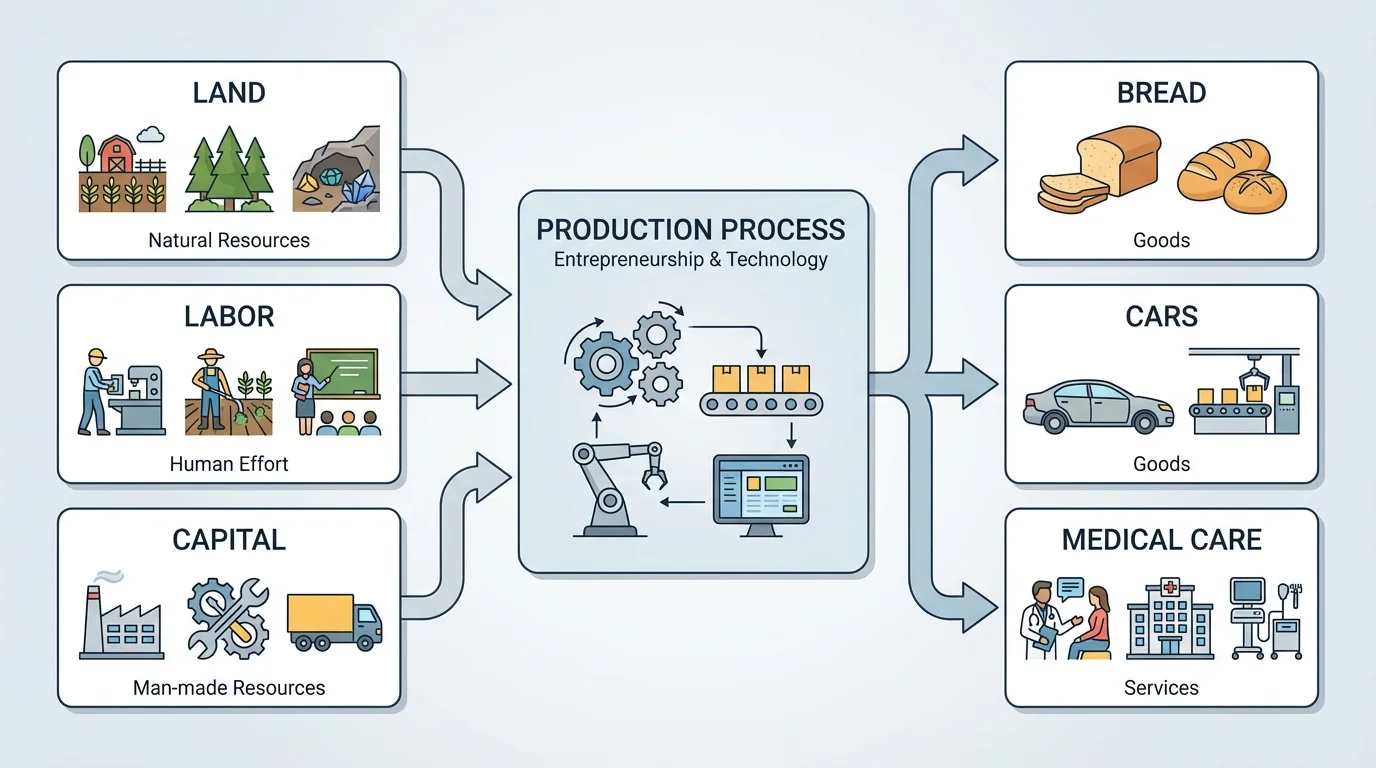
Capital means the tools, equipment, buildings, and technology used to produce other goods and services. A tractor, a bakery oven, a warehouse, a laptop, and a robotic arm in a factory are all capital goods. Capital does not mean money in this context. Money can help buy capital, but capital itself is the productive asset.
Many economists also highlight entrepreneurship, the ability to organize land, labor, and capital, take risks, and make decisions about production. An entrepreneur decides what to make, which workers to hire, what machines to buy, and how to respond to consumer demand. In a practical sense, entrepreneurship is often the coordinating force that brings the other factors together.
The relationship among these factors is dynamic. A farm may need fertile soil from land, skilled workers from labor, and tractors from capital. A video game company needs office space and electricity from land, programmers and artists from labor, and computers and software systems from capital. Even though the products are very different, the production logic is similar, just as [Figure 1] illustrates.
A business produces output by deciding how much of each factor to use and in what combination. This is called the production process. Businesses do not simply gather resources; they must combine them in a planned way. For example, a restaurant needs a location, food supplies, cooks, servers, ovens, refrigerators, tables, and a payment system. If any major piece is missing, the service cannot be delivered effectively.
Businesses usually aim to produce at a cost low enough to earn a profit while still meeting quality expectations. That means they are constantly comparing different combinations of resources. A company may ask whether it should hire more workers or invest in more machines. A farmer may compare hand harvesting with machine harvesting. An online retailer may choose between expanding warehouse space or improving software that tracks inventory more efficiently.
Combining factors efficiently means using land, labor, and capital in a way that creates the most value from limited resources. Efficiency does not always mean using the fewest workers or the cheapest materials. It means choosing the mix that best fits the product, technology, time limits, and consumer demand.
These choices often involve trade-offs. More machinery may increase output but require high upfront costs. More labor may offer flexibility but can be slower or more expensive over time. Businesses also respond to prices. If wages rise sharply, a firm might automate more tasks. If energy prices fall, a factory may expand operations. If a natural resource becomes scarce, producers may search for substitutes.
[Figure 2] shows how globally connected smartphone production can be. One device depends on minerals, factories, transport systems, software design, assembly workers, and retail networks spread across many places.
The land factor includes resources such as lithium, cobalt, copper, rare earth elements, and sand used to make glass and electronic parts. These materials come from mines, quarries, and other natural sources. Without access to these resources, smartphone production would stop before it began.
The labor factor includes miners, engineers, designers, assembly-line workers, quality testers, truck drivers, port workers, marketers, and store employees. Some workers perform highly specialized technical tasks. Others handle logistics, sales, or repair. The final product depends on many layers of labor rather than one kind of job.
The capital factor includes mining equipment, chip-making machines, assembly robots, shipping containers, cargo aircraft, warehouses, and retail stores. It also includes digital infrastructure such as servers and software systems that coordinate orders and supply chains. This shows that production is a chain, not a single event.
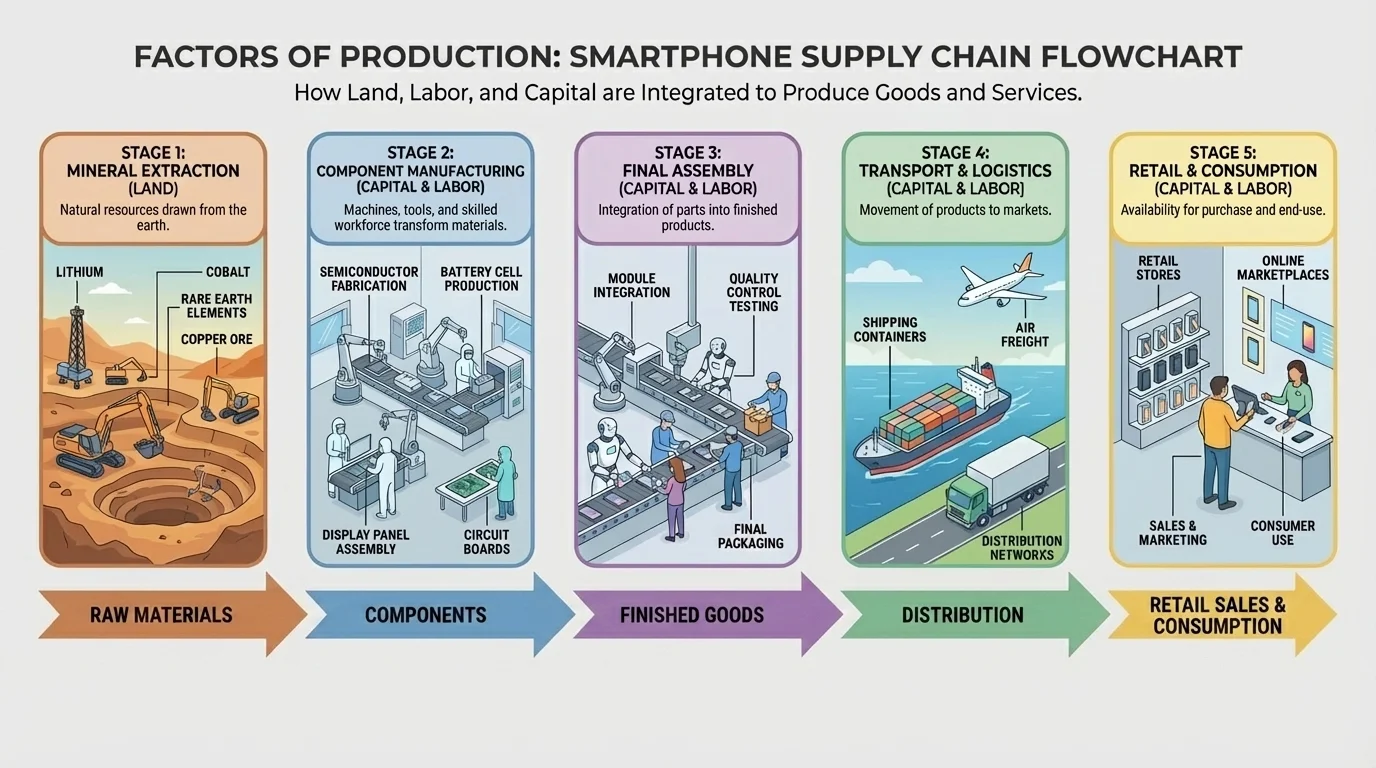
This example also shows why production in a modern economy is interdependent. If one country experiences a port shutdown, if one mine reduces output, or if one factory lacks microchips, the entire chain can slow down. A shortage in one factor or one stage affects the availability and price of the final good.
Case study: producing a pair of sneakers
A sneaker company must decide how to combine factors of production to meet demand for a new model.
Step 1: Identify the land resources
Rubber, cotton, leather alternatives, water, and energy all come from natural resources.
Step 2: Identify the labor resources
Designers create the shoe, factory workers assemble it, managers coordinate production, and retail workers sell it.
Step 3: Identify the capital resources
Sewing machines, cutting tools, factory buildings, shipping systems, and retail technology support production and sale.
Step 4: Analyze the choice
If consumer demand rises, the company may hire more workers, add machines, or open another factory. Each option uses resources differently and has a different cost.
The company's final decision depends on scarcity, expected demand, and the cost of each factor.
Production is therefore about coordination. It is not enough to have resources. They must be in the right place, at the right time, in the right amounts.
Students sometimes think factors of production apply mainly to physical goods, but services also depend on them. A hospital produces healthcare services. Land includes the building site, water supply, and energy. Labor includes doctors, nurses, technicians, cleaners, and administrative staff. Capital includes MRI machines, hospital beds, ambulances, computers, and surgical tools.
A streaming platform produces entertainment services. Land includes data center locations and electricity sources. Labor includes actors, editors, coders, marketing teams, and legal staff. Capital includes cameras, servers, software, and network infrastructure. The final product is not a tangible object, but factors of production still have to be combined.
Restaurants, banks, schools, airlines, and repair shops all work the same way. Goods and services differ in form, but both require scarce productive resources. That is one reason economists study production broadly rather than limiting it to factories.
Some of the most valuable companies in the world produce mainly services or digital products, yet they still depend heavily on physical capital such as servers, office space, and communication networks.
In many advanced economies, services make up a large share of total output. That does not mean land, labor, and capital have become unimportant. It means the way those factors are combined has changed.
[Figure 3] helps show how every economic system answers basic questions: What should be produced? How should it be produced? For whom should it be produced? In a mixed economy, households, businesses, and governments all help answer those questions through different kinds of decisions.
Households allocate resources when they decide whether to work, save, spend, move, or invest in education. A family may choose to spend less now and save for college later. It may decide that one adult should work more hours, or that another should stay home to provide unpaid care. These are resource allocation choices because time, income, and skills are limited.
Businesses allocate resources when they hire workers, buy equipment, choose factory locations, and decide what products to sell. Their decisions are influenced by prices, costs, competition, and expected demand. If consumers want more electric vehicles, producers may shift labor and capital away from gasoline engine production.
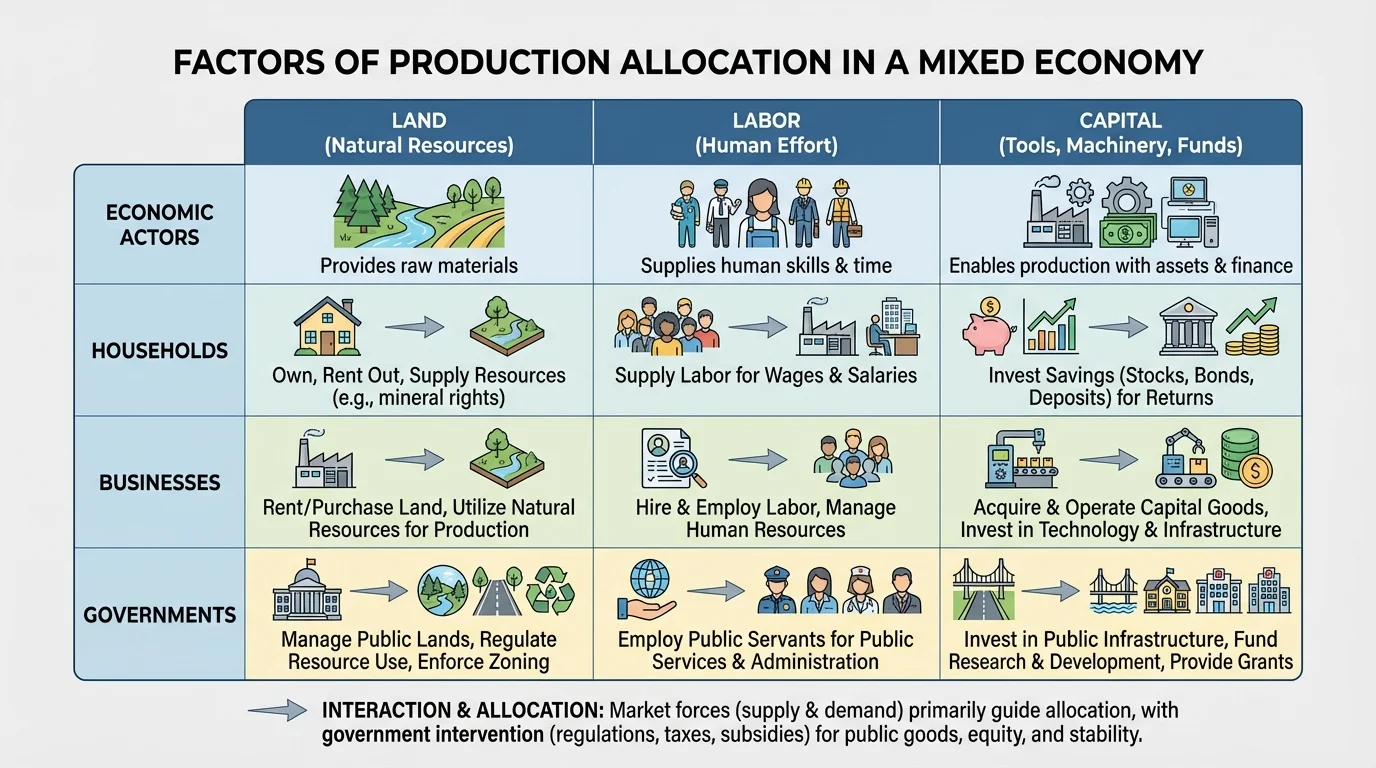
Governments allocate resources by collecting taxes and spending on public goods and services such as roads, schools, courts, parks, and emergency response. They also shape production indirectly through laws, safety rules, environmental regulations, and incentives such as subsidies or tax credits.
No economy is purely market-based or purely command-based in practice. Most countries use a mixed system in which private decision-making plays a large role, but government action also influences how factors of production are used. The balance differs from country to country, and that balance affects prices, wages, environmental quality, and access to services.
| Decision-maker | Main allocation choices | Examples |
|---|---|---|
| Households | How to use time, income, and skills | Work hours, education, saving, consumption |
| Businesses | How to combine factors for profit | Hiring, automation, expansion, product design |
| Governments | How to use public funds and regulate production | Infrastructure, education, safety standards, subsidies |
Table 1. Major decision-makers and how they allocate productive resources in an economic system.
When students hear debates about taxes, minimum wage laws, or infrastructure spending, they are really hearing debates about how society should direct scarce resources. This comparison remains useful because it shows how these decision-makers interact rather than acting separately.
Productivity measures how much output is produced from a given amount of input. If a factory produces more bicycles with the same workers and machines, productivity has increased. Rising productivity is important because it can raise incomes and living standards over time.
Technology often changes the way factors are combined. A warehouse using advanced robots may need fewer workers for lifting and sorting, but more technicians and software specialists. A farm using precision agriculture may use satellite data and sensors to apply water and fertilizer more accurately. Technology does not eliminate scarcity, but it can help economies get more output from limited resources.
Specialization also matters. When workers, businesses, or regions focus on tasks they do relatively well, production can become more efficient. One country may specialize in semiconductor design, another in assembly, and another in shipping services. Within a company, one team designs products while another handles marketing or distribution. Specialization increases output, but it also increases dependence on exchange and coordination.
Human capital and productivity are closely linked. When workers gain education, training, and experience, they can often produce more or higher-quality output. Investment in people can be as important as investment in machines.
However, productivity gains can create new choices and new tensions. If automation increases output, businesses may lower costs and consumers may benefit from lower prices. But some workers may need retraining if their old tasks disappear. That is why changes in production are not only economic issues; they are also social and political issues.
Production can be disrupted when one factor becomes scarce or less available. A drought can reduce agricultural output by limiting water and damaging soil conditions. A labor shortage can make it hard for hospitals, schools, or transportation systems to operate normally. A lack of machinery or computer chips can slow manufacturing even when workers are ready and natural resources are available.
This is called a bottleneck, a point in production where limited capacity holds back total output. If a bakery has enough flour and workers but only one small oven, the oven becomes the bottleneck. If a car company has factories and workers but not enough semiconductors, the chips become the bottleneck.
Real-world example: a shipping delay
A furniture company imports wood, uses local labor, and relies on factory equipment to produce tables.
Step 1: The wood supply is delayed at a port.
Land resources are not physically in the factory when needed.
Step 2: Workers and machines are still available.
Labor and capital remain ready, but production still slows.
Step 3: Output falls.
The company produces fewer tables, stores receive fewer shipments, and prices may rise.
This shows that factors of production are complementary. Even if two are available, the shortage of one can reduce total production.
Sometimes producers respond by substituting one factor for another. A business may install self-checkout machines if labor is hard to find. A farm may shift crops if water becomes scarce. A city may invest in public transit to reduce fuel use. But substitution is not always easy. Some resources are highly specific and cannot be quickly replaced.
Government policy affects how factors of production come together in everyday life. Education spending can improve labor quality by building human capital. Infrastructure spending can improve capital by making transportation and communication more efficient. Environmental rules can protect land resources from overuse and pollution. Tax incentives can encourage businesses to invest in new equipment or expand into new areas.
Policy choices often involve trade-offs because public resources are scarce too. Spending more on workforce training may mean spending less somewhere else. Stronger environmental protections may raise short-term production costs for some firms, but they may preserve natural resources and public health over the long run. These are allocation decisions at the national, state, and local levels.
"There is no such thing as a free lunch."
— A common economic principle about trade-offs and scarcity
These policies matter to everyday life in direct ways. Wages influence whether people choose certain careers. Public transit affects where businesses locate and where workers can reach jobs. Internet access affects whether students can build skills and whether companies can operate efficiently. Water and air quality affect health, agriculture, and energy production. Economic systems are not abstract machines; they shape the conditions of daily life.
When economists analyze production, they are really studying coordination under conditions of scarcity. A good or service exists because natural resources are available, workers apply effort and skill, and tools or technology make production possible. Entrepreneurs and managers organize these parts, while households, firms, and governments make allocation choices about where resources go.
That is why production is both practical and strategic. A company cannot simply ask, "Can we make this?" It must also ask, "Do we have the right land resources, workers, and capital? What will they cost? What are we giving up by using them here instead of somewhere else?" Households and governments ask similar questions on different scales.
Whether the output is bread, medical care, online banking, electric cars, or music streaming, the same economic principle applies: scarce factors of production must be brought together in organized ways to create value. The quality of those decisions affects prices, jobs, innovation, and living standards across the entire economy.
