Two people can look at the same thing and still disagree. One student might say, "This paper airplane design is the best," while another says, "No, mine flies farther." Who is right? The answer is not decided by who talks louder. It is decided by the evidence. Good thinkers do more than listen to claims. They ask questions that help them understand what the evidence really shows.
When people make a claim, they are often making an argument. In school, an argument is not just a fight with words. It is a statement or idea that someone tries to support with reasons and evidence. Asking questions helps us identify the evidence and clarify what it means. That means we figure out what the evidence is, where it came from, and whether it really supports the claim.
Questions are powerful because they encourage us to think carefully. Instead of saying, "That sounds right," or "I don't believe it," we can ask, "How do you know?" "What did you observe?" "Did you test it more than once?" These questions help us think carefully.
Argument is a claim supported by reasons and evidence.
Claim is what someone says is true.
Evidence is the information, observations, facts, or test results used to support a claim.
Clarify means to make something clearer and easier to understand.
Questions are especially important in science and engineering. Scientists ask questions to understand the natural world. Engineers ask questions to define problems and test solutions. In both areas, evidence matters.
An argument has parts, and [Figure 1] shows a simple example with labeled parts. If a student says, "Plants grow better in sunlight," that is the claim. If the student explains, "My plant near the window grew taller," that begins to give a reason. If the student measured the plants each week and recorded their heights, that information is evidence.
Not every argument is strong. Some arguments have clear evidence. Some have weak evidence. Some have evidence that is confusing or incomplete. That is why asking questions is so useful.
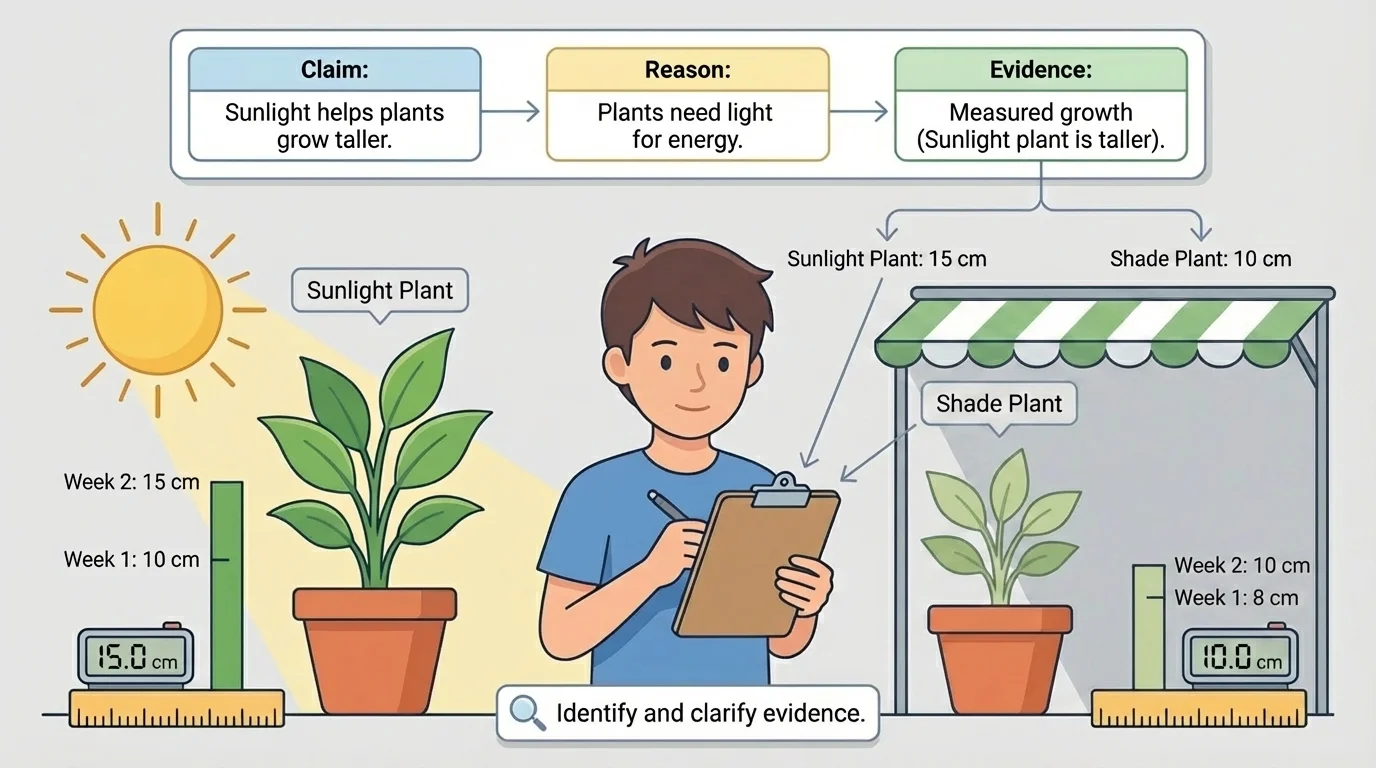
A strong argument usually has three helpful parts: a clear claim, a reason that connects the claim to the evidence, and evidence that can be checked. If one of these parts is missing, the argument becomes harder to trust.
Evidence can come in different forms. In science, it may be an observation, a measurement, notes from an investigation, or results from repeated tests. In engineering, it may be test results showing whether a design works well.
Here are some common kinds of evidence:
Some evidence is stronger because it is more exact. For example, "The ice melted fast" is less clear than "The ice melted in 3 minutes." A number often gives a more precise picture than a general description.
Scientists often repeat a test many times because one result can be unusual. Repeated results help them see patterns and avoid being fooled by accidents.
Evidence can also be weak. If someone says, "This bridge design is the best because I like it," that is an opinion, not strong evidence. Opinions matter in some situations, but they do not prove that something works.
In science, students ask questions to understand the world. A observation may lead to a claim, but scientists need evidence to support it. When we examine evidence, we ask questions such as: "What did you observe?" "What did you measure?" "How many times did you test it?" and "Was the test fair?"
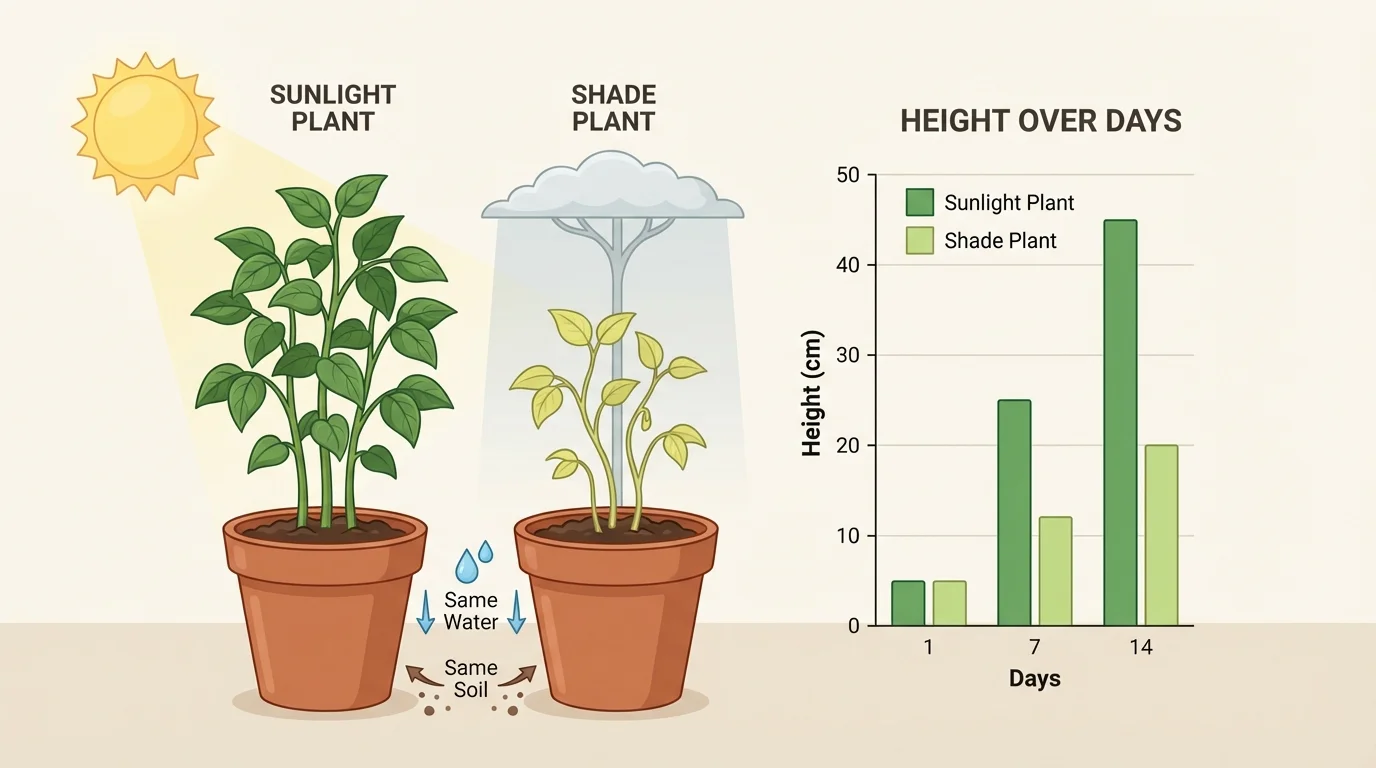
[Figure 2] A fair test is an investigation where only one main thing is changed at a time. If you want to know whether sunlight affects plant growth, you should keep the soil, water, type of plant, and pot size the same. Otherwise, you cannot tell which change caused the result.
Here are useful science questions that identify evidence:
Questions can also clarify evidence. If someone says, "The shaded plant grew badly," you might ask, "What do you mean by badly?" "How tall was it?" "How tall was the other plant?" "After how many days?" These questions turn vague evidence into clearer evidence.
Suppose one student says, "Seeds grow faster with warm water." A careful classmate can ask, "How much warmer?" "How many seeds did you test?" "Did all the seeds get the same amount of light?" "Did you compare with cool water?" Asking these questions does not mean being rude. It means being careful and fair.
Science example: Which paper towel absorbs more water?
A group claims that Brand A is more absorbent than Brand B.
Step 1: Identify the claim.
The claim is that Brand A absorbs more water than Brand B.
Step 2: Ask what evidence was collected.
Did the group pour the same amount of water on each towel? Did they test equal-sized pieces?
Step 3: Clarify the method.
How many trials did they do? Did they measure the water left over? Did they record the results?
Step 4: Decide whether the evidence is strong.
If the towels were the same size and the test was repeated several times, the evidence is stronger.
Later, when you compare different kinds of evidence, this example still matters because it reminds you that strong scientific evidence usually comes from a fair comparison.
Scientists often ask, "What is happening?" Engineers often ask, "What problem needs to be solved?" In engineering, students define a problem clearly before building a solution. A problem in engineering is a need or challenge that can be solved by designing something.
[Figure 3] Engineers ask questions about success and limits. A design must meet certain goals, called criteria, and stay within limits, called constraints. If the problem is keeping a lunch cold, the criteria might include staying cold and being easy to carry, while the constraints might include low cost and limited materials.
Helpful engineering questions include:
Suppose a team designs a small bridge from straws. One student says, "Our bridge is strong." You can ask, "How much weight did it hold?" "How many times did you test it?" "Did another design hold more?" "Did the bridge bend before it broke?" These questions identify the evidence and make it clearer.
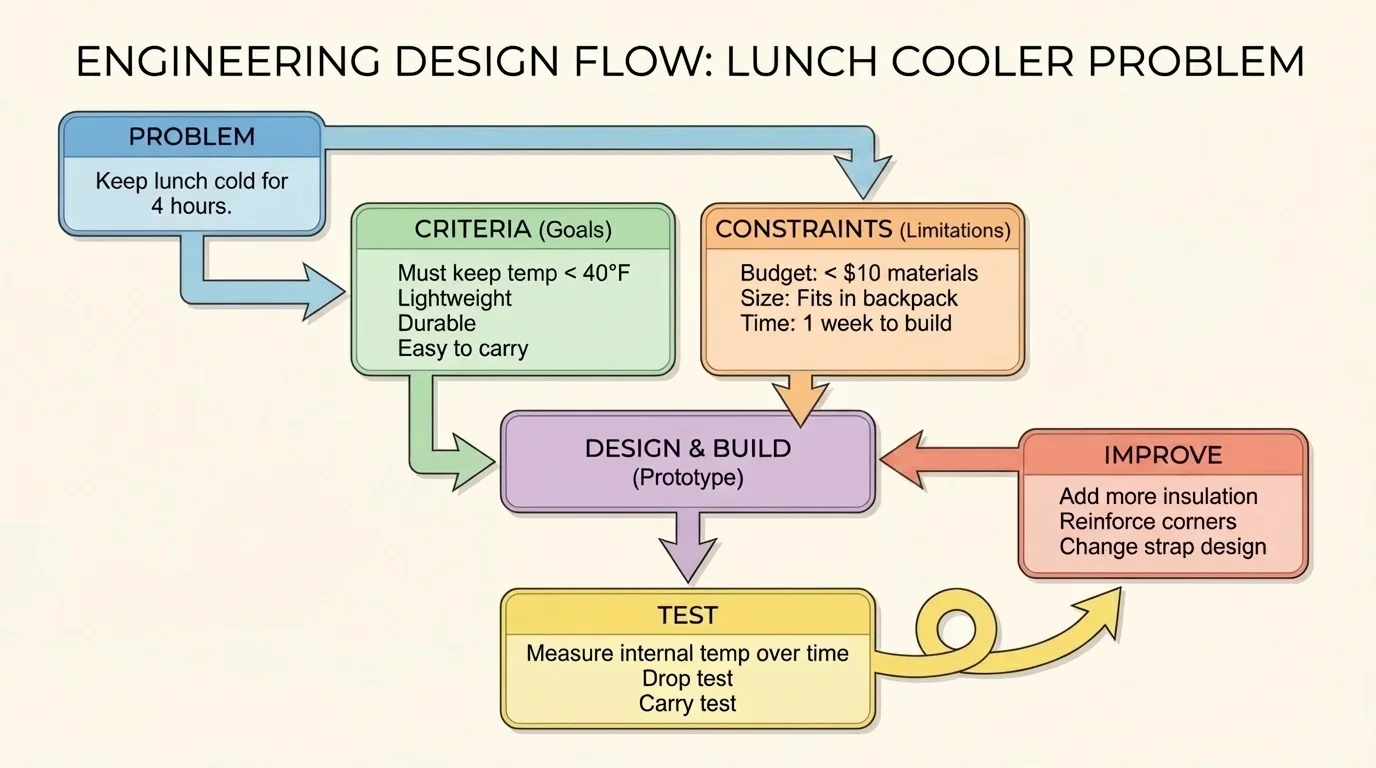
Engineers do not just build once. They test, learn from evidence, and improve. If the first design fails, that is not the end. The evidence helps them make a better design.
Science and engineering use questions in different ways. Science questions often ask about explanations in nature, such as why plants grow or how shadows change. Engineering questions focus on solving a problem, such as how to build a stronger tower or a better container. In both cases, evidence helps people decide what works and what is true.
When you look again at the design process, you can see that evidence is not only about proving success. It also helps explain what needs to be fixed.
Sometimes evidence is present, but it is not clear. Maybe the speaker uses words like "better," "faster," or "stronger" without explaining exactly what those words mean. To clarify evidence, ask questions that make the meaning more exact.
These questions are especially useful:
For example, if a student says, "This shoe grips the floor better," you can ask, "On what surface?" "Did you compare it with another shoe?" "How did you test grip?" Without those questions, the claim stays blurry.
Remember that a question does not attack a person. A good question examines the idea. In science and engineering, asking questions is a respectful way to learn more.
Clarifying evidence can also mean asking for numbers, labels, or notes. "The rocket went high" is less helpful than "The rocket reached about 12 meters." Clear evidence helps everyone understand the argument the same way.
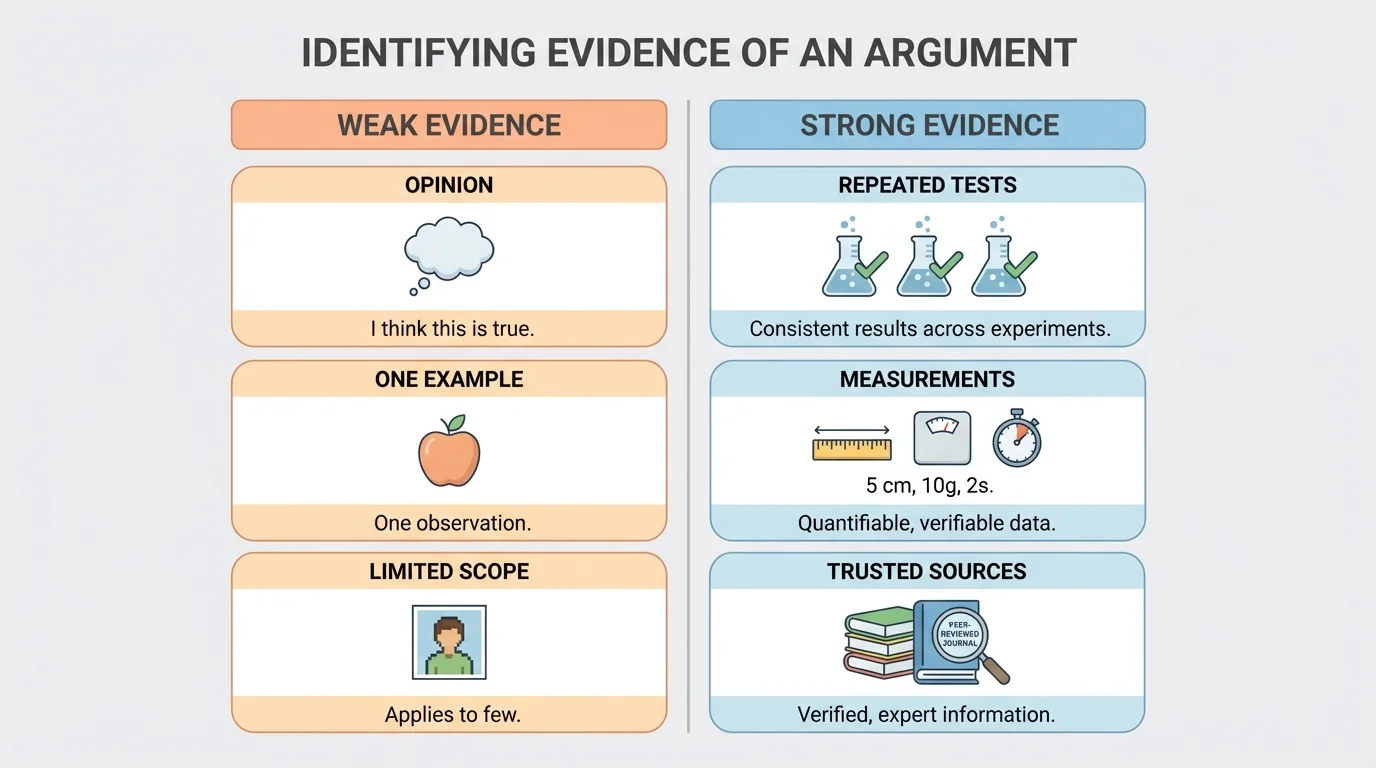
[Figure 4] Strong evidence can be compared with weak evidence. Some evidence is stronger because it can be checked, measured, and repeated. Strong evidence fits the claim closely and gives enough detail for others to understand it. Weak evidence is often based on guessing, only one example, or personal opinion.
Think about these examples:
Another example:
One piece of evidence does not always settle everything. Sometimes a claim needs several kinds of evidence. A scientist might use observations, measurements, and repeated tests. An engineer might use test results, comparisons, and notes about design changes.
| Type of support | How strong is it? | Why? |
|---|---|---|
| Opinion | Usually weak | It tells what someone thinks, not what was tested. |
| One example | Sometimes weak | One case may not represent all cases. |
| Measurement | Often strong | Numbers can be checked and compared. |
| Repeated test | Very strong | Repeated results are more trustworthy. |
| Trusted source | Can be strong | Reliable experts use careful methods. |
Table 1. A comparison of common kinds of support and how strongly they usually help an argument.
When judging evidence later, think back to [Figure 4]. The chart makes it easier to see why measured and repeated results are often better than guesses.
These skills are not only for science class. You can use them in everyday life. If an advertisement says, "This snack gives you more energy," ask, "How do they know?" "What does more energy mean?" "Compared with what?" If a friend says, "This route to school is faster," ask, "Did you time both routes?"
At school, questions help during class discussions. If someone says a habitat changed because of less rain, you can ask, "What observations support that?" "Did anyone measure rainfall?" These questions help the class focus on evidence instead of guesses.
Real-world example: Choosing the best lunch container
Two containers are tested to see which keeps food cold longer.
Step 1: State the claim.
One container keeps food colder for a longer time.
Step 2: Ask about evidence.
Were both containers filled with the same food? Did they start at the same temperature?
Step 3: Clarify the test.
How long were they tested? Was temperature checked at the same times?
Step 4: Use the results.
If one container stayed cooler in repeated tests, that is stronger evidence for the claim.
Questioning evidence also helps you become fairer. You listen more carefully, compare ideas, and avoid jumping to conclusions too quickly.
Sometimes people feel that changing their minds means they were weak. In science and engineering, changing your mind because of stronger evidence is a strength. It shows honesty and careful thinking.
If you first believe one paper airplane is best, but later testing shows another flies farther in repeated trials, the best choice is to accept the stronger evidence. If a bridge design looks strong but fails testing, the evidence tells you to improve it.
"Good questions help us see what the evidence really means."
That is why asking questions is such an important skill. Good questions help identify the evidence, clarify what it means, and show whether an argument is strong. Scientists use questions to understand the natural world. Engineers use questions to define problems and improve solutions. In both cases, careful questions lead to better thinking.
