A drop of water in the ocean today might someday freeze in a glacier, soak into soil, flow through a river, enter a plant, and then return to the air. Earth is full of motion like this. Winds move, rivers carve valleys, rocks break apart, and living things grow and decay. What keeps all of this going? The answer is energy transfer. In natural systems, energy drives the motion and cycling of matter.
Earth may look solid and unchanging when you stand on the ground, but it is actually a busy planet. Water moves through clouds, streams, and oceans. Air moves as wind and storms. Rock materials move downhill, underground, and even through volcanoes. Carbon, oxygen, and nutrients move through living and nonliving parts of Earth. These changes happen because energy is constantly being transferred from one place to another.
The biggest source of energy for many Earth processes is the Sun. Solar energy heats land, water, and air. Because Earth's surface does not heat evenly, some areas become warmer than others. Those temperature differences cause movement. Warm air rises, cool air sinks, and winds begin. Water evaporates from lakes and oceans, rises into the atmosphere, and later falls as precipitation.
Another major driver is gravity. Gravity pulls rain downward, makes rivers flow downhill, causes landslides, and helps dense materials sink. Earth also has energy from inside the planet. Internal heat, much of it left from Earth's formation and produced by radioactive decay, helps melt rock, move tectonic plates, and build mountains and volcanoes.
Energy is the ability to cause change or do work. In Earth science, energy often appears as heat, sunlight, or motion.
Matter is the "stuff" that makes up everything around us, including air, water, rocks, and living things.
System is a group of connected parts that interact with one another.
One of the most important ideas in science is that energy and matter behave differently. Energy can move from place to place and change form, but matter is recycled. A water molecule such as \(\textrm{H}_2\textrm{O}\) can move from ocean to cloud to river to plant and back again. The molecule itself is matter. The sunlight that helped evaporate it is energy.
[Figure 1] Earth can be understood as a set of interacting parts. The geosphere includes rocks, soil, mountains, and Earth's interior. The hydrosphere includes all water in oceans, lakes, rivers, ice, and groundwater. The atmosphere is the layer of gases around Earth. The biosphere includes all living things. Matter moves between these systems constantly.
For example, rainwater falls from the atmosphere into the hydrosphere and geosphere. Plants in the biosphere absorb that water from the soil. Animals drink it. Later, water returns to the atmosphere through evaporation and transpiration. At the same time, energy from the Sun and Earth's interior drives these changes.
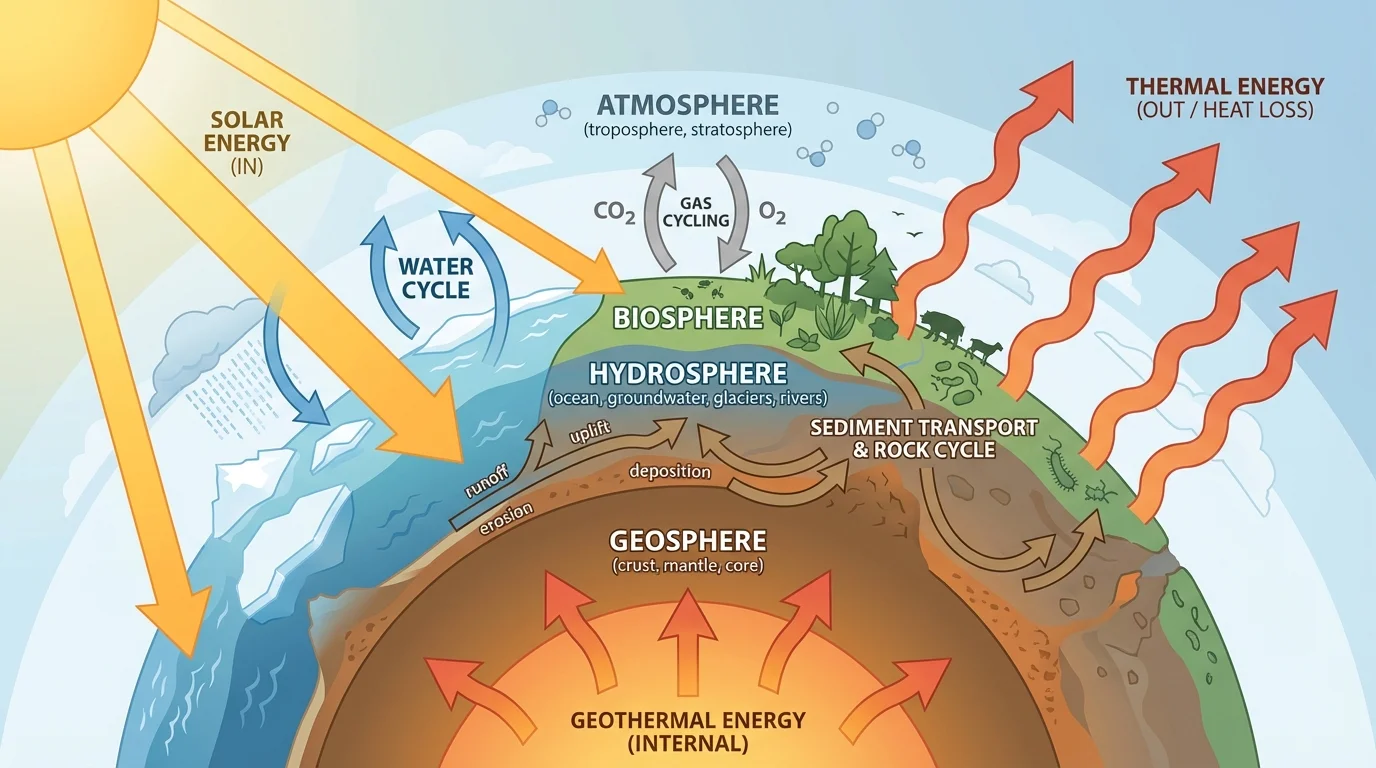
Thinking in systems helps scientists ask better questions. If a forest burns, the effects are not limited to trees. Smoke enters the atmosphere, ash settles on the geosphere, nutrients wash into rivers in the hydrosphere, and living populations in the biosphere change. A change in one part of the system can spread to others.
This is why Earth science is about connections. The four spheres are not separate boxes. They interact all the time, and matter often travels across sphere boundaries many times.
Students often mix up energy and matter because both are involved in every process. A useful way to separate them is this: energy drives the process, while matter is what moves or changes form.
Take a puddle after rain. Sunlight warms the water. The energy transfer gives water molecules enough motion to evaporate. The water itself does not vanish. It changes location and state, moving from liquid water on the ground to water vapor in the air. The matter cycles; the energy flows through the system.
Another example is a river. Gravity provides the pull that makes water flow downhill. As water moves, it carries sediment such as sand, silt, and clay. Here, gravity is the driver of the process, while the water and sediment are matter being transported.
Energy flow and matter cycling are linked but not identical. Energy often enters a system, causes motion or change, and then leaves as heat. Matter is reused. The same atoms of oxygen, carbon, hydrogen, nitrogen, silicon, and iron can be part of many different materials over time.
This distinction helps explain why Earth keeps changing without "using up" all its materials. Water, carbon, and rock materials are recycled in different ways and at different speeds.
[Figure 2] The water cycle is one of the clearest examples of energy transfer driving the movement of matter. Water moves through oceans, lakes, rivers, glaciers, groundwater, living things, and the atmosphere. The water itself is matter. Solar energy and gravity are the main drivers.
When sunlight heats liquid water, some water molecules gain enough energy to escape into the air as water vapor. This process is evaporation. Water also enters the air from plant leaves through transpiration. Higher in the atmosphere, cooler temperatures cause water vapor to lose energy and form tiny droplets. This is condensation, which helps build clouds.
When droplets or ice crystals grow large enough, gravity pulls them down as rain, snow, sleet, or hail. This is precipitation. Once water reaches the ground, several things can happen. It may flow over land as runoff, soak into the ground through infiltration, be stored as groundwater, freeze in ice, or be taken up by living things.
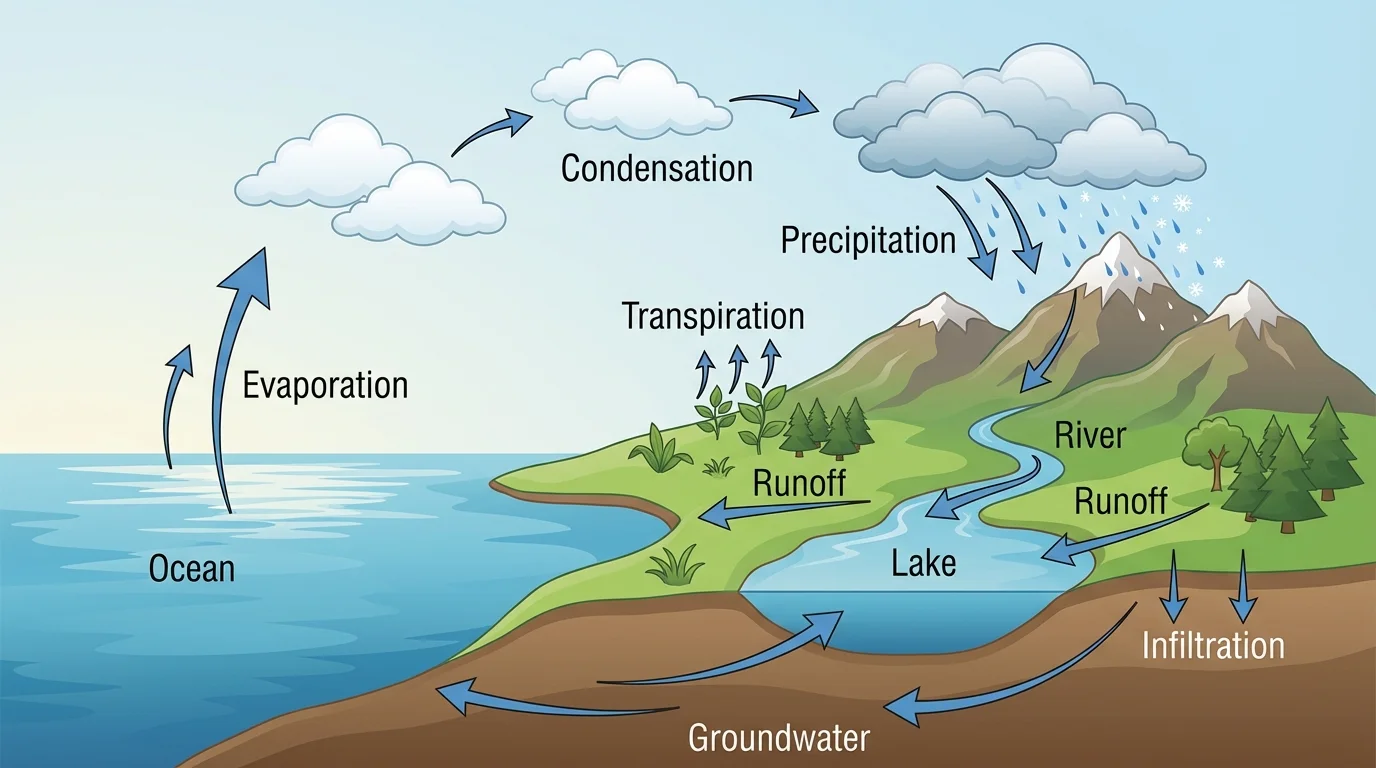
The water cycle does not move at the same speed everywhere. Water in the atmosphere may stay there only for days, while groundwater can remain underground for years, and glacier ice can store water for centuries. That means matter cycles at different rates depending on where it is stored.
A simple way to model this system is to think about reservoirs and flows. Reservoirs are places where matter is stored, such as oceans or ice caps. Flows are processes that move matter, such as evaporation or runoff. The Sun adds energy to power evaporation, and gravity helps move water downhill and pull precipitation to Earth.
This figure is also useful when thinking about droughts and floods. During a drought, less precipitation enters rivers, lakes, and soil. During heavy storms, more water runs off the land quickly, which can increase flooding. In both cases, the cycling of matter is still happening, but the pattern has changed, much like the pathways shown in [Figure 2].
Numeric example: heating water
If solar energy adds heat to a small sample of water, the temperature can rise. A simplified relationship is \(Q = mc\Delta T\), where \(Q\) is heat energy, \(m\) is mass, \(c\) is specific heat, and \(\Delta T\) is temperature change.
Step 1: Choose values.
Suppose \(m = 100 \textrm{ g}\), \(c = 4.18 \textrm{ J/g}{}^\circ\textrm{C}\), and \(\Delta T = 5{}^\circ\textrm{C}\).
Step 2: Substitute.
\(Q = 100 \cdot 4.18 \cdot 5\).
Step 3: Calculate.
\[Q = 2{,}090 \textrm{ J}\]
This means \(2{,}090 \textrm{ J}\) of energy transfers into the water. In nature, solar energy warming water can help lead to evaporation.
The atmosphere and oceans are always moving because the Sun heats Earth unevenly, as shown in [Figure 3]. Land near the equator usually receives more direct sunlight than land near the poles. Dark surfaces absorb more energy than light surfaces. Water warms and cools differently from land. These differences create temperature and pressure differences that drive circulation.
Convection is a major process here. Warm air becomes less dense and rises. Cooler air sinks. This rising and sinking creates convection currents. Similar currents happen in water. These motions help form winds, storms, and ocean currents.
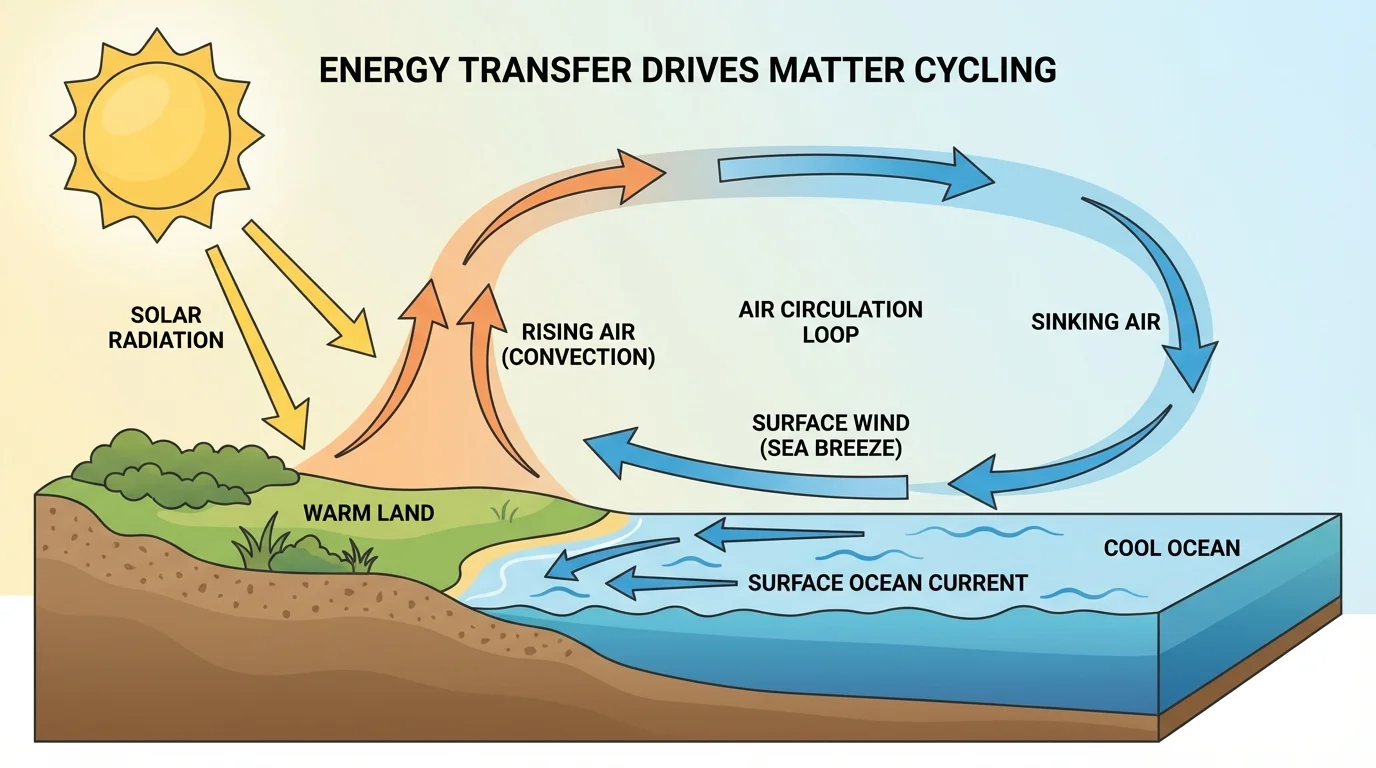
These motions also move matter. Winds carry water vapor, dust, pollen, and even volcanic ash. Ocean currents transport heat, salt, dissolved gases, and tiny organisms called plankton. So the transfer of energy causes motion, and that motion transports matter.
Storms provide a dramatic example. Warm ocean water transfers energy to the air above it. If enough warm, moist air rises and cools, large storm systems can form. Matter in the form of air, water droplets, and ice particles moves rapidly through the atmosphere. The stronger the energy transfer, the more powerful the motion can become.
If you have ever felt a sea breeze at the beach, you have experienced this process directly. During the day, land heats faster than water. Air above the land rises, and cooler air from above the ocean moves in to replace it. That simple breeze is energy transfer creating movement of matter in the atmosphere.
Some dust from the Sahara Desert in Africa travels across the Atlantic Ocean and reaches the Americas. Wind energy moves this matter thousands of kilometers, and the dust can even add nutrients to soils and rainforests.
[Figure 4] The rock cycle is another strong example of matter cycling while energy drives change. Rocks do not stay in one form forever. They can be broken down, buried, heated, melted, cooled, and changed again over long periods of time.
At Earth's surface, solar energy and gravity help drive weathering, erosion, and deposition. Weathering breaks rock into smaller pieces. Erosion moves those pieces by water, wind, ice, or gravity. Deposition drops them in new places, such as riverbanks, beaches, or deltas.
Over time, sediments can be compacted and cemented into sedimentary rock. If rocks are buried deep underground, heat and pressure can change them into metamorphic rock. If rock melts into magma and later cools, it forms igneous rock. These changes can take thousands to millions of years.
Not all the energy in the rock cycle comes from the Sun. Earth's internal heat is extremely important. It helps drive plate tectonics, mountain building, and melting below the surface. This means that both external energy from the Sun and internal energy from Earth contribute to the cycling of rock materials.
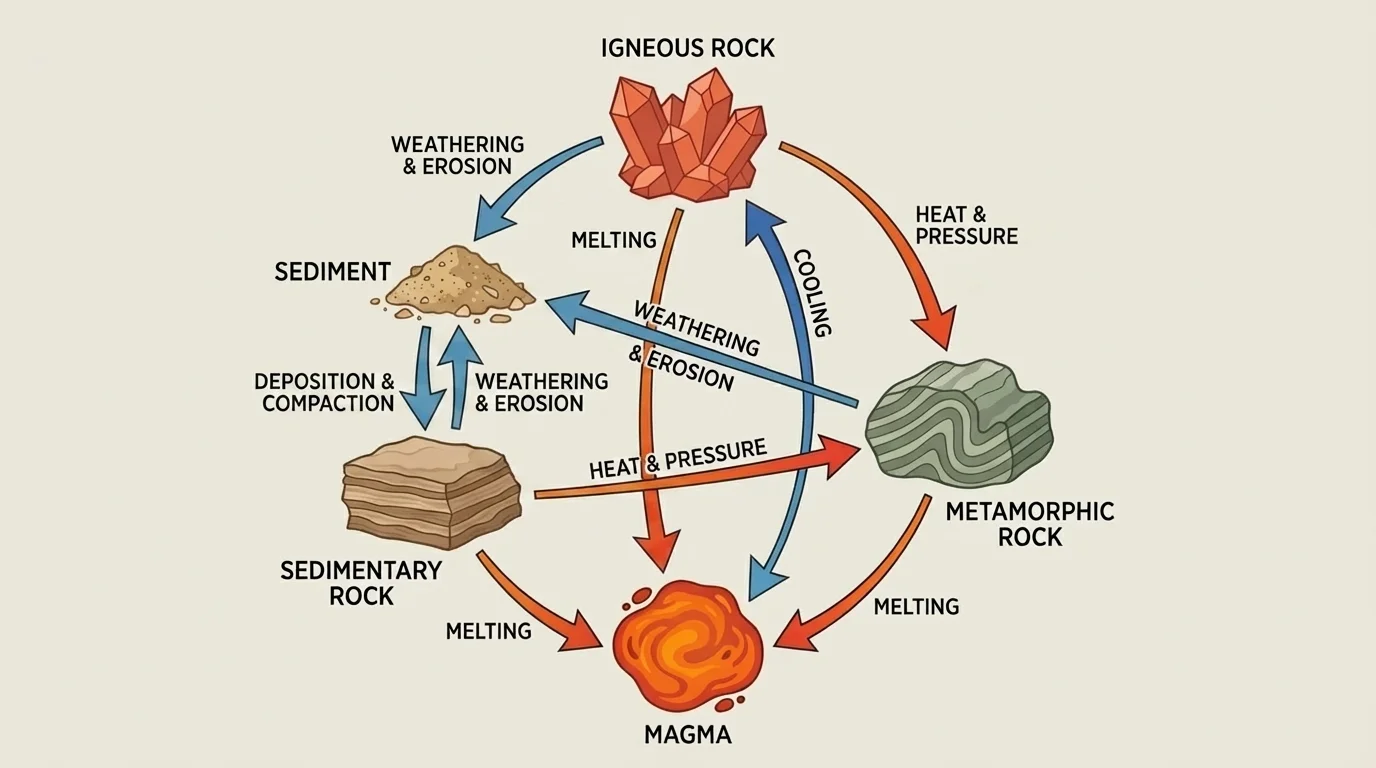
A mountain range offers a good example. Rain and ice weather the rocks. Gravity and rivers move sediment downhill. Layers of sediment build up in basins. Deep burial changes some materials with heat and pressure. Tectonic forces may later lift them back up. Matter is cycling through forms and places, and energy sources keep the process going.
The connections across systems are clear here too. Rain from the atmosphere enters the geosphere. Water in the hydrosphere erodes rock. Plant roots in the biosphere break rock apart. Later, minerals released from rock can become part of soil that supports life. The interactions in [Figure 1] and the pathways in [Figure 4] are part of the same larger Earth system.
Case study: a river shaping land
Step 1: Rain falls on a hillside, and gravity pulls the water downhill.
Step 2: Running water erodes soil and rock particles.
Step 3: The river transports the sediment downstream.
Step 4: When the water slows, sediment is deposited in a floodplain or delta.
In this example, energy from gravity drives motion, and matter in the form of water and sediment cycles through the landscape.
Living things are not separate from Earth's cycles. They are active parts of them. Plants use energy from sunlight to make sugars from carbon dioxide and water. This process is photosynthesis.
The simplified chemical equation is \(6\textrm{CO}_2 + 6\textrm{H}_2\textrm{O} \rightarrow \textrm{C}_6\textrm{H}_{12}\textrm{O}_6 + 6\textrm{O}_2\). The matter in this equation is rearranged into new substances. The energy source is sunlight. A numeric example helps show conservation of matter: there are \(6\) carbon atoms on the left in \(6\textrm{CO}_2\), and there are also \(6\) carbon atoms on the right in \(\textrm{C}_6\textrm{H}_{12}\textrm{O}_6\).
Animals, plants, and many microorganisms also carry out cellular respiration, which releases usable energy from food. Decomposers such as fungi and bacteria break down dead organisms and waste. In doing so, they return matter to soil, water, and air. Nutrients such as nitrogen and phosphorus become available again for other organisms.
Atoms are not destroyed in ordinary chemical changes. They are rearranged into new molecules. That is why matter can cycle through living and nonliving parts of Earth.
The carbon cycle connects all four Earth systems. Carbon can be in the atmosphere as \(\textrm{CO}_2\), in the hydrosphere dissolved in water, in the geosphere as fossil fuels or carbonate rocks, and in the biosphere as part of living tissue. Photosynthesis, respiration, decomposition, combustion, and ocean exchange all move carbon from one place to another.
Here again, energy transfer is the driver behind motion and change. Sunlight powers photosynthesis. Heat affects decomposition rates. Combustion releases stored chemical energy. Matter moves through the system while energy changes form.
These ideas are not just for textbooks. They help explain real events people care about. Farmers watch the water cycle because rainfall, evaporation, and groundwater affect crops. City planners study runoff and drainage to reduce flood damage. Meteorologists track air masses and energy transfer to forecast storms.
Reservoirs and dams show how humans interact with natural systems. A dam changes how water and sediment move. Water still flows because of gravity, but the timing and path of that motion are changed. Less sediment may reach downstream wetlands or deltas, which can affect ecosystems and increase erosion in some places.
Climate is also tied to energy flow and matter cycling. If more greenhouse gases such as \(\textrm{CO}_2\) build up in the atmosphere, more heat can be trapped. That changes temperatures, weather patterns, evaporation rates, ice melt, and ocean circulation. A change in one part of the system can affect many others.
Natural hazards often involve energy and matter together. Floods move water and sediment. Hurricanes move air and water vapor. Landslides move rock and soil downhill under gravity. Volcanic eruptions release molten rock, ash, and gases using energy from Earth's interior.
Renewable energy systems also connect to Earth processes. Solar panels depend on incoming solar energy. Hydroelectric plants depend on water moving downhill under gravity. Wind turbines depend on atmospheric motion caused by uneven heating. Even when people build technology, the energy sources often come from the same Earth system processes found in nature.
A useful model of Earth systems includes inputs, outputs, matter reservoirs, and processes. For the water cycle, the main energy input is solar energy. Gravity acts throughout the whole system. Stored matter includes oceans, lakes, glaciers, groundwater, and atmospheric water vapor. Processes include evaporation, condensation, precipitation, runoff, and infiltration.
For the rock cycle, energy inputs include sunlight at the surface and Earth's internal heat below. Stored matter includes different rock types and sediments. Processes include weathering, erosion, deposition, compaction, heat, pressure, melting, and cooling.
When scientists make models, they often use arrows to show movement. Arrows can represent both the flow of energy and the movement of matter, but it is important to label them clearly. In a good model, students can answer questions such as: What is moving? What is causing the movement? Where is matter stored? What happens if one process speeds up or slows down?
| System example | Main matter moving | Main energy driver | Common results |
|---|---|---|---|
| Water cycle | \(\textrm{H}_2\textrm{O}\) | Sun and gravity | Clouds, rain, rivers, groundwater |
| Atmosphere and oceans | Air, water, salt, particles | Uneven solar heating | Wind, currents, storms |
| Rock cycle | Rock, sediment, minerals | Sun, gravity, internal heat | Weathering, erosion, melting, uplift |
| Carbon cycle | Carbon in \(\textrm{CO}_2\), food, rock | Sun, chemical energy, heat | Photosynthesis, respiration, decomposition |
Table 1. Examples of matter moving through Earth systems and the energy sources that drive those changes.
Earth's natural systems are active because energy is always being transferred. The Sun heats Earth unevenly, gravity pulls materials downhill, and internal heat reshapes the planet from below. These energy sources create motion in air, water, and rock.
Matter does not disappear when it seems to be "used up." Water cycles through air, land, and living things. Rock material changes form and location over time. Carbon and nutrients move between organisms and the environment. The same matter can be reused again and again.
Understanding this idea helps explain why a single event can have wide effects. A storm, drought, wildfire, volcanic eruption, or human-made change can alter how energy moves and how matter cycles across multiple Earth systems.
