Have you ever noticed that two people can have the same job, but one job turns out neat and helpful while the other turns out messy? The difference is often responsibility and effort. These two things help you become someone others can trust.
Responsibility means doing what you are supposed to do. It means you remember your job, you try to finish it, and you take care of what you use. If you say, "I will water the plant," responsibility means you actually water it and do not forget.
Responsibility means taking care of a job and doing what you said you would do. Effort means using your energy and attention to do your best.
Being responsible can be a small thing. You might put your art supplies away after using them. You might feed a pet at the right time. You might log in to your online lesson when it is time to learn. These jobs may seem small, but they matter because people count on you.
When you are responsible, people learn they can trust you. Trust is important at home, in clubs, on teams, and later in jobs when you are older. A person who remembers and completes tasks is helpful to others.
Effort means trying hard. It means you keep going even when something is not easy right away. Effort is not about being perfect. It is about paying attention, taking your time, and doing your best.
If you sweep the floor, effort means you move the dirt into a pile instead of stopping after one little swipe. If you help set the table, effort means you place the forks, spoons, and cups carefully instead of tossing them down fast. Effort helps your work turn out better.
Small jobs done with care help families run smoothly. When each person does one task well, everyone has more time and less stress.
Sometimes effort also means trying again. Maybe you spill a little water while filling a pet bowl. You do not quit. You wipe it up and finish the job. That is effort too.
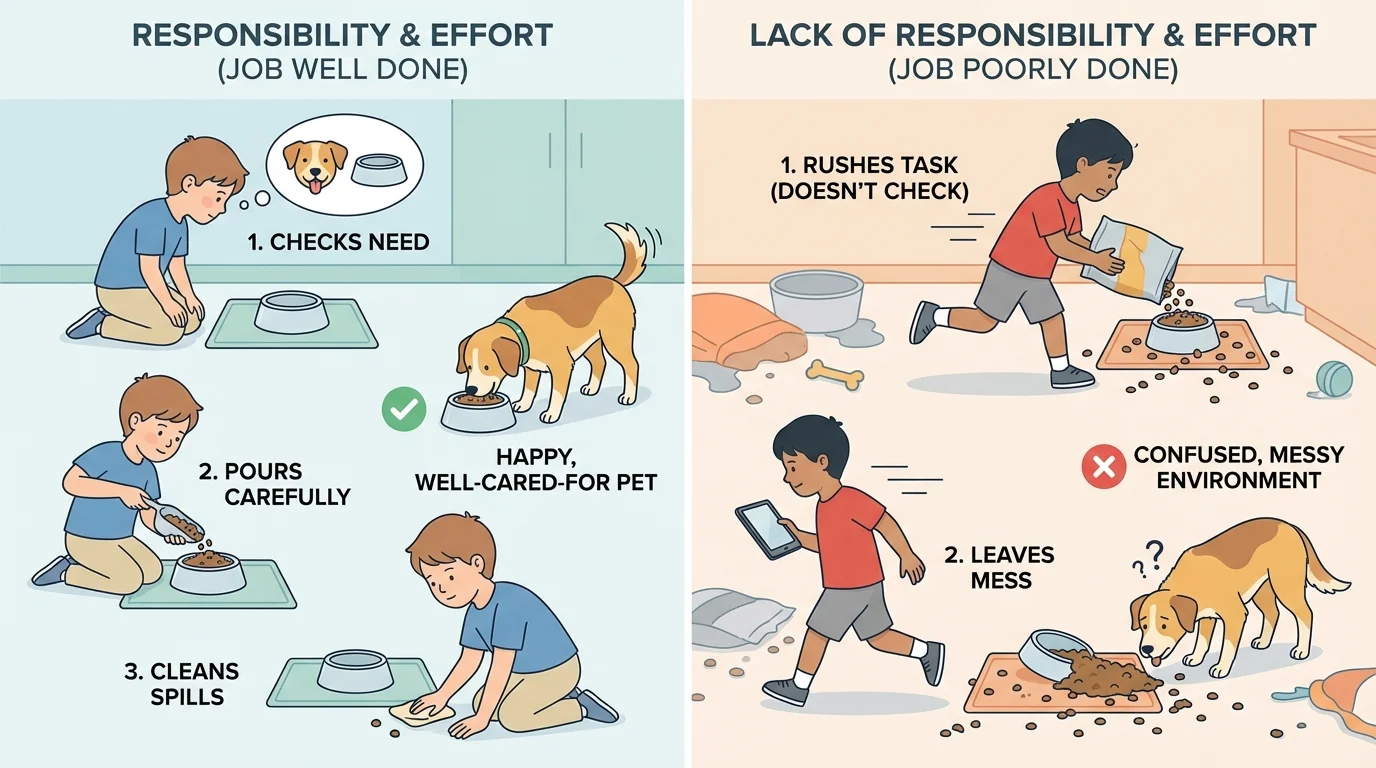
Responsibility and effort are like two helpers working on the same team. As [Figure 1] shows, responsibility helps you remember and own the job, and effort helps you do the job carefully. When both are there, the work is more likely to be done well.
If you have responsibility but little effort, you may start the job but rush through it. If you have effort but no responsibility, you may work hard on the wrong thing or forget the job completely. Doing a job well usually needs both.
Think about cleaning up toys. Responsibility says, "These are my toys, and I need to put them away." Effort says, "I will put them in the right bins and make the space neat." Together, they lead to a clean room and a job completed the right way.
A job can be any task you need to do. For a first grader, a job might be making your bed, feeding a pet, helping fold towels, putting dishes in the sink, or getting ready for an online class.
Doing a job well means you listen to directions, begin the task, stay with it, and check your work. You also try to leave things better, not messier. A well-done job is safe, careful, and complete.
| Doing a Job Well | Not Doing a Job Well |
|---|---|
| Starts the task on time | Waits too long or forgets |
| Works carefully | Rushes and makes a mess |
| Finishes the task | Stops halfway |
| Checks the work | Walks away without looking |
| Fixes small mistakes | Ignores mistakes |
Table 1. Signs of careful work compared with careless work.
When people do jobs well, others feel helped and cared for. When jobs are done poorly, someone else often has to fix the problem. That can waste time and cause frustration.
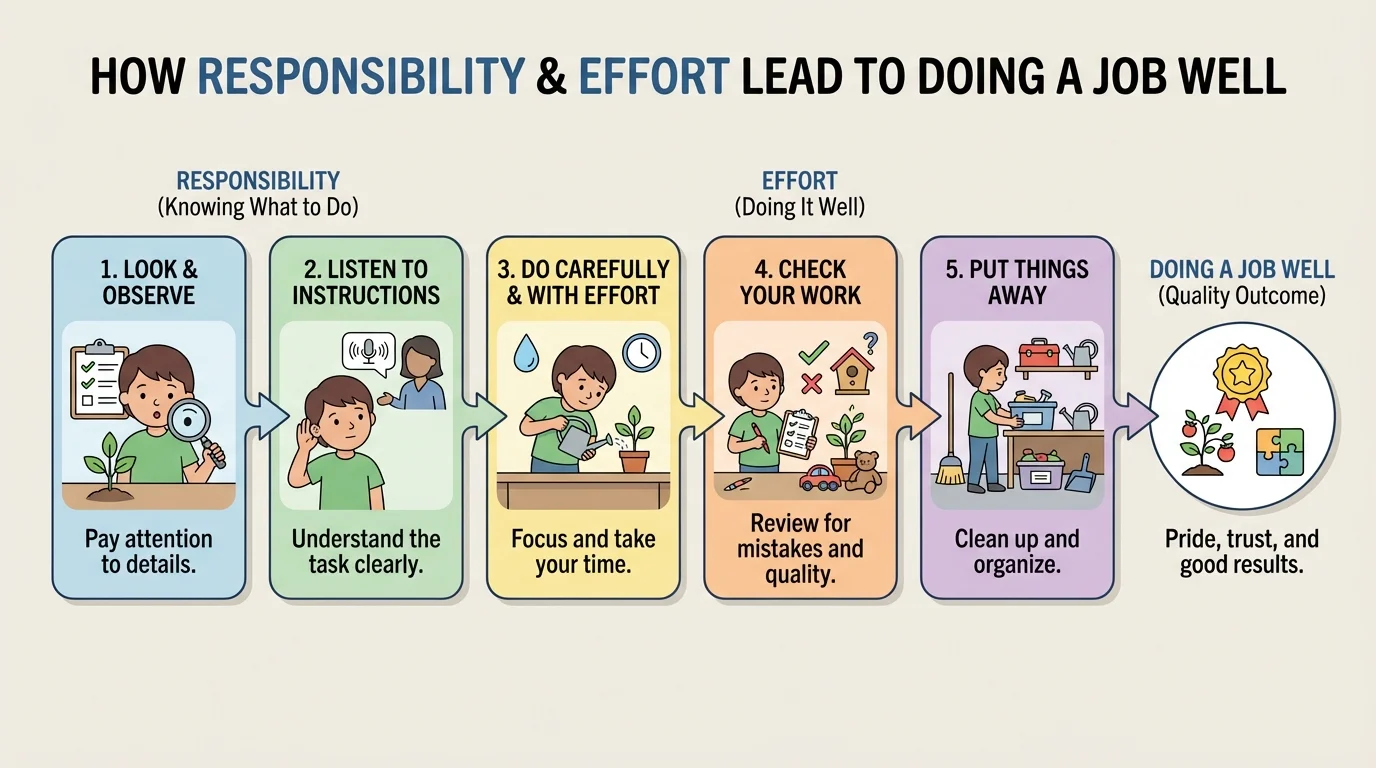
You do not need a big plan to do a small task well. A simple routine works for many jobs, as [Figure 2] illustrates. You can use these same steps when you clean up, help with laundry, organize your desk, or get ready for an online lesson.
First, know the job. Make sure you understand what to do. Next, get what you need. Then do the job slowly and carefully. After that, check your work. Last, put things away.
A simple way to do a job well
Step 1: Listen or look carefully.
Ask, "What is my job?"
Step 2: Get ready.
Bring the things you need, like a cloth, a bowl, or your computer charger.
Step 3: Do the task with care.
Use steady hands, quiet focus, and take your time.
Step 4: Check.
Look to see if the job is finished and neat.
Step 5: Clean up.
Put tools away and tell the grown-up if the job is done.
These steps help because they stop you from forgetting parts of the job. Later, when you are older, these same habits help with bigger responsibilities too.
At home, you might be asked to match socks from the laundry. Responsibility means you remember that it is your task. Effort means you keep matching until all the socks are sorted, not just a few.
During online learning, you may need to charge your device before a lesson. Responsibility means you remember to do it. Effort means you check that the charger is plugged in and the device is ready to use. As we saw in [Figure 2], getting ready before you start is part of doing the job well.
If you help feed a pet, responsibility means feeding the pet at the right time. Effort means pouring the right amount, setting the bowl down safely, and wiping spills. This is like the careful example in [Figure 1], where the task is done fully instead of rushed.
Why this matters
When you practice responsibility and effort now, you build habits. Habits are things you do again and again. Good habits make it easier to help at home, work with others, and handle bigger jobs later.
You can also use these skills when you help in your neighborhood or group activities outside school. If you bring supplies for a club, clean up after a game, or help set out snacks, responsibility and effort make you a dependable helper.
Sometimes a task feels boring, tricky, or tiring. That happens to everyone. The important thing is not to give up right away. Take a breath, look at the job again, and do one small part first.
If you make a mistake, that does not mean you failed. A mistake is something you can fix. If you drop crayons, pick them up. If you forget one spoon while setting the table, go back and add it. Responsible people fix what they can.
"Do your best, then make it better if you can."
You can also ask for help. Asking for help is still responsible when you have tried first. You might say, "I started, but I need help with this part." That shows honesty and effort.
Over time, these small actions help you become dependable. Dependable means people know they can count on you. That is a powerful skill for life.
