Have you ever been asked to do something new and thought, "Can I do it?" The good news is that being ready does not mean being perfect. It means you are prepared to try, to listen, and to keep going. Every time you learn a new skill or take care of a job, you are growing stronger on the inside.
Being ready for new learning and responsibilities means you are prepared to learn, help, and do your best. A responsibility is a job or duty that belongs to you. It might be putting away your toys, feeding a pet with an adult nearby, logging in for online learning on time, or remembering to bring a pencil and paper to your workspace.
Readiness also means having a good attitude. You may not know how to do something yet, but you can still be open, brave, and willing. When you say, "I can learn," you make room for your brain to grow.
Ready means prepared to begin. Learn means to find out how to do something new. Responsibility means a job you are expected to do and care about.
When you are ready, other people can trust you more. Your family knows you will try. Your teacher knows you will join and listen. Your group or club knows you will be kind and helpful. Trust grows when people see that you can begin, work, and finish.
Before you start something new, it helps to prepare your body and your space. A simple routine, shown in [Figure 1], helps you know what to do before online learning or a home job begins. You can wake up, wash up, eat if it is mealtime, and get the things you need. Then your brain can pay attention better.
Your body gives clues, too. If you are very tired, hungry, upset, or wiggly, it may be hard to focus. Taking a slow breath, getting a drink of water, or sitting in a quiet spot can help. Being ready is not only about supplies. It is also about feeling calm enough to start.
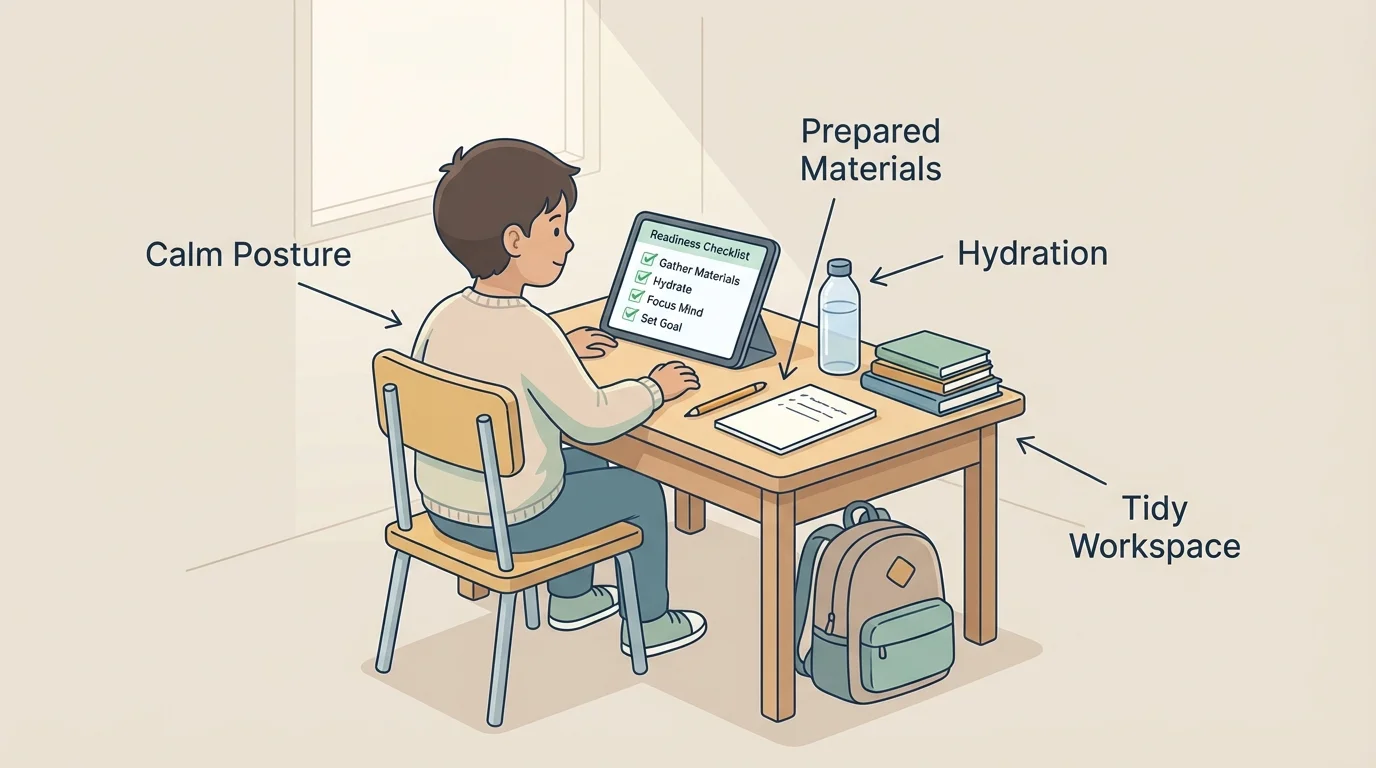
You also need the right tools. For online learning, that may mean a charged device, headphones, paper, and a adult nearby if needed. For a home responsibility, it may mean knowing where the laundry basket goes, where the pet food is kept, or where to put books after reading.
If you do not understand what to do, asking a question is part of being ready. Asking for help is not giving up. It is a smart way to learn. You can say, "Can you show me the first step?" or "I need help getting started."
Your brain gets stronger when you practice new things, even when they feel hard at first. Mistakes can be signs that your brain is learning.
Listening is another big part of readiness. That means using your eyes, ears, and mind to pay attention. During a video lesson, you can look at the screen, wait for directions, and keep your hands busy only with the learning tools you need.
Responsibilities can be small, but they still matter. You may help put dirty clothes in the basket, place your plate in the sink, water a plant, or put books back on a shelf. These jobs teach you to care for your space and the people around you.
Online, responsibilities matter too. A community is a group of people who help and respect one another. Your online class, your family, and a library club are all communities. You help your community when you are on time, use kind words, mute when asked, and wait your turn to speak.
| Situation | Ready Choice | Not-Ready Choice |
|---|---|---|
| Online lesson starts soon | Log in early and have supplies ready | Wait until the last moment and search for supplies |
| You have a chore | Start when reminded and finish it | Ignore it and leave it half done |
| You need help | Ask politely | Cry, yell, or walk away without trying |
| Someone else is speaking | Listen and wait | Interrupt again and again |
Table 1. Examples of choices that show readiness and choices that show a person is not ready yet.
When you do your part, life goes more smoothly. If you put away your art supplies, the next person can use the table. If you join your lesson on time, you do not miss directions. If you speak kindly, other people feel safe and respected.
Being dependable means people can count on you. A dependable person tries to do the job, tells the truth, and keeps working even when the task feels a little hard.
Being dependable does not mean you never forget. It means you keep practicing and improve. That is how readiness grows.
Right now, your responsibilities may seem small. But small habits grow into big strengths. A child who learns to listen, begin a task, and finish it is building skills for later life. One day, these skills help with bigger jobs, teamwork, and learning in new places.
Your future is the time ahead of you. In the future, people will still need to be ready: ready to learn a new game, a new tool, a new job, or a new place to study after high school. Children build these strengths one small step at a time.
"I may not know it yet, but I can learn."
When you practice readiness now, you are also helping your family and groups outside school. If you remember your role in a music class, a sports team, a faith group, or a neighborhood activity, other people can trust you more. That trust is important in every community.
The calm setup and focused posture from earlier still matter here; the routine in [Figure 1] shows how simple actions before a task can help you do better and feel more confident.
You do not have to guess how to get ready. A short routine helps. The step order in [Figure 2] gives you a simple way to begin almost any new learning task or responsibility at home or online.
Step 1: Stop and look. What is the job?
Step 2: Listen. What are the directions?
Step 3: Get what you need.
Step 4: Try the first step.
Step 5: Ask for help if you need it.
Step 6: Finish the job.
Step 7: Put things away.
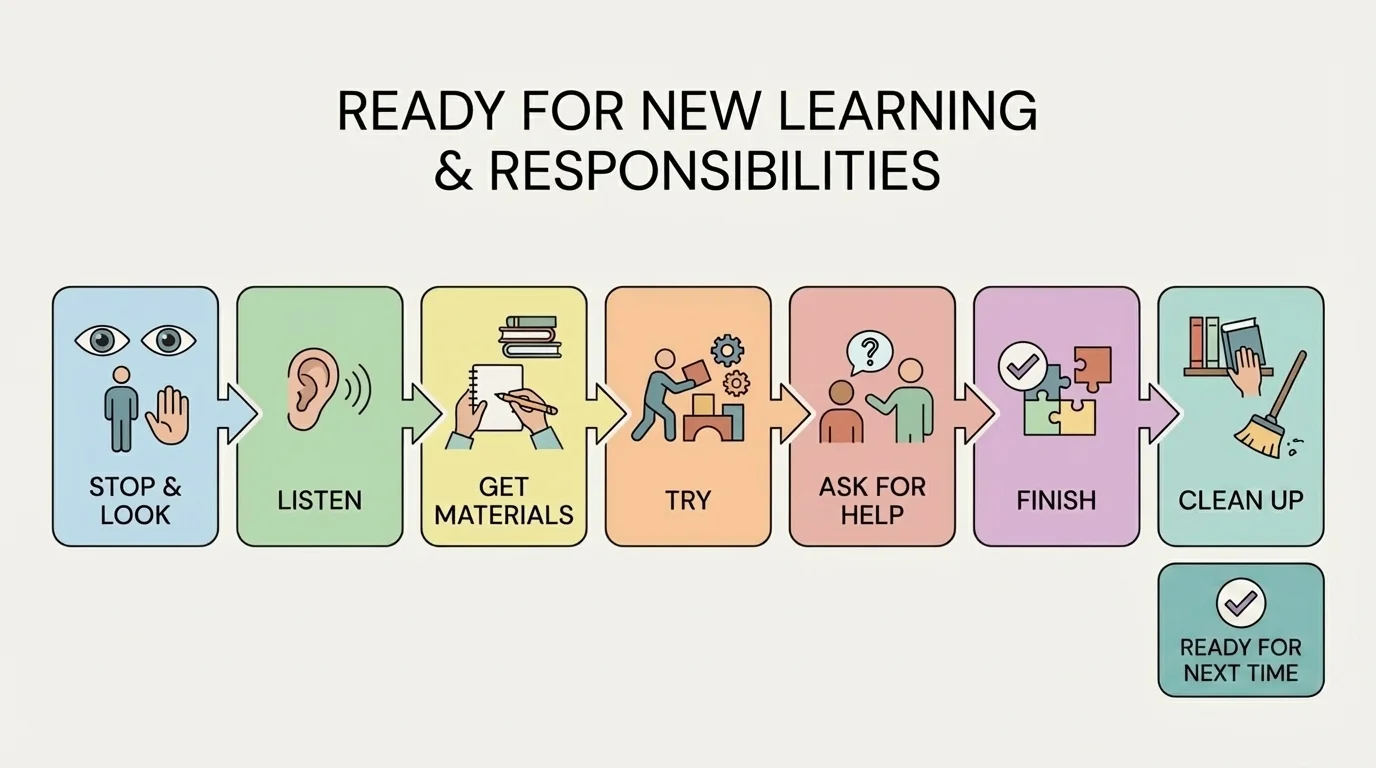
This routine works for many things: drawing during a live lesson, helping fold towels, setting the table, or getting ready for a library program on a video call. The steps stay almost the same, even when the task changes.
Example: Getting ready for an online art activity
Step 1: You hear that art time begins in a few minutes. You stop and think about what you need.
Step 2: You get paper, crayons, and a pencil. You place them on the table.
Step 3: You log in, listen to the directions, and start with the first part.
Step 4: When you cannot find the next color, you ask politely for help instead of quitting.
Step 5: When the activity ends, you put the crayons away and throw away scraps.
This shows readiness because you prepared, listened, tried, and cleaned up.
When you use the same steps again and again, they become habits. Habits make hard things feel easier because you already know how to begin.
Sometimes you forget. Sometimes you feel grumpy. Sometimes a new job feels too big. That happens to everyone. Being ready does not mean everything goes perfectly. It means you know how to reset.
A habit is something you do often, and habits can be changed. If a not-ready habit has started, you can pause, breathe, and begin again. You can say, "Let me try one more time." That is a strong choice.
You have probably already practiced readiness before. Whenever you cleaned up after play, waited for a turn, or asked for help kindly, you were already building this skill.
If you forgot a responsibility, tell the truth. Then fix what you can. For example, if you left your books on the floor, pick them up. If you missed directions, ask for them again. If you spoke unkindly online, apologize and choose kinder words next time.
The step-by-step plan from [Figure 2] is useful here too. When you feel stuck, you can go back to the first box: stop, look, and listen. Then take just one step instead of trying to do everything at once.
Each time you get ready, try, and follow through, you show that you are growing. New learning and new responsibilities may feel big at first, but you can meet them with practice, kindness, and courage.
