One message, one click, one ride, one purchase, one post—major decisions often look small at first. A choice can take only a few seconds, but its effects can last for months or even years. That is why strong decision-making is not about being perfect. It is about slowing down enough to notice what could go wrong, what is right, and what happens next.
At your age, major decisions are already part of everyday life. You may decide whether to take a part-time job, whether to share a screenshot, whether to get into a car with someone who is driving recklessly, whether to post something that could spread fast online, or whether to spend most of your savings on something you want right now. These are not just "yes or no" moments. They involve judgment.
Major decisions feel hard because they usually involve uncertainty. You do not know exactly what will happen. Sometimes every option has a downside. Sometimes the pressure is emotional: you want to fit in, avoid conflict, help someone, or stop feeling stressed. Sometimes the pressure is practical: money, time, reputation, or safety.
A difficult choice can also be confusing because different questions are mixed together. You may ask, "Can I do this?" when the more important question is "Should I do this?" Or you may focus on what happens today and ignore what happens next week, next month, or next year.
Risk is the chance that a choice could lead to harm, loss, or danger.
Ethics is the use of values and principles to judge what is right, fair, honest, and respectful.
Consequences are the results that follow from a decision, whether those results are expected or unexpected, positive or negative.
Strong decisions usually come from looking at all three of these ideas together instead of focusing on only one.
When you face a major choice, it helps to look at it through three connected lenses, as [Figure 1] shows: risk, ethics, and consequences. Risk asks what could go wrong and how serious it could be. Ethics asks whether the choice is fair, honest, safe, and respectful. Consequences ask what happens after the choice—for you and for other people.
These lenses overlap. A risky choice may also be unethical. An unethical choice may create harmful consequences. A choice with small short-term benefits may cause large long-term problems. Looking through only one lens can lead to bad judgment. For example, a choice might seem low-risk for you personally, but still be wrong because it hurts someone else or violates their privacy.
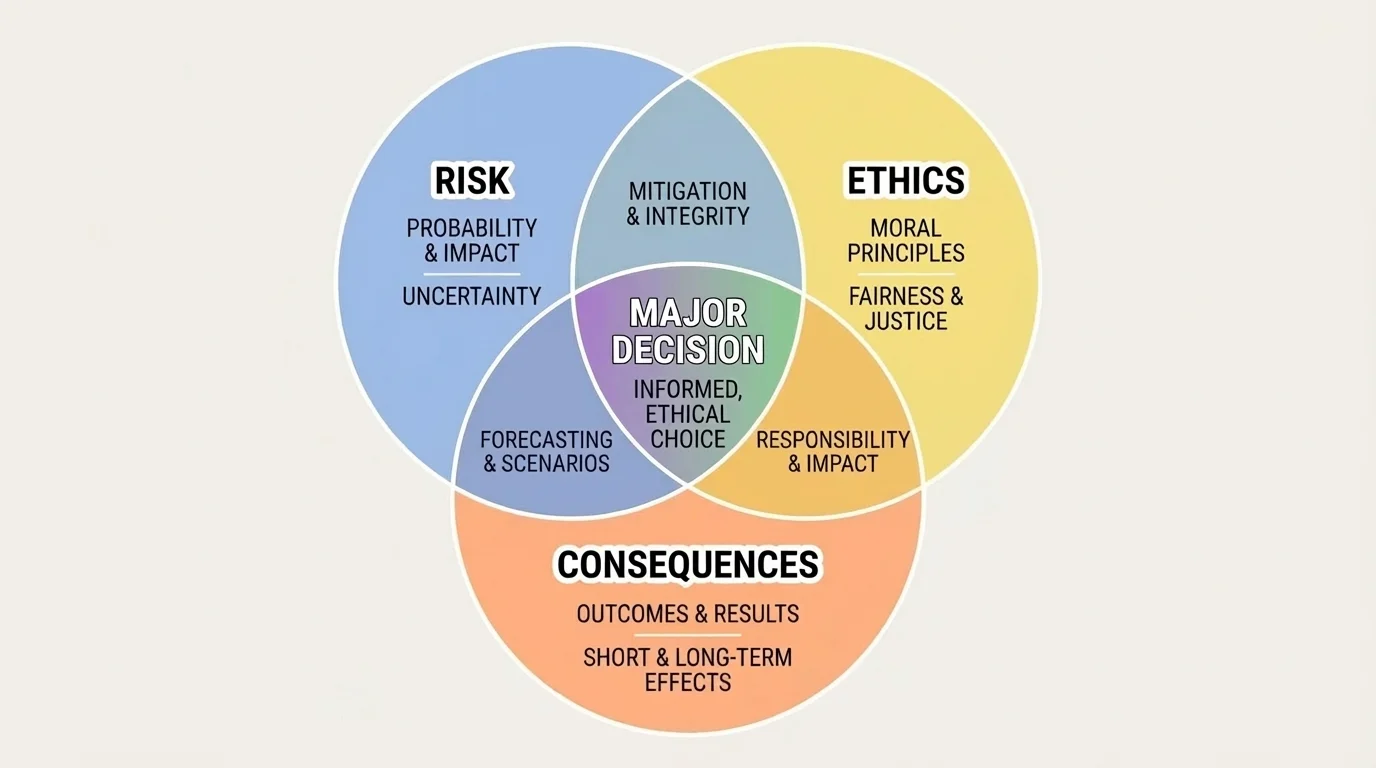
Think about posting a private screenshot of a conversation. The risk question is whether sharing it could damage trust, spark conflict, or expose private information. The ethical question is whether the other person gave permission and whether posting it is respectful. The consequence question is what happens after it spreads—maybe fast, and maybe beyond your control.
If you skip one lens, your judgment weakens. You might think, "It is not illegal, so it must be okay," but legality and ethics are not the same thing. You might think, "Everyone else is doing it," but popularity does not make a choice wise or right.
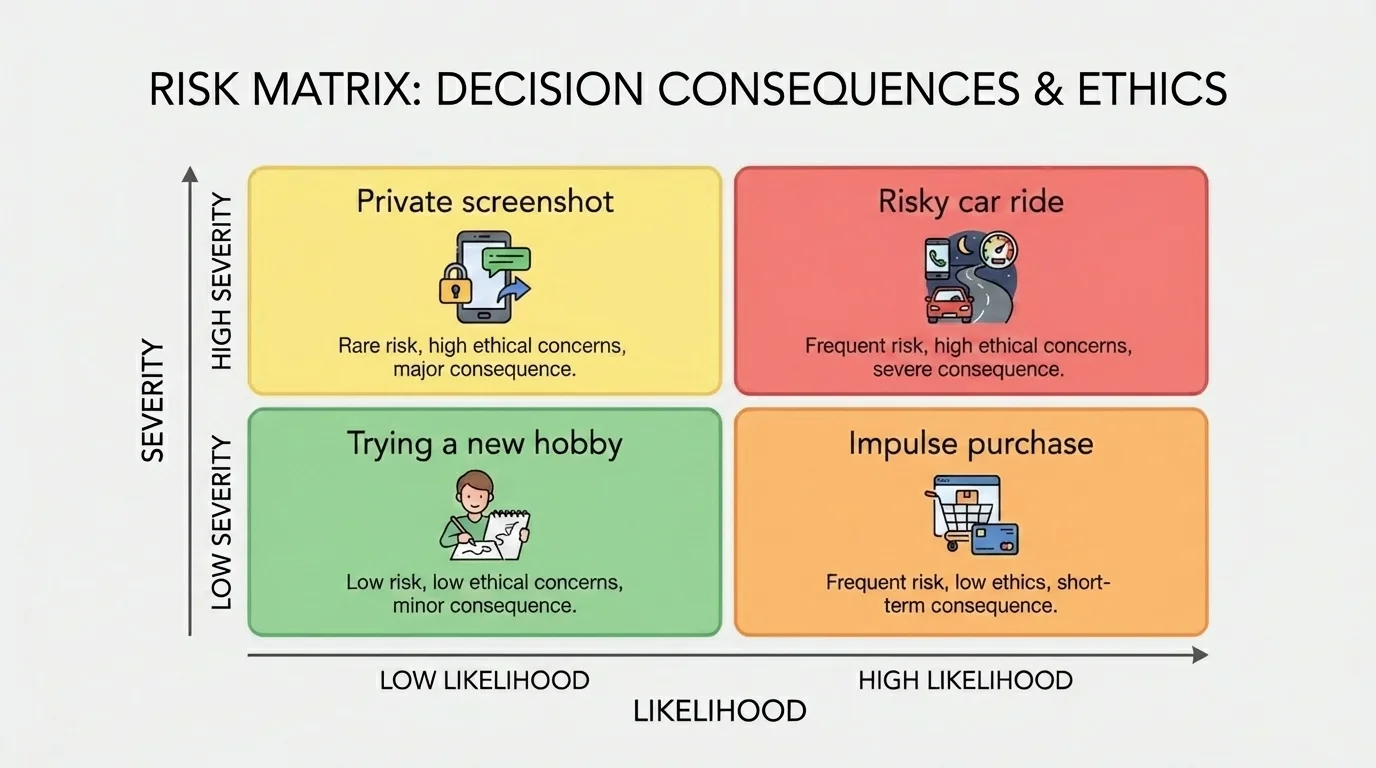
Likelihood means how likely something is to happen, and severity means how serious the harm would be if it did happen. Risk is not just about whether something is possible. It is about both likelihood and severity, as shown in a simple risk matrix.
[Figure 2] A useful way to think about risk is to ask: What is the worst realistic outcome? How likely is it? Who could be hurt? Can the harm be reversed, or would it last? A choice with low likelihood but very high severity still deserves serious attention. For example, getting into a car with an impaired or reckless driver may not always end in a crash, but the possible harm is so severe that the risk is unacceptable.
Some risks are obvious, like physical danger. Others are easy to miss. A risky social media post may not cause physical harm, but it could affect your reputation, future opportunities, family trust, or someone else's mental well-being. A job that pays well might still be risky if it interferes with sleep, schoolwork, or safety.
You can sort risks into categories: physical, emotional, social, financial, digital, and legal. This helps you avoid tunnel vision. If you only think about one type of harm, you may miss another.
| Risk Type | What it might look like | Example |
|---|---|---|
| Physical | Injury or danger to health | Riding with an unsafe driver |
| Emotional | Stress, guilt, shame, anxiety | Joining online bullying to fit in |
| Social | Damaged trust or relationships | Sharing private messages |
| Financial | Losing money or creating debt | Spending all savings impulsively |
| Digital | Privacy loss or online permanence | Posting personal information publicly |
| Legal | Breaking rules or laws | Using someone else's account without permission |
Table 1. Common types of risk and realistic examples of how they may appear in everyday decisions.
As you saw in [Figure 2], choices in the high-likelihood/high-severity area deserve the strongest caution. But even "low-likelihood" choices matter when the possible harm is serious, irreversible, or affects other people.
Your brain is still developing skills connected to planning, impulse control, and weighing long-term outcomes. That does not mean you cannot make strong decisions; it means using a process matters even more.
A practical warning sign is urgency. If someone says, "Decide right now," "Don't tell anyone," or "It's not a big deal," stop and pay attention. Pressure and secrecy often hide risk instead of reducing it.
Ethics matters because many major decisions affect more than just you. A choice can be convenient for you but unfair to someone else. It can feel harmless to you but disrespect someone's boundaries, privacy, or safety.
A simple ethical check includes five questions: Is it honest? Is it fair? Is it respectful? Is it safe? Would I be okay if someone did this to me? That last question is not perfect for every situation, but it often reveals problems quickly.
Ethical thinking is not the same as personal preference. Personal preference is what you want. Ethical thinking asks whether your choice respects other people's rights, dignity, and well-being. A choice can be tempting, efficient, or popular and still be unethical.
Consider privacy. If a friend tells you something personal during a video call and asks you not to share it, passing it on because "people should know" may violate trust. Even if your goal feels understandable, the method may still be wrong. Ethical thinking pushes you to ask whether you have permission, whether the information is yours to share, and whether sharing it protects or harms.
Ethics also matters in money decisions. If you sell something online and hide damage so the buyer will pay more, you may gain in the short term, but you are being dishonest. That harms trust and can come back to you through complaints, conflict, or a damaged reputation.
Another ethical issue is conflict of interest. This happens when your personal benefit makes it harder to act fairly. If you are choosing between helping a friend and following a safety rule, you may feel torn. Good decision-making means noticing when your emotions or loyalties might be pulling you away from what is right.
Consequences can be short-term or long-term, direct or indirect, and intended or unintended. Strong decision-makers think beyond the first effect.
A short-term consequence happens soon. A long-term consequence may build slowly. For example, staying up very late to work extra hours at a job may give you money now, but if it keeps happening, the long-term effects could include poor sleep, lower focus, stress, and weaker performance in other responsibilities.
Direct consequences are the immediate results of your own action. Indirect consequences are the ripple effects. Posting something hurtful may directly upset one person and indirectly change how other people see you. Buying an expensive item may directly reduce your savings and indirectly limit your options later when something important comes up.
Case study: buying a gaming setup
You have $600 saved and want to spend $520 on an upgrade.
Step 1: Identify the short-term result.
You get the item quickly and feel excited.
Step 2: Identify the financial consequence.
Your remaining savings are found by subtracting: \(600 - 520 = 80\). You would have only $80 left.
Step 3: Identify the risk.
If an urgent cost appears—such as replacing headphones for work, paying for transportation, or covering an activity fee—you may not have enough money.
Step 4: Add the ethical question if someone else is involved.
If you promised to help with a family expense or repay someone, spending first may be unfair or irresponsible.
The decision is not automatically wrong, but it becomes smarter when you compare the benefit now with the consequences later.
Notice that a "good" consequence for you does not cancel a harmful consequence for someone else. That is why consequences and ethics need to be considered together, just as the overlap in [Figure 1] suggests.
[Figure 3] When the choice is important, do not rely only on mood or instinct. Use a repeatable process so you are less likely to miss something important.
Step 1: Pause. If possible, create space between the pressure and your response. Even a few minutes can help. Urgency often makes weak choices feel necessary.
Step 2: Define the real decision. Be specific. Instead of "Should I help my friend?" ask "Should I lie for my friend about something that could get another person blamed?" Clear questions lead to clearer thinking.
Step 3: List your options. There are usually more than two. You may be able to delay, ask for advice, offer a safer alternative, or say no without ending the relationship.
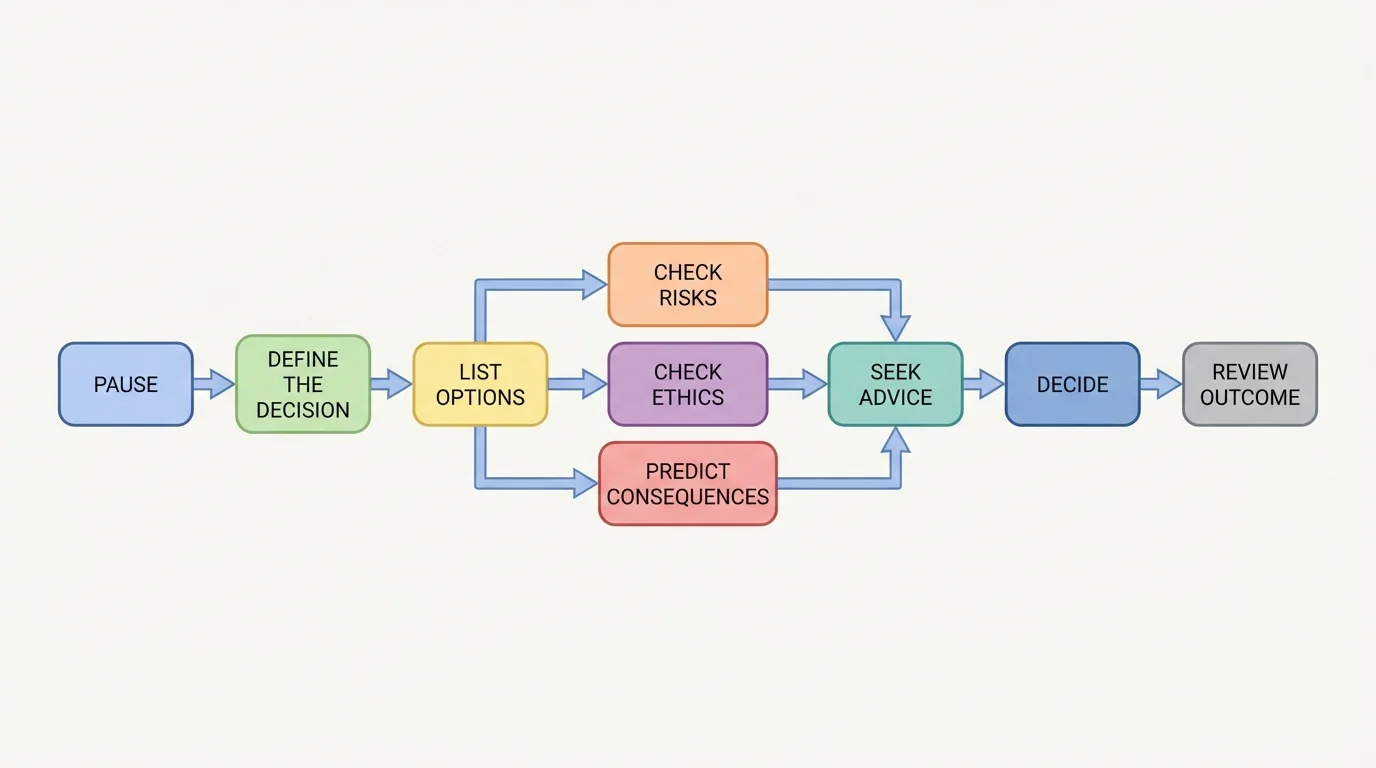
Step 4: Check risk. Ask what could go wrong, how likely it is, how severe the harm could be, and whether the harm can be prevented.
Step 5: Check ethics. Ask whether the choice is honest, fair, respectful, and safe. Ask whether it violates privacy, trust, or consent.
Step 6: Predict consequences. Think about today, next week, and later. Think about yourself and other people.
Step 7: Seek advice when needed. If the decision has serious safety, legal, digital, or financial consequences, talk to a trusted adult or knowledgeable person before acting.
Step 8: Decide and review. Afterward, look at the result. Good decision-makers learn from outcomes instead of pretending every choice was perfect.
"A good decision is based on knowledge and not on numbers."
— Plato
The flow in [Figure 3] works especially well for choices that affect safety, money, privacy, trust, or future opportunities.
Suppose a group chat is encouraging you to post an embarrassing clip of someone. Risk says it could spread permanently and damage trust. Ethics says the person did not consent and may be harmed. Consequences include conflict, reputation damage, and possibly disciplinary or legal trouble depending on the situation. The stronger decision is not to post it, even if the group thinks it is funny.
Suppose you are offered a part-time job with good pay, but the hours would leave you exhausted. Risk includes burnout and poor performance in other responsibilities. Ethics includes being honest with the employer about what hours you can actually handle. Consequences include money gained now, but maybe stress and lost balance later. A better option may be accepting fewer hours or waiting for a different job.
Case study: unsafe ride home
Your ride starts speeding, looking at messages, and ignoring traffic rules.
Step 1: Identify the risk.
The physical risk is high because a crash could cause serious harm.
Step 2: Identify the ethical issue.
If you stay silent to avoid awkwardness, you are still dealing with a situation where safety is being ignored. Protecting life matters more than protecting comfort.
Step 3: Identify the consequence of action and inaction.
Speaking up may feel uncomfortable now, but staying silent could allow much worse consequences.
Step 4: Make the safer choice.
Ask the driver to slow down and stop using the phone. If needed, contact a trusted adult, ask to get out in a safe place, or arrange another ride.
This is a case where the severity of harm makes the decision clearer.
Suppose a friend asks for your password "just for a second." Risk includes account theft, impersonation, privacy loss, and trouble caused in your name. Ethics includes respecting platform rules and protecting your own information. Consequences may continue long after the moment feels over. Saying no is a reasonable boundary.
One reason bad decisions happen is not lack of intelligence but distorted judgment. Pressure and emotion can make a weak choice feel urgent, normal, or harmless, as [Figure 4] illustrates in an online social setting. Fear of missing out, anger, excitement, guilt, or the desire to impress others can all shrink your thinking.
Bias is a thinking pattern that pushes your judgment in a certain direction. For example, you may assume that because nothing bad happened last time, nothing bad will happen this time. You may also trust people too quickly because they are confident, popular, or familiar.
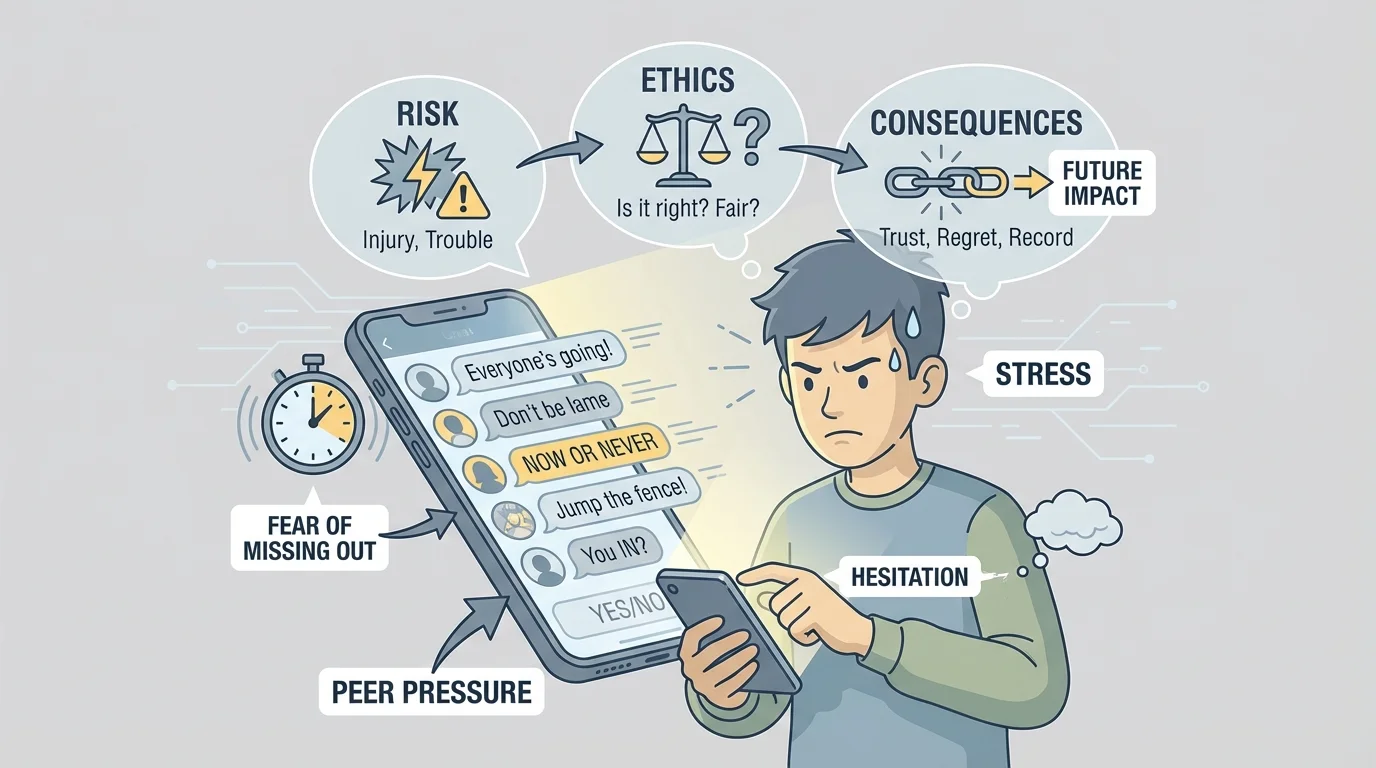
Another common bias is focusing too much on immediate rewards. If a decision gives instant relief, excitement, or approval, your brain may undervalue the later cost. That is why a pause matters so much.
You can protect yourself by naming the pressure directly: "I feel rushed." "I am angry." "I want approval." "I do not want to disappoint them." Once you name the pressure, it becomes easier to question it instead of obeying it.
If a choice feels harder to defend when you imagine explaining it to a trusted adult later, that is useful information. The discomfort may be warning you that your values and your impulse are not lining up.
The scene in [Figure 4] is common online: fast messages, strong opinions, and social pressure can make risky behavior feel normal. Slowing down is a skill, not a weakness.
Some decisions should not be handled alone. Ask for help when safety is involved, when money is significant, when personal information could be exposed, when someone is pressuring you to keep a secret, or when you feel trapped between loyalty and what is right.
Saying no does not require a long speech. You can be clear and brief: "I'm not doing that." "That's not safe." "Don't send that to me." "I can't agree to that." "I need time to think." These responses protect your boundaries without creating extra confusion.
If a person reacts badly to a reasonable boundary, that does not prove your boundary is wrong. It may prove it was needed.
Good decisions often protect future freedom. When you avoid serious risk, act ethically, and think ahead, you keep more options open for yourself. Unsafe, dishonest, or impulsive choices often reduce freedom later by creating damage you then have to fix.
Sometimes the best choice is not the easiest one in the moment. It may feel awkward, disappointing, or unpopular. But temporary discomfort is often far better than lasting harm.
People learn whether they can trust you by watching your choices. If you keep private information private, tell the truth, think before posting, handle money responsibly, and take safety seriously, people notice. That reputation can affect friendships, work opportunities, family trust, and your own confidence.
Good decision-making is not about never making mistakes. It is about using a process, learning from outcomes, repairing harm when needed, and acting with integrity more consistently over time.
The more you practice assessing risk, ethics, and consequences, the more natural it becomes. What feels slow at first eventually becomes a strong habit: pause, think, choose, and stand by what is right.
