Some choices feel huge because they are huge. What you do after high school can affect where you live, how you spend your time, how much money you earn, how much debt you take on, and how quickly you move toward the life you want. That does not mean there is only one "right" answer. It means you need a smart process. The goal is not to pick the most impressive path. The goal is to pick a path that fits you and is backed by real evidence.
Many students hear the same message over and over: "Go to college." But that advice is incomplete. A better question is: What pathway gives you the best match between your goals, your situation, and the evidence available? That could be a university, community college, a certification program, an apprenticeship, military service, immediate employment, or a combination. Choosing well is part of being responsible to yourself, your future, and the people who may depend on you later.
Your postsecondary decision is not only about a job title. It is about your daily life. Do you want hands-on work, academic study, paid training, flexible scheduling, faster entry into the workforce, or time to explore before committing? These questions affect stress levels, finances, motivation, and long-term satisfaction. A path that looks good on social media may be a bad fit in real life.
When students make decisions without evidence, they often rely on pressure, assumptions, or fear. That can lead to problems like dropping out, changing majors multiple times, taking on debt without a clear plan, or entering a field they do not actually enjoy. On the other hand, when students compare pathways carefully, they are more likely to save money, stay motivated, and make steady progress.
Postsecondary pathway means any education, training, or work route you take after high school to build skills, credentials, and career options.
Evidence means trustworthy information you can verify, such as program costs, graduation rates, job outlook data, required credentials, and conversations with people actually doing the work.
Personal priorities are the needs, values, goals, and limits that matter most to you, such as affordability, location, family responsibilities, or the kind of work environment you want.
A strong decision usually balances three things: who you are, what the pathway actually offers, and what the future likely looks like if you choose it. If one of those is missing, the decision gets shaky.
Postsecondary choices are wider than many people realize, as [Figure 1] illustrates through a side-by-side comparison of routes that differ in cost, time, and outcomes. If you think only in terms of "college or no college," you may miss pathways that fit your goals better.
A four-year college or university can be a strong choice if your intended field usually requires a bachelor's degree, such as teaching, engineering, nursing in many cases, or accounting. It can also offer broader campus resources, networking, and a traditional degree path. But it often takes more time and money, and it is not automatically the best route for every career.
Community college can be a smart option if you want lower tuition, smaller class sizes, a local commute, or a transfer pathway to a university later. It can also offer associate degrees and career-focused programs in areas such as health technology, business, information technology, and skilled trades.
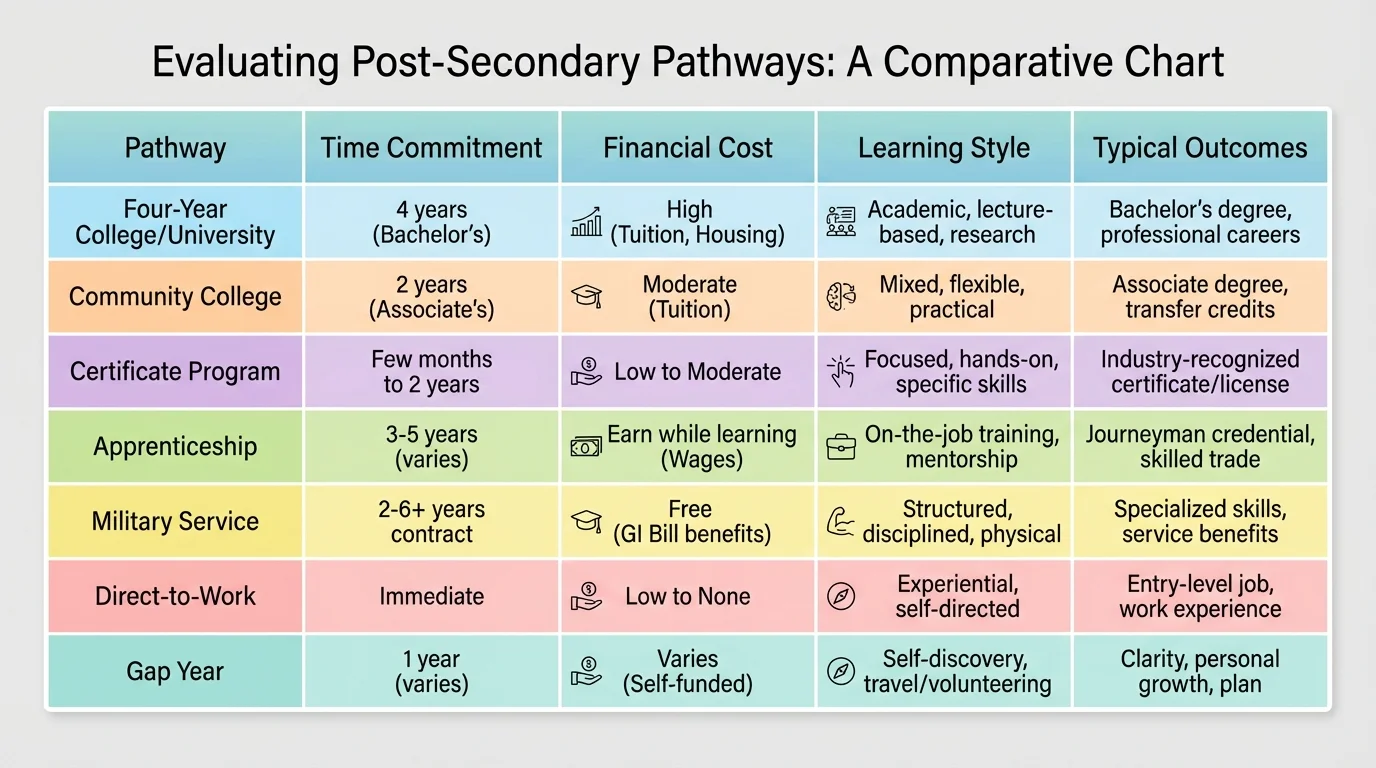
A certificate program focuses on a specific skill area and is often shorter than a degree program. Examples include medical assisting, welding, cybersecurity support, HVAC, cosmetology, and commercial driving. These programs can help you enter the workforce faster, but you need to check whether employers in your area respect that credential.
An apprenticeship combines paid work with structured training. This can be a powerful option if you learn best by doing and want to earn money while building skills. Electricians, plumbers, carpenters, and some manufacturing and technology roles may use this model. Unlike some classroom-only routes, apprenticeships can let you avoid heavy student debt while still gaining valuable credentials.
Other routes include military service, direct-to-work, and a purposeful gap year. Military pathways may offer training, experience, and education benefits, but they also involve serious commitments and risks. Direct-to-work can make sense when an employer offers advancement, on-the-job training, or tuition support. A gap year is most useful when it has a plan behind it, such as working to save money, completing service, building a portfolio, or exploring fields through job shadowing and online certifications.
One important truth: pathways can stack. You might start at community college, transfer to a university, and later add an industry certification. Or you might work first, then return to training once you know your direction. The comparison in [Figure 1] makes this easier to see: different routes are not always competing; sometimes they connect.
Before you compare schools or programs, compare them to your life. A pathway that works for one student may fail for another because their priorities are different. If you skip this step, you may end up researching options that look great on paper but do not fit your actual needs.
Start by listing what matters most. Think about your interests, your strengths, your financial reality, your responsibilities at home, your need for structure or flexibility, and the kind of work you want your days to include. Some students want high earning potential as soon as possible. Others care most about creative work, helping people, location, or low debt. None of those priorities are wrong. What matters is being honest.
Your priorities are decision filters
When you know your top priorities, you stop treating every option as equal. For example, if staying close to family is essential, out-of-state programs may move lower on your list. If you need to start earning quickly, a shorter training route may be more realistic than a longer degree. Priorities do not make the decision for you, but they narrow the field and reduce confusion.
Helpful questions to ask yourself include: What kind of tasks give me energy? Do I prefer hands-on learning, independent study, discussion, or structured practice? How much debt am I willing to take on? Do I need a local option because of transportation or family duties? How important are prestige, speed, flexibility, and income? What environment helps me stay disciplined when learning online or independently?
You should also pay attention to your limits. Maybe you struggle with unstructured time. Maybe you need steady income. Maybe you have caregiving responsibilities, health needs, or transportation challenges. These are not weaknesses in the decision process. They are part of reality. Smart planning respects reality.
Students sometimes choose a path because it sounds impressive, then leave when the daily routine does not fit them. The mismatch is often about lifestyle and support, not intelligence.
A useful method is to separate priorities into three groups: must-have, important, and nice-to-have. For example, "affordable without large loans" may be a must-have. "Can lead to remote work later" may be important. "Has a strong sports culture" may be nice-to-have. This makes it easier to compare options without getting distracted by features that matter less.
Once you know your priorities, the next step is research. This is where many students either do too little or trust the wrong sources. A program's advertising is not enough. You need evidence that the pathway leads where it claims to lead.
Start with official sources: program websites, admissions pages, course lists, tuition breakdowns, state labor data, federal career outlook sites, employer job postings, and licensing boards for regulated careers. If a program says graduates get jobs quickly, look for numbers. If a career seems exciting, check whether local employers are hiring and what credentials they actually require.
Here are strong pieces of evidence to collect for each option: total cost, length of program, graduation or completion rate, transfer options, job placement support, internship or apprenticeship opportunities, industry recognition, average starting pay, required certifications, and schedules. If a school is online or hybrid, check how support services work in practice. Can you actually meet with advisors virtually? Is tutoring available? What happens if you fall behind?
Talk to real people too. Reach out by email, video call, or messaging to admissions staff, program advisors, recent graduates, current trainees, or professionals in the field. Ask practical questions: What does a normal week look like? What surprised you? What costs did you not expect? Would you choose this pathway again?
Be careful with anecdotal evidence. One person's experience matters, but it is not the whole story. If three people say a program is disorganized and the online reviews show similar complaints, that pattern matters. If one person loved a program but the debt was extremely high and completion rates were low, you need to weigh all the evidence together.
Questions to ask when researching a pathway
Step 1: Ask about requirements.
What credential do employers expect for entry-level jobs in this field? Is a degree required, or is a certification enough?
Step 2: Ask about total cost.
What are the tuition, fees, books, tools, testing costs, transportation costs, and housing costs?
Step 3: Ask about outcomes.
How many students complete the program? How many get jobs in the field? What is typical starting pay in my region?
Step 4: Ask about support.
What tutoring, advising, disability support, and career help are available? How easy is it to access those supports remotely?
Evidence-based choices are not cold or impersonal. They protect your future. They help you avoid choosing based on pressure, branding, or wishful thinking alone.
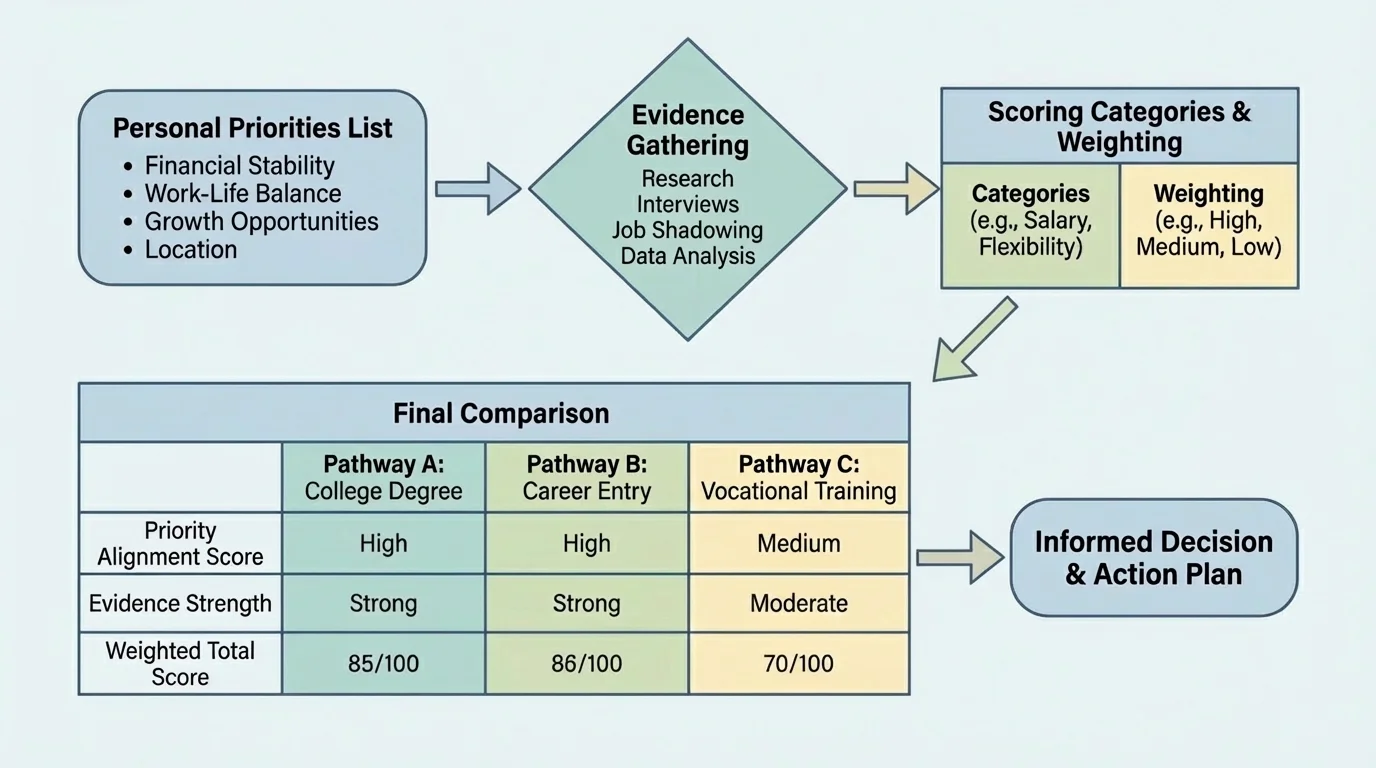
A structured tool can turn a confusing choice into a manageable one. One practical method is a weighted decision matrix. You list your top criteria, give each one a weight based on importance, then score each pathway.
[Figure 2] Suppose your top criteria are affordability, speed to employment, interest in the work, flexibility, and long-term growth. You can assign weights that add to \(100\textrm{%}\) or simply use points. For example, affordability might be worth \(30\), interest \(25\), growth \(20\), flexibility \(15\), and speed \(10\).
Then rate each option on a simple scale, such as \(1\textrm{ to }5\), where \(1\) means poor fit and \(5\) means strong fit. Multiply each score by the weight. A pathway that feels less exciting at first may come out ahead because it fits your real priorities better.
Using a weighted comparison
You are comparing three options: a local community college program, a university, and an apprenticeship.
Step 1: Choose weights.
Affordability \(=\dfrac{30}{100}\), interest fit \(=\dfrac{25}{100}\), job growth \(=\dfrac{20}{100}\), flexibility \(=\dfrac{15}{100}\), speed to earnings \(=\dfrac{10}{100}\).
Step 2: Score each option from \(1\) to \(5\).
Apprenticeship: affordability \(5\), interest \(4\), growth \(4\), flexibility \(3\), speed \(5\).
Step 3: Calculate the weighted score.
Apprenticeship score = \(5 \times 30 + 4 \times 25 + 4 \times 20 + 3 \times 15 + 5 \times 10\)
\(150 + 100 + 80 + 45 + 50 = 425\)
Step 4: Compare totals.
If the university scores \(340\) and the community college program scores \(390\), the apprenticeship ranks highest for this student's priorities.
The highest score does not force your decision, but it gives you a clear starting point for discussion and reflection.
This kind of tool is useful because it reduces the power of random emotions in the moment. You can still care about your dreams, but you are testing them against evidence. That is a mature way to make a big decision.
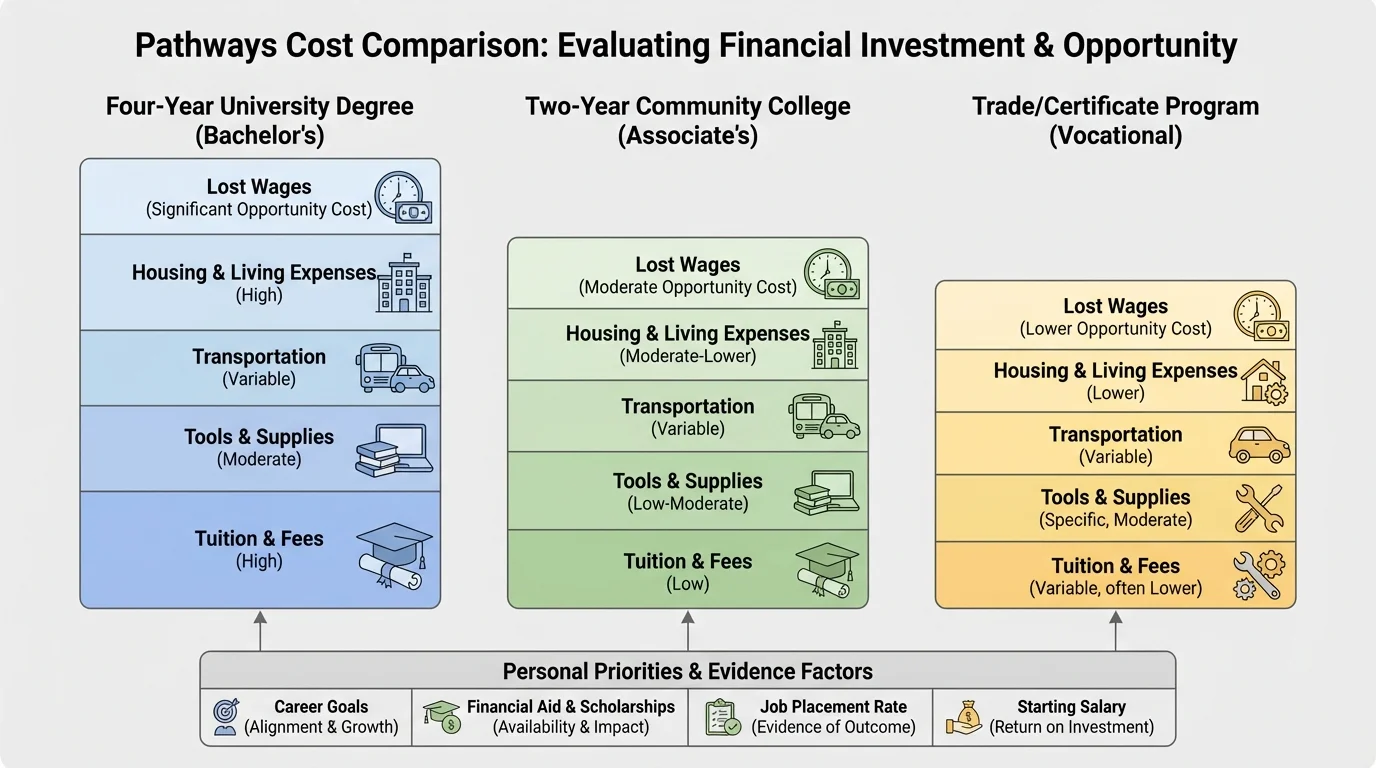
Total cost is more than the sticker price. A program may advertise low tuition but still require fees, equipment, transportation, internet access, certification exams, or lost work hours. Looking only at tuition can lead to a bad surprise.
[Figure 3] When you compare pathways, include both direct costs and indirect costs. Direct costs include tuition, books, fees, supplies, and tools. Indirect costs include commuting, meals, housing, childcare if relevant, and opportunity cost. Opportunity cost means what you give up by choosing one option over another. If one path takes longer before you can earn full-time income, that matters.
Debt is not always bad, but unmanaged debt can limit your freedom for years. If you borrow, you should have a realistic sense of whether your future earnings can support repayment. A high-cost program for a low-paying field should make you pause unless there is a strong reason and a solid plan.
| Pathway | Length | Main costs | Possible earnings timeline | Common risk |
|---|---|---|---|---|
| Four-year degree | Approximately \(4\) years | Tuition, housing, fees, books | Later entry, possibly higher ceiling | High debt without a clear major or plan |
| Community college + transfer | Approximately \(2 + 2\) years | Lower starting tuition, transfer costs later | Later entry, lower early cost | Poor transfer planning can waste credits |
| Certificate/apprenticeship | Approximately \(0.5\textrm{ to }2\) years | Tools, certification fees, lower tuition or paid training | Faster entry to earnings | Narrow training if field fit is poor |
Table 1. Comparison of common pathway patterns, costs, and financial risks.
You do not need to predict your entire future perfectly. But you do need to ask responsible questions. How much will this really cost? How soon can I earn? What happens if I change direction? What is the likely payoff?
"Don't ask only, 'What do I want to become?' Ask also, 'What will this path require from me every day?'"
Scholarships, grants, employer tuition support, and paid work-based learning can change the picture a lot. A pathway that looks too expensive at first may become realistic with financial aid. A low-cost path may become expensive if it has poor completion rates and students often need extra time. That is why the cost patterns in [Figure 3] matter: they remind you to examine the full picture, not just one number.
Success is not only about getting accepted. It is about staying in the program and finishing. That depends heavily on fit. A student may be capable of demanding coursework but still struggle in an environment with weak support, long commutes, isolation, or schedules that clash with family responsibilities.
Consider the learning environment carefully. Do you do well with lectures, labs, hands-on practice, or independent online modules? Do you need regular deadlines and close guidance? If you are learning from home, can you stay focused in a mostly self-directed program, or do you need frequent check-ins and live sessions?
Support systems matter too. Look for advising, tutoring, disability accommodations, counseling access, career services, mentoring, and technical support. If you are balancing work or caregiving, evening courses or flexible scheduling may matter more than a school's reputation.
Good decisions are not only about what sounds ambitious. They are also about what is sustainable. A sustainable plan is more likely to become a completed plan.
Well-being belongs in career planning. If a route leaves you constantly overwhelmed, disconnected, or financially strained beyond reason, the long-term cost can be high. A slightly slower path with stronger support may be the better path.
Consider three students. Jordan wants to work with technology, dislikes heavy theory without application, and wants to start earning soon. Jordan researches local IT support certificates, entry-level help desk roles, and community college cybersecurity pathways. The evidence suggests that a certificate plus work experience could lead to quick entry, while later stacking credentials keeps future options open.
Maria wants to become a physical therapist. After checking job requirements, she learns that this field requires extensive higher education. A short certificate would not lead to that career. For Maria, a college pathway is not just one option among many; it is part of the required route. Her responsible choice is to compare colleges based on cost, transfer planning, academic support, and long-term affordability.
Devon enjoys building things, prefers hands-on learning, and wants to avoid large loans. After talking with workers and researching local demand, Devon finds that an electrical apprenticeship offers paid training, strong earning potential, and clear advancement. That option may fit better than a four-year degree, even if some people around Devon assume college is automatically better.
How one student tests a pathway claim
A student sees an ad claiming a short program leads to "high-paying jobs fast." Instead of trusting the slogan, the student checks actual employer postings, local wage data, completion rates, and whether the credential is recognized in the region.
Step 1: Find five real job postings in the local area.
The student notes the required credential and whether the program matches employer expectations.
Step 2: Compare advertised pay with local averages.
If the ad suggests unusually high pay, the student verifies whether that is entry-level pay or experienced-worker pay.
Step 3: Ask about outcomes.
The student contacts the program and asks for completion rates, job placement data, and common first jobs after graduation.
Step 4: Decide based on evidence.
If the claims are weak or vague, the student removes that option from the shortlist.
These examples show an important pattern: the best pathway depends on the goal. There is no single winner for everyone.
Once you narrow your options, move from thinking to action. Start with a shortlist of \(3\textrm{ to }5\) pathways. For each one, gather the same categories of evidence so your comparison stays fair. If you research one option deeply and another only casually, your decision may be biased by missing information.
Use a checklist. Confirm admissions requirements, deadlines, application materials, financial aid forms, training prerequisites, and any needed exams or portfolios. Schedule virtual information sessions or calls. Save notes in one document or spreadsheet. Keep screenshots or links to wage data and program details.
It also helps to create a decision deadline. Without one, you may keep researching forever and avoid choosing. A deadline does not mean rushing. It means giving your decision a structure.
Watch out for common mistakes: choosing based only on other people's opinions, ignoring hidden costs, assuming a popular path is a good fit, underestimating how much support you need, and failing to verify career requirements. Another common mistake is treating one decision as permanent. Most people adapt over time. Your first step matters, but it does not lock your entire life into one path forever.
If you feel pressure, return to your evidence and priorities. Ask yourself: Which pathway matches my goals, my reality, and the facts I found? That question keeps the decision grounded.
