Have you ever been in a group where one person did almost everything, while others just watched? That does not feel fair, and it usually does not make the best work either. In good group work, everyone has a part. A leader helps the group move forward, and teammates help by doing their jobs, sharing ideas, and supporting one another.
Group work can happen in many places. You might work with other students on a video call, help your family plan a meal, join a club activity, or work with a sports team. No matter where it happens, groups do best when responsibility is shared. That means the job belongs to the whole team, not just one person.
Group work means people working together to reach the same goal. The goal could be making a slideshow, cleaning up after baking, planning a game for a club, or helping with a community event. Each person brings something helpful.
Responsibility means doing what you are supposed to do and taking care of your part. Leadership means helping a group move in a good direction. Teamwork means people helping one another to finish a shared job.
When people share responsibility, the work often gets done better and faster. The group also feels calmer. People know what to do, and they feel included. When responsibility is not shared, one person may feel tired or upset, and the group may miss important ideas.
Think about building something with blocks during a family activity. As [Figure 1] shows, if one child tries to grab all the blocks and decide everything, the others may stop helping. But if one person suggests the plan, another finds the right blocks, and another checks if the tower is straight, the group works as a team.
A leader is not the boss of everyone. A good leader helps the team stay organized. The leader helps the group understand the goal, listens to ideas, and makes sure everyone gets a turn.
A leader might say, "Let's decide our jobs," or "Who wants to read the first part?" The leader helps people begin, but does not take over all the work. A leader should be kind, fair, and ready to help others succeed.
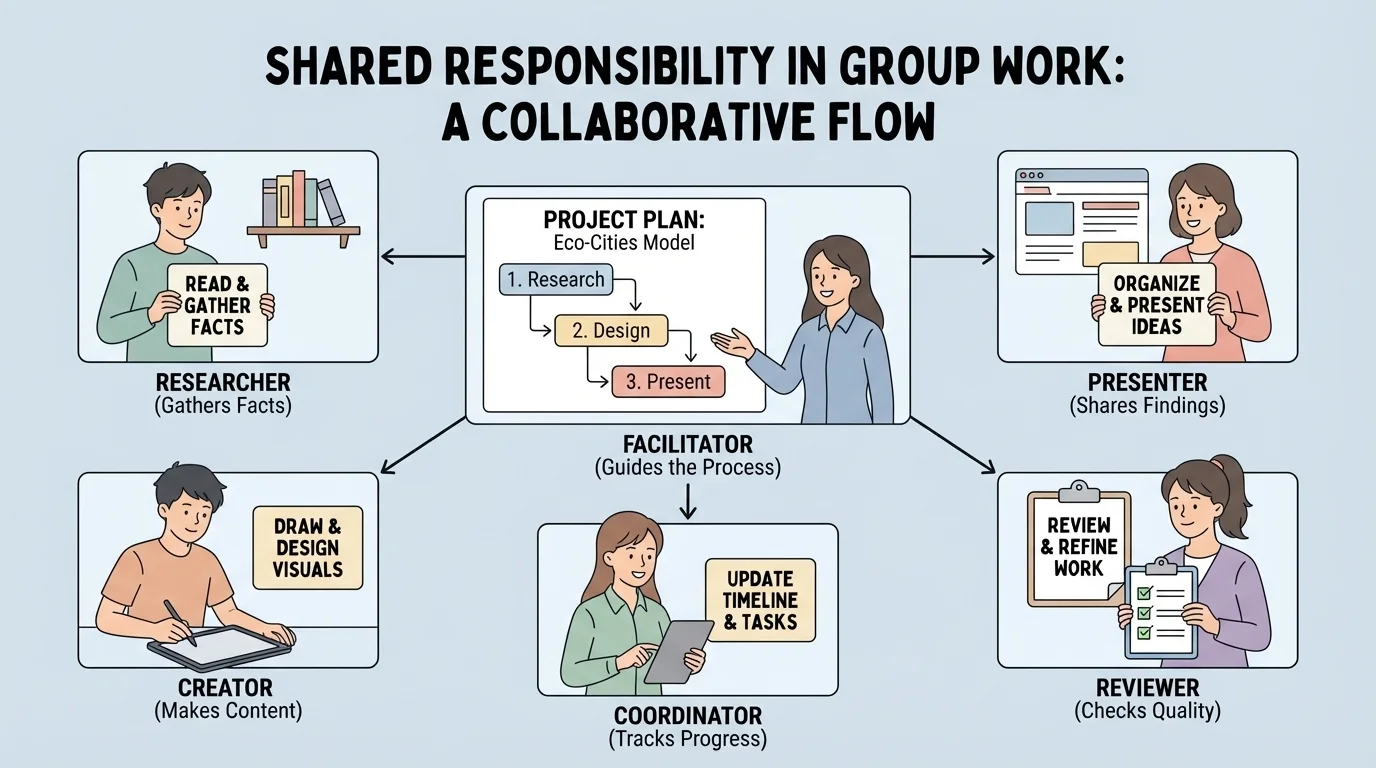
Leaders also help solve small problems. If two people want the same job, the leader can help the team take turns or choose another fair plan. If someone feels left out, the leader can invite that person to join in. Good leaders notice what the group needs.
Sometimes people think a leader should do the hardest part and fix everything alone. That is not true. If a leader does all the work, the team is not really working together. As we saw in [Figure 1], the leader guides the team, but each person still has a job.
Many strong leaders are also strong listeners. Listening helps a leader notice good ideas, feelings, and problems before they get bigger.
A good leader can also say, "I need help." That is a smart choice, not a weak one. Leaders share responsibility too.
A teammate is every person in the group, not just a helper to the leader. Teammates have an important job: they take part. They listen, share ideas, do their own tasks, and help the group stay respectful.
Being a good teammate means you do not wait for someone else to do everything. You can show initiative by starting your part, asking what needs to be done, or kindly helping someone who is stuck. You do not need to be the leader to be helpful.
For example, if your group is making an online presentation, one teammate might draw pictures, one might read aloud, one might check spelling, and one might help put slides in order. Each part matters. Even a small job helps the whole group succeed.
Everyone matters in a team
Shared responsibility means every person has value. Some teammates are good at speaking, some are good at drawing, some are good at checking details, and some are good at encouraging others. A strong group notices these strengths and uses them well.
Teammates also help by speaking kindly. They can say, "I like your idea," "Can I help you?" or "Let's try that together." Kind words make teamwork easier. Mean words, interrupting, or ignoring people can hurt the group.
Shared responsibility means the group's job is divided so everyone has a part, as [Figure 2] shows. One person may lead the plan, but everyone helps carry it out.
Sharing responsibility starts with a clear goal. First, the team needs to know what it is trying to do. Then the group can split the work into smaller jobs. This makes the big task feel easier.
It helps to make a simple plan. The group can ask: What jobs need to be done? Who will do each one? When will we check in? A chart can help people remember their parts and see how the work fits together.
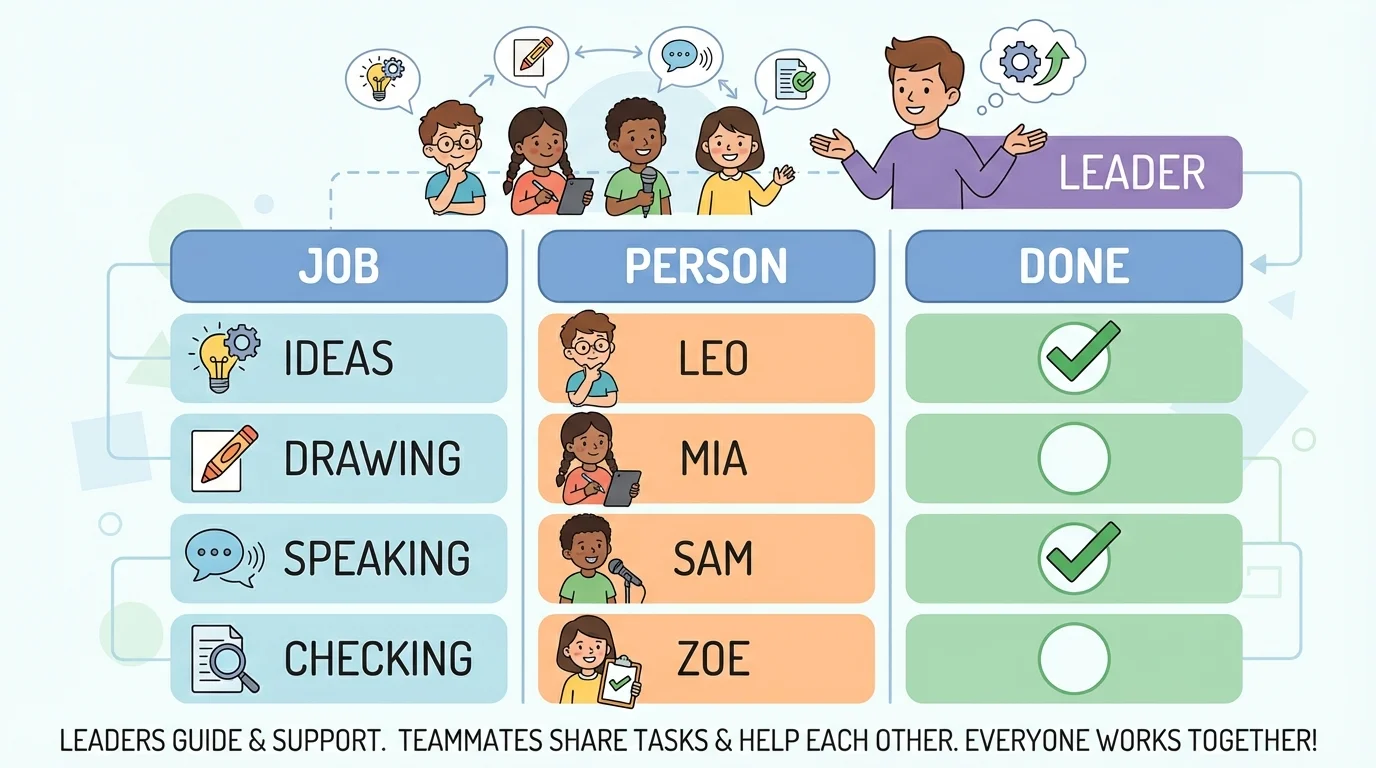
Fair does not always mean everyone does the exact same thing. Fair means the jobs match what people can do and that no one is carrying the whole team alone. A small child helping set napkins for dinner and an older child stirring soup are different jobs, but both jobs matter.
Shared responsibility also means checking your own part. After you finish, ask yourself: Did I do my best? Is my job really done? Do I need to tell the group I finished? This kind of follow-through helps the whole team.
| Group role | Main job | Helpful words |
|---|---|---|
| Leader | Guide the team and make sure everyone is included | "Let's make a plan." |
| Teammate | Do a part of the job and share ideas | "I can help with this part." |
| All group members | Listen, be kind, and finish their tasks | "How can we help each other?" |
Table 1. This table compares the jobs of leaders, teammates, and the whole group.
Sometimes group work feels easy, and sometimes it feels tricky. Problems can happen when someone forgets a job, talks over others, or tries to control everything. These problems do not mean the group has failed. They mean the group needs to stop, talk, and fix the problem.
If someone forgets a task, the group can give a reminder in a kind way. You could say, "Your part is the picture page. Do you want help getting started?" This is better than blaming. Blaming can make people shut down.
If one person talks all the time, the leader or another teammate can say, "Let's hear from everyone." If no one wants to begin, a teammate can show initiative by taking the first small step. One brave, kind action can help the whole group move again.
Example: Solving a group problem during an online project
Step 1: Notice the problem
Two students are doing all the talking, and one student has not had a turn.
Step 2: Name the goal
The goal is for everyone to help and feel included.
Step 3: Use kind words
The leader says, "Let's pause and hear one idea from each person."
Step 4: Share jobs again
Each person gets one clear task, such as reading, drawing, checking, or speaking.
The group becomes calmer because responsibility is shared again.
Another problem is when someone says, "I'll just do it myself." That may sound faster, but it stops teamwork. Groups grow stronger when people learn to trust one another and practice together.
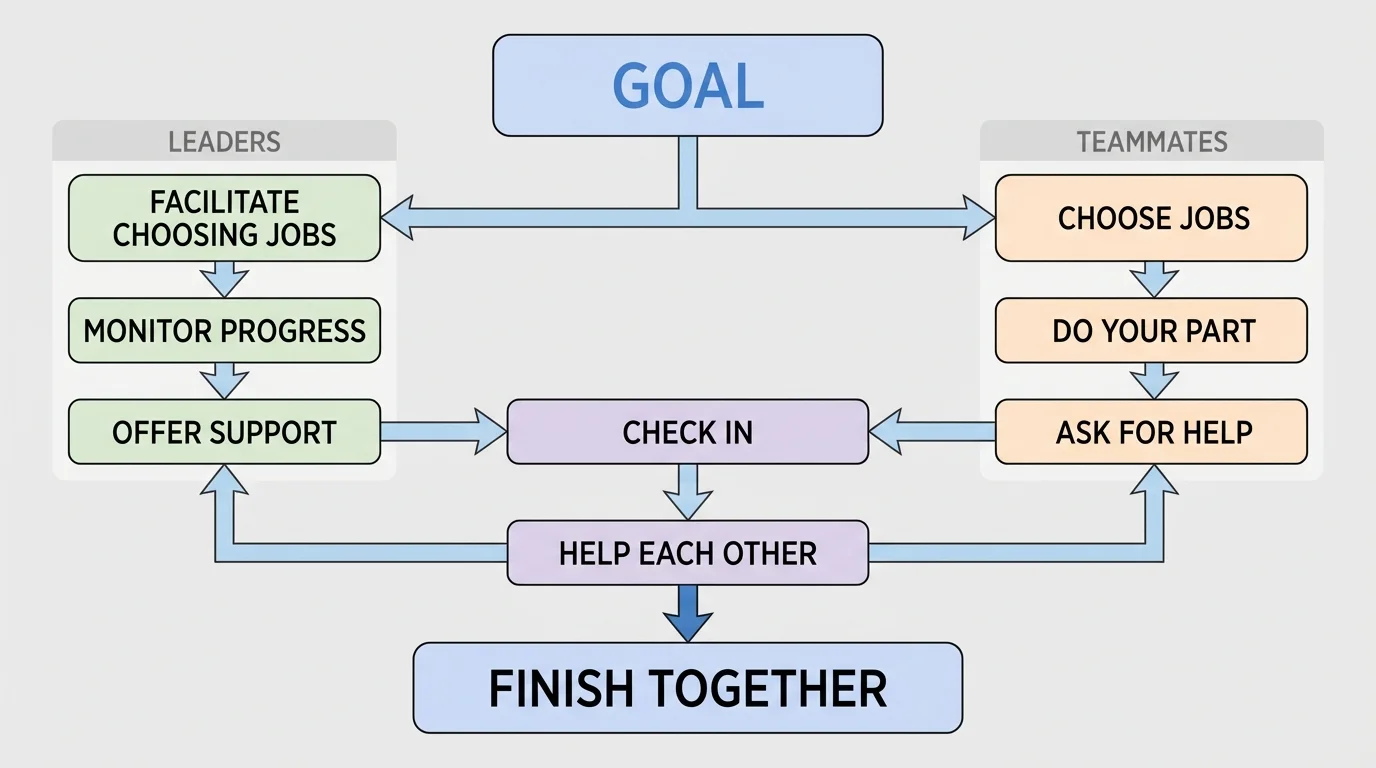
If you want a simple way to work well in any group, follow this plan. [Figure 3] shows a process that gives you an easy path from the beginning of a task to the end.
Step 1: Know the goal. Ask, "What are we trying to do?" Make sure everyone understands.
Step 2: Choose jobs. Pick tasks that match what each person can do.
Step 3: Do your part. Start your job and stay focused.
Step 4: Check in. Ask, "How is everyone doing?"
Step 5: Help kindly. If someone is stuck, offer support.
Step 6: Finish together. Make sure the whole project is ready, not just your own part.
You can use these steps for many real-life situations. Maybe your family is getting ready for guests. One person sets out cups, one wipes the table, one puts snacks on plates, and one checks that everything is ready. The job goes better when everyone knows their part.
You can also use this plan in clubs, sports, or neighborhood activities. Later, when you are older, the same skills will help in jobs and community work. The clear path in [Figure 3] works because it keeps people organized and connected.
"Many hands make light work."
— Old saying
Try This: The next time you work with others, say one helpful sentence: "What is my part?" or "How can I help?" That small question can turn you into a strong teammate right away.
When you learn to share responsibility, you build trust. People know they can count on you. That matters in friendships, teams, clubs, and family life. It will also matter when you are older and need to work with others in bigger ways.
Leaders and teammates need each other. A leader without helpful teammates cannot do much. Teammates without a leader may feel confused about where to start. But when both sides do their part, the group can do amazing things.
Try This: During your next group task, notice one thing the leader does well and one thing a teammate does well. This helps you understand that both roles are important.
