A friendship can make your day feel brighter, or it can make your stomach feel tight. That is a big clue. The people you spend time with online, in your neighborhood, in sports, at clubs, or in other activities can affect how safe, happy, and confident you feel. Learning how to spot a healthy friendship is an important life skill because not every person who says, "I'm your friend," acts like one.
Friends can help you laugh, learn new things, and feel less alone. They might cheer for you during a game, listen when you are upset, or enjoy the same hobbies you do. Good friendships help you feel respected. They let you be yourself.
But sometimes a friendship starts to feel confusing. A person may be nice one day and hurtful the next. They may act kindly in a video call but be mean in a private message. They may say, "If you were really my friend, you would do this." When that happens, it is important to notice the pattern, not just one moment.
Healthy friendship means a relationship where both people treat each other with kindness, respect, honesty, and care.
Harmful relationship pattern means actions that happen again and again that make someone feel unsafe, pressured, small, worried, or unhappy.
Boundary means a limit you set to protect your feelings, time, space, and safety.
You do not need a huge number of friends to have strong relationships. Even one trustworthy friend can make a big difference. What matters most is how you are treated.
A healthy friendship is built on small actions over time. As [Figure 1] shows, healthy friendships are not just about having fun together. They include respect, honesty, and care in everyday moments.
In a healthy friendship, both people get turns. Both people talk and listen. Both people matter. One friend does not always control the game, the chat, or the plan. If one person says, "I do not want to share that photo," the other person respects that choice.
Healthy friends are kind even when they disagree. They do not have to like all the same things. They can enjoy different games, music, sports, or hobbies and still treat each other well. A real friend does not make fun of you for being different.
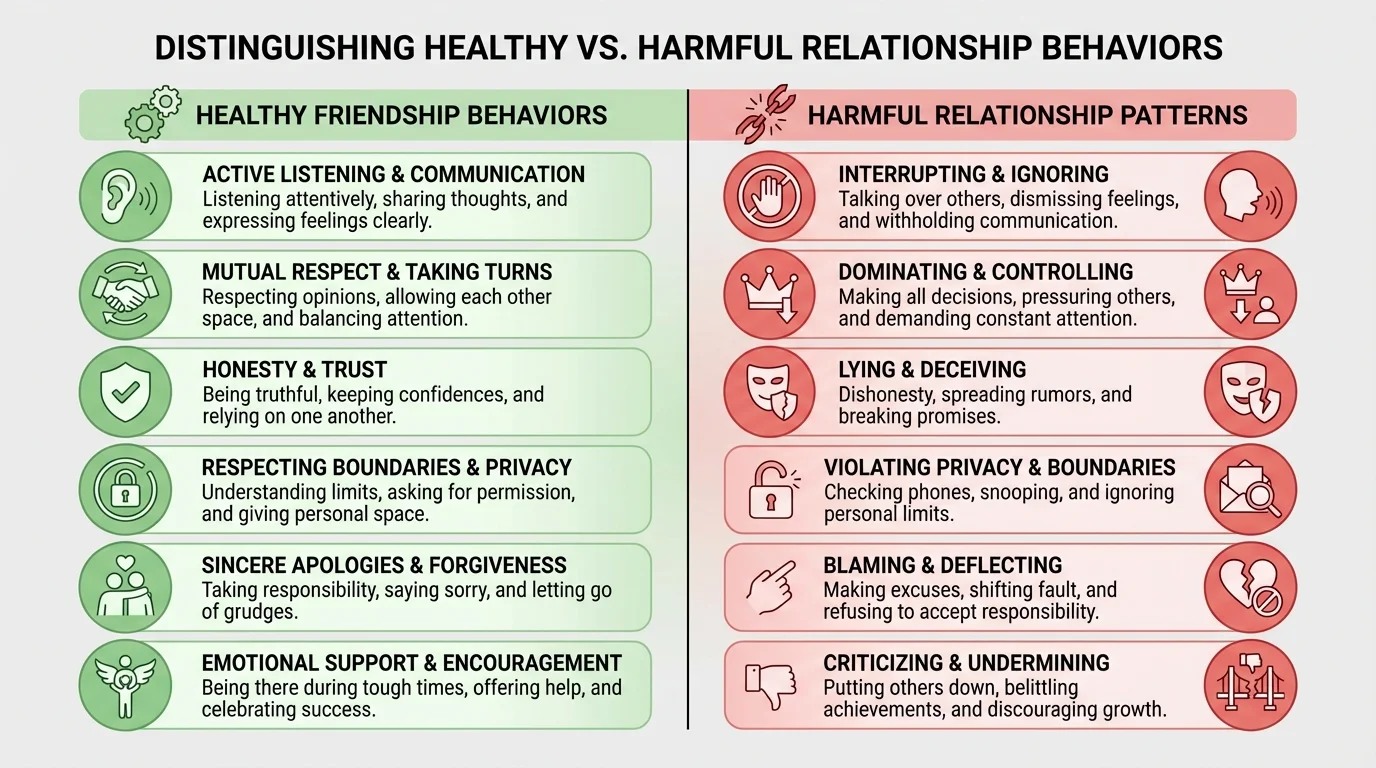
Here are some strong signs of a healthy friendship:
Healthy friendships can still have problems. Friends sometimes misunderstand each other. They may forget to reply, say something rude, or get upset. The difference is that in a healthy friendship, problems are handled with care. People listen, apologize, and try to do better.
Friendships do not have to be perfect to be healthy. What matters is whether both people keep trying to be respectful and safe.
Think about this: if you make a mistake and say sorry, does the other person let the friendship heal? And if they make a mistake, do they also take responsibility? That balance matters, and it connects back to the healthy behaviors in [Figure 1].
A harmful pattern is not just one bad mood. It is when unkind or unsafe behavior keeps happening. As [Figure 2] illustrates, harmful patterns can happen in texts, game chats, video calls, or community activities.
One warning sign is control. A controlling person tries to control your actions all the time. They may demand your password, tell you who you can talk to, insist you answer right away, or get angry if you spend time with someone else. Friendship is not supposed to feel like being trapped.
Another warning sign is pressure. A person may push you to break a rule, send a picture, say something mean, or keep a secret that feels wrong. They might say, "Come on, prove you are my friend." Real friendship does not require you to do unsafe or uncomfortable things.
Mean jokes can also be harmful. Sometimes people say, "I was only kidding," after they embarrass you. But if the joke hurts your feelings and they keep doing it, that is not playful. That is disrespect.
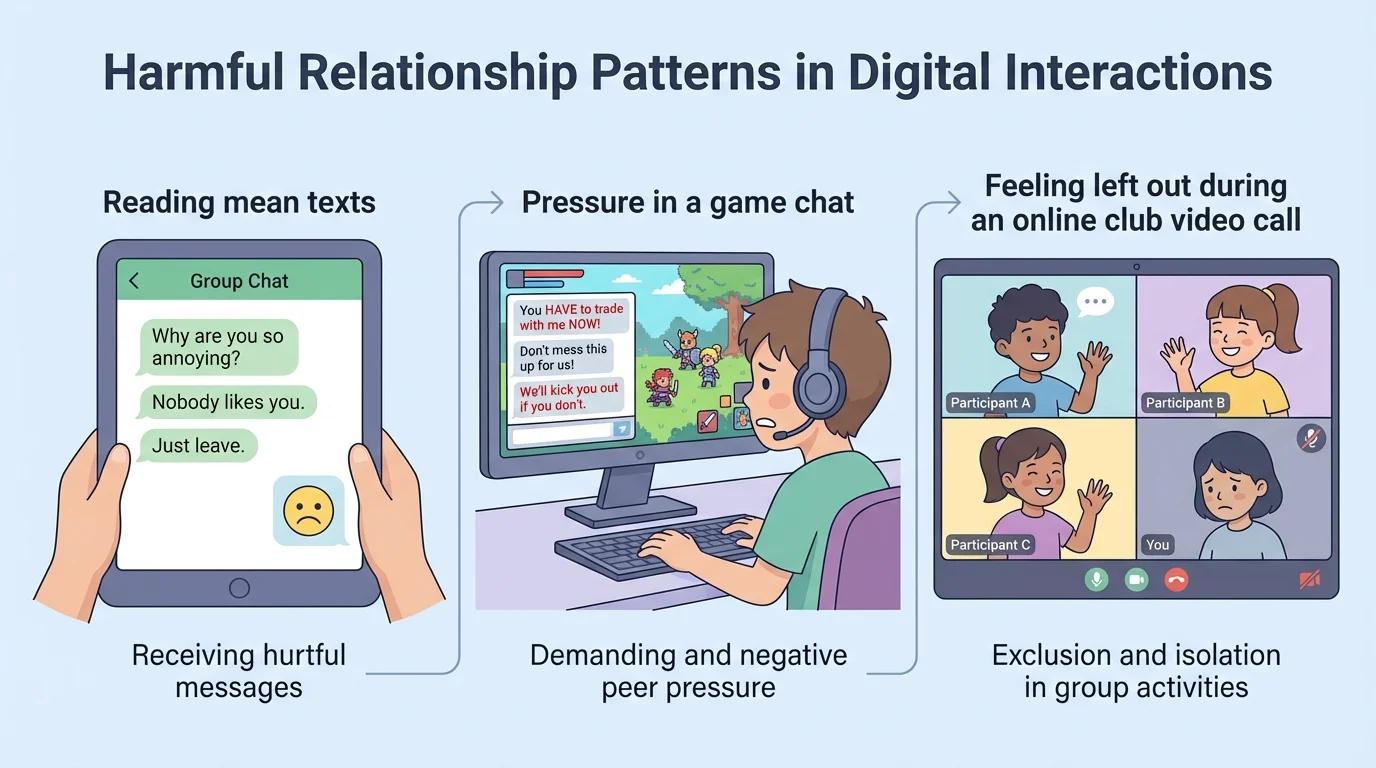
Here are common harmful patterns:
Sometimes harmful behavior is loud and obvious. Sometimes it is sneaky. A person may be sweet in front of adults but unkind in private messages. That is why patterns matter more than appearances.
Patterns tell the truth. One kind message does not erase many hurtful ones. When you are trying to decide if a friendship is healthy, look at what usually happens. Ask yourself: "How do I feel most of the time with this person?"
If you often feel nervous before opening their messages, or worried about making them mad, that is important information. The situations in [Figure 2] show that harmful behavior can happen through screens just as much as face-to-face in community settings.
It can help to compare behaviors side by side. This makes confusing situations easier to understand.
| Situation | Healthy Friendship | Harmful Pattern |
|---|---|---|
| You say no | They respect your answer | They pressure, beg, or threaten |
| You make a mistake | They talk it through fairly | They shame you or use it against you later |
| You talk to others | They understand you can have more than one friend | They act jealous and try to control you |
| You share something private | They keep it safe | They spread it or joke about it |
| You succeed at something | They cheer for you | They try to ruin your happiness |
| You disagree | They stay respectful | They insult, mock, or punish you |
Table 1. Comparison of healthy friendship behaviors and harmful relationship patterns in common situations.
A helpful question is: Do I feel free to be myself? In healthy friendships, you can like what you like, wear what you want, enjoy your hobbies, and still feel accepted. In harmful relationships, you may feel like you must change yourself just to keep the other person calm.
Your body and emotions can give you signals. You might feel calm, relaxed, and happy around a healthy friend. You may feel safe speaking honestly. You may feel disappointed sometimes, but not afraid.
With a harmful friendship, you might notice a knot in your stomach, a racing heart, or a feeling of dread before a chat or activity. You might replay conversations in your head because you are afraid of saying the wrong thing. You might feel confused because the person is nice sometimes and hurtful other times.
These feelings do not prove everything by themselves, but they are clues. If something feels wrong again and again, pause and pay attention.
Feelings are signals, not weaknesses. Feeling upset, pressured, scared, or confused is a sign to slow down and think about what is happening.
You never have to stay in a friendship that keeps hurting you just because it has good moments once in a while. A few fun times do not cancel out a pattern of unkindness.
When a friendship starts to feel unhealthy, it helps to have a plan. Early steps like pausing, naming the problem, setting a limit, leaving if needed, and getting help from a trusted adult are shown in [Figure 3].
First, slow down. You do not have to answer a text or message immediately. If someone is pushing you, taking a pause can help you think clearly.
Next, name what is happening. You can think, "This person is pressuring me," or "This joke is hurtful," or "They are sharing something private." Naming the behavior helps you decide what to do.
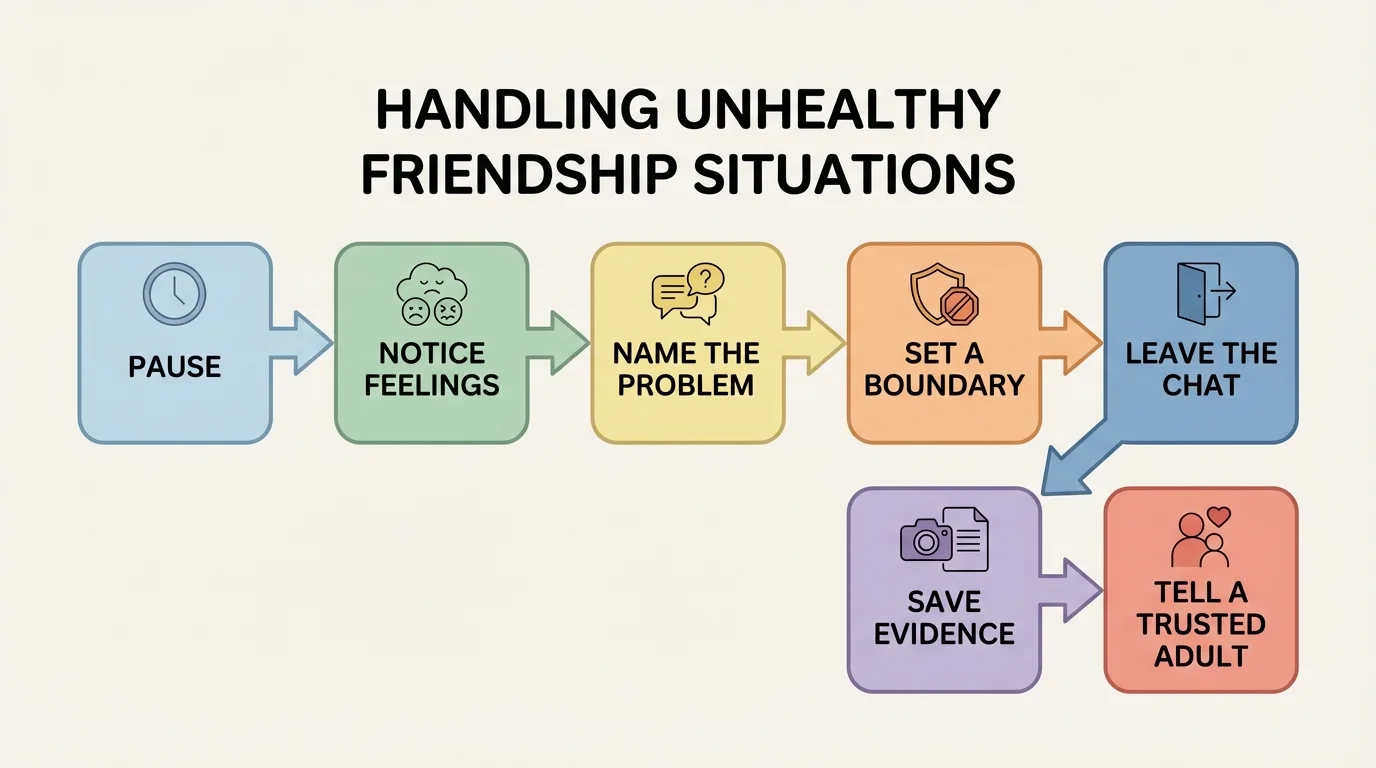
Then, use an assertive communication statement. Assertive means calm, clear, and respectful. It is not rude, and it is not weak. It sounds like:
If the person stops and changes their behavior, the friendship may still be repaired. If they laugh, get meaner, or keep pressuring you, that tells you something important.
A simple action plan
Step 1: Pause
Take a breath. Do not reply while upset or scared.
Step 2: Check your feelings
Ask yourself whether you feel safe, respected, and calm.
Step 3: Say your boundary
Use a short, clear sentence such as "Stop. I do not like that."
Step 4: Protect yourself
Leave the chat, block the person, mute notifications, or stop the call if needed.
Step 5: Get help
Tell a trusted adult and show the messages if the problem happened online.
If something harmful happens online, save evidence before deleting it if it is safe to do so. A screenshot can help an adult understand the problem. Then block, report, or leave the space when needed. The flowchart reminds you that safety comes before being polite.
Here are some situations you might actually face.
Example 1: A gaming friend says you must only play with them. When you join another group, they send angry messages and call you fake. This is a harmful pattern because they are trying to control your choices.
Example 2: A friend from a community art class teases your drawings during a group video call. You say, "Please stop." They apologize later and do not do it again. That may be a healthy friendship mistake that got repaired.
Example 3: Someone asks you to keep a secret from adults about something unsafe. This is not a normal friendship secret. Unsafe secrets should be told to a trusted adult right away.
Example 4: A friend shares your silly photo in a group chat without asking. If they truly care, they should remove it, apologize, and not repeat it. If they keep doing it, that becomes a harmful pattern.
"A good friend does not make you choose between being safe and being accepted."
These examples show why it is smart to look at behavior over time. One repaired mistake is different from repeated harm.
Learning to spot harmful patterns is important, but so is learning how to be a good friend yourself. Strong friendships grow through habits.
Try these simple actions:
Try This: The next time you message or talk with a friend, check for balance. Did both of you get a turn? Did both of you feel heard? That tiny check can help you build healthier relationships.
Try This: Practice one boundary sentence out loud when you are calm. It is easier to use when you have said it before.
Some situations are too big to handle alone. Tell a trusted adult right away if a person threatens you, asks for private photos, talks about hurting you, shares your personal information, keeps contacting you after you say stop, or asks you to keep an unsafe secret.
Trusted adults can include a parent, guardian, coach, club leader, counselor, or another safe grown-up in your life. Asking for help is not tattling when safety is involved. It is smart and brave.
You deserve friendships that feel safe, respectful, and caring. If a relationship keeps making you feel small, worried, or trapped, you are allowed to step back. You are allowed to protect your well-being. You are allowed to ask for help.
