Here is a surprising truth: the best leader is not always the one who talks the most, takes charge fastest, or seems the most confident. In real life, a leadership approach that works perfectly in one situation can fail badly in another. If you are helping run a volunteer cleanup, leading an online club project, organizing a family event, or moderating a community server, your success often depends on choosing the right style for the moment.
Leadership matters because groups can either gain energy from a good leader or lose time, trust, and motivation with a poor one. A group with no clear direction may stall. A group with a leader who controls everything may feel ignored. A group with endless discussion may never act. Learning to evaluate leadership styles helps you become someone who can guide others in a way that fits the real situation, not just your personal preference.
A leadership style is the way a person guides, influences, and works with a group. It affects how decisions are made, how problems are solved, and how people feel while working together. Leadership is not just about being "the boss." It is about helping a group move toward a goal.
In everyday life, you may lead more often than you think. You might organize a shared online document for a group task, guide younger siblings through a chore plan, help a sports team communicate during practice, or coordinate volunteers for a neighborhood drive. In each case, the job is not only to get things done. It is also to keep people informed, respected, and focused.
Leadership is guiding a group toward a goal. Leadership style is the way that guidance happens, including how decisions are made, how much input others have, and how support is given. Effective leadership means using a style that fits the people, the task, and the situation.
One of the biggest mistakes people make is thinking there is one "best" style. Strong leaders usually practice situational leadership. That means they pay attention to what the group actually needs right now. A calm brainstorming session needs something different from a stressful deadline or a safety issue.
Leadership styles differ in how decisions are made, how much control the leader keeps, and how much support group members receive, as [Figure 1] shows through a side-by-side comparison. Knowing these differences helps you evaluate which style might work best instead of reacting automatically.
One common style is autocratic leadership, sometimes called direct leadership. In this style, the leader makes decisions quickly and clearly, with less group input. This can sound harsh, but it is not always bad. If there is danger, confusion, or a very short deadline, a direct approach can protect the group from wasting time.
Another style is democratic leadership. Here, the leader invites ideas, listens to the group, and often makes decisions with shared input. This style can build trust and better ideas because people feel heard. It works especially well when the group has time to discuss and the quality of ideas matters.
A third style is coaching leadership. A coaching leader does not only focus on the task. They also help people improve their skills, confidence, and understanding. This works well when group members are still learning and need guidance, feedback, and encouragement.
A fourth style is delegating leadership. In this style, the leader gives responsibility to others and trusts them to handle parts of the work. This can be powerful when the group members are capable and motivated. It shows trust and can help a group work faster because one person is not controlling every detail.
A fifth style is affiliative leadership, which focuses on relationships, morale, and emotional support. This style is useful when a group is tense, discouraged, or dealing with conflict. It helps rebuild trust and connection so the group can function well again.
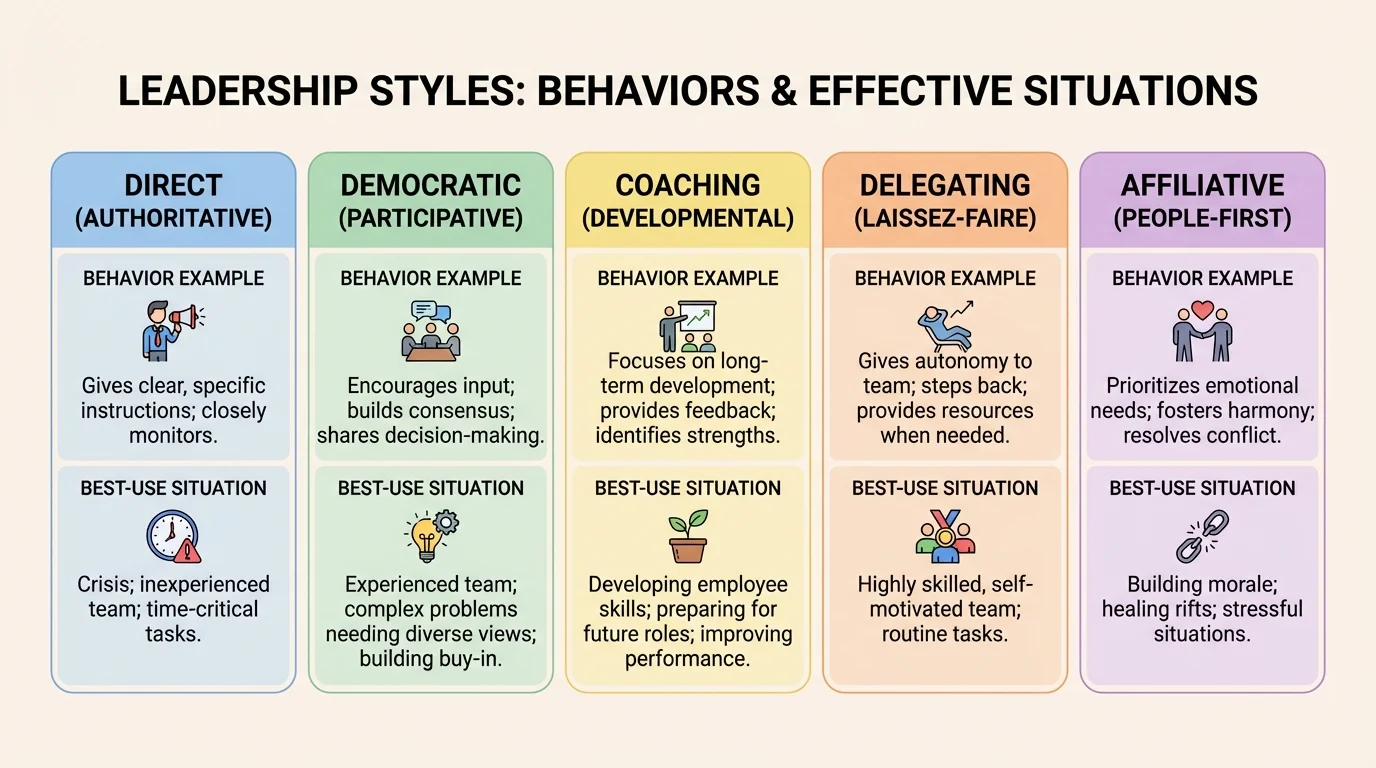
None of these styles is perfect all the time. Direct leaders can become controlling. Democratic leaders can take too long. Coaching leaders can spend so much time teaching that progress slows. Delegating leaders can seem absent if they hand off too much. Affiliative leaders can avoid hard decisions if they focus only on keeping everyone happy.
Adaptable leadership means changing your approach when the situation changes. A strong leader may begin with democratic discussion, switch to direct action when a deadline gets close, and then use coaching afterward to help the team improve next time.
This is why leadership is a practical skill, not a fixed label. You do not need to decide, "I am a democratic leader" or "I am a direct leader." A better question is, "What does this group need from me right now?"
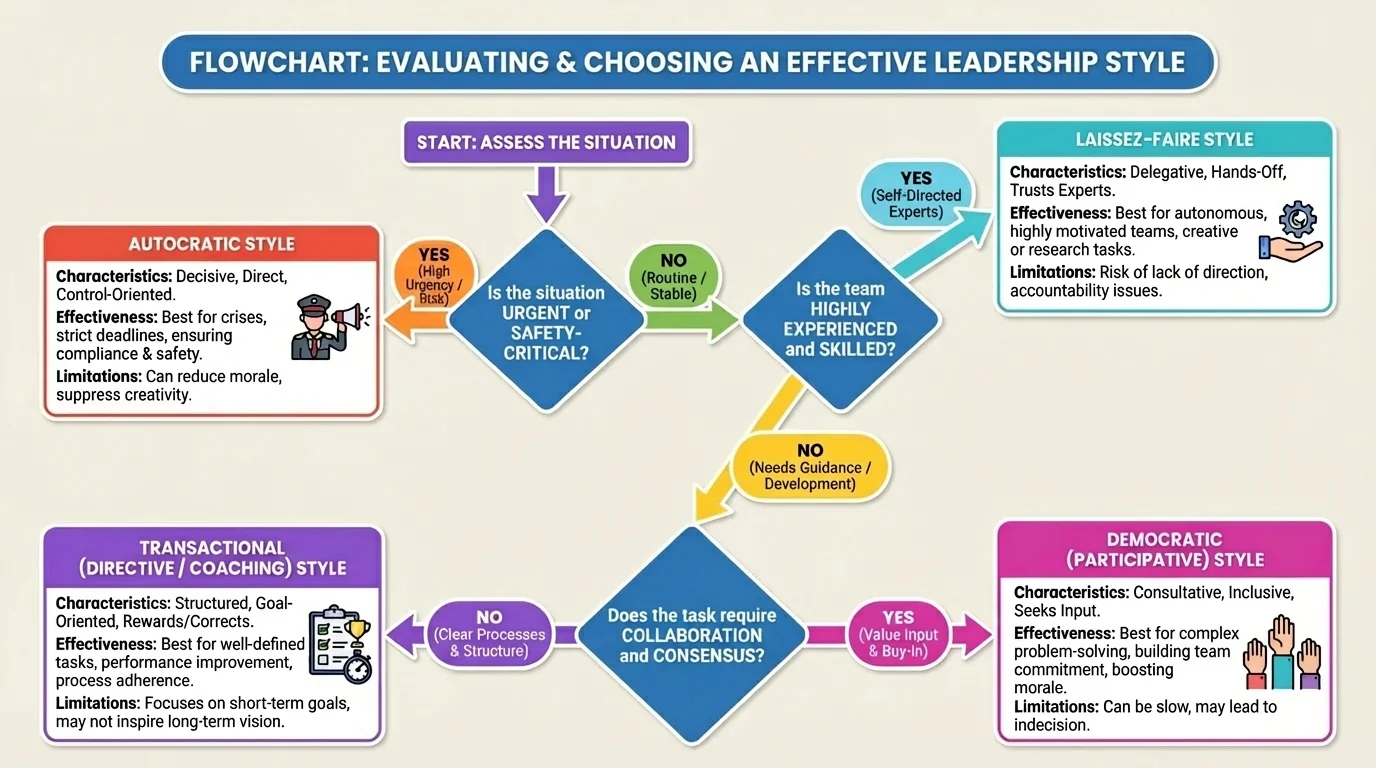
Effective leaders match style to the situation, as [Figure 2] illustrates through a simple decision path. Before choosing how to lead, pause and look at the task, the people, and the pressure. The same group may need different leadership styles at different moments.
Direct leadership works best when time is short, safety matters, or the group is confused. For example, if you are helping organize supplies for a community event and a storm suddenly changes the plan, someone may need to say, "Everyone stop. Move the equipment inside now. You two carry the boxes. I will message the volunteers." In that moment, long discussion would slow the group down.
Democratic leadership works best when you need ideas, commitment, or fairness. If you are planning an online awareness campaign and choosing between several themes, asking the group for input can improve the final choice. People also tend to support a plan more when they helped create it.
Coaching leadership is effective when the goal includes growth. If a newer team member does not know how to create a schedule, a coaching leader might explain the process, show an example, and then let them try. This takes more time now, but it builds ability for the future.
Delegating leadership works best when team members are skilled, reliable, and clear about the goal. Suppose you are running a digital fundraiser. One person is great at graphics, another at writing messages, and another at tracking responses. Delegating lets each person use their strengths instead of waiting for approval on every tiny step.
Affiliative leadership works best when emotions are getting in the way of progress. If a group chat becomes tense after a misunderstanding, the leader may need to slow down, check how people are feeling, and rebuild respect before returning to the task.
Notice that "best" does not mean "nicest" or "strictest." It means most helpful for this exact situation. A style is effective when it helps the group meet its goal while treating people fairly.
Urgency matters a lot. If a decision must be made in the next few minutes, democratic discussion may be too slow. If there is plenty of time, direct control may be unnecessary and frustrating. Skill level matters too. Beginners often need more coaching and structure, while experienced people usually do better with delegation and trust.
Group emotions also matter. A talented group that is upset, embarrassed, or angry may not respond well to a purely task-focused leader. In that case, affiliative moves such as listening, naming the tension, and resetting expectations can save the group from falling apart.
When you need to decide how to lead, use a quick check instead of guessing. Think through five questions.
First, what is the goal? Is the goal speed, safety, creativity, learning, or teamwork? If the goal is immediate action, direct leadership may fit. If the goal is strong ideas, democratic leadership may fit. If the goal is growth, coaching may fit.
Second, how much time do you have? When there is very little time, the leader usually needs to be more direct. When there is enough time, it makes sense to invite ideas and discussion.
Third, how experienced is the group? If people are confused or new, they usually need clearer direction. If they are experienced and dependable, delegation becomes more effective.
Fourth, what is the emotional climate? Are people calm, excited, nervous, frustrated, or in conflict? If emotions are intense, relationship-focused leadership may need to come first.
Fifth, what happens if the group chooses badly? If the consequences are serious, such as wasted money, missed deadlines, or safety risks, the leader may need to guide the decision more closely instead of leaving everything open.
Quick decision guide for choosing a style
Step 1: Name the pressure.
Ask: Is this urgent, risky, or emotionally tense?
Step 2: Check the group.
Ask: Are the people new, experienced, motivated, distracted, or upset?
Step 3: Match the style.
Use direct for urgency, democratic for shared ideas, coaching for growth, delegating for capable teams, and affiliative for rebuilding trust.
Step 4: Recheck after a few minutes.
If the group is still stuck, switch styles instead of repeating what is not working.
This quick framework shows why decision-making in leadership is more than simply having opinions. It is about reading the moment accurately and responding on purpose.
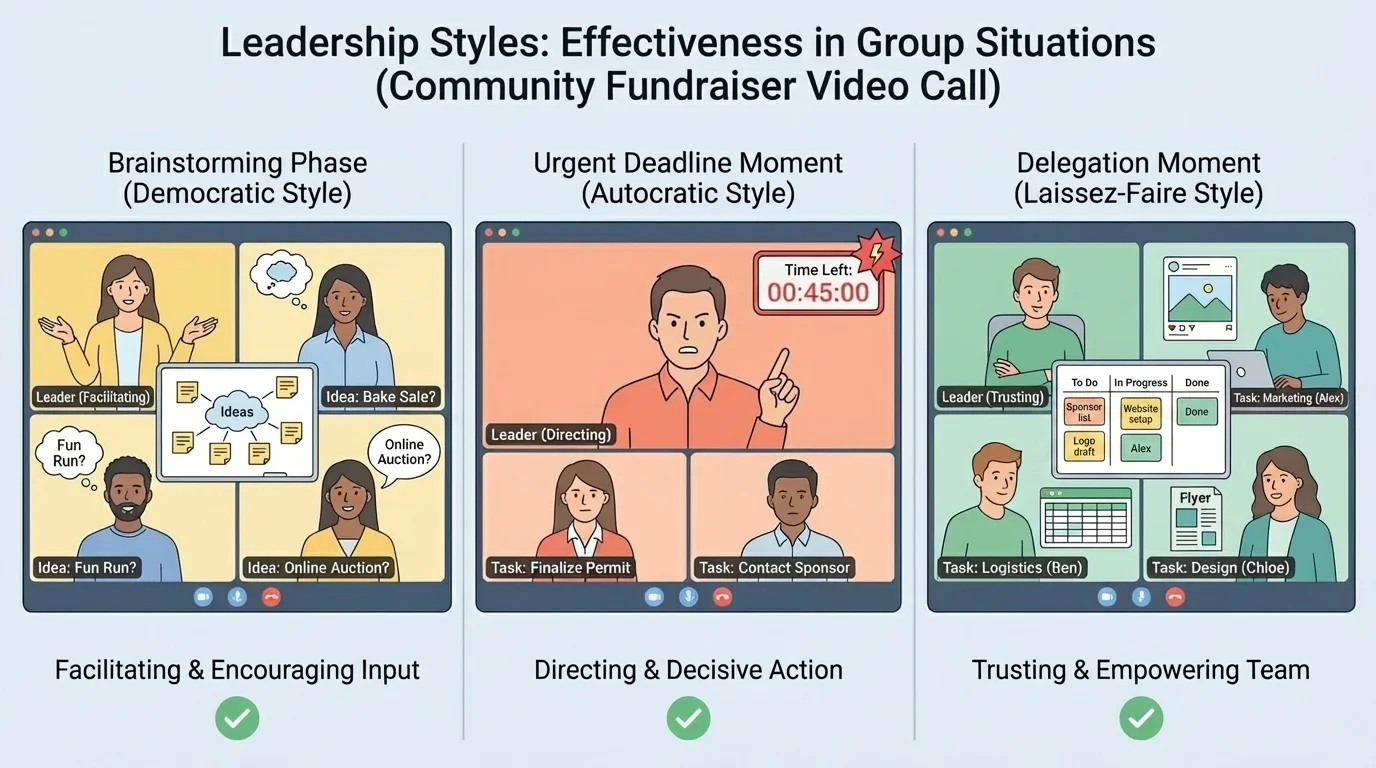
One group may need different leadership styles during different phases, as [Figure 3] illustrates with an online planning meeting that shifts from brainstorming to urgency to delegation. That is why evaluating the situation matters more than copying one style all the time.
Scenario 1: Online community fundraiser. At the start, democratic leadership works well. You ask for theme ideas, vote on a plan, and let people suggest roles. Later, when the event page must go live that night, direct leadership may be needed: "We are out of time. Maya, finish the graphics. Eli, post the schedule. I will send the reminder messages." After the event, coaching leadership helps the group improve by discussing what worked and what to do better next time.
Scenario 2: Family responsibility project. Suppose you are helping organize a large family meal or celebration. If younger siblings or relatives are unsure what to do, coaching helps them learn tasks. If the kitchen is getting chaotic and food is close to burning, direct leadership becomes useful. If older family members are experienced, delegating roles saves time and reduces stress.
Scenario 3: Sports or activity team. During practice planning, democratic leadership can help a team choose goals. During an intense game moment, direct leadership is often more effective because players need clear, fast communication. After a tough loss, affiliative leadership matters because the group may need encouragement before it can focus on improvement.
Scenario 4: Volunteer cleanup or service event. At the beginning, direct leadership may be needed for safety instructions and clear assignments. Once everyone understands the job, delegating becomes more efficient. If volunteers start feeling unappreciated or tired, affiliative leadership helps keep morale up.
Scenario 5: Online server or club moderation. If members are peacefully suggesting rule updates, democratic leadership helps create fair rules. If a serious conflict suddenly breaks out, direct leadership may be needed to pause chat, enforce rules, and protect people. Afterward, affiliative and coaching approaches can help repair community trust and teach better communication.
These examples show something important: leadership is not just about control. It is also about timing. As we saw in [Figure 3], strong leaders shift their approach when the group's needs change.
One common mistake is micromanagement. This happens when a leader controls every small detail and does not trust others to do their part. Micromanagement often causes frustration, slows the group down, and makes capable people feel useless. If your group already knows what to do, step back and delegate more.
Another mistake is avoiding decisions to seem nice. A leader who keeps asking for more opinions when the group clearly needs action can leave everyone stuck. Listening matters, but leadership also means deciding when it is time to move.
Groups often lose motivation not because the members are lazy, but because the leadership style does not fit the situation. People usually respond better when they know what is expected and feel their effort matters.
A third mistake is confusing fairness with sameness. Fair leadership does not always mean treating everyone exactly alike. It means giving people what they need to contribute well. A beginner may need coaching, while an expert may need space and trust.
Poor communication is another major problem. Even the right leadership style can fail if you are vague. Instead of saying, "Someone should probably handle the messages," try, "Jordan, please send the update by 5 p.m."
Clear leadership communication usually includes three parts: what needs to happen, who is responsible, and when it needs to be done. If any one of those is missing, confusion grows quickly.
You do not need a formal title to practice leadership. Start by paying attention to what happens in small group situations. If people are lost, practice being clear. If one person dominates, practice inviting others in. If the group is tired or upset, practice calm support. Flexibility grows through noticing and adjusting.
Try these habits in daily life. Before leading, pause for a few seconds and ask what the group needs most. During the task, watch how people respond. If they seem confused, add structure. If they seem capable, step back. Afterward, reflect honestly: Did my style help this group, or did I choose what felt easiest for me?
Another useful habit is to ask for feedback. You can say, "Was I clear?" "Did I give enough space?" or "What would have helped our group work better?" Feedback can feel uncomfortable, but it helps you become more accurate and effective.
Try This: a simple leadership reset
Step 1: Stop and observe.
Before jumping in, notice whether the group is stuck because of confusion, disagreement, low skill, or tension.
Step 2: Choose one leadership move.
Give a clear direction, invite ideas, teach a skill, assign roles, or rebuild trust.
Step 3: Say it clearly.
Use short, respectful language so everyone knows what happens next.
Step 4: Watch the result.
If the group improves, continue. If not, switch styles instead of forcing the same approach.
Leadership is a form of responsibility. It affects the people around you, the health of your community, and the future results of your group. When you choose a style carefully, you help people feel both guided and valued. That combination is what makes groups stronger over time.
"The right leadership style is the one that helps the group do the right work in the right way at the right time."
The more you practice adapting, the more trustworthy you become. People tend to follow leaders who are clear, fair, calm, and willing to adjust. Those qualities matter in online spaces, at home, in community projects, and later in jobs and adult responsibilities.
