Some students think success in high school comes from being "naturally smart." In real life, success usually depends much more on knowing yourself. A student who understands, "I stay calm under pressure," or "I'm good at planning ahead," has a real advantage. In online high school especially, where you manage your time, study environment, and routines more independently, your personal strengths often matter just as much as your academic ability.
Knowing your strengths is not about bragging or pretending you are good at everything. It is about being accurate. When you can clearly name what helps you do well, you can use those strengths on purpose. That makes it easier to meet deadlines, communicate respectfully, stay focused, recover from mistakes, and keep moving when school feels stressful.
High school responsibilities are bigger than just finishing assignments. You may need to log in on time, read instructions carefully, keep track of deadlines, respond to teacher messages, participate in online discussions, manage distractions at home, and balance school with family responsibilities, activities, or part-time work. If you do not know what already helps you handle these tasks, you may rely only on willpower, and that usually wears out fast.
When you know your strengths, you can make better decisions. For example, if one of your strengths is self-awareness, you may notice that your focus drops at night, so you schedule harder tasks earlier. If one of your strengths is persistence, you may use that to keep working through a confusing assignment instead of giving up after five minutes. Strengths help you turn good intentions into dependable habits.
Personal strengths are qualities, skills, habits, or ways of thinking that help you handle challenges and responsibilities effectively. They can include things like organization, patience, honesty, adaptability, responsibility, focus, and communication.
A strength does not have to mean you are the best at something. It only means it is a reliable advantage for you. You might not love public speaking, but you may still be a strong communicator in messages and video calls because you explain ideas clearly and respectfully. You might not enjoy schedules, but you may still be responsible because you follow through when something matters.
Many students only notice obvious strengths like "good at math" or "good at writing." But practical life strengths are often more important in daily school success. A strength can be a skill, like writing a clear email. It can be a habit, like checking your planner each morning. It can be an attitude, like staying open to feedback. It can even be a pattern of behavior, like asking questions before confusion becomes a bigger problem.
Some strengths are easy to see because other people praise them. Others are quieter. For example, being dependable may not get much attention, but it matters a lot. A student who submits work consistently, replies politely, and keeps promises builds trust with teachers, family members, teammates, and employers.
Your strengths also do not need to look like someone else's. One student may succeed because they are highly organized. Another may succeed because they are flexible and recover quickly when plans change. Different strengths can lead to success in different ways.
Before you can assess your strengths, it helps to know what responsibilities you are actually trying to handle. In online high school, these often include managing time, following instructions, meeting due dates, checking announcements, communicating with teachers, contributing appropriately in digital spaces, and completing independent work without someone standing next to you.
Responsibilities also continue beyond school tasks. You may need to help at home, care for siblings, attend appointments, manage screen time, or balance activities in your community. The more clearly you can name your real responsibilities, the more accurately you can see which strengths support them.
| Responsibility | What it looks like in real life | Possible supporting strength |
|---|---|---|
| Time management | Starting work before the deadline | Planning |
| Communication | Sending respectful messages when you need help | Clarity |
| Independent learning | Following directions without repeated reminders | Responsibility |
| Handling stress | Staying calm when work piles up | Emotional regulation |
| Staying engaged | Continuing after a setback | Persistence |
Table 1. Examples of online high school responsibilities and strengths that can support them.
Your strengths become easier to identify when you group them into categories, as [Figure 1] shows. Instead of asking only, "What am I good at?" ask, "What helps me get things done, work with people, and handle pressure?" This gives you a fuller picture of yourself.
One major category is executive functioning. These are the mental skills that help you plan, organize, start tasks, manage time, remember steps, and stay on track. If you make checklists, break big assignments into smaller parts, or notice when you are getting off task, you may have strengths in this area.
A second category is interpersonal skills. These help you interact well with other people. In online school, that can mean writing respectful messages, listening carefully during video meetings, understanding tone, responding thoughtfully, and handling disagreements without making things worse.
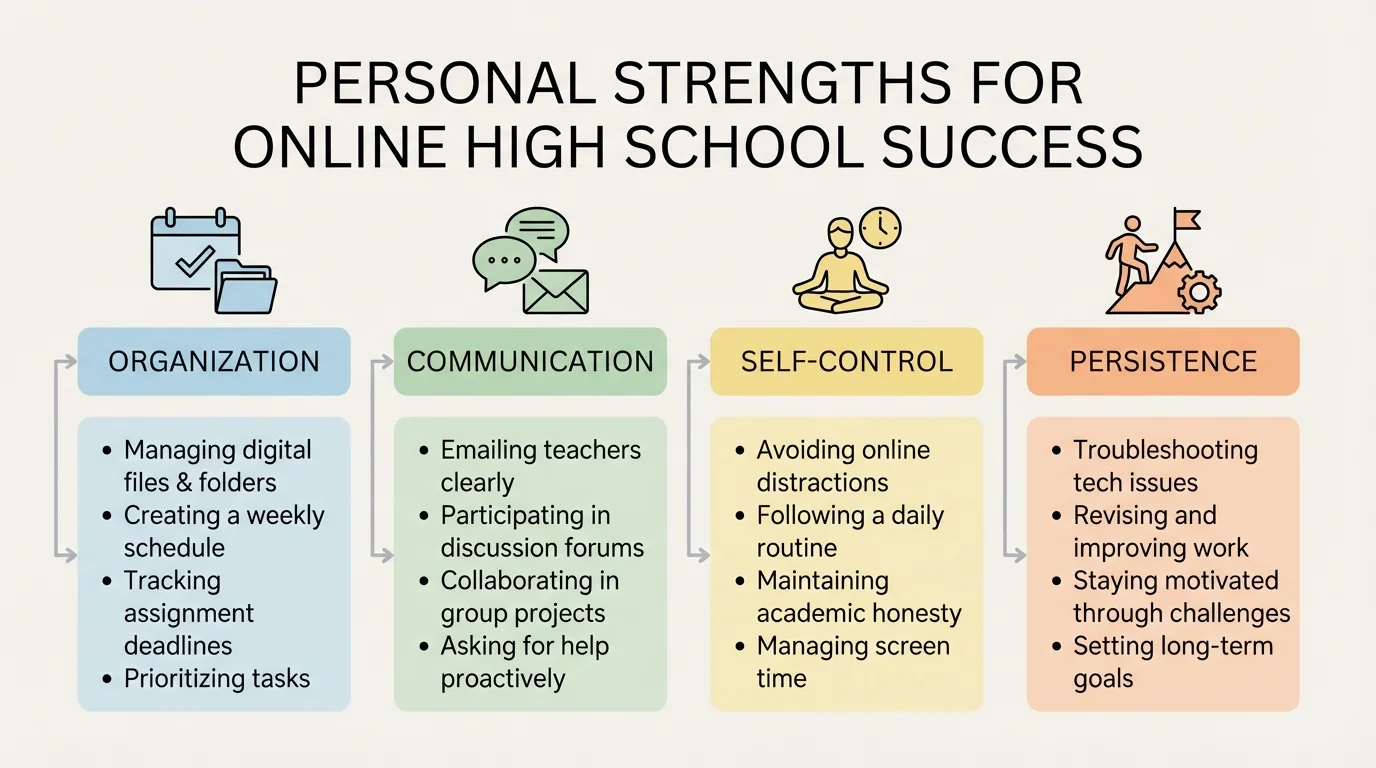
A third category is emotional regulation. This means managing your feelings in ways that help you make good decisions. It does not mean never feeling upset. It means noticing your emotions and responding in a controlled way instead of letting frustration, anxiety, or anger take over your choices.
A fourth category is adaptability. This is the ability to adjust when plans change, technology fails, or life gets messy. Online learning often requires this. If your internet cuts out, your home is noisy, or your weekly schedule suddenly shifts, adaptability helps you recover instead of shutting down.
There are also character-based strengths such as honesty, responsibility, initiative, patience, kindness, and reliability. These may seem simple, but they strongly affect school success. A reliable student is easier to trust. A patient student is more likely to work through confusion. A student with initiative solves small problems before they become major ones.
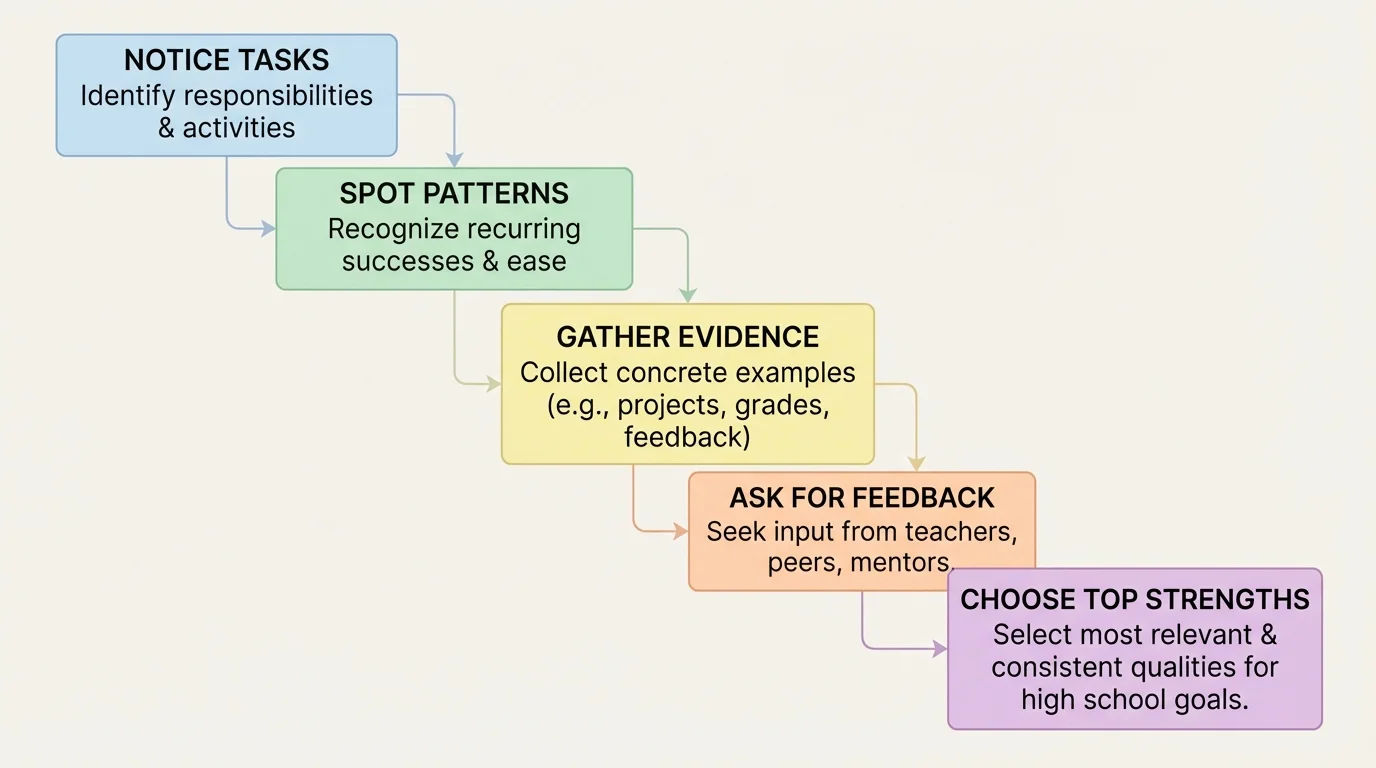
You do not need a complicated test to assess your strengths. A clear process works better, and [Figure 2] illustrates that process step by step. The key is to use evidence, not guesses. Saying "I think I'm organized" is less helpful than noticing, "I have turned in the last eight assignments on time and I keep one folder for every class."
Step 1: Look at your actual responsibilities. Write down the tasks you regularly need to manage: weekly assignments, responding to messages, keeping a schedule, helping at home, or attending activities.
Step 2: Notice what goes well. Ask yourself, "Which tasks feel easier for me than they do for some other people?" and "What positive patterns keep showing up?"
Step 3: Find evidence. Look for proof in your behavior: finished work, consistent routines, strong relationships, calm responses, or positive feedback.
Step 4: Ask trusted people. A parent, guardian, mentor, coach, or teacher may notice strengths you ignore because they feel normal to you.
Step 5: Choose your top strengths. Pick the ones that show up repeatedly and truly help you meet responsibilities.
Example: Honest strength assessment
A ninth-grade student wants to figure out what supports success in online classes.
Step 1: The student lists responsibilities: logging in daily, tracking due dates, responding to teacher messages, and avoiding phone distractions.
Step 2: The student notices two patterns: assignments are almost always turned in on time, and messages to teachers are polite and clear.
Step 3: The evidence suggests strengths in organization and communication. The student also notices that stress sometimes causes procrastination, so "time management" is not as strong as first assumed.
Step 4: A parent adds that the student stays calm when plans change, which points to adaptability.
The student's strongest supports are organization, clear communication, and adaptability.
Notice what makes this assessment useful: it is specific. It does not rely on vague labels like "good student." It connects strengths to real behavior. That makes the results much easier to use.
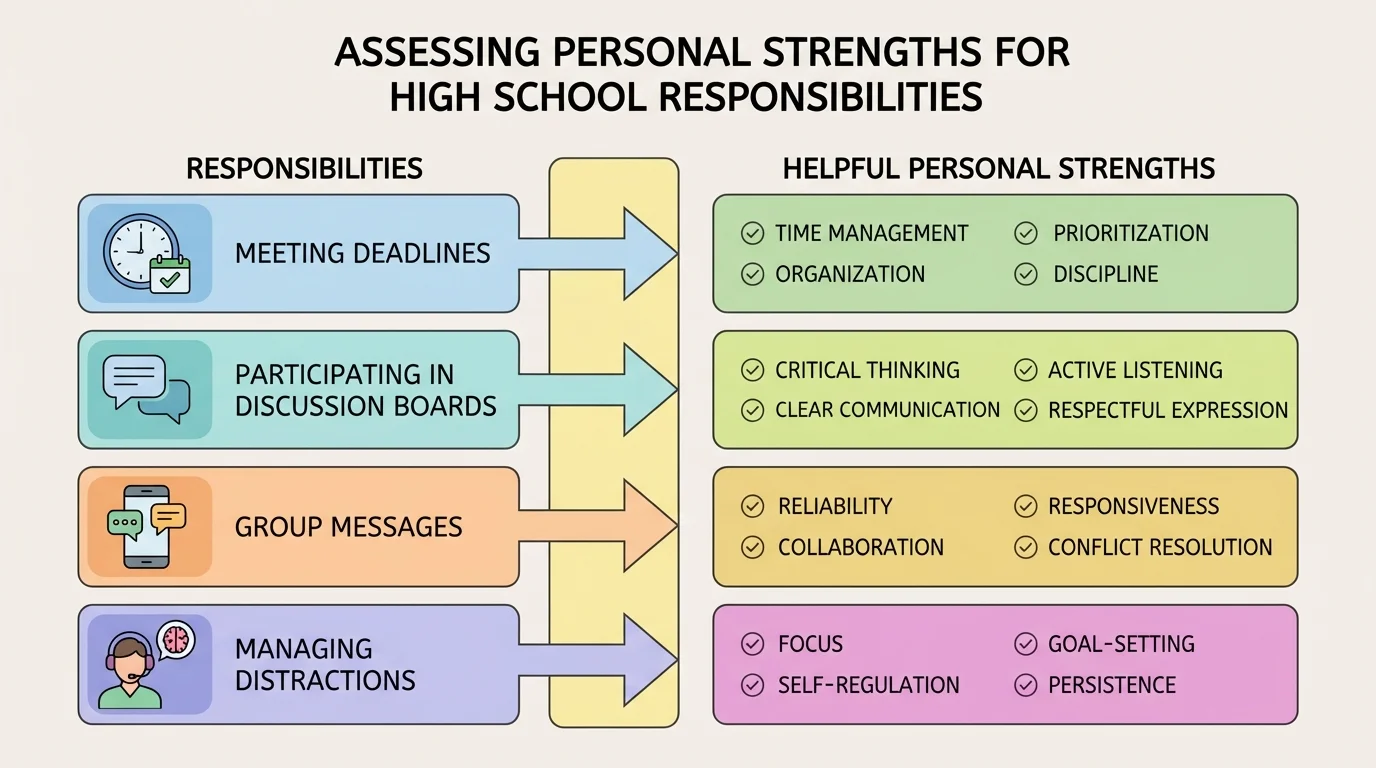
After you identify your strengths, the next step is matching them to the tasks that matter most. One responsibility can be supported by more than one strength, as [Figure 3] shows. For example, meeting deadlines may require organization, persistence, and self-control. Asking for help may require self-awareness, communication, and confidence.
This matters because students often try to fix everything with the wrong strategy. If your challenge is forgetting deadlines, motivation speeches will not solve it. A strength in planning might. If your challenge is misunderstanding online instructions, better communication might help more than simply spending extra time.
| Strength | Responsibility it can support | Practical use |
|---|---|---|
| Organization | Managing assignments | Use folders, checklists, and a weekly plan |
| Persistence | Finishing hard work | Keep going after confusion or mistakes |
| Self-awareness | Managing energy and focus | Schedule hard tasks at your best time of day |
| Communication | Getting help and avoiding conflict | Write clear, respectful messages |
| Adaptability | Handling disruptions | Switch plans without giving up |
Table 2. Examples of matching personal strengths to common responsibilities.
If you look back at [Figure 1], you can see that strengths are not isolated traits. They connect directly to everyday responsibilities. That is why strength assessment is practical, not just personal reflection.
Even strengths need balance. A student who is highly independent may avoid asking for help too long. A student who is adaptable may become too casual about planning ahead. A student who is persistent may keep using a strategy that is not working instead of stepping back and changing course.
This is why honest assessment includes two questions: "What am I good at?" and "When does this strength stop helping?" The goal is not to become less strong. The goal is to use strengths wisely. A balanced strength is useful. An overused strength can create new problems.
Strength-based thinking means starting with what already works for you and using it intentionally. It does not mean ignoring weaknesses. It means your strengths become tools for improving weaker areas. For example, if you are a strong communicator but weak in organization, you might use your communication strength to ask an adult to help you build a planning routine.
This approach is more realistic than trying to transform your whole personality. You do not need to become a completely different person to succeed. You need to understand what supports you and then apply it more consistently.
Once you know your strengths, turn them into actions. A strength that stays in your head does not help much. A strength used on purpose can change your daily results.
First, choose one or two responsibilities that matter most right now. Maybe you need to improve turning in work on time or responding more professionally to messages.
Second, connect each responsibility to one of your strengths. If you are organized, use that to create a Sunday planning routine. If you are self-aware, notice the times when distractions are strongest and put your phone in another room during that period. If you are persistent, decide in advance that you will spend at least 15 minutes trying a difficult task before switching to something else.
Third, make the action visible. Write it down somewhere you will see it. Strengths work best when they are attached to routines, reminders, and clear expectations.
Fourth, review the results. After one week, ask: "Did this strength help? What changed? What still needs work?" This is where [Figure 2] becomes useful again, because assessing your strengths is not a one-time event. It is a cycle of noticing, testing, and adjusting.
Example: Turning a strength into a plan
A student knows one of their strongest traits is persistence, but they still struggle to begin large assignments.
Step 1: Identify the responsibility: starting assignments early.
Step 2: Connect the strength: persistence means the student usually keeps going once started.
Step 3: Create the plan: begin every major assignment with a 10-minute starter session on the day it is assigned.
Step 4: Review after one week: if the starter sessions happened consistently, persistence is now being used more effectively.
The student did not need a brand-new personality. The student needed a better way to use an existing strength.
Try This: At the end of today, write down one responsibility you handled well and the strength that helped you do it. Keep doing this for a week. Patterns will start to appear.
A student who is strong in communication may do well in online discussion boards because they can express disagreement respectfully. That same strength helps when writing a message such as, "I reviewed the directions, but I am still confused about part two. Could you clarify what the chart should include?" Clear communication saves time and prevents misunderstandings.
A student with strong emotional regulation may still feel stressed before a deadline, but instead of panicking, they pause, list the next three tasks, and start with the smallest one. This does not remove the stress instantly, but it keeps stress from taking control.
A student with adaptability may have a day where the house is noisy, a device update interrupts work, and a planned study time disappears. Instead of deciding the day is ruined, the student shifts to a quieter corner, changes the task order, and keeps going. That is a powerful school strength and a life strength too.
Many strengths feel ordinary to the person who has them. Because they feel normal, students sometimes overlook their best advantages. The things you do consistently and almost automatically may be exactly what supports your success.
As [Figure 3] makes clear, the smartest move is not trying to use every strength for every problem. It is matching the right strength to the right responsibility.
Your strengths are not fixed forever. They can get stronger with practice, experience, and reflection. A student who is somewhat organized in ninth grade can become highly organized by building routines. A student who feels awkward in communication can become much stronger by practicing respectful, clear messages regularly.
This should also take pressure off you. Assessing your strengths is not a test you pass or fail. It is a way to understand your starting point. Once you know what supports you now, you can build from there.
It is also okay if your strengths change depending on the situation. You might be confident in one subject and unsure in another. You might be calm at home but nervous in group video calls. Honest self-assessment pays attention to context. It asks not only, "What are my strengths?" but also, "When do they show up most clearly?"
"You do not have to be good at everything to be successful. You do have to know how to use what is already strong in you."
The more clearly you can answer those questions, the more control you gain over your habits, decisions, and results. That is one of the most useful forms of growth in high school: learning how to understand yourself well enough to act with purpose.
