Have you ever tried to do something and it did not work the first time? Maybe a block tower fell down, a shoe would not tie, or a drawing did not look the way you wanted. That does not mean you cannot do it. It means you are learning. When you keep trying, your work can get better little by little.
Effort is the energy you put into something. It is using your hands, your body, your mind, or your time to keep working. Progress means getting a little better or a little closer to your goal.
Effort is trying, practicing, and not giving up right away.
Progress is moving forward, even in small ways.
Goal is something you want to do or learn.
Sometimes progress is easy to see. Your picture has more details. You spill less water when pouring. You remember more words in a song. Sometimes progress is small and quiet, but it still counts.
Big growth often comes from small tries. As [Figure 1] shows, one practice time may not look perfect, but each try helps you learn what to do next. A tower may fall at first, then stand a little taller, then stand tall.
You do not have to do everything all at once. You can take one small step, then another small step. Over time, those steps add up. If you practice putting on your coat every day, it can feel easier after many days.
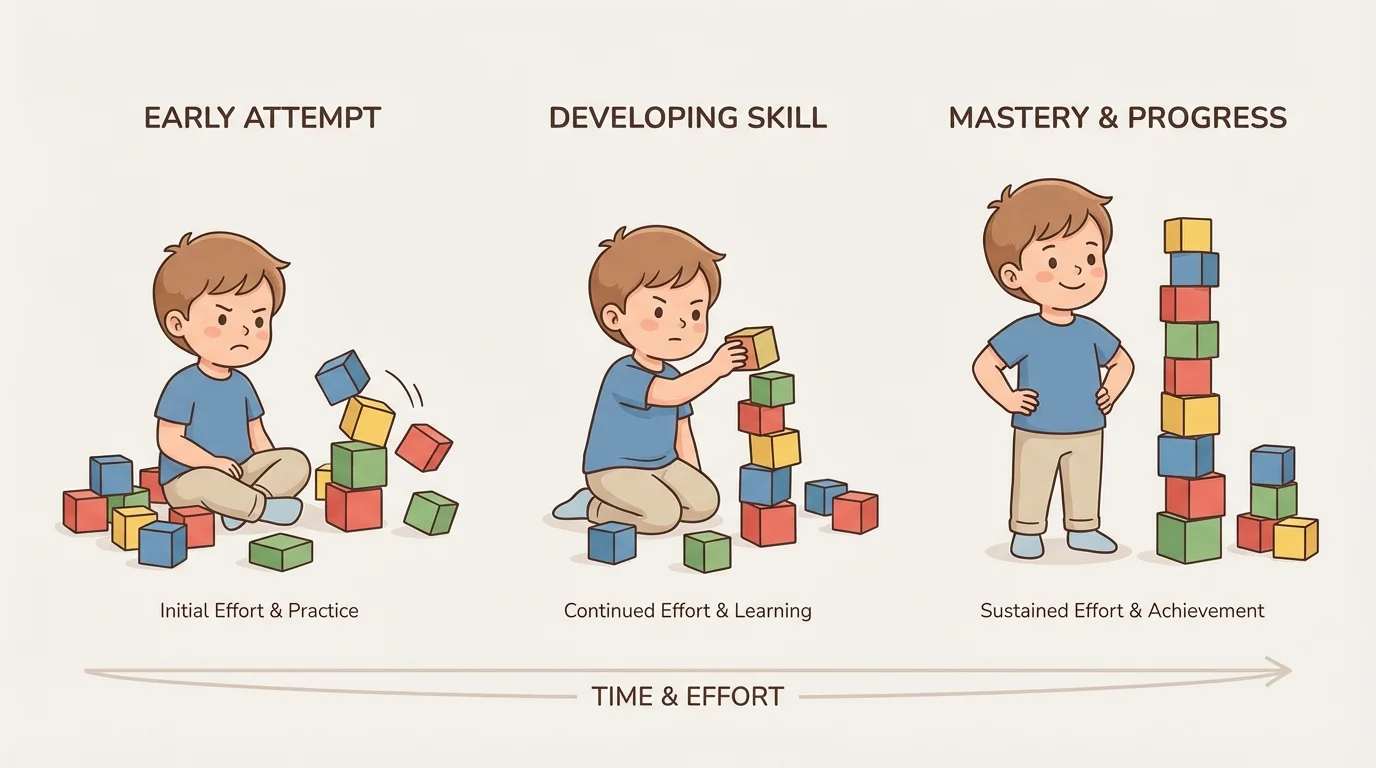
This is how many skills grow. You learn to hold a spoon, zip a jacket, wash your hands well, speak clearly on a video call, and put away your things by practicing again and again.
Your brain grows stronger when you practice. Each time you try, you help your brain learn what to do.
That is why effort matters. If you stop after one hard moment, you miss the chance to grow. If you keep going, you give yourself a chance to improve.
Effort is not only for big jobs. In everyday life, effort can be seen in many small actions, and [Figure 2] illustrates some of them. You show effort when you listen during online learning, clean up your toys, try to button your shirt, or say kind words when talking to someone.
You also show effort when you wait your turn, help feed a pet, carry your plate to the sink, or keep coloring even when your hand gets tired. Effort means, "I am still trying."
Sometimes adults notice your effort before they notice the finished job. A bed may not be perfect, but if you tried to pull up the blanket, that matters. A drawing may not look exactly right, but if you stayed with it and added more, that matters too.
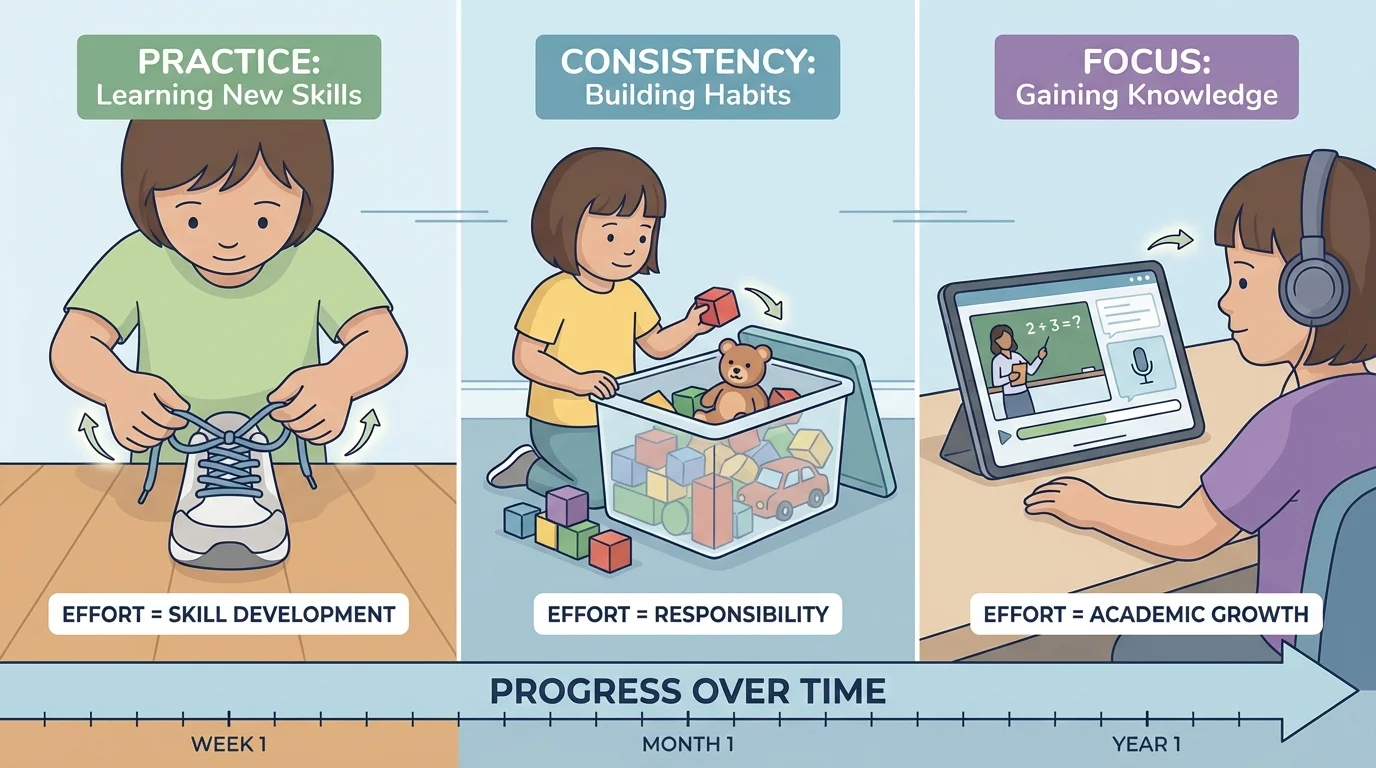
When people keep trying, they often become more independent. That means they can do more things by themselves. This helps at home, in the community, and later in life. These daily efforts build habits that make many tasks easier.
Sometimes effort does not feel fun. You might feel upset, tired, or frustrated. That is normal. Hard things can make your body feel tight or your eyes feel teary. The important part is what you do next.
Trying again after a mistake helps learning happen. A mistake is not the end. A mistake can teach you what to change on your next try.
Here are some helpful steps. Step 1: Stop and take a calm breath. Step 2: Say, "I can try again." Step 3: Ask for help if you need it. Step 4: Try one small part, not the whole thing at once.
For example, if a puzzle feels hard, start with one piece. If putting on socks feels tricky, try just opening the sock wide first. If speaking on a video call feels shy, try saying one short hello.
People make more progress when they keep going after small mistakes. Earlier, [Figure 1] showed that even a fallen tower can become a taller one after more attempts.
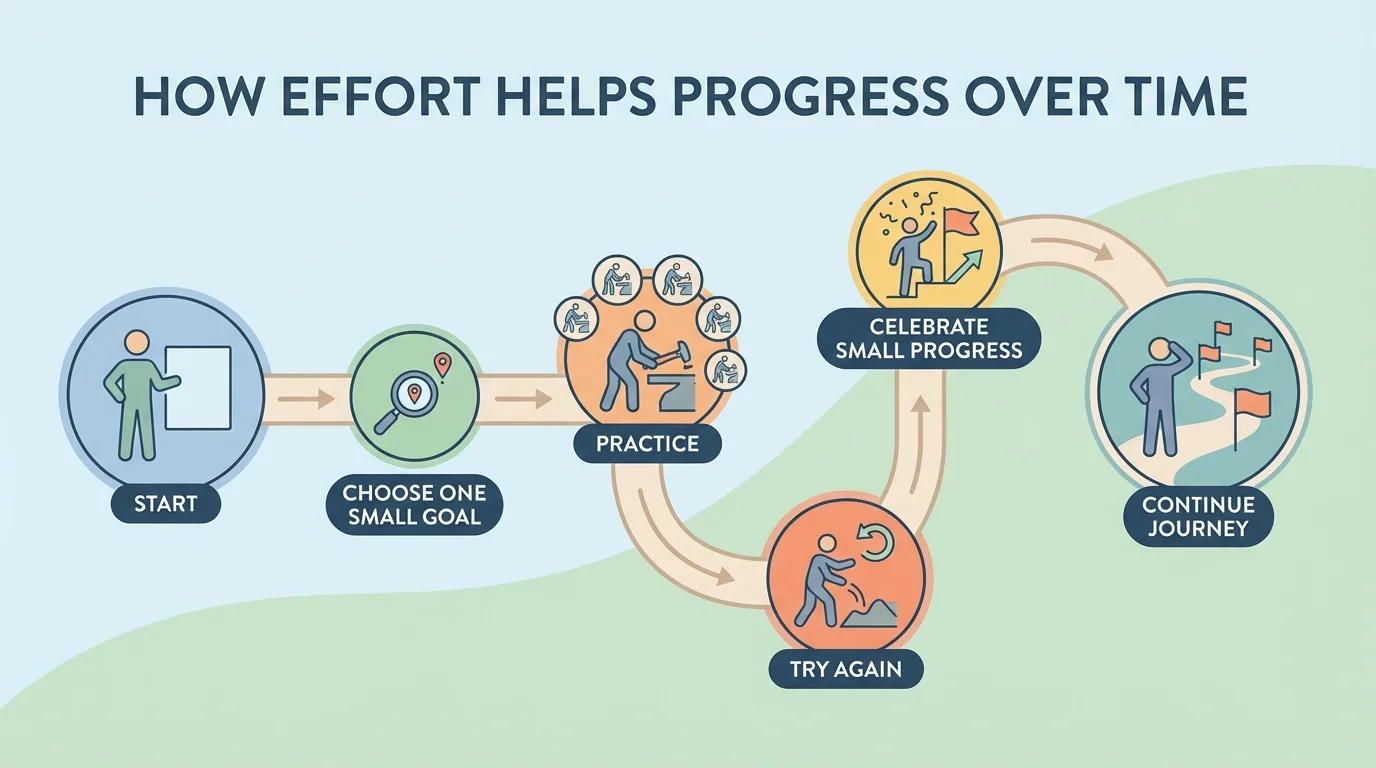
A goal can be very small. In fact, tiny goals are great for young learners. As [Figure 3] shows, a good path is to choose one small goal, practice, try again, and notice your progress.
A tiny goal might be: put one toy away after playtime, wash hands with soap, say "please," or sit ready for online learning. One goal is enough. You do not need many goals at once.
Example: a tiny goal at home
Step 1: Pick one small job.
The child chooses, "I will put my crayons back in the box."
Step 2: Practice every day.
After drawing, the child puts the crayons away.
Step 3: Keep trying if it is forgotten once.
An adult gives a reminder, and the child tries again.
Step 4: Notice growth.
After many days, the child remembers more often.
This is progress. The child is building a helpful habit.
You can say, "I am learning." That is a strong sentence. It reminds you that growth takes time.
You do not have to do everything alone. Family members, caregivers, coaches, neighbors, and other trusted adults can help you. They may show you a step, cheer for you, or remind you to keep going.
When someone helps you, your effort still matters. Help is not doing it all for you. Help can give you support while you practice. Then you keep building the skill yourself.
"Little by little, a little becomes a lot."
It is also kind to notice other people's efforts. If your brother keeps practicing a song, or a friend keeps trying to ride a scooter, you can say, "Good trying." Communities grow stronger when people encourage one another.
What you do today can help tomorrow feel easier. If you practice putting dishes in the sink now, helping at home may become easier later. If you practice listening and following directions now, future tasks may feel smoother.
Effort helps with future planning because small actions today build skills for later. You may not be able to see all of the future yet, but your trying is helping you get ready for it. The simple path in [Figure 3] shows how one tiny goal can lead to growth over time.
Try This: Pick one small thing to practice this week. Keep it tiny. Keep it kind. Keep trying, even if it is not perfect.
