Have you ever wondered how coins and bills get into a wallet? Money does not just appear. People get money in different ways. Some money is earned by doing work. Some money is received as a gift or from family. Learning about money helps us make good choices with it.
When we understand where money comes from, we can also learn what to do with it. We can spend some, save some, and share some. These are important money habits to start when you are young.
Earn means to get money for doing work. Receive means to get money from someone, such as a gift. Save means to keep money for later. Share means to give some to help others.
Adults often earn money by working at jobs. A teacher, firefighter, farmer, nurse, or bus driver works and then gets paid. That pay is money earned for the job. Children usually do not have full-time jobs, but they can still learn that work and money are connected.
Sometimes children receive money in other ways. A grandparent may give a child birthday money. A family member may give a small allowance. A child may also receive money as a prize or a gift. This shows that not all money is earned through work, but it should still be used carefully.
Money can come in different forms, like coins, bills, or even numbers in a bank account, but it still helps people buy things, save for later, and help others.
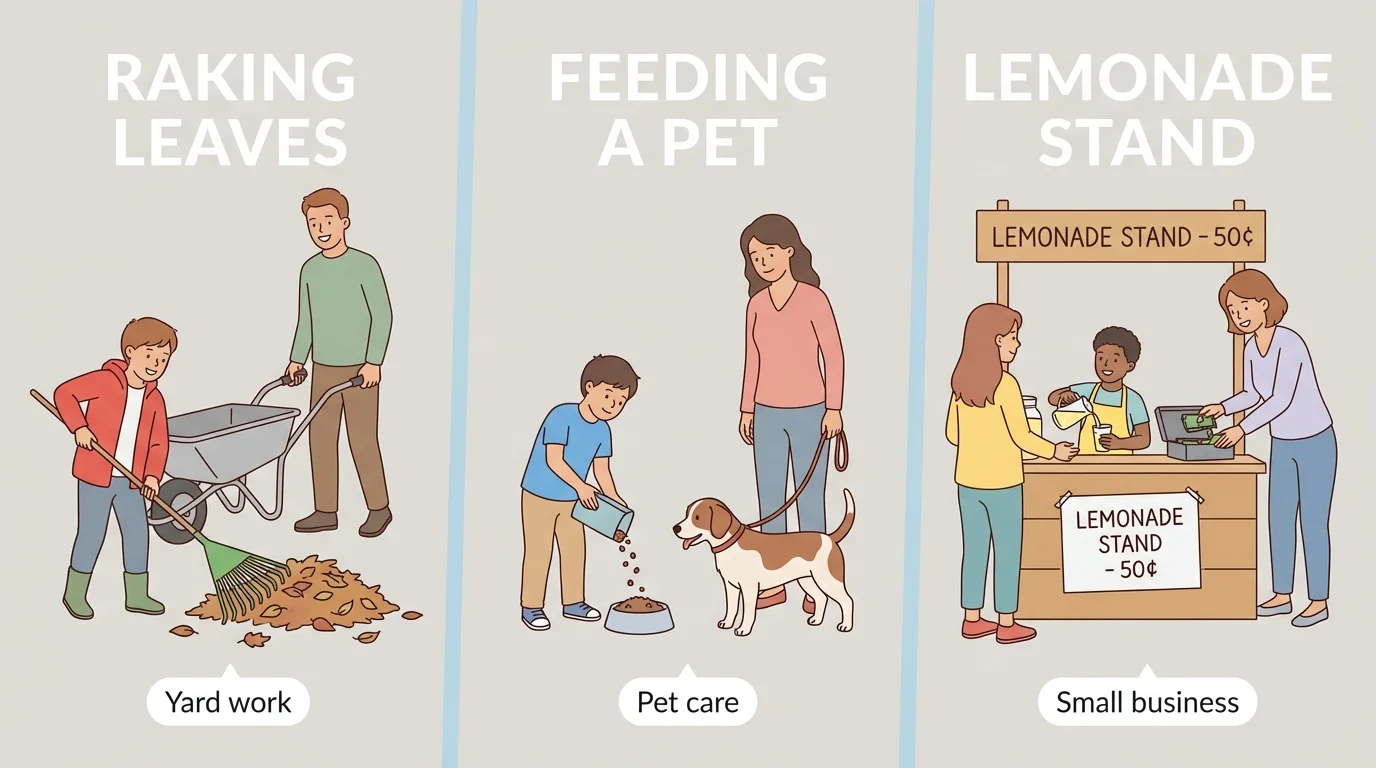
Earning money means doing work and getting paid for it. For children, this may happen in small, safe ways, as [Figure 1] shows. A child might help wash a car, rake leaves, or help at a lemonade stand with an adult. Some families also choose to pay children for extra chores. Extra chores are jobs beyond what a child is already expected to do at home.
For example, a child may help pick up sticks in the yard and receive $2. Another child may help sort cans for recycling and receive $1. If a child earns $2 one day and $1 another day, the total is \(2 + 1 = 3\). The child has $3.
It is important to remember that families make different choices. In one home, a child may get paid for extra jobs. In another home, chores may be done because everyone helps the family. Both can teach responsibility.
People should earn money in honest ways. That means telling the truth, doing the job they promised to do, and being fair. If someone says, "I will water the plants," then they should really water the plants. Honest work helps people trust each other.
Earning and effort means that money often comes after someone spends time and energy doing a task. This helps children see that money is valuable and should not be wasted.
Sometimes money is not earned. A child may receive money as a birthday gift, a holiday gift, or from the tooth fairy in a story tradition some families enjoy. A child may also receive an allowance each week. An allowance is money given regularly, often to help a child practice making choices.
Receiving money as a gift is different from earning it. If an aunt gives a child $5 for a birthday, the child did not work for that money. The child received it. If a child earns $4 for helping wash a car, that money was earned.
Both earned money and received money should be treated with care. It is wise to count it, keep it in a safe place, and ask a trusted adult for help when making a choice about it.
Money is used to buy goods and services. Goods are things you can touch, like a book or a ball. Services are jobs people do, like cutting hair or fixing a sink.
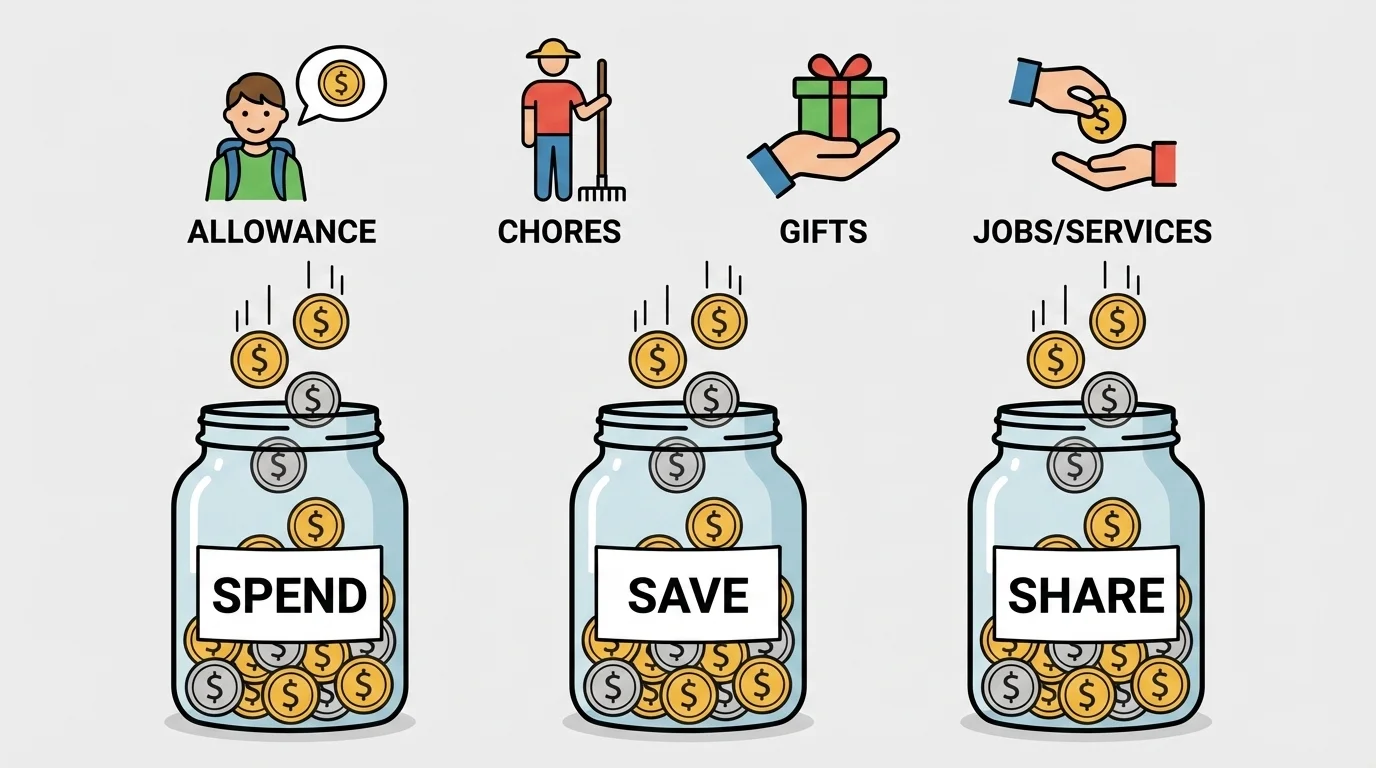
After getting money, people make choices. One helpful way to plan money is to think about saving, spending, and sharing. Some children use jars or envelopes for these choices. This helps them see where their money is going.
A need is something important, like food, clothes, or a place to live. A want is something you would like to have, like a toy or a game. Adults often use money first for needs. Children can practice thinking carefully before spending on wants.
If a child has $6 and wants a toy that costs $8, the child does not have enough yet. We can compare the amounts with \(6 < 8\). The child may choose to save more money first.
Sharing money can mean giving some to help other people or animals. A child might put a little money in a class fundraiser jar or donate to an animal shelter. Sharing shows kindness.
Example: Sorting money into choices
A child receives $9 and wants to use some for different purposes.
Step 1: Put $4 in spend.
The spend amount is $4.
Step 2: Put $3 in save.
The save amount is $3.
Step 3: Put $2 in share.
The share amount is $2.
The total is \(4 + 3 + 2 = 9\). All $9 has been planned.
[Figure 3] Wise money choices take practice. Saving for a goal is one smart idea, and this illustration shows how money can grow over time as more coins are added. A goal might be a book, a puzzle, or a small toy. When children save, they learn patience.
Suppose a child wants to buy a ball for $10. The child already has $4. How much more is needed? We can find the difference with \(10 - 4 = 6\). The child needs $6 more.
Example: Saving a little at a time
A child saves $2 each week for a toy that costs $8.
Step 1: After the first week, the child has $2.
Step 2: After the second week, the child has \(2 + 2 = 4\).
Step 3: After the third week, the child has \(4 + 2 = 6\).
Step 4: After the fourth week, the child has \(6 + 2 = 8\).
After 4 weeks, the child has enough money because \(8 = 8\).
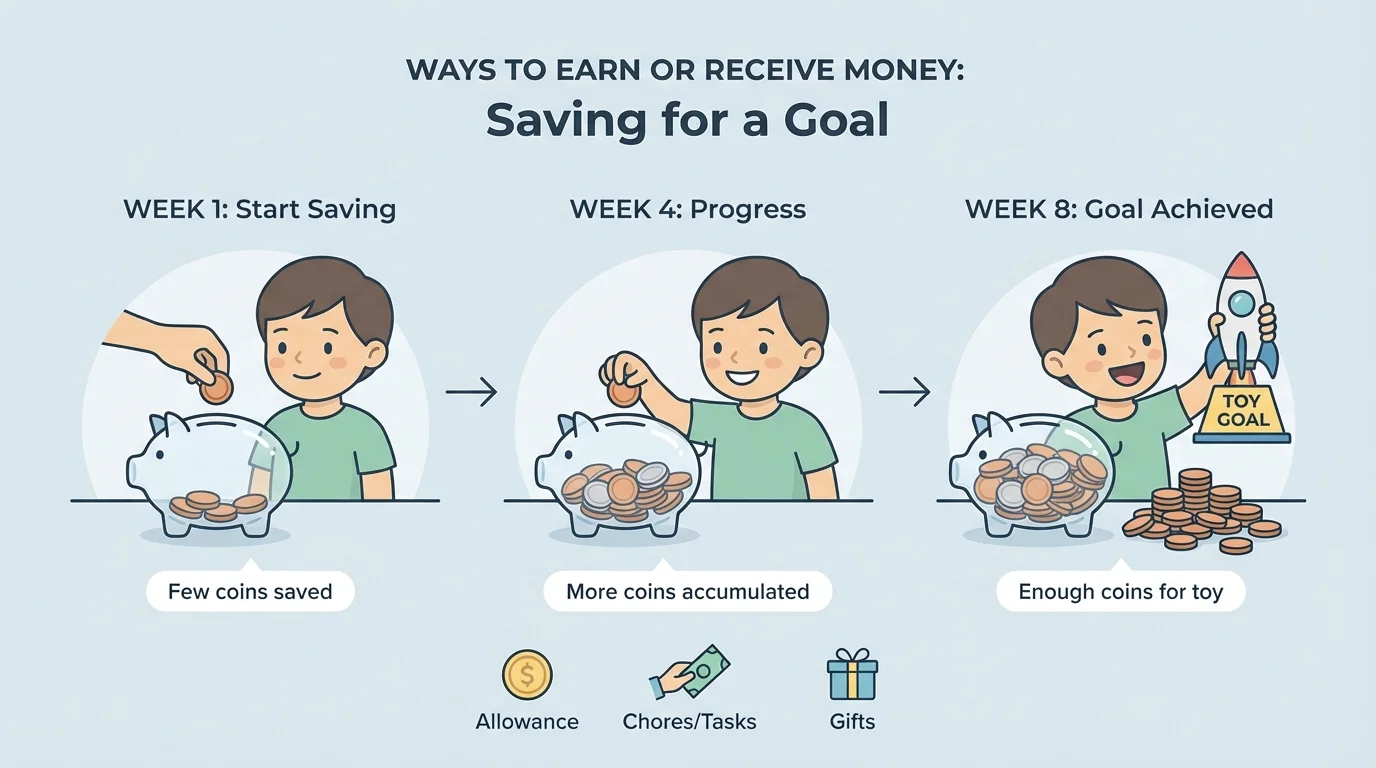
Spending wisely means thinking before buying. A child may ask, "Do I want this now, or do I want to save for something bigger later?" That question helps with self-control. This illustration reminds us that small amounts can add up.
It is also helpful to compare choices. If one snack costs $2 and another snack costs $3, the $2 snack costs less because \(2 < 3\). Sometimes choosing the lower price helps money last longer.
"Save a little now, and you can do more later."
Money should be kept in a safe place, like a piggy bank, wallet, or special box. Some families may keep a child's money in a bank account. A bank is a place where money can be stored safely.
Children should ask a trusted adult before spending money online, carrying a lot of money, or giving money away. Safety matters. So does honesty. We should never take money that is not ours. We should return lost money to a teacher or adult who can help find the owner.
When children understand how money is earned or received, they can make better choices. They learn that money is useful, but it should be handled with care, fairness, and thoughtfulness. Just as we saw with work in [Figure 1], effort often comes before earning, and planning helps money do good things.
