Have you ever seen someone pay in different ways at a store? One person may use coins. Another may hand over paper money. Someone else may tap a card. All of these can help people buy the things they need. Learning about money helps us make smart choices every day.
Currency is the money people use to buy goods and services. Goods are things we can hold, like apples or crayons. Services are things people do, like cutting hair or delivering mail. Currency helps us trade in a simple way instead of bartering.
Currency means money used to pay for things. It usually includes coins and bills.
People use currency at grocery stores, restaurants, book fairs, and many other places. A family might use money to buy bread, milk, shoes, or a bus ticket. When we learn what kinds of currency exist, we can better understand how people pay.
There are different kinds of money, as [Figure 1] shows. One kind is cash. Cash means money you can hold in your hand. Cash includes paper bills and coins.
Coins are small, round pieces of money made of metal. Bills are paper money. A person might use a few coins to buy a small item, like a pencil. A person might use a bill to pay for a sandwich or a book.
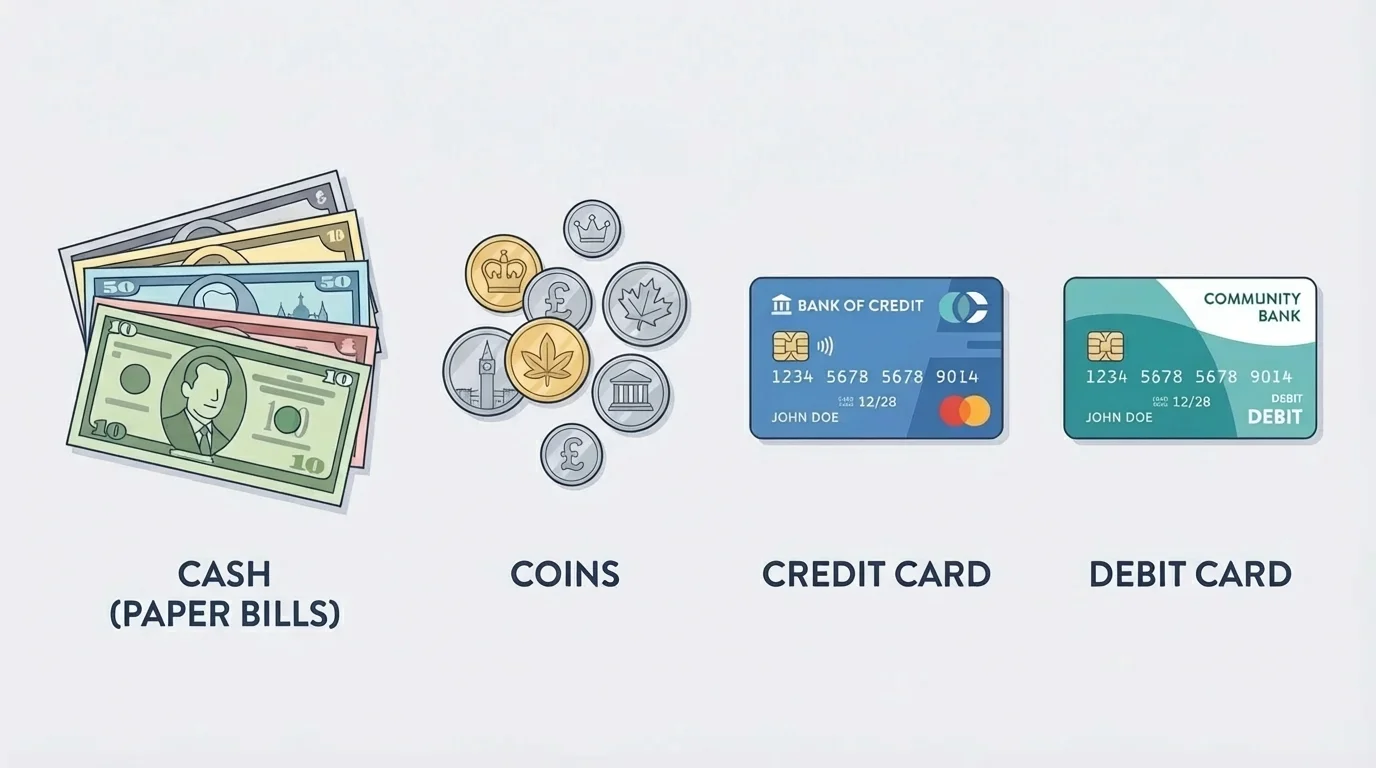
Another common way to pay is with a credit card. A credit card is a card used to pay now and pay the money back later. Adults usually use credit cards. This is why children should always ask an adult before using one.
A debit card is also used to pay for things. A debit card uses money from a bank account. That means the money needs to already be there. If there is not enough money in the account, the card may not work for the purchase.
Cash and cards do the same job: they help people pay. But they do not all work the same way. Looking back at [Figure 1], you can compare money you can hold directly with cards that use money from an account or let someone pay and repay later. Coins and bills are easy to see and count. Cards are small and quick to use.
| Type | What it is | Example use |
|---|---|---|
| Coins | Metal money | Buying a small snack |
| Bills | Paper money | Paying for a book |
| Credit card | Card used to pay now and pay later | An adult buys groceries |
| Debit card | Card that uses money already in a bank account | An adult pays for gas |
Table 1. A comparison of common forms of money and payment methods and how each one is used.
People use currency to buy what they need and want. A need is something important, like food or clothes. A want is something nice to have, like a sticker book or a game. Before buying, people often think about the cost and choose how to pay.
At a store, a person may count coins, hand over cash, swipe a card, insert a card, or tap a card. The store worker or machine checks the payment. Then the person gets the item. Currency helps this happen in a fair and organized way.
Different ways to pay
Coins and bills are forms of cash that a person gives directly. A debit card takes money from a bank account. A credit card lets a person borrow money to pay and then pay it back later. Even though these ways look different, each one can be used to buy something.
Sometimes people get change back when they use cash. For example, if a toy costs $4 and an adult pays with $5, the change is $1. In math, that is written as \(5 - 4 = 1\). Change helps return the extra amount.
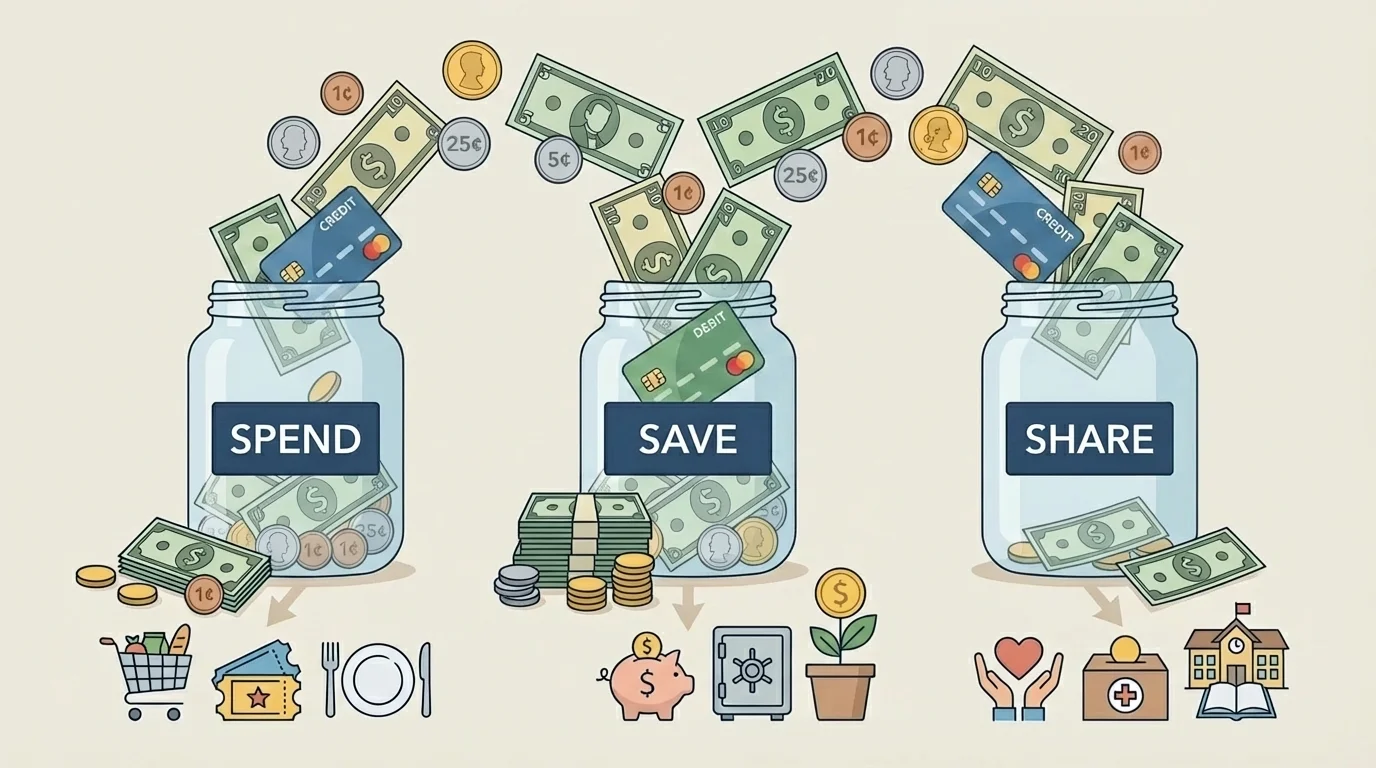
Money can be used in three important ways: we can spend it, save it, or share it. To save money means to keep it for later. To spend money means to use it now to buy something. To share money means to give some to help others.
A child might spend $2 on a small treat, save $3 for a toy, and share $1 by giving to a charity jar. That plan uses the same total amount of money. In math, we can show it as \(2 + 3 + 1 = 6\). As [Figure 2] shows, planning helps people use money carefully.
Saving can help with bigger goals. If you want a book that costs $8 and you already have $5, you need $3 more. We can write that as \(8 - 5 = 3\). When people save little by little, they can buy something later without spending all their money at once.
Some families use jars or envelopes to sort money for spending, saving, and sharing. This makes it easier to see where the money goes.
Sharing money is one way to help others. A family may give money to a food bank, a school fundraiser, or someone in need. Spending, saving, and sharing are all good choices, and smart planning helps balance them. The three jars in [Figure 2] make that idea easy to see.
Money is important, so people try to keep it safe. Coins and bills can be kept in a wallet, purse, or piggy bank. Cards should also be kept in a safe place. Children should only use a card with permission from a trusted adult.
Being smart with money also means checking before buying. Do we have enough money? Is this something we need now, or can we save for later? These questions help people make careful choices instead of rushing.
Remember: When you count money, each coin or bill has a value. Knowing that money has value helps you decide how much to spend and how much to keep.
Debit cards and credit cards may look alike, but they are different. A debit card uses money already in an account. A credit card means paying later. That is why adults need to understand how much they are spending.
Here are some ways currency is used in daily life. At a bake sale, a student might bring coins to buy a cookie. At a grocery store, a parent may pay with cash for fruit. At a gas station, an adult may use a debit card. At a restaurant, an adult may use a credit card to pay the bill.
Example 1: Paying with coins
Lia buys an eraser for $1. She gives $1 in coins. She uses currency to pay for an item.
Each type of payment helps people get what they need, but the way it works can differ. Cash is easy to see. Coins are good for small amounts. Debit cards use money that is already there. Credit cards are paid back later.
Example 2: Saving for later
Ben has $2 today and wants a puzzle that costs $5. He needs $3 more because \(5 - 2 = 3\). He can save his money until he has enough.
When people plan before they buy, they can make better choices. They can decide what to spend now, what to save, and what to share. Knowing the kinds of currency helps us understand the many ways money is used in the world around us.
