You probably use state government services more often than you realize. When you ride on a big highway, learn in a public school, visit a state park, or hear about firefighters getting help during a wildfire, the Colorado state government is involved. State government is not something far away and mysterious. It helps make many parts of everyday life work.
People in Colorado need roads, schools, safety, and help in emergencies. A city government cannot do every job for the whole state, and the national government does not handle everything close to home. That is where state government comes in. It works in the middle, serving everyone in Colorado and taking care of needs that affect the whole state.
Colorado is a large state with mountains, plains, cities, farms, rivers, forests, and small towns. Different places may need different kinds of help, but all of them depend on state government in some way. A snowy mountain road, a school in Denver, and a state park near a river may seem very different, yet they are all connected to state services.
State government is the government that serves all the people in one state, such as Colorado.
Service is something the government provides to help people and communities.
Funding is the money used to pay for government services.
Budget is a plan for how money will be collected and spent.
State government has important jobs, but it also has limits. It cannot spend money on everything people want. Leaders must decide what is most important, how much money is available, and how to share that money fairly across the state.
Colorado's state government is part of the American system of government. It has laws, leaders, and agencies that work for the people of the state. It stands between local governments, such as cities and counties, and the national government in Washington, D.C.
Some jobs belong mostly to local governments, such as running a town library or collecting neighborhood trash. Some jobs belong mostly to the national government, such as printing money or running the military. State government handles jobs that are too big for one town but still need close attention inside the state, such as state highways, state courts, and rules for public schools.
In Colorado, the state government is based in Denver at the Capitol. Leaders there make laws, carry out laws, and make sure laws are followed fairly. Even though many state workers are not famous, they help communities every day.
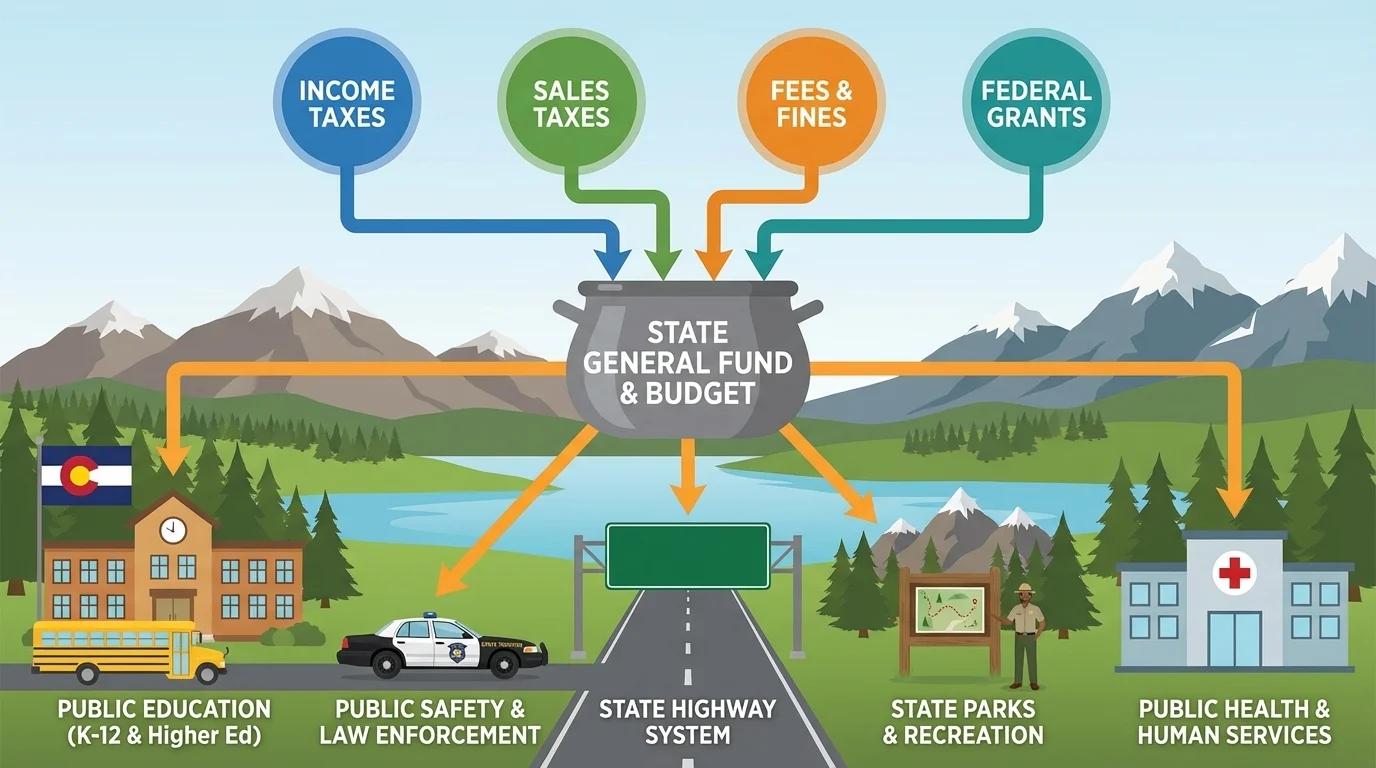
State government supports many parts of daily life, as [Figure 1] shows. Some services are easy to notice, like highways and state parks. Others are less visible, such as making sure hospitals follow safety rules or helping communities after a natural disaster.
One major service is public education. Colorado helps fund public schools, sets learning rules, and supports school programs across the state. Local school districts run many daily school activities, but the state helps make sure students in different communities have educational support.
Another major service is transportation. The state helps build and care for highways, bridges, and important roads that connect places across Colorado. If families drive from one city to another, or trucks carry food and supplies across the state, they often travel on roads supported by the state.
State government also works to protect public safety. This includes agencies such as the Colorado State Patrol, state investigators, and other workers who help enforce laws and respond to dangerous situations. Public safety can include traffic safety, criminal investigations, and emergency response.
Health services are another part of state government's work. The state helps with programs that support children, families, older adults, and people with disabilities. It also helps oversee some health rules and works with local communities during health emergencies.
Colorado's beautiful land is another reason state government matters. The state takes care of state parks, protects natural resources, and helps manage forests, wildlife, and water. When people hike, camp, fish, or enjoy outdoor spaces, they may be using services paid for and managed by the state.
State government also helps during emergencies. In Colorado, this can include major snowstorms, floods, wildfires, and other disasters. The state can send workers, equipment, and money to help communities recover. The scene in [Figure 1] connects these different services because roads, safety workers, schools, parks, and health support are all part of the state's job.
Colorado has many state parks, and they give people places to camp, hike, boat, and learn about nature. Keeping parks open and safe takes workers, equipment, and money.
These services matter because they help people live, learn, travel, and stay safe. Without them, daily life would be harder and less fair. A child in one part of the state should still have access to schools and safe roads, even if that community is far from a large city.
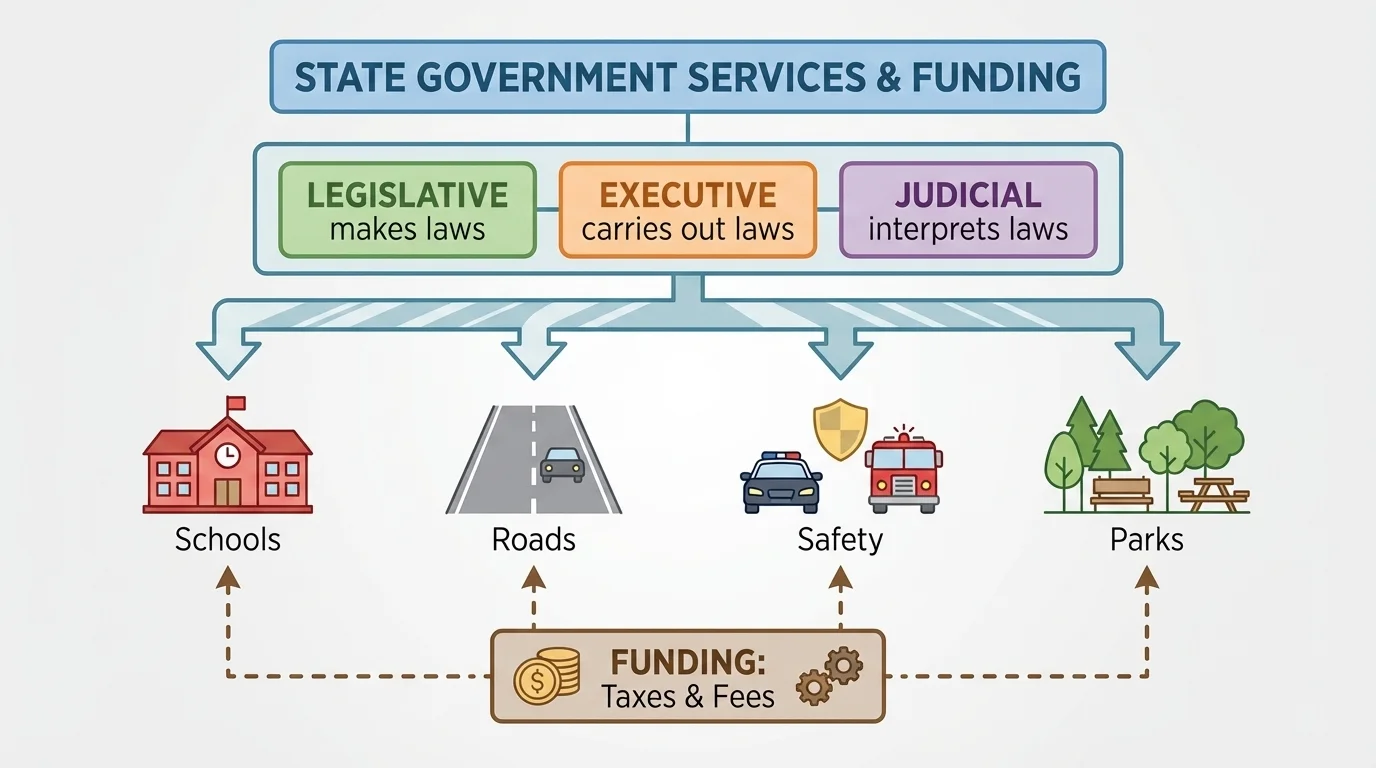
Providing services takes teamwork among the three branches of state government, as [Figure 2] illustrates. Each branch has a different job, but all three help the state serve people.
The legislature is the lawmaking branch. In Colorado, lawmakers decide on laws and help decide how state money should be spent. If the state needs rules for schools, roads, or safety, the legislature plays a big part in creating them.
The executive branch carries out the laws. The governor leads this branch, and many state departments and agencies are part of it. These agencies do the day-to-day work of providing services. For example, one department may handle transportation, while another focuses on education or health.
The judicial branch interprets the laws. Courts help make sure laws are applied fairly. They can settle disagreements and decide what laws mean. This matters because services must follow the law, and citizens' rights must be protected.
Think of the branches as a team with different roles. One branch writes the rules, another branch does the work, and another branch checks legal questions. When these branches work well together, state services can run more smoothly.
For example, if Colorado wants to improve a highway, lawmakers may approve money, executive agencies may plan and repair the road, and courts may step in if there is a legal dispute. This example shows how the branches work together in a simple way.
Services cost money, and that money comes from several sources, as [Figure 3] shows. The state cannot simply wish roads into repair or parks into existence. Workers must be paid, buildings must be maintained, and supplies must be purchased.
One important source of money is taxes. A tax is money people and businesses pay to the government so it can provide services. Colorado collects different kinds of taxes. For example, people may pay state income tax, and shoppers may pay sales tax on many items they buy. That money helps support state services.
Another source is fees. A fee is a payment for a specific service or activity. For example, when someone pays for a driver's license, a vehicle registration, or entry to a state park, that fee can help support the work connected to that service.
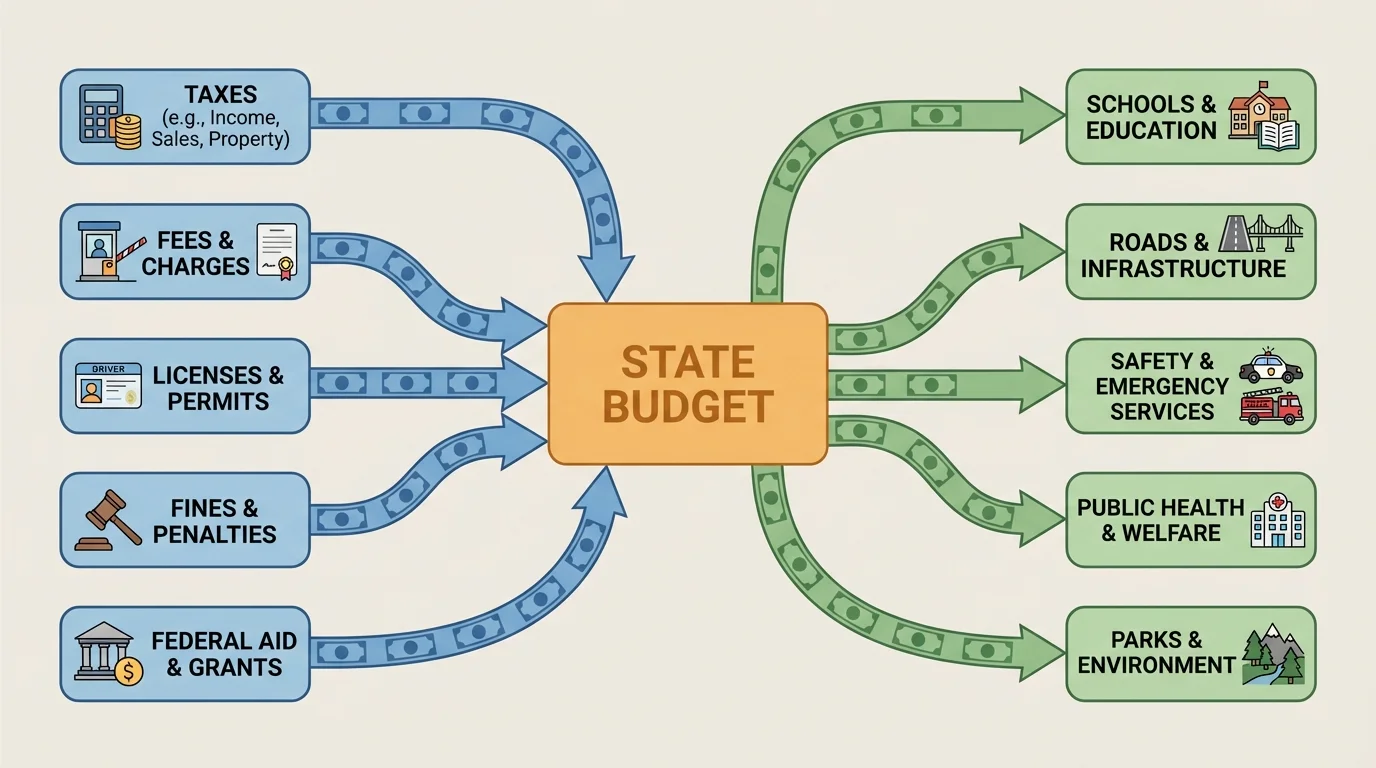
The state may also collect money from licenses and permits. Businesses and professionals often need permission from the state to do certain kinds of work. There can also be fines, which are payments required when someone breaks certain rules or laws.
Another source of funding is money from the national government. Sometimes the federal government sends money to states to help with transportation, education, health programs, or emergency aid. Colorado may use that money for special purposes, but the state still must make careful choices about how to spend it.
Where state money comes from
State government funding usually does not come from just one place. It is more like a collection of streams flowing into one river. Taxes, fees, licenses, fines, and federal aid all help fill the state budget. Then the state uses that budget to pay for services people need.
People do not always notice these funding sources, but they are part of everyday life. Buying something at a store, renewing a license, or visiting a state park can all connect to state funding. This flow helps show how money moves from different sources into services.
A budget is like a plan for money, and [Figure 4] shows how one budget can be divided among several needs. Families make choices about spending on food, housing, and transportation. In a similar way, state leaders must decide how much money goes to schools, roads, safety, health, and other services.
If the state collects a certain amount of money in a year, leaders cannot spend more than they have without causing problems. So they study needs carefully. They ask questions such as: Which roads are most important to repair? How much support do schools need? How much money should go to emergency services?
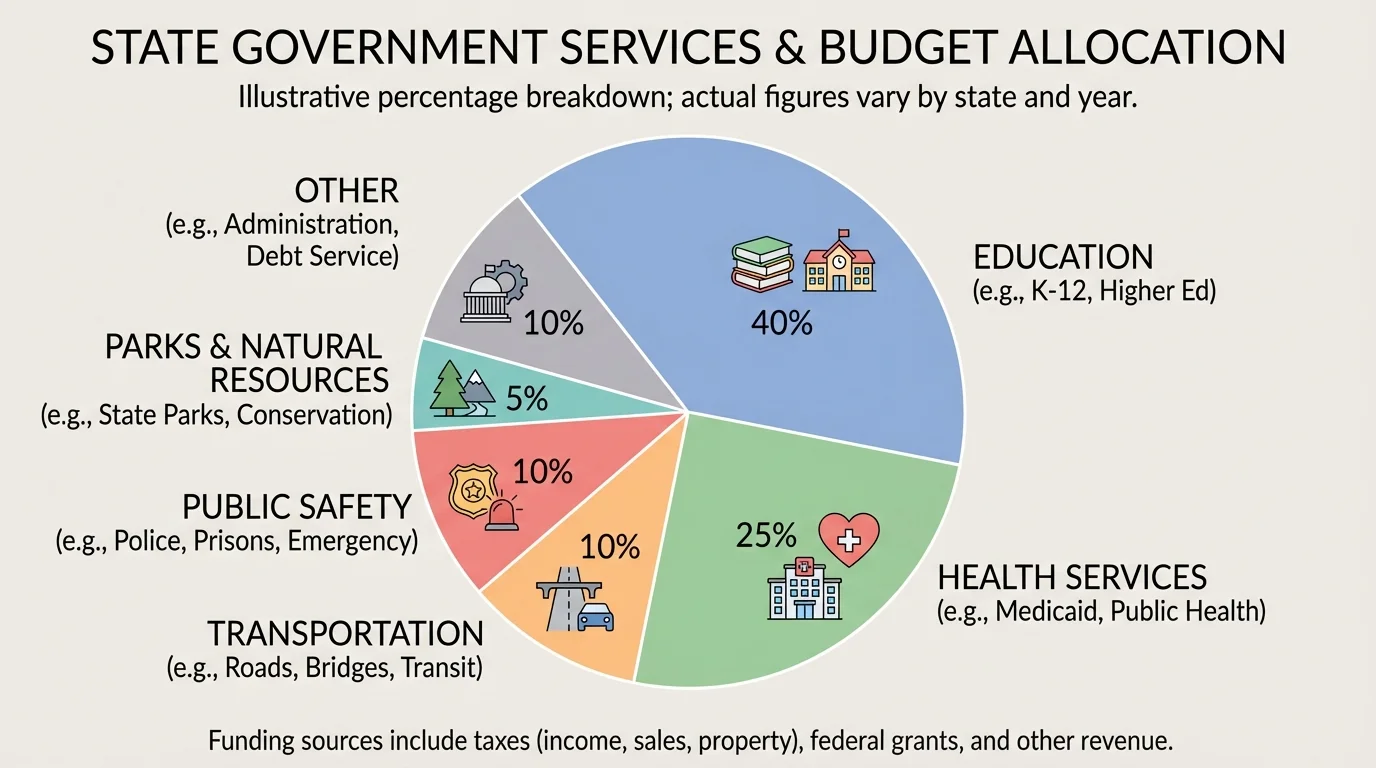
Some parts of the budget are very large because those services reach many people. Education often takes a major share because schools serve children across the state. Transportation can also require large amounts because highways, snow removal, and bridges are expensive to maintain.
Budget choices can be difficult. If more money goes to one service, there may be less available for another. Leaders try to make choices that are wise, fair, and helpful for the people of Colorado.
Colorado budget example
Suppose state leaders have $100 to represent a very tiny model budget for easy understanding.
Step 1: They might place $50 toward schools because education serves many children and communities.
Step 2: They might place $20 toward roads and transportation so people and goods can travel safely.
Step 3: They might place $15 toward health programs, $10 toward public safety, and $5 toward parks and natural resources.
This is only a simple model, but it shows that a budget divides one amount of money among many important needs.
Even though real state budgets are much more complicated than a $100 model, the main idea stays the same. The state has limited money and many responsibilities. The slices in the chart make that balancing act easier to picture.
Colorado gives many real examples of state services. The Colorado Department of Transportation helps care for state highways. In winter, clearing snow from mountain roads is a huge job. That work costs money for snowplows, fuel, equipment, and workers.
The Colorado State Patrol helps keep roads safer. Troopers may respond to crashes, help drivers, and enforce traffic laws. Their vehicles, training, and equipment are paid for through public funding.
Colorado state parks welcome visitors from around the state. Park rangers help protect land and wildlife, answer questions, and keep visitors safe. Money from taxes and park fees can help support those jobs.
Public schools also connect to state support. A school building, classroom materials, transportation help, and learning programs all depend in part on government funding. Local communities help too, but the state has a major role in making public education available across Colorado.
When wildfires threaten homes and forests, state agencies may help coordinate resources, send emergency support, and work with local communities. This is one reason state government matters so much in Colorado, where weather and nature can create serious challenges.
Local, state, and national governments all have different jobs. When a service affects the whole state, such as statewide roads or state courts, Colorado's state government usually has an important role.
These examples help show that state government is not only about laws on paper. It is also about real workers doing real jobs that affect families and communities every day.
Most people want good schools, safe roads, strong emergency services, and healthy parks. The challenge is that all of those things cost money. State leaders must choose how to use limited funding in the best way.
Sometimes one year brings special problems. A bad wildfire season may require more emergency spending. A damaged bridge may need urgent repair. A growing community may need more school support. When needs change, budget decisions can change too.
People may also disagree about what is most important. One group may want more money for transportation. Another may want more money for health services or schools. In a democracy, leaders listen to different ideas and try to make fair choices.
Funding decisions are also about fairness across regions. Colorado includes large cities, small towns, mountain communities, and farming areas. State leaders must think about all of them, not just one place. That is one reason state government can be complex.
"Government of the people, by the people, for the people."
— Abraham Lincoln
This idea matters in state government too. The money belongs to the public, and the services are meant to help the public. That is why decisions about funding are important and sometimes carefully debated.
Citizens are connected to state government in many ways. Adults vote for leaders, pay taxes, follow laws, and share ideas with public officials. Even children can learn about issues, ask questions, and understand how government decisions affect their communities.
If people want stronger parks, safer roads, or better schools, they can speak up. They can write letters, attend meetings, and learn about what state leaders are doing. Good citizenship includes paying attention to how services are provided and how they are funded.
Understanding state government helps people become informed citizens. When students know where services come from and how they are paid for, they can better understand their communities and their state.
Colorado's state government exists to serve the people of Colorado. It provides important services, collects money from several sources, and uses a budget to decide how that money should be spent. Those choices affect nearly everyone in the state.
