Why would someone leave everything behind and cross an ocean in a wooden ship, or pack up a wagon and head into unfamiliar territory? In early American history, people moved for many reasons: hope, fear, pressure, greed, faith, hunger, and sometimes because they had no choice at all. The story of the early United States is, in many ways, a story of movement. People came from Europe, Africa, and other parts of the Americas, and they also moved from colony to colony and later from the Atlantic coast toward the interior. These movements changed who lived where, who controlled land, and who benefited from resources.
To understand this history, historians often use two key ideas: push factors and pull factors. A push factor is something that drives people away from a place. A pull factor is something that attracts people to a new place. Some people were pushed by war, poverty, or religious persecution. Others were pulled by land, jobs, trade, or the chance to practice their religion more freely. Still others, especially millions of Africans, were victims of forced migration, meaning they were moved against their will.
Push factors are problems or pressures that make people want or need to leave a place. Pull factors are opportunities or advantages that attract people to a new place. Forced migration happens when people are moved by violence, slavery, or other coercion instead of personal choice.
In early America, these reasons for movement were closely tied to geography. Rivers, coastlines, mountains, forests, fertile soil, and access to ports all affected where people settled and why they moved. Competition for land and resources was one of the most important forces shaping early American history. When one group gained control of land, another group often lost it.
Push and pull factors are not just abstract ideas. They help explain real decisions made by real people. A family in Europe facing crop failures, high rents, or lack of land might decide to leave because staying seemed impossible. That was a push. The same family might hear that in North America they could farm their own land or find work in a port city. That was a pull.
Sometimes push and pull factors worked together. For example, religious minorities in Europe were often pushed out by unfair laws or persecution and pulled toward colonies that promised greater freedom. Poor laborers might be pushed by unemployment and pulled by reports that the colonies needed workers. These reasons were powerful because they involved survival, belief, and the chance for a better future.
Not all movement was equal. Wealthy landowners, small farmers, indentured servants, enslaved Africans, Native American communities, and immigrants from different countries all experienced migration differently. Their choices, freedoms, and risks were not the same. This is why historians distinguish between voluntary migration and coerced or forced migration.
Movement and power
Migration was never only about travel. It was also about who had power. When settlers moved into a new region, they wanted land, timber, water access, and trade routes. Governments and companies often encouraged that movement because it increased wealth and control. As a result, migration was deeply connected to expansion, labor systems, and conflict.
This connection between movement and power helps explain why early American migration had such lasting effects. It shaped population growth, regional economies, and political arguments about who belonged and who had rights.
The physical landscape of North America guided movement from the beginning, as [Figure 1] shows through the relationship among ports, rivers, mountains, and settlement areas. The Atlantic coast offered newcomers access to ports such as Boston, New York, Philadelphia, Charleston, and later Baltimore. These ports connected the colonies to world trade and made immigration easier than settling far inland.
Rivers were like highways before railroads and modern roads. The Hudson, Delaware, Susquehanna, Ohio, and Mississippi Rivers helped people and goods move over long distances. Fertile river valleys supported farming, and forests supplied wood for homes, ships, and fuel. Colonists looked for places where transportation and resources came together.
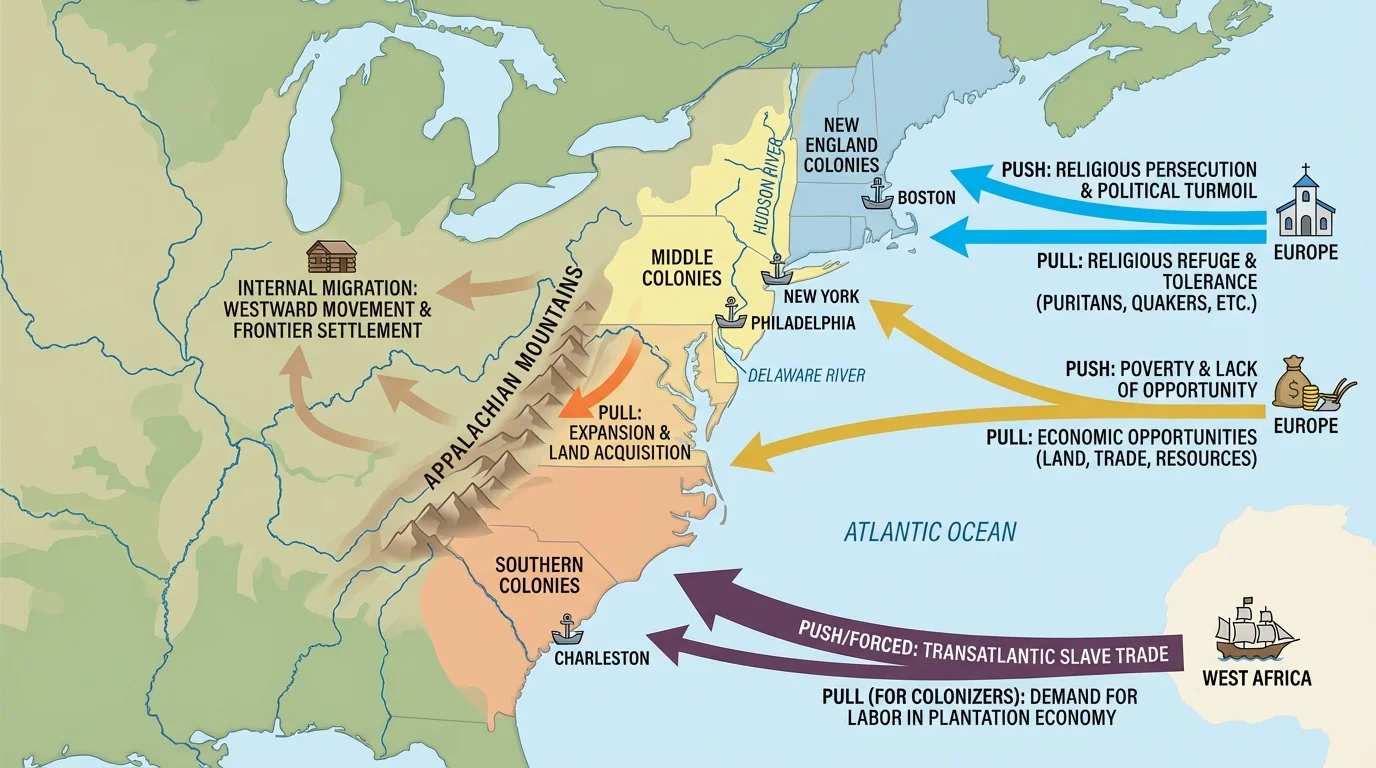
Mountains could both protect and block movement. The Appalachian Mountains formed a major barrier between the coastal colonies and the interior. Travel through them was difficult, so early settlement clustered along the coast. Over time, passes such as the Cumberland Gap became important routes for westward migration.
Geography also affected the economy. New England had rocky soil but excellent harbors and forests, so shipping, fishing, and trade became important. The Middle Colonies had fertile farmland and river access, which supported grain production and commerce. The Southern Colonies had long growing seasons and rich soil suitable for labor-intensive crops such as tobacco and rice. These regional differences created different pull factors for different kinds of settlers.
As we see again in [Figure 1], people did not spread evenly across the land. They moved where travel was possible and where land and resources seemed most useful. That pattern explains why some areas grew quickly while others remained harder to reach.
Many immigrants came to British North America for economic opportunity. Europe in the 1600s and 1700s had growing populations, and many ordinary people struggled to gain land or stable work. In the colonies, land seemed more available, even though that land was already inhabited by Native peoples. Merchants were drawn by trade, artisans by demand for skilled labor, and farmers by the possibility of owning property.
Some immigrants arrived as indentured servants. These were people who signed contracts agreeing to work for a set number of years in exchange for passage across the Atlantic, food, and shelter. For many poor Europeans, this system offered a path to America when they could not afford the trip themselves. Their lives were often harsh, but they had at least some possibility of freedom after serving their terms.
Colonial leaders actively promoted immigration. They wanted workers, taxpayers, soldiers, and settlers who would strengthen colonial claims to land. Pamphlets and advertisements described America as a place of abundance, though they often exaggerated. This message was part of the attraction: the idea of a new beginning.
Case study: Pennsylvania as a destination
Step 1: Identify the push factors.
Many Europeans, including Germans and other groups, faced war, high taxes, or limited land in Europe.
Step 2: Identify the pull factors.
Pennsylvania offered fertile soil, religious tolerance for many groups, and access to markets through Philadelphia.
Step 3: Connect geography to migration.
Its rivers and port city made transportation and trade easier, which helped attract more settlers.
This combination made Pennsylvania one of the fastest-growing colonies.
Immigration did not stop after independence. Even in the early United States, newcomers continued to arrive because the country still offered access to farmland, trade, and expanding towns. However, opportunity depended heavily on race, class, and legal status.
Religion was another major reason people moved. In Europe, governments often supported one official church, and people who belonged to different faiths could face punishment, discrimination, or exclusion from public life. For some, the colonies offered a chance to worship more freely.
The Pilgrims, for example, left England and then the Netherlands before sailing to Plymouth in 1620. They wanted to build a community centered on their beliefs. The Puritans, who settled Massachusetts Bay in the 1630s, also sought a place to practice religion according to their own ideas. Yet there was a paradox: some groups came seeking religious freedom but did not always grant the same freedom to others.
Other colonies became refuges for specific religious groups. Maryland was founded partly as a haven for English Catholics. Pennsylvania, founded by William Penn, welcomed Quakers and many other groups. Rhode Island, established by Roger Williams, became known for stronger religious tolerance than many neighboring colonies.
Religious freedom in early America often meant freedom for some groups more than for everyone. Colonies that welcomed one persecuted group sometimes punished people whose beliefs were different from their own.
Religious migration affected geography too. Settlers formed towns, meetinghouses, farms, and local governments based on their beliefs and traditions. These patterns helped create distinct regional cultures that lasted for generations.
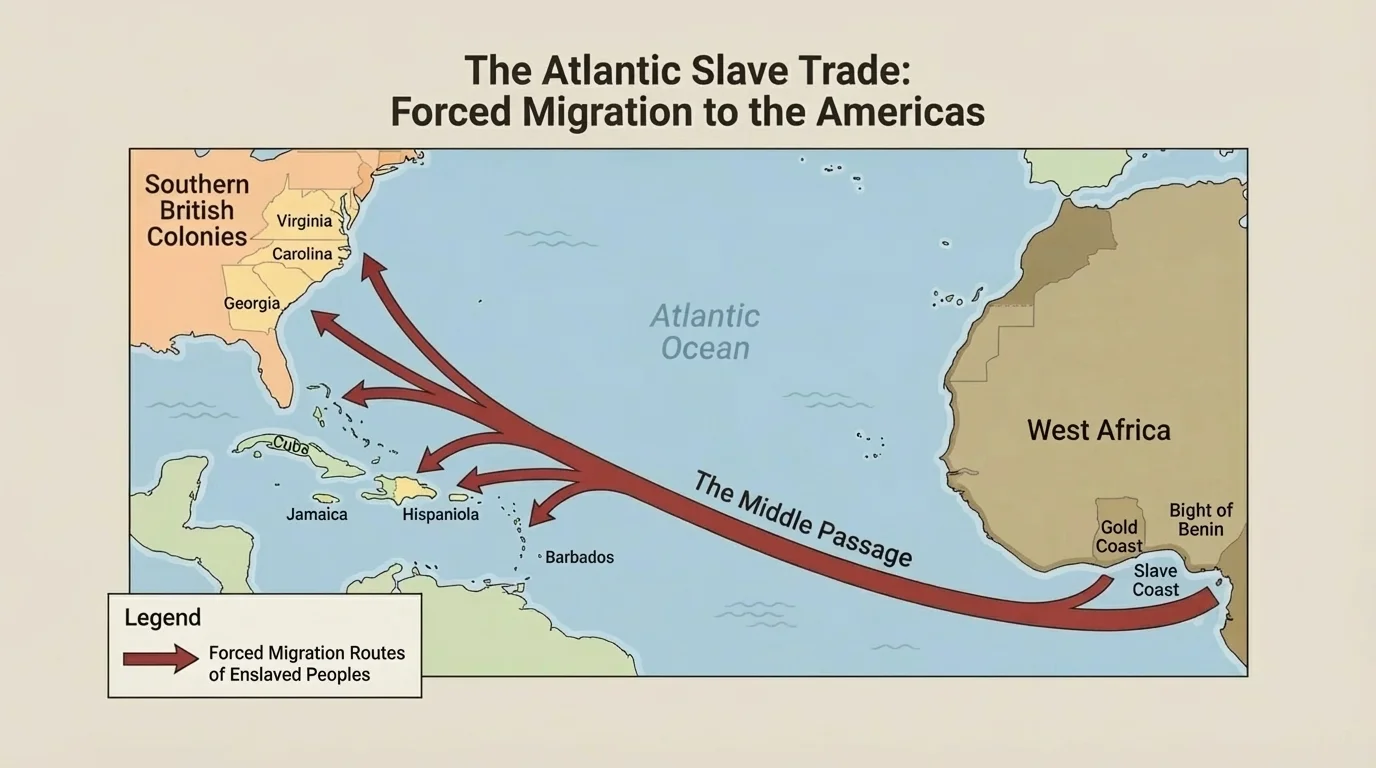
One of the most important and tragic migrations in early American history was the forced transport of Africans across the Atlantic, as [Figure 2] illustrates through the routes linking West Africa, the Caribbean, and the American colonies. Unlike voluntary immigrants, enslaved Africans were captured, sold, and transported through violence. They did not choose to migrate; migration was imposed on them.
The Middle Passage was the sea journey that carried enslaved Africans across the Atlantic Ocean. Conditions on slave ships were brutal. People were crowded into tight spaces, denied freedom, and exposed to disease, hunger, and abuse. Many died during the voyage.
Enslaved labor became central to the economies of many colonies, especially in the South and the Caribbean. Plantation agriculture relied on large numbers of workers to grow tobacco, rice, indigo, and later cotton. The demand for profit and control of land drove the expansion of slavery. In this way, competition for resources and wealth directly shaped forced migration.
This migration also changed the population of the Americas. African knowledge, labor, skills, languages, and cultural traditions deeply influenced American society, even though slavery denied basic human rights and caused immense suffering. Family separation and resistance were constant parts of this history.
"I was soon put down under the decks..."
— Olaudah Equiano, describing the terror of the Middle Passage
Primary sources such as Equiano's narrative help historians understand the human experience behind large migration patterns. When we return to [Figure 2], the arrows on a map represent not just routes but millions of lives disrupted by slavery.
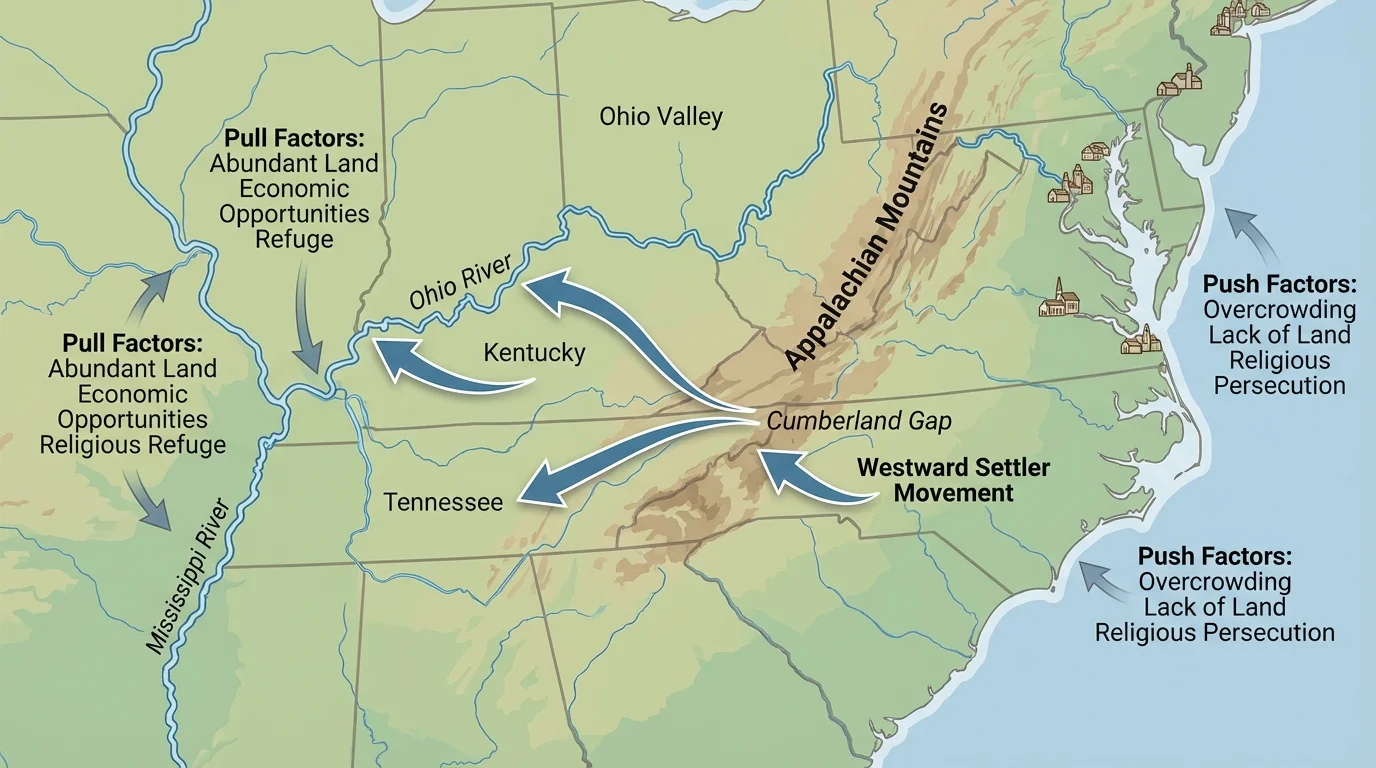
Migration did not end when people arrived on the Atlantic coast. Many families later moved within the colonies and the new United States, following land, rivers, and trade paths, as [Figure 3] shows in the routes crossing the Appalachians into the interior. Internal migration became especially important in the late 1700s and early 1800s.
One major pull factor was cheap or newly opened land. Coastal areas became more crowded over time, and younger generations often had trouble obtaining farms of their own. Moving west seemed to offer independence. Hunters, farmers, and land speculators all looked beyond the mountains to places such as Kentucky, Tennessee, and the Ohio Valley.
Transportation shaped these moves. Flatboats and river travel made it easier to move goods and people into the interior. Trails and mountain gaps connected older settlements to frontier regions. The Northwest Ordinance of 1787 created a process for organizing territory north of the Ohio River, encouraging settlement by laying out how new territories could become states.
But westward migration had consequences. When settlers moved into frontier lands, they entered areas where Native nations had long lived, hunted, traded, and governed. Expansion for one group often meant loss for another. The desire for farmland, timber, and access to river routes increased conflict.
Later, roads and canals improved movement even more. Although these developments belong partly to the early 1800s, they grew out of earlier migration patterns. Geography still mattered. As shown in [Figure 3], waterways and mountain passes did not just influence travel; they directed settlement itself.
No study of migration in early America is complete without recognizing Native American experiences. Native peoples were not simply background to colonial expansion. They were central actors with their own nations, trade networks, alliances, and territorial claims. European immigration and U.S. expansion placed growing pressure on Native lands.
Competition for control of land and resources led to repeated conflicts. Colonists wanted farmland, fur-trading regions, and strategic river valleys. Native nations sought to defend their homelands and maintain political independence. Wars, broken treaties, and settlement pressure often led to Native displacement.
Examples include conflicts in New England, fighting in the Ohio Valley, and resistance movements led by Native leaders. Even when Native groups made alliances with European powers or the United States, those agreements were often ignored once settlers wanted more land. Migration, therefore, was tied to conquest as well as opportunity.
Competition for land
Land in early America was more than space on a map. It meant food, trade, political power, security, and wealth. Because different groups valued the same land for different reasons, migration often created conflict. Settlement patterns cannot be understood without asking whose land was being entered, claimed, or taken.
This issue remained one of the most important geographic forces in early U.S. history. Control of river valleys, ports, forests, and fertile plains shaped both migration routes and government decisions.
Different parts of early America attracted different people because the land and economy were not the same everywhere. Looking region by region makes the push and pull factors easier to compare.
| Region | Main Pull Factors | Important Resources | Migration Pattern |
|---|---|---|---|
| New England | Religious communities, ports, trade | Harbors, forests, fisheries | Immigration to towns and coastal settlements |
| Middle Colonies | Fertile farmland, tolerance, commerce | Rich soil, rivers, grain production | Diverse immigration and inland farm settlement |
| Southern Colonies | Plantation economy, land for crops | Tobacco land, rice fields, long growing season | Large plantation settlement and forced migration of enslaved Africans |
| Frontier/Interior | Cheap land, hunting, independence | Forests, river valleys, farmland | Westward migration and conflict over Native lands |
Table 1. Regional differences in pull factors, resources, and migration patterns in early America.
The Middle Colonies were especially diverse, with immigrants from England, Germany, the Netherlands, Scotland, Ireland, and elsewhere. Their ports and farmland supported both urban and rural settlement. The South, by contrast, relied more heavily on plantation agriculture and enslaved labor. New England attracted families and religious communities, while the frontier drew people seeking land and autonomy.
Comparing two migrations
Step 1: A Quaker family moves to Pennsylvania.
Push factors include discrimination in England. Pull factors include tolerance, farmland, and a growing port city.
Step 2: An enslaved African is transported to South Carolina.
This is not voluntary migration. It is forced migration driven by the plantation economy and demand for labor.
Step 3: Compare the outcomes.
Both movements change population patterns, but one involves hope and choice, while the other involves violence and captivity.
This comparison reminds us that the word migration can describe very different human experiences.
These regional patterns influenced politics too. Population growth affected representation, trade policy, defense, and disputes over western expansion.
[Figure 4] shows that migration changed over time rather than all at once and highlights some major turning points from the early 1600s into the early 1800s. Important events and individuals help explain how push and pull factors shifted.
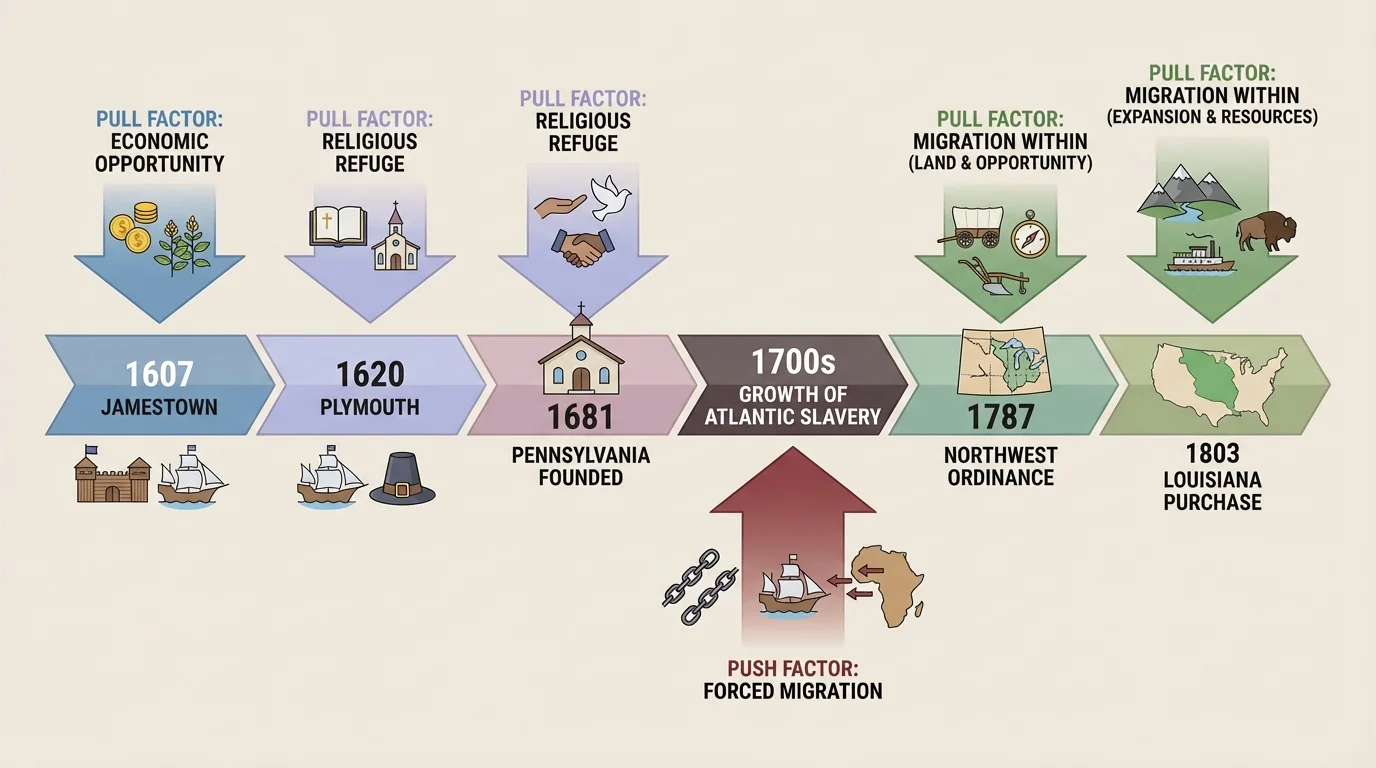
1607: Jamestown is founded in Virginia. Economic goals, especially profit from land and resources, strongly shape settlement.
1620: Plymouth is founded by Pilgrims seeking a place to live according to their religious beliefs.
1630s: Large Puritan migration to Massachusetts Bay increases New England settlement.
1681: William Penn receives the charter for Pennsylvania, encouraging settlement based on religious tolerance and farmland.
1700s: The Atlantic slave trade expands, increasing forced migration to the colonies.
1787: The Northwest Ordinance organizes western lands and encourages migration into the Ohio Valley.
1803: The Louisiana Purchase doubles U.S. territory, increasing interest in westward movement.
Key figures include William Penn, Roger Williams, Olaudah Equiano, and frontier leaders such as Daniel Boone. These people did not all play the same role. Some encouraged settlement, some defended religious liberty, and some recorded the horrors of slavery. Migration was shaped by a series of turning points rather than one single cause.
Historians learn about migration through both primary sources and secondary sources. A primary source comes from the time being studied, such as a diary, letter, ship list, law, map, or advertisement. A secondary source is created later by a historian who analyzes evidence.
For example, a ship passenger record can show who arrived and when. A colonial advertisement might promise cheap land or jobs, revealing pull factors. A letter from an immigrant might describe hunger or persecution in Europe, revealing push factors. A slave narrative such as Olaudah Equiano's account gives direct evidence of forced migration.
Maps are especially useful in geography and history because they show spatial patterns. They help us see how ports, rivers, and frontier lines affected movement. When historians compare maps with letters, laws, and census records, they can better understand why populations changed over time.
Earlier studies of colonization, Native American history, and regional geography all connect to this topic. Migration is easier to understand when you remember that land was already occupied, environments were different from region to region, and governments often encouraged settlement for economic and political reasons.
Studying sources also helps us ask better questions. Who had the freedom to move? Who was pushed out? Who was forced to move? Who gained control of land and resources after migration happened? These questions make the history more complete and more honest.
