A smartphone designed in one country, assembled in another, built with minerals from several continents, shipped across oceans, and sold in a crowded city is more than a piece of technology. It is evidence that the modern world runs on connections between people and places. Population shifts—whether they involve rapid growth, aging societies, migration, or urbanization—do not happen in isolation. They change who works, who consumes, who produces food and energy, and who depends on others to meet basic needs.
Geographers study these changes by asking two linked questions: Where are people? and How are those people connected? A change in population in one region can affect labor markets in another, water use in another, and food prices across the globe. That is why understanding world population is not just about counting people. It is about tracing networks of dependence.
Population shift is a significant change in where people live, how fast populations grow or shrink, or the age structure of a population over time.
Human resources are the skills, labor, knowledge, and abilities that people contribute to economic and social life.
Natural resources are materials and environmental systems people rely on, such as freshwater, soil, forests, minerals, fisheries, and energy sources.
Interdependence means that people, regions, and countries rely on one another for goods, services, labor, and resources.
Population change affects nearly every part of geography. If a country's population grows quickly, it may need more schools, homes, jobs, food, water, and electricity. If a population ages, it may need more healthcare workers and fewer elementary schools. If large numbers of people move into cities, transportation systems, housing, and sanitation services may face intense pressure. These shifts also create opportunities: growing populations can provide new workers, migrants can fill labor shortages, and urban concentration can support innovation and economic development.
The key idea is that no region can fully meet all of its needs alone. Countries rich in oil may lack enough workers. Countries with large labor forces may depend on imported fuel. Dense cities often depend on distant rivers, farms, and mines. Even local events, such as drought or factory closures, can trigger wider changes when populations are already under stress.
Population change is uneven across the world, as [Figure 1] shows through contrasting regions of rapid growth, aging, and migration. Some regions, especially parts of Sub-Saharan Africa and South Asia, continue to experience fast population growth. Other regions, including much of Europe and East Asia, have low birth rates and aging populations. Meanwhile, major migration streams connect Latin America to North America, South Asia to the Persian Gulf, and North Africa and Southwest Asia to Europe.
These differences matter because population is not just about total numbers. It also includes demographic transition, the long-term shift from high birth and death rates to lower birth and death rates as societies industrialize and develop. Countries at different stages of this transition face different challenges. A youthful population may need jobs and schools; an older population may need pensions and caregiving systems.
Another major shift is urbanization, the movement of people into towns and cities. Today, more than half of the world's people live in urban areas. In some places, city growth is planned and supported by infrastructure. In others, growth happens faster than housing, clean water, roads, and public transit can keep up.
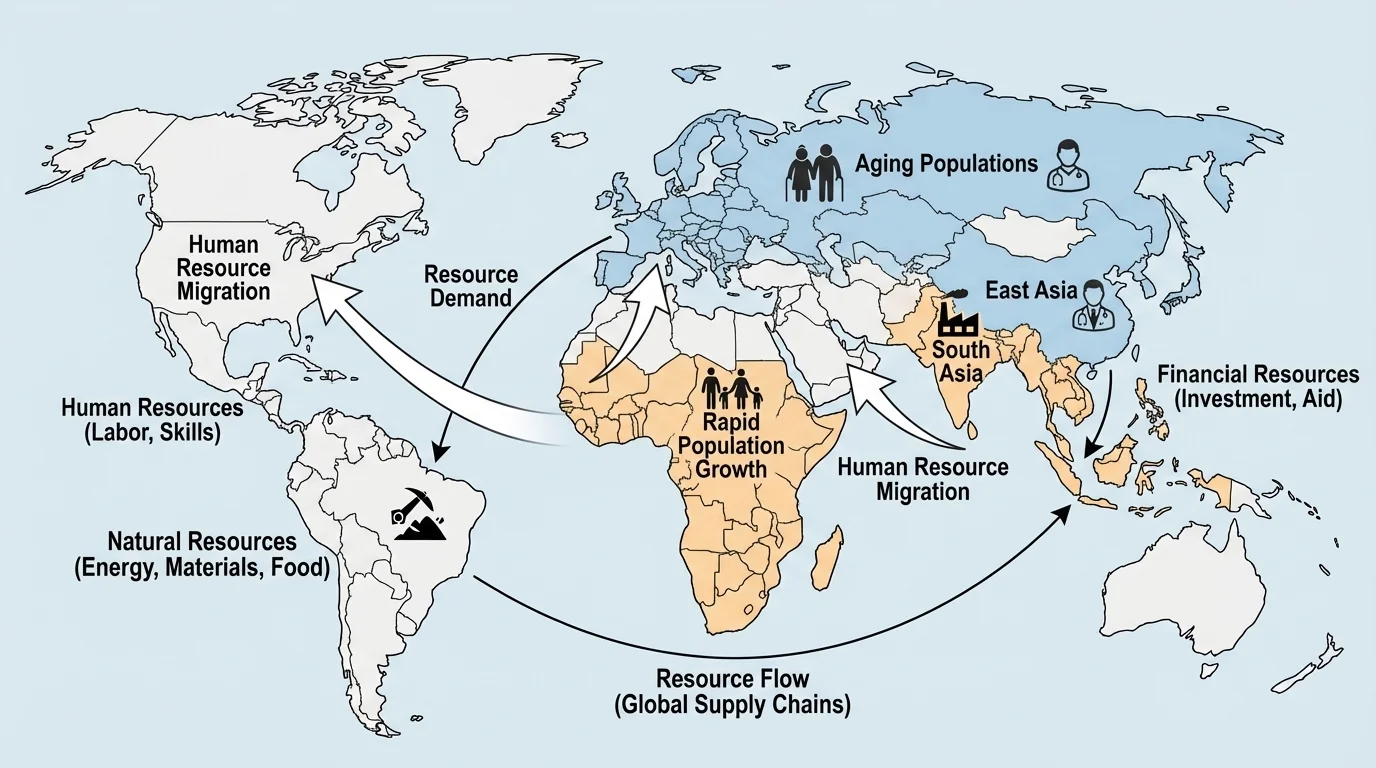
Migration adds another layer. People move for jobs, safety, education, family reunification, or because environmental change makes their homes harder to live in. A person leaving one country does not simply disappear from that place and appear in another. That movement creates flows of money, ideas, languages, and skills. Migrants often support family members through remittances, and destination countries may come to depend on migrant labor in agriculture, construction, healthcare, or domestic work.
Because of these patterns, the world's population map is also a map of economic and environmental connections. The same uneven patterns shown in [Figure 1] help explain why some countries worry about unemployment among young adults while others worry about not having enough workers to care for older citizens.
Some of the world's fastest-growing cities are not in the richest countries. That means urban growth often happens where governments are also trying to expand electricity, transit, sanitation, and housing at the same time.
Population shifts are deeply connected to labor force changes. A labor force is the portion of the population that is working or available to work. When countries have shrinking or aging populations, they may face worker shortages. This is especially visible in healthcare, elder care, agriculture, transportation, and engineering. To keep economies functioning, these countries often rely on immigrants or temporary foreign workers.
For example, many hospitals in the United States, the United Kingdom, and Canada employ doctors and nurses who trained in countries such as India, the Philippines, or Nigeria. This can benefit destination countries by filling shortages, but it can also create problems in origin countries if too many trained professionals leave. Geographers and economists sometimes describe this as brain drain, the loss of highly educated workers from one country to another.
At the same time, migration can also create brain gain. Workers who move may send money home, invest in local businesses, or return later with new knowledge and experience. Remittances can support education, housing, and healthcare in the communities migrants leave behind. In some countries, money sent home from workers abroad is a major source of household income.
Why human resources are not evenly distributed
People do not move randomly. Migration usually follows opportunity, safety, and existing social networks. As a result, some regions gain workers while others lose them. This creates a world in which labor shortages and labor surpluses exist at the same time, pushing countries into systems of mutual dependence.
Human resources also include less visible forms of knowledge. Farmers adapt crops to local climates. Engineers design ports and power grids. Teachers and medical workers build social systems that support future growth. When populations shift quickly, these skills may not be available where they are most needed. A booming city may need builders and plumbers immediately. A rural region losing young adults may struggle to maintain schools or medical clinics.
This means population geography is not only about numbers. It is about the spatial distribution of skills and work. A place can be rich in oil, copper, or fertile land and still depend heavily on workers from elsewhere to extract, transport, process, and distribute those resources.
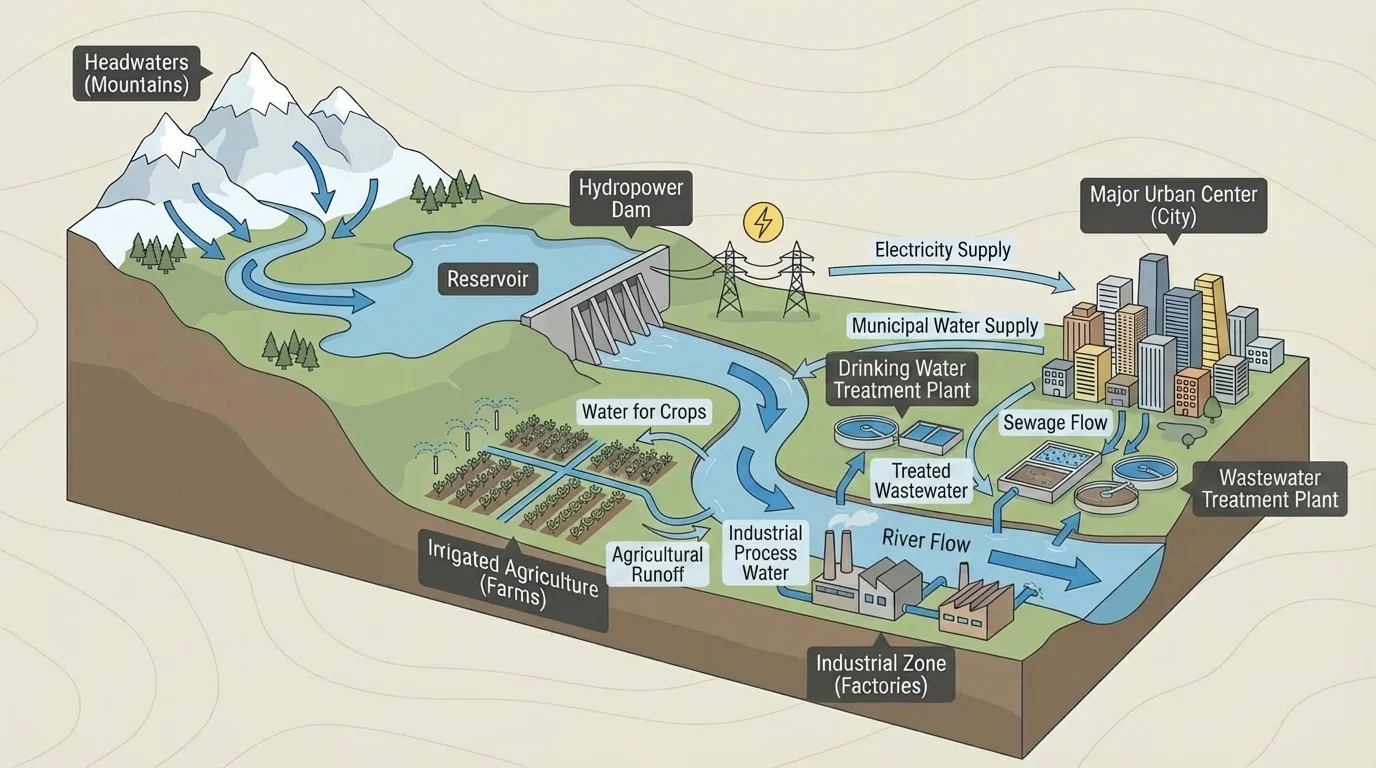
Population shifts also change the demand for resource distribution. Resource distribution is the geographic pattern of where natural resources are found and how they are accessed and shared. As [Figure 2] illustrates, the same river basin may support farms, factories, hydropower, and a large city at the same time. When populations grow or move, these competing demands often intensify.
Freshwater is one of the clearest examples. A city can expand far beyond the water available within its own boundaries, so it draws water from distant watersheds, reservoirs, or underground aquifers. If rainfall decreases or upstream users increase withdrawals, urban residents, farmers, and ecosystems may all be affected. In this sense, a growing city depends on people it may never see: dam operators, rural communities, engineers, and farmers in the larger basin.
Food systems work in a similar way. Most large cities do not produce enough food to feed themselves. They rely on vast agricultural regions, refrigerated transport, storage systems, ports, and global trade networks. If drought reduces wheat yields in one major exporting country or war disrupts shipping, bread prices can rise in cities thousands of kilometers away.
Energy dependence is equally important. Industrial regions need fuel for factories, electricity grids, transportation, and homes. Many countries import oil, natural gas, coal, or uranium because they do not have enough domestic energy resources. Others export these resources but import machinery, technology, and labor. The result is a web of mutual dependence rather than simple self-sufficiency.
Minerals and metals show another layer of interconnection. Electric vehicles, solar panels, smartphones, and batteries rely on materials such as lithium, cobalt, copper, nickel, and rare earth elements. These resources are unevenly distributed, so countries with fast-growing populations and expanding technology use depend on mining regions elsewhere. Those mining regions, in turn, depend on foreign investment, transport routes, and global demand.
Land use is also shaped by population movement. When urban areas expand outward, farmland may be converted into housing or industrial zones. When rural populations decline, some land may be abandoned or consolidated into larger commercial farms. In rapidly growing regions, pressure on forests, fisheries, and soils can increase if governments cannot regulate extraction and land use effectively.
The competition visible in [Figure 2] helps explain why environmental conflicts are often also population conflicts. The issue is not just how much of a resource exists, but who needs it, where they live, and how fast those patterns are changing.
Case example: wheat and global dependence
A loaf of bread sold in a large city may depend on several regions at once.
Step 1: Farmers in a grain-producing region grow wheat using local soil, water, machinery, and labor.
Step 2: The wheat is transported by rail or ship to mills and food-processing centers, sometimes across national borders.
Step 3: Urban populations buy bread produced from that wheat, often without realizing that drought, fuel prices, or conflict far away affect the final price.
This example shows that city populations depend on distant natural resources and the people who manage them.
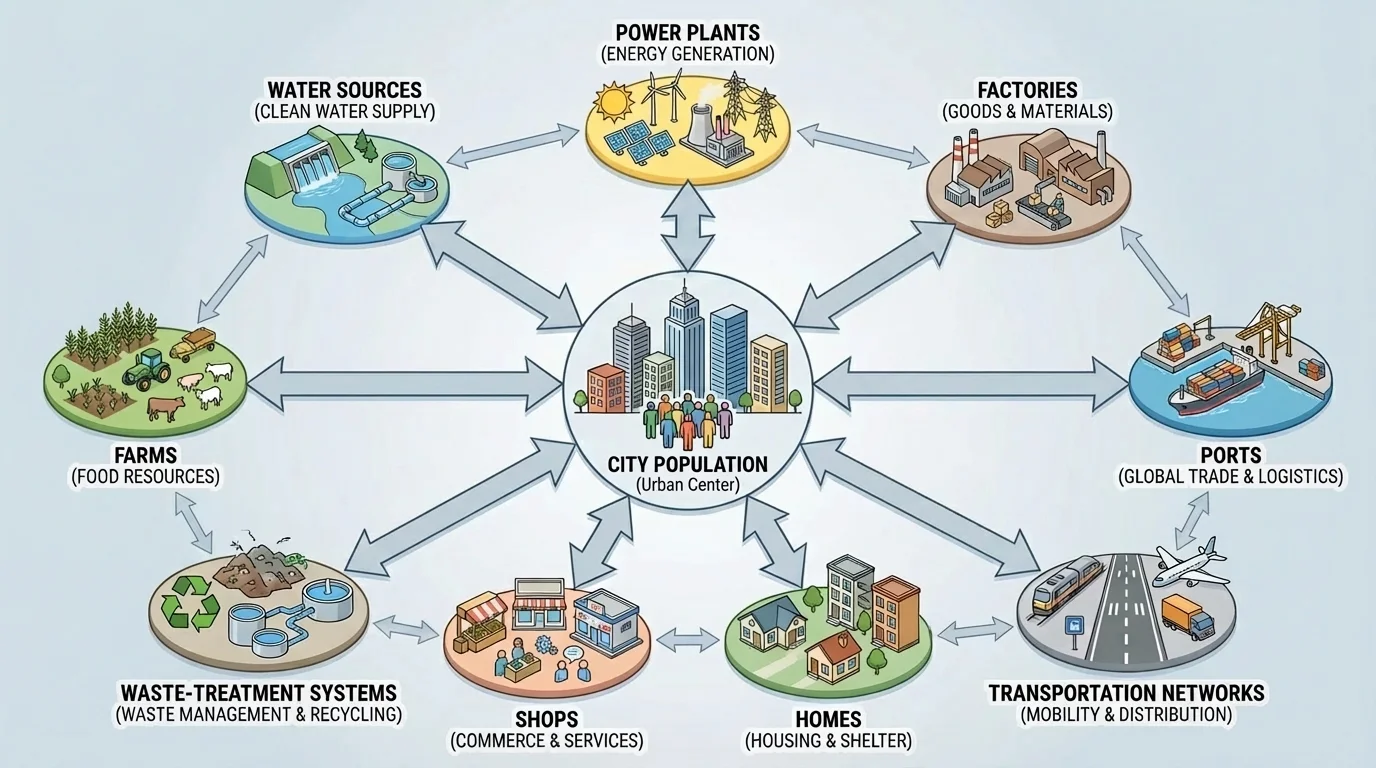
A growing city is not just a dense cluster of buildings. It is a node in a much larger system of flows, as [Figure 3] shows through the movement of food, energy, goods, and waste. Urban populations need housing materials, construction workers, electricity, water pipes, roads, internet systems, public transportation, and waste removal. When millions of people move into cities within a short time, every one of these systems must expand.
Urban growth can create economic opportunity because cities bring workers, businesses, schools, and markets close together. This concentration often increases productivity and innovation. But rapid growth can also produce overcrowding, informal housing, air pollution, traffic congestion, and unequal access to services. The challenge is not urbanization itself; it is whether infrastructure grows at the same pace as population.
Supply chains connect cities to the wider world. A single urban supermarket may stock bananas from Ecuador, rice from India, fish from Norway, electronics from China, and coffee from Ethiopia. A disruption in shipping lanes, a fuel shortage, or a crop failure can affect availability almost immediately. Urban residents are therefore highly dependent on global logistics systems and the workers who operate them.
Infrastructure also reveals inequalities. Wealthier neighborhoods may receive reliable electricity and piped water, while informal settlements may depend on water trucks or shared taps. In many rapidly growing cities, migrants provide the labor that builds roads, homes, and office towers, yet they may live in the most vulnerable areas themselves. This highlights a major geographic truth: the people who make urban systems function are not always the ones who benefit most from them.
Later policy choices often determine whether urban population growth becomes a crisis or a strength. Investments in transit, zoning, water systems, and affordable housing can help cities absorb newcomers more effectively. The network in [Figure 3] makes clear that a city survives only when its connections to surrounding regions remain stable.
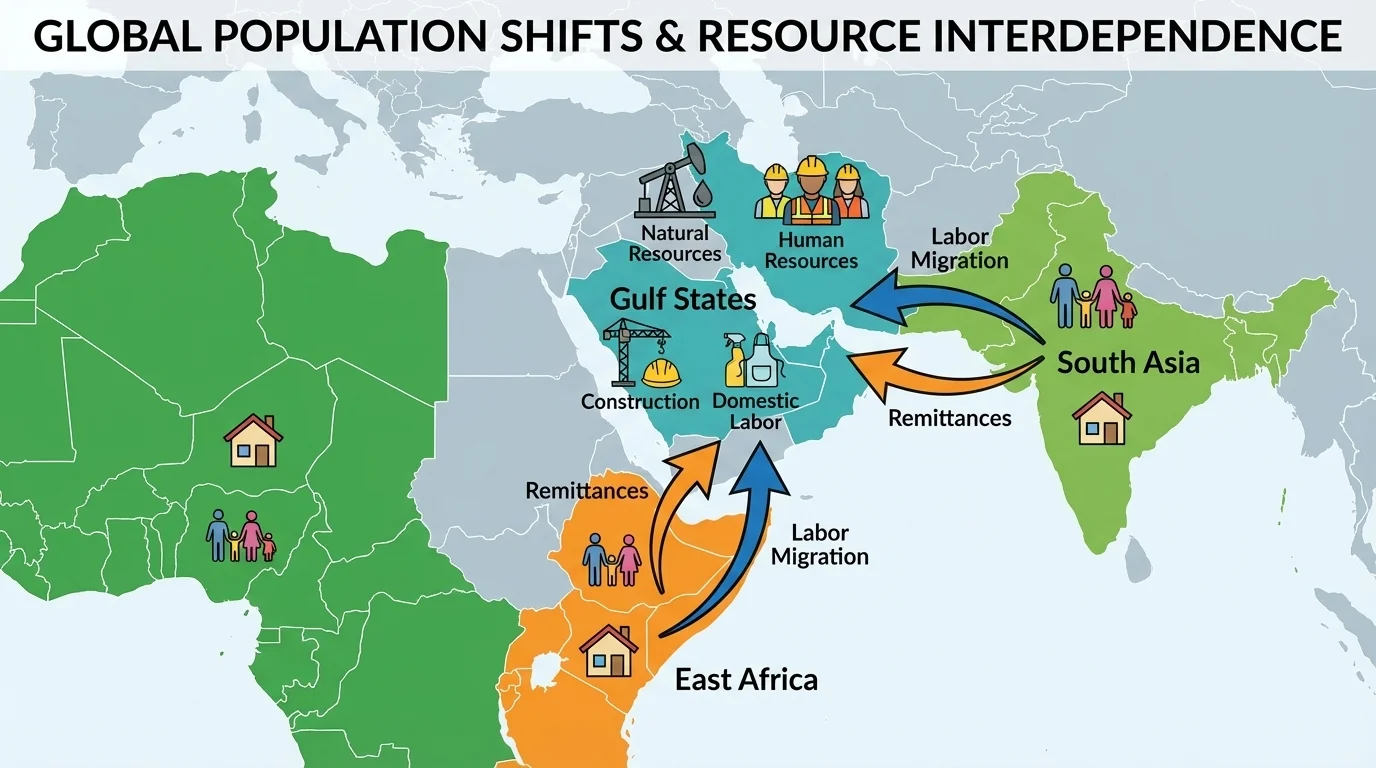
Gulf States: Countries such as the United Arab Emirates and Qatar have large energy wealth but relatively small citizen populations. To build cities, airports, stadiums, ports, and service sectors, they rely heavily on migrant workers from South Asia, Southeast Asia, and parts of Africa. As [Figure 4] illustrates, human resources move toward the Gulf while money in the form of remittances flows back to origin countries.
This case shows an important pattern: natural-resource wealth does not guarantee a sufficient workforce. Oil and gas revenues can fund development, but construction, domestic service, retail, transport, and engineering often depend on imported labor. At the same time, sending countries depend on the income migrants send home.
Japan: Japan has one of the world's oldest populations and very low birth rates. This creates labor shortages in caregiving, healthcare, and some industrial sectors. The country has increasingly explored robotics, automation, and carefully managed immigration as ways to address demographic change. Japan demonstrates that a highly developed economy can still be vulnerable when population structure shifts.
Sub-Saharan Africa: Many countries in this region have youthful populations and rapidly growing cities. This can be a demographic advantage if education systems, infrastructure, and job creation expand fast enough. But if job growth lags behind population growth, unemployment and informal work can rise. Fast urban expansion also increases pressure on water, transit, waste systems, and housing.
Europe and North America: These regions often rely on migrant labor for agriculture, food processing, elder care, and construction. Seasonal harvests, for example, may depend on workers who cross borders temporarily. Consumers may see produce in grocery stores as a simple local purchase, but the labor behind it often reflects global migration systems similar to those mapped in [Figure 4].
South Asia: This region includes some of the world's most densely populated and rapidly urbanizing areas. Cities such as Dhaka, Mumbai, and Karachi depend on complex networks for food, water, energy, and transportation. Climate risks such as flooding and heat waves add extra pressure, making resource management and planning even more critical.
| Region | Major Population Shift | Key Dependency | Main Challenge |
|---|---|---|---|
| Gulf States | High in-migration of workers | Dependence on foreign labor | Worker rights and long-term sustainability |
| Japan | Aging and low birth rates | Dependence on automation and selective migration | Caregiving and labor shortages |
| Sub-Saharan Africa | Rapid growth and urbanization | Dependence on infrastructure expansion | Jobs, housing, and services |
| Europe/North America | Aging in some areas, migration into others | Dependence on migrant labor and imports | Political debate and economic adjustment |
Table 1. Examples of how different regions experience population shifts and related forms of interdependence.
One major challenge is sustainability. If population growth or migration overwhelms water supplies, farmland, or energy systems, societies may face shortages, conflict, or environmental damage. Yet the answer is not to view people only as pressure on resources. People are also problem-solvers. Better planning, new technology, international agreements, and improved infrastructure can reduce strain and increase resilience.
Sustainability means meeting present needs without destroying the ability of future generations to meet their own needs. In population geography, this involves balancing human needs with the limits of ecosystems. A city that imports food and water but pollutes its river systems or expands onto flood-prone land may grow in the short term while becoming more vulnerable in the long term.
Earlier geographic study often separates physical systems from human systems, but in reality they constantly interact. Climate, water, landforms, and ecosystems shape human settlement, while human settlement reshapes those natural systems through farming, mining, construction, and energy use.
Climate change is likely to make population interdependence even more visible. Rising sea levels, stronger storms, drought, and heat stress may push more people to migrate. Those movements will affect labor markets, housing demand, political systems, and resource use in destination regions. Environmental migration is therefore not only a humanitarian issue but also a geographic and economic one.
International cooperation matters because resources and populations cross borders. Rivers flow through multiple countries. Fisheries move across maritime zones. Carbon emissions affect the entire atmosphere. Migration connects households on different continents. Governments, businesses, and communities must therefore think beyond national boundaries when responding to population shifts.
"No place is truly isolated in a world linked by movement, trade, and shared resources."
For students of geography, the most important insight is that population shifts reveal the interconnected nature of the world. A farmer facing drought, a nurse migrating for work, a city planner building transit, a miner extracting cobalt, and a family sending remittances are all part of the same global story. Population is not just where people live. It is how people depend on one another—and on the Earth's resources—to survive and thrive.
