A single human cell is tiny, while the population of Earth is enormous. Yet mathematicians can describe both kinds of quantities with the same powerful idea: multiplying by powers of \(10\). This is one of the reasons exponents matter so much. They give us a fast way to write, estimate, and compare numbers that would otherwise be awkward to handle.
Some numbers are so large that writing every digit is inconvenient. For example, the population of the United States is about \(300{,}000{,}000\), and the population of the world is about \(7{,}000{,}000{,}000\). Other numbers are so small that all the zeros can hide the important part. A bacterium might be about \(0.000001\) meters long.
To make numbers like these easier to use, mathematicians write them in a compact form using powers of \(10\). A common version of this form is called scientific notation. In this lesson, we focus on estimates written with a single leading digit times a power of \(10\). It is especially useful in science, engineering, medicine, and technology, where people work with extreme sizes all the time.
Recall that powers of \(10\) follow a place-value pattern: \(10^1 = 10\), \(10^2 = 100\), \(10^3 = 1{,}000\), and so on. Negative exponents represent fractions: \(10^{-1} = 0.1\), \(10^{-2} = 0.01\), and \(10^{-3} = 0.001\).
Because each power of \(10\) changes the value by a factor of \(10\), exponents let us focus on scale. Instead of counting zeros one by one, we can understand how many places the decimal point moves.
[Figure 1] shows how writing a number as a single digit times a power of \(10\) tells you how far the decimal point moves in large- and small-number examples. In this lesson, we focus on estimates such as \(3 \times 10^8\) or \(7 \times 10^9\), where the first factor is a single digit.
A number in this form looks like \(a \times 10^n\), where \(a\) is a nonzero single digit such as \(3\), \(7\), or \(9\), and \(n\) is an integer. If \(n\) is positive, the number is large. If \(n\) is negative, the number is small.
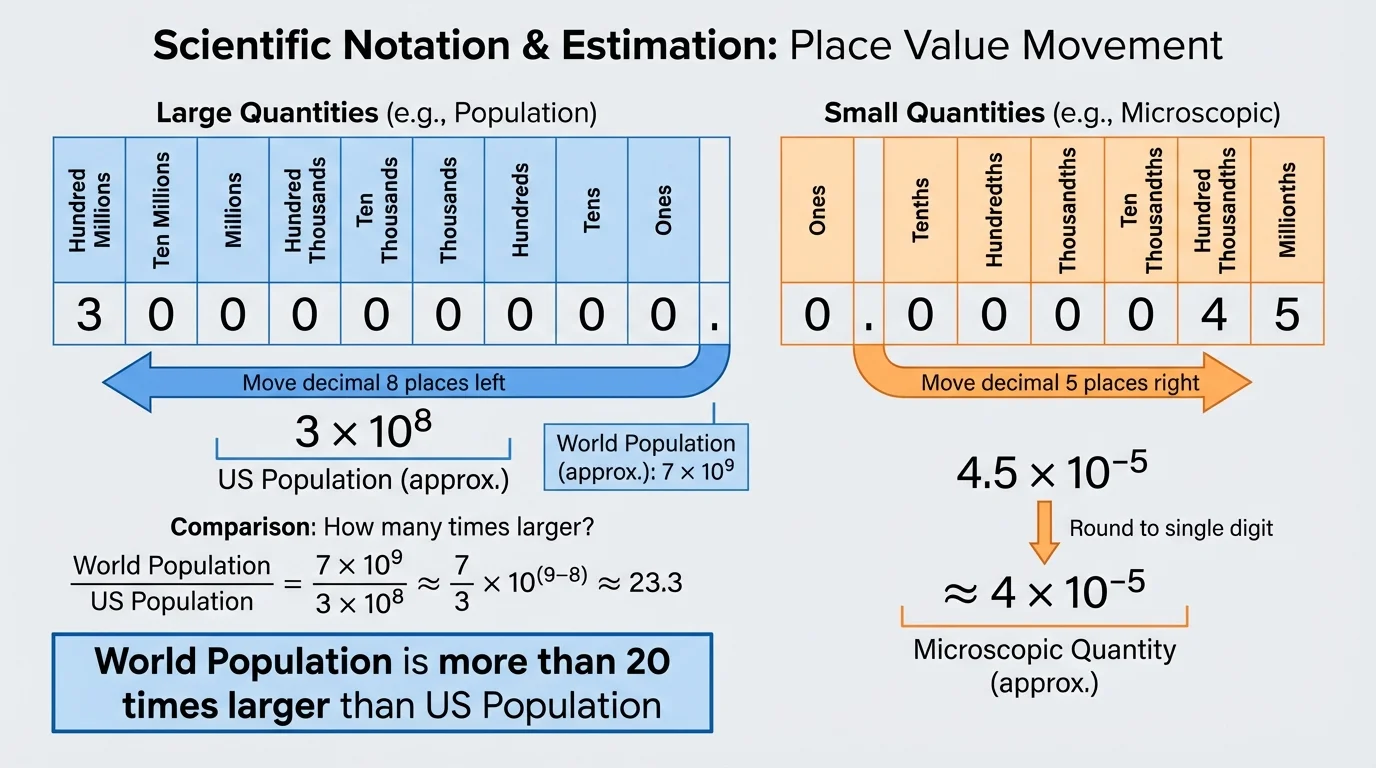
For example, \(3 \times 10^8\) means \(3\) multiplied by \(100{,}000{,}000\), so it equals \(300{,}000{,}000\). The exponent \(8\) tells us that the decimal point in \(3\) moves \(8\) places to the right.
For a small number, \(5 \times 10^{-4}\) means \(5 \times 0.0001\), which equals \(0.0005\). The exponent \(-4\) tells us the decimal point moves \(4\) places to the left.
Power of 10 means a number of the form \(10^n\), where \(n\) is an integer. In powers of \(10\), a positive exponent moves the decimal point to the right, and a negative exponent moves it to the left. A coefficient is the number multiplying the power of \(10\), such as the \(3\) in \(3 \times 10^8\).
This form is useful because it separates two ideas: the coefficient gives the leading digit, and the power of \(10\) gives the size. Numbers with the same exponent are on the same scale, even if their leading digits differ.
Estimation means finding a close, simpler value. When we estimate a quantity using powers of \(10\), we usually round the number to one leading digit and then write the rest as a power of \(10\).
For example, suppose a city has \(8{,}420{,}000\) people. The leading digit is \(8\), and the number is in the millions. An estimate using one leading digit is \(8 \times 10^6\).
If a quantity is \(0.000072\), then the first nonzero digit is \(7\). The decimal point must move \(5\) places to write the number as \(7.2 \times 10^{-5}\), and a one-digit estimate is \(7 \times 10^{-5}\).
Estimating by scale
When you estimate with powers of \(10\), you are not trying to keep every digit. You are trying to keep the size of the number and its most important leading digit. This is often enough when comparing quantities or deciding whether one number is much larger or much smaller than another.
Estimation is especially helpful when exact values change over time. Populations, internet storage sizes, and scientific measurements are often updated, but their powers of \(10\) still give a useful picture of scale.
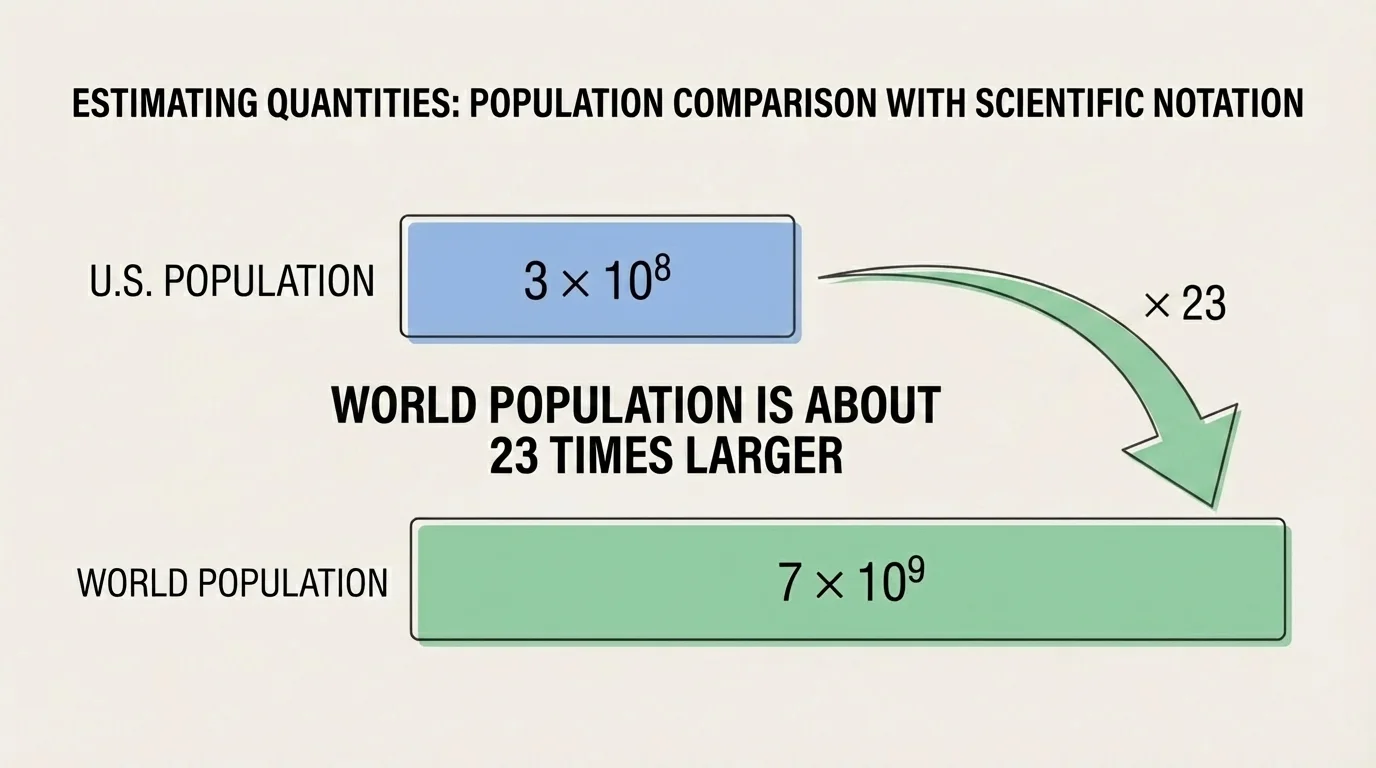
[Figure 2] illustrates how powers of \(10\) help compare quantities. If we want to know how many times as much one quantity is as another, we divide. The size difference becomes very clear when the numbers are written with exponents.
Suppose the population of the United States is estimated as \(3 \times 10^8\), and the population of the world is estimated as \(7 \times 10^9\). To compare them, divide world population by U.S. population:
\(\dfrac{7 \times 10^9}{3 \times 10^8} = \dfrac{7}{3} \times 10^{9-8} = \dfrac{7}{3} \times 10\).
Since \(\dfrac{7}{3} \approx 2.33\), the result is about \(2.33 \times 10 = 23.3\). So the world population is more than \(20\) times the population of the United States.
The key exponent rule here is:
\(\dfrac{10^a}{10^b} = 10^{a-b}\).
This means that when dividing powers of \(10\), subtract the exponents. That simple rule makes comparison much faster. Instead of working with every zero, you compare the leading digits and the exponent difference.
If two numbers have the same coefficient but different exponents, the exponent difference tells the factor directly. For example, \(4 \times 10^6\) is \(10^3 = 1{,}000\) times as large as \(4 \times 10^3\), because \(\dfrac{4 \times 10^6}{4 \times 10^3} = 10^{6-3} = 10^3\).
A difference of just \(1\) in the exponent means a factor of \(10\). A difference of \(6\) means a factor of \(1{,}000{,}000\). Small exponent changes can represent enormous real-world differences.
This is why scientific notation is so powerful in science. Quantities may look similar at first glance, but one exponent can completely change the scale.
Now let's work through several examples carefully. Notice how the coefficient and the exponent each play a role.
Worked example 1
Estimate the population of a country with \(326{,}000{,}000\) people using one leading digit, and compare it to a world population of \(7{,}400{,}000{,}000\).
Step 1: Write each quantity as a one-digit estimate.
\(326{,}000{,}000 \approx 3 \times 10^8\)
\(7{,}400{,}000{,}000 \approx 7 \times 10^9\)
Step 2: Divide to compare.
\(\dfrac{7 \times 10^9}{3 \times 10^8} = \dfrac{7}{3} \times 10^{1}\)
Step 3: Simplify.
\(\dfrac{7}{3} \approx 2.33\), so \(2.33 \times 10 = 23.3\)
The world population is about \(23\) times as large, so it is more than \(20\) times as large.
This example matches the kind of estimation often used in news reports and global studies. Exact populations change constantly, but the comparison stays meaningful.
Worked example 2
A dust particle is about \(6 \times 10^{-4}\) meters wide, and a bacterium is about \(2 \times 10^{-6}\) meters wide. How many times as wide is the dust particle?
Step 1: Set up the ratio.
\(\dfrac{6 \times 10^{-4}}{2 \times 10^{-6}}\)
Step 2: Divide coefficients and subtract exponents.
\(\dfrac{6}{2} \times 10^{-4-(-6)} = 3 \times 10^2\)
Step 3: Rewrite the result.
\(3 \times 10^2 = 300\)
The dust particle is \(300\) times as wide as the bacterium.
Negative exponents may look tricky, but the same rule works: subtract the exponents. Because \(-4 - (-6) = 2\), the final power is positive.
Worked example 3
A storage device holds about \(9 \times 10^{11}\) bytes. Another holds about \(3 \times 10^9\) bytes. How many times as much data can the larger device hold?
Step 1: Write the comparison as division.
\(\dfrac{9 \times 10^{11}}{3 \times 10^9}\)
Step 2: Simplify the coefficients and exponents.
\(\dfrac{9}{3} \times 10^{11-9} = 3 \times 10^2\)
Step 3: Convert to standard form if helpful.
\(3 \times 10^2 = 300\)
The larger device holds \(300\) times as much data.
This kind of comparison appears in computing all the time. Large memory sizes are much easier to compare in powers of \(10\) than in long strings of digits.
Worked example 4
Estimate \(0.000089\) using one leading digit times a power of \(10\).
Step 1: Find the first nonzero digit.
The first nonzero digit is \(8\).
Step 2: Determine the power of \(10\).
\(0.000089 = 8.9 \times 10^{-5}\)
Step 3: Round to one leading digit.
\(8.9 \times 10^{-5} \approx 9 \times 10^{-5}\)
The estimate is \(9 \times 10^{-5}\).
For very small numbers, be careful to count decimal places correctly. Looking back at [Figure 1] can help you track whether the exponent should be negative.
Students often make a few predictable mistakes when working with powers of \(10\). Knowing them in advance can help you avoid them.
Mistake 1: Using the wrong sign on the exponent. Large numbers use positive exponents, and small decimals use negative exponents. For example, \(4 \times 10^6\) is large, but \(4 \times 10^{-6}\) is tiny.
Mistake 2: Forgetting to subtract exponents when dividing. In a comparison like \(\dfrac{5 \times 10^7}{5 \times 10^3}\), the result is \(10^{7-3} = 10^4\), not \(10^{10}\).
Mistake 3: Ignoring the coefficient. Compare \(2 \times 10^5\) and \(9 \times 10^5\). They have the same exponent, but the second is \(\dfrac{9}{2} = 4.5\) times as large.
Mistake 4: Thinking estimates must be exact. An estimate like \(3 \times 10^8\) is useful because it captures the scale of the number, even though the exact value may be different.
| Standard form | Estimated power-of-\(10\) form | Type of number |
|---|---|---|
| \(645{,}000\) | \(6 \times 10^5\) | Large |
| \(8{,}900{,}000{,}000\) | \(9 \times 10^9\) | Very large |
| \(0.00034\) | \(3 \times 10^{-4}\) | Small |
| \(0.00000072\) | \(7 \times 10^{-7}\) | Very small |
Table 1. Examples of standard-form numbers written as one-digit estimates using powers of \(10\).
Tables like this help show that the exponent tells the scale, while the first digit gives a quick estimate of the amount.
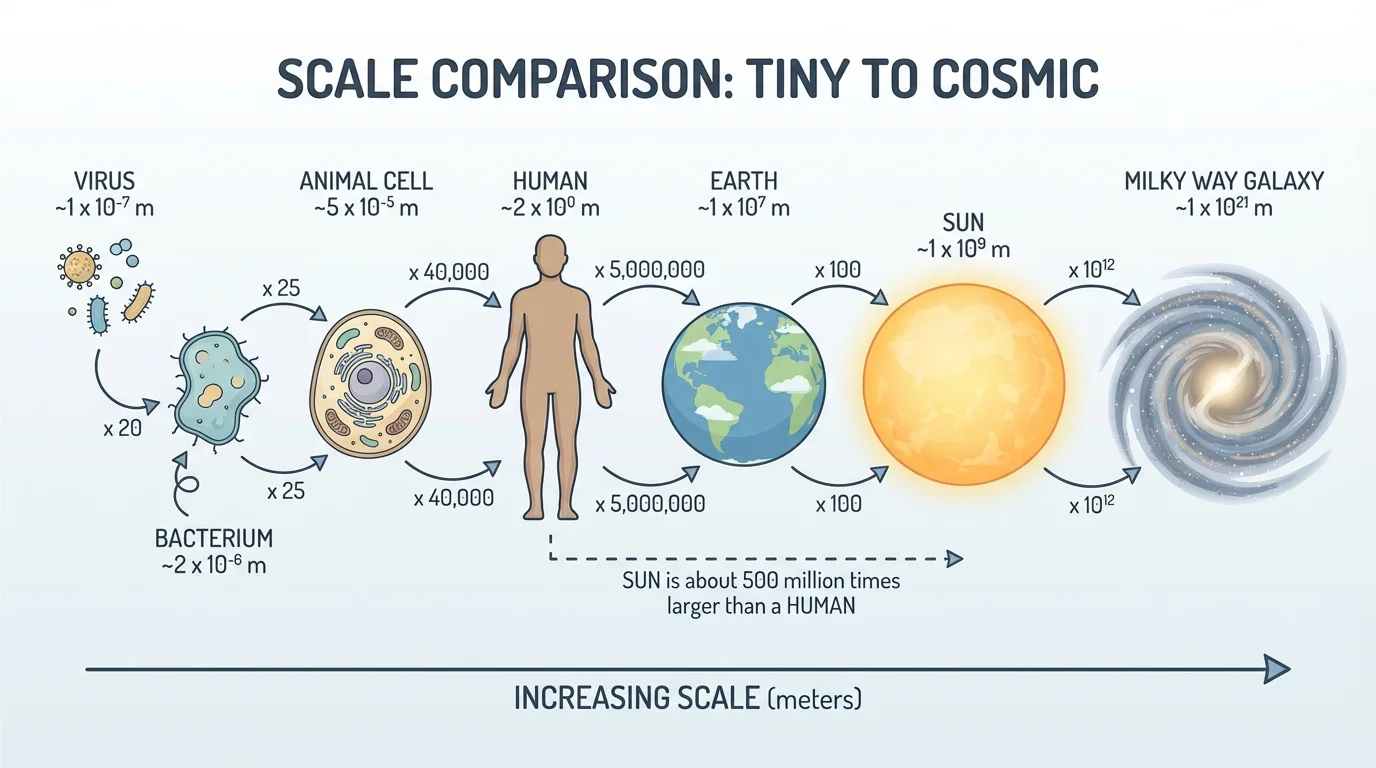
[Figure 3] shows how powers of \(10\) help scientists and engineers compare things across huge differences in size, with a scale running from extremely tiny objects to enormous ones. Without this notation, many measurements in astronomy, biology, and computing would be difficult to understand at a glance.
In astronomy, distances between planets and stars are so large that writing every digit becomes impractical. In biology, cells and viruses are so small that decimals with many zeros are hard to compare. In technology, storage and processing speeds can differ by factors of \(10\), \(100\), or \(1{,}000\).
Suppose one microscope can view objects as small as \(2 \times 10^{-6}\) meters and another can view down to \(5 \times 10^{-8}\) meters. The second reaches a finer scale because \(10^{-8}\) is smaller than \(10^{-6}\). Comparing their minimum visible sizes gives \(\dfrac{2 \times 10^{-6}}{5 \times 10^{-8}} = \dfrac{2}{5} \times 10^2 = 40\), so one scale is \(40\) times finer.
Population studies also use estimation. A country with \(8 \times 10^7\) people has about \(10\) times the population of a country with \(8 \times 10^6\) people. The matching coefficients make the exponent difference stand out immediately.
Computer science gives another strong example. A process taking \(2 \times 10^{-3}\) seconds is much faster than one taking \(2 \times 10^{-1}\) seconds. The ratio is \(\dfrac{2 \times 10^{-1}}{2 \times 10^{-3}} = 10^2 = 100\), so the second time is \(100\) times larger. This type of comparison matters when engineers improve performance.
Looking again at [Figure 3], notice how powers of \(10\) organize quantities by scale. That is the real strength of exponent notation: it lets you compare the almost unimaginably small and the unimaginably large in one common language.
The main skill in this topic is not just writing numbers differently. It is understanding size. A number such as \(7 \times 10^9\) is not just a shorter way to write \(7{,}000{,}000{,}000\); it also tells you immediately that the number is in the billions.
When comparing two quantities, remember this pattern:
If \(A = a \times 10^m\) and \(B = b \times 10^n\), then
\(\dfrac{A}{B} = \dfrac{a}{b} \times 10^{m-n}\).
This formula helps you decide how many times as much one quantity is as another. It works for very large numbers, very small numbers, and even one of each.
The population example from [Figure 2] is a model for many other comparisons: estimate, write in power-of-\(10\) form, divide coefficients, subtract exponents, and interpret the answer in context.
"Exponents are a language of scale."
— A useful mathematical idea to remember
Once you become comfortable with this language, numbers that once seemed too big or too small become much easier to understand.
