A lot of serious life problems start with one small sentence: "I didn't realize that was in the agreement." That can happen when you accept a job, start gig work, rent a room, or agree to live with roommates. The good news is that many problems can be prevented if you know your rights, know your responsibilities, and slow down long enough to read what you are agreeing to.
If you get a part-time job, your employer cannot simply make up every rule they want. If you rent a place to live, a landlord cannot ignore the law just because they own the property. In both workplace and housing settings, there are legal protections that set limits. Those protections matter because work and housing affect your money, your safety, your time, and your future options.
Knowing the rules is also part of civic engagement. A community works better when people understand fair treatment, report abuse, keep records, and make informed decisions instead of signing whatever is put in front of them. This is not just about avoiding trouble. It is about learning how to function as a responsible adult in a system built on laws, agreements, and trust.
At the center of this topic are three connected ideas. First, you have rights. Second, you have responsibilities. Third, many of those responsibilities are shaped by written agreements.
Labor rights are the basic legal protections workers have, such as the right to be paid properly, to work in reasonably safe conditions, and to be protected from discrimination and unlawful retaliation.
Employment protections are laws and policies that limit unfair treatment by employers and set standards for pay, safety, time, and workplace conduct.
A contract is a legally binding agreement between people or organizations. In housing, a lease is a contract. In work settings, a job offer, employment agreement, or independent contractor agreement may function as a contract.
Rights do not erase responsibilities. For example, you may have the right to a safe workplace, but you still have the responsibility to follow safety rules. A landlord may have the right to collect rent, but also the responsibility to keep the property habitable. Good decision-making means analyzing both sides.
One useful mindset is this: laws set the floor, and contracts fill in the details. The law says what cannot go below basic standards. The contract explains the specific deal.
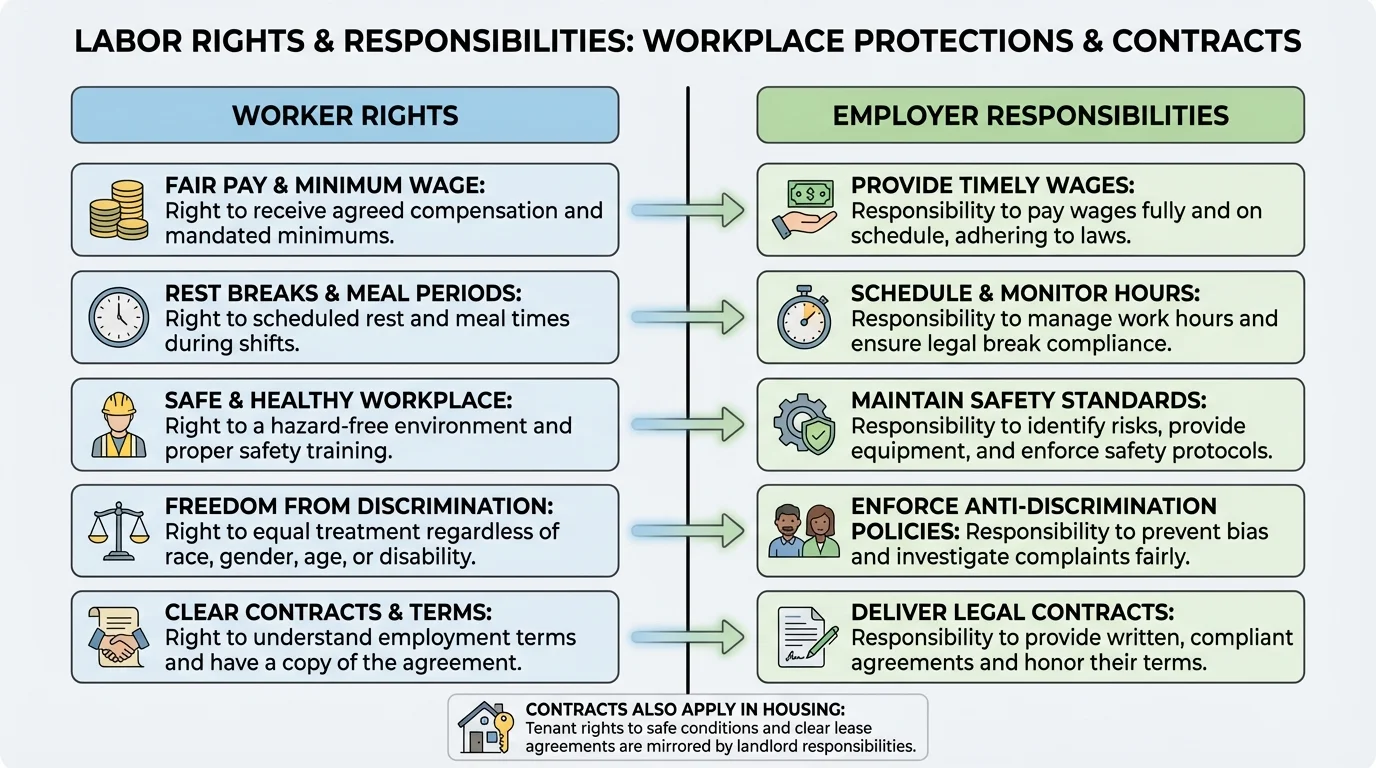
When you start a job, you enter a legal relationship. As [Figure 1] shows, that relationship includes minimum wage rules, wage payment rules, safety requirements, and protections against certain forms of mistreatment. Even if a manager seems friendly, verbal promises are not enough by themselves when a conflict happens later.
One major right is proper pay. In many places, workers must be paid at least the legal minimum wage, and they must be paid for the hours they actually work. If you work 12 hours at $15 per hour, your expected gross pay would be calculated as \(12 \times 15 = 180\), so you would expect $180 before taxes and deductions that are legally allowed. That sounds simple, but real problems happen when people are asked to work "off the clock," stay after signing out, or perform trial work with no pay.
Another major right is workplace safety. Employers are generally required to provide a reasonably safe environment, training for hazards, and equipment when needed. A restaurant worker should know how to handle hot surfaces and cleaning chemicals. A warehouse worker should receive guidance on lifting and equipment use. A teen employee should not simply be assigned dangerous tasks just because the shift is busy.
You also have protections against discrimination and harassment. Discrimination means being treated unfairly based on a protected trait such as race, religion, sex, disability, or other legally protected characteristics, depending on the law where you live. Harassment includes unwelcome behavior that creates a hostile environment or pressures someone in an abusive way. This can happen in person, by text, in work chat apps, or through social media connected to the job.
A related protection is retaliation. Retaliation happens when an employer punishes a worker for reporting a legal concern, asking about pay, participating in an investigation, or using a protected right. For example, if a worker reports repeated unpaid hours and suddenly gets all their shifts cut for that reason, that may raise retaliation concerns.
Break laws, scheduling laws, and youth worker rules vary by place, so details depend on state or local law. But the practical lesson is consistent: never assume your employer's policy is automatically legal. Check official labor information for your area if something feels wrong.
Some workers lose money not because of a low hourly wage, but because of unpaid extra minutes before and after shifts. Those small amounts add up fast across weeks and months.
As you saw in [Figure 1], labor rights are strongest when you can match each right to a specific employer duty. That makes it easier to notice when something is missing, such as no pay stub, no safety training, or discipline that seems connected to reporting a problem.
Employment protections are not magic shields. They work best when you know how to use them. In real life, that means keeping records, asking questions early, and noticing patterns.
Step 1: Save the job posting, offer email, schedule messages, and pay information. If your boss later says, "We never promised that rate," your records matter.
Step 2: Track your own hours. Use your phone notes, a calendar, or a spreadsheet. Write down when you start, when you stop, and whether you were required to stay late. If your payroll says \(18\) hours but your notes show \(21\), you have something concrete to compare.
Step 3: Read every pay stub. Check hourly rate, total hours, deductions, and whether overtime rules apply in your location. If your expected pay is \(21 \times 15 = 315\), but the stub shows only $270 before deductions, you know to ask why.
Step 4: Raise concerns calmly and specifically. Instead of saying, "This is unfair," say, "I tracked 21 hours this week, but the pay stub shows 18. Can we review the time record together?" Specific facts usually work better than emotional arguments.
Step 5: If the issue is serious or repeated, use formal channels. That could mean human resources, a labor agency, or a trusted legal aid organization. In some situations, a parent, guardian, or another trusted adult can help you organize documents and plan communication.
Case study: Missing pay for training time
You are hired by a local café. The manager says your first two training shifts are "just practice," so they are unpaid. You worked 4 hours each day at the same tasks as paid staff.
Step 1: Identify the issue.
You performed real work for \(4 + 4 = 8\) hours. Training that benefits the employer is often paid time.
Step 2: Gather proof.
Save schedule texts, messages about training, and your own hour log.
Step 3: Ask clearly.
Send a calm message: "I worked 8 training hours on Monday and Tuesday. When will those hours appear on payroll?"
Step 4: Escalate if needed.
If the manager refuses and the law supports you, contact the appropriate labor office or legal aid group.
The key skill is not just knowing a rule. It is knowing how to document and respond.
Another real-life issue is being labeled the wrong kind of worker. A independent contractor is usually treated differently from an employee for taxes, benefits, and workplace protections. Some businesses misclassify workers to avoid costs. If a company controls your hours, your tasks, your tools, and your supervision like a normal employer, but calls you an "independent contractor," that may be a warning sign.
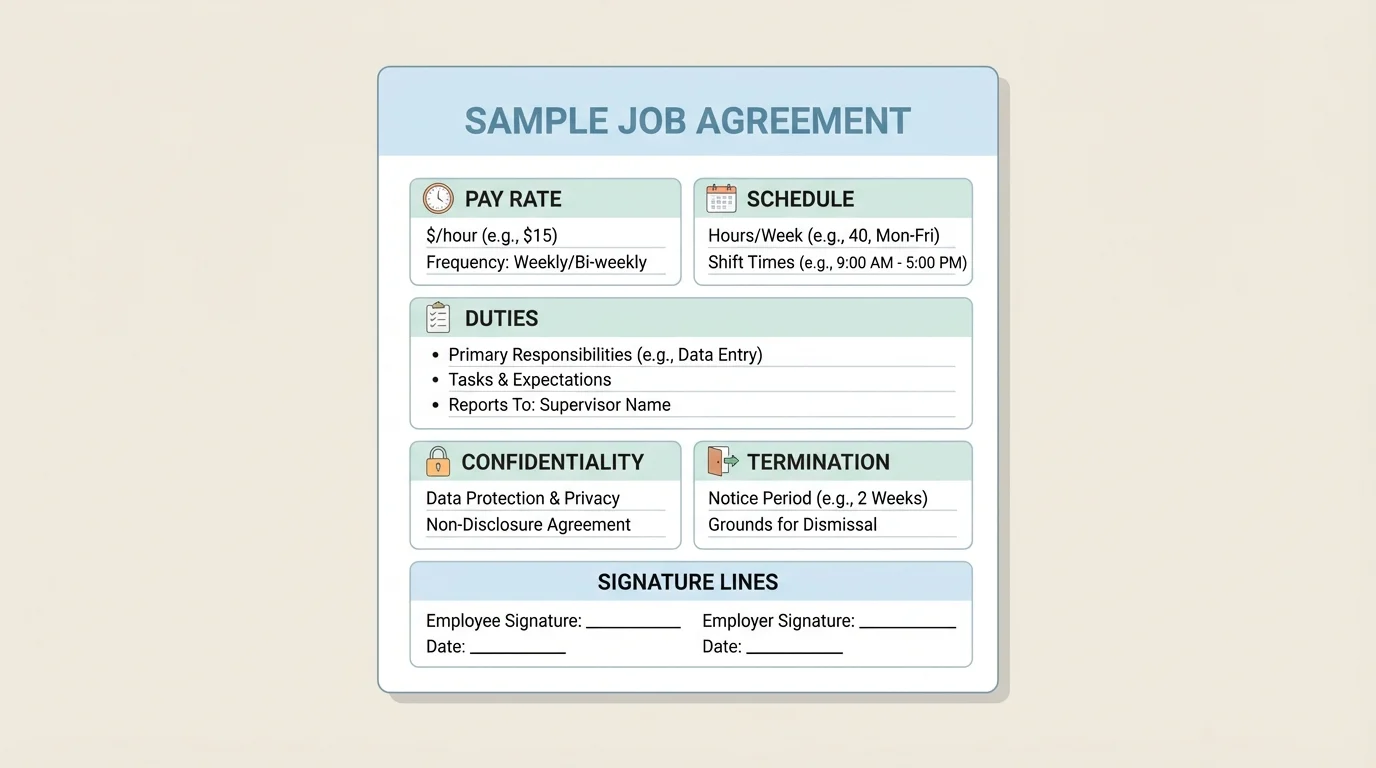
An employment contract is not just paperwork. As [Figure 2] illustrates, it is a map of expectations, limits, and risks. Sometimes the contract is a formal document with signatures. Sometimes it is made up of several pieces, such as an offer letter, a policy handbook, and digital onboarding forms.
Before accepting a job, check the exact pay rate, schedule expectations, job duties, start date, and conditions for leaving or being terminated. If the employer says, "You may work anywhere from 5 to 30 hours depending on business needs," that means your income may be unpredictable. If your monthly phone bill is $45 and your transportation costs are $80, unstable hours can create real stress.
Watch for extra clauses. Some agreements include confidentiality rules, social media rules, noncompete restrictions, or repayment demands for equipment. Not every clause is unreasonable, but every clause should be understood. If a line seems confusing, ask what it means in plain language before signing.
One important idea is at-will employment. In many places, this means an employer can end employment for many reasons that are legal, and a worker can leave without a long-term commitment, unless a contract says otherwise. But at-will does not mean an employer can fire someone for illegal discrimination, retaliation, or another unlawful reason.
Job handbooks matter too. A handbook may not always be a full contract, but it can still shape expectations and procedures. If the handbook says complaints should be reported to a specific email or portal, using that system can protect you later by creating a record.
Later, when comparing jobs, return to [Figure 2] mentally and ask: What am I being paid? When am I expected to work? What behavior is restricted? What happens if I want to leave? Those simple questions prevent a lot of bad decisions.
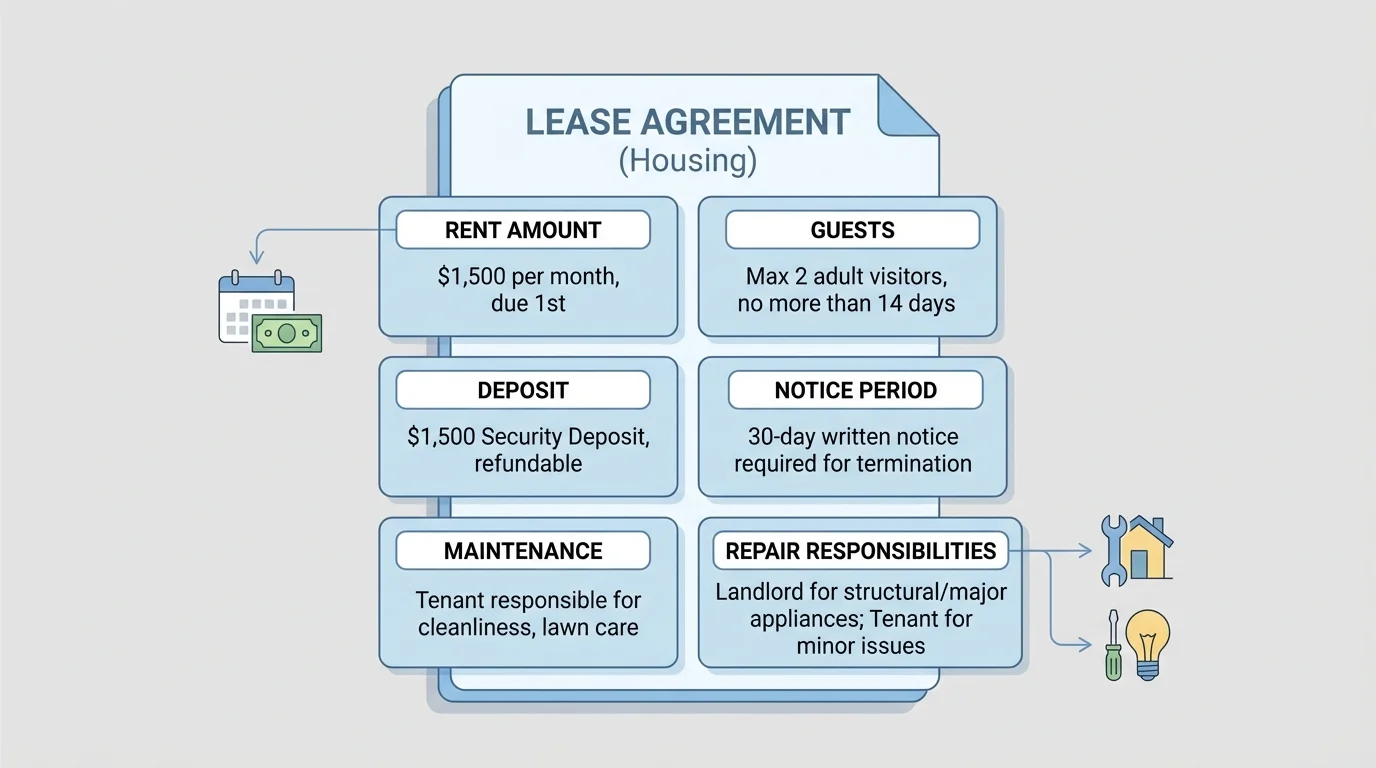
Housing agreements can affect your daily life even more than job paperwork. As [Figure 3] shows, a lease is a contract that explains the terms of renting a place to live. Even if you are only renting a room, the written terms still matter.
A lease usually includes rent amount, due date, security deposit, lease length, guest rules, maintenance responsibilities, late fees, and move-out requirements. If rent is $800 and the late fee is $50 after the fifth day, paying on day six may mean you owe $850, not just $800. Small details can cost real money.
Tenants often have the right to a habitable living space. That usually means basics such as working water, heat when required, safe structure, and necessary repairs. A landlord generally cannot just collect rent and ignore dangerous conditions. On the other hand, tenants usually must pay on time, follow lawful lease rules, and avoid damaging the property.
Privacy matters too. In many places, landlords cannot enter whenever they want unless there is an emergency. They often must give notice before entering. Rules differ by location, but the general principle is that renting out a property does not give a landlord unlimited access to your living space.
Another important protection is fair housing. Fair housing laws limit discrimination in renting and housing-related decisions. A landlord should not reject someone for unlawful discriminatory reasons or advertise housing in a way that excludes protected groups.
Be careful with deposits and move-in promises. If a listing says "deposit refundable," ask under what conditions. Take photos when you move in. Save payment receipts. If there is damage already present, record it immediately. Otherwise, you may be blamed for it later.
| Situation | What to Check | Why It Matters |
|---|---|---|
| Signing a lease | Rent, deposit, term length, late fees | These control your monthly cost and obligations |
| Moving in | Photos, inspection notes, receipts | These protect you in deposit disputes |
| Repair problem | Lease terms, notice sent, response time | These show whether the landlord is meeting duties |
| Roommate arrangement | Who pays what, guests, shared supplies | These reduce conflict and confusion |
Table 1. Practical checks tenants should make in common housing situations.
Housing scams are common online. If someone refuses to show the property, pressures you to send money immediately, or claims they are "out of the country" but want a deposit today, slow down. A contract does not protect you if the other party is fake.
Why contracts matter in both work and housing
In jobs and housing, contracts turn assumptions into terms. They answer questions such as: How much will be paid? What happens if someone is late? Who handles repairs? What conduct is allowed? Without clear terms, disagreements often turn into one person's word against another's.
When lease disputes arise, [Figure 3] remains useful because most problems connect back to a few core categories: money, maintenance, notice, and who is responsible for what.
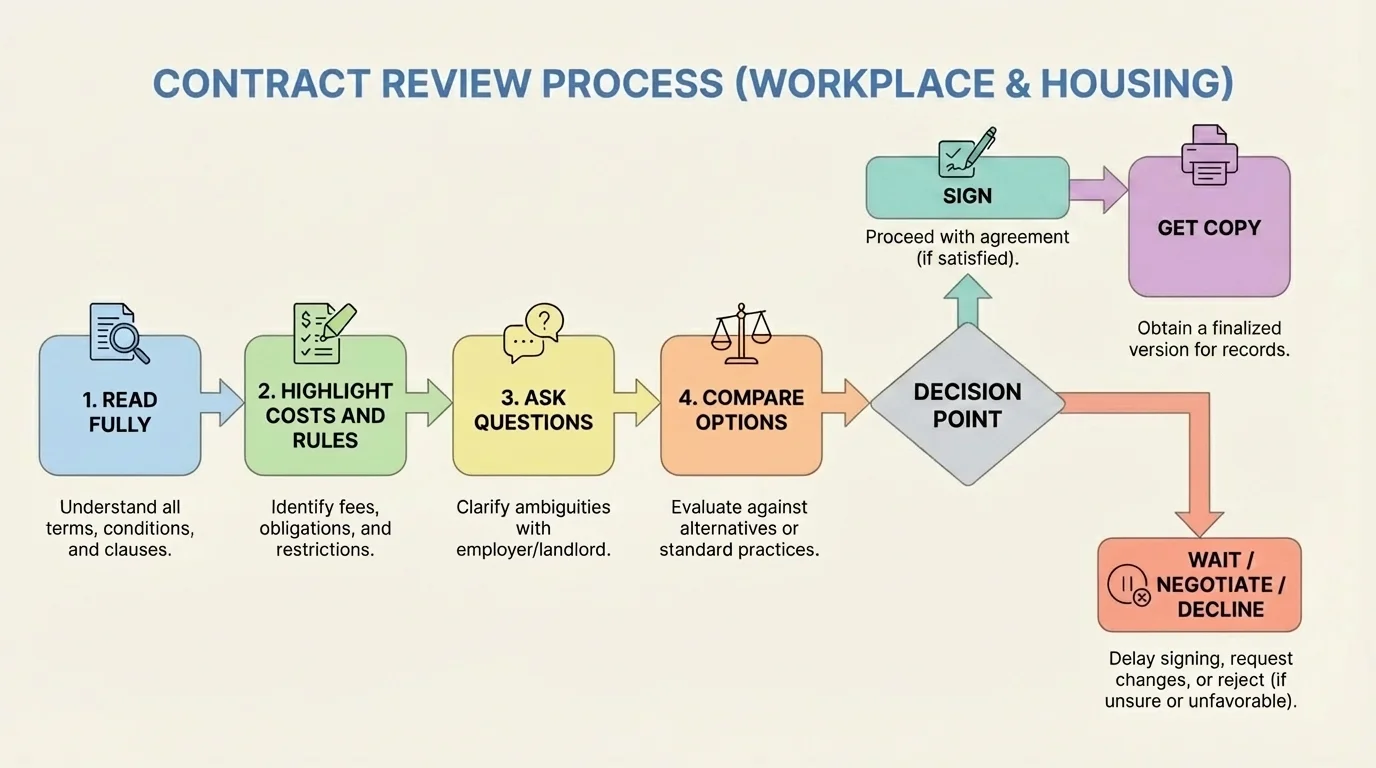
You do not need to be a lawyer to review an agreement well. As [Figure 4] shows, you need a system. This review process gives you a repeatable way to slow down, spot risk, and protect yourself before signing a work or housing contract.
First, read the entire document, not just the highlighted parts or the summary someone gives you. If it is long, read it in sections.
Second, mark every number: pay rate, rent, fees, deposit, due dates, penalties, notice periods, and renewal terms. These details usually control the biggest consequences.
Third, identify responsibilities on both sides. Ask: What am I required to do? What is the other party required to do? If one side has many duties and the other side has vague promises, be cautious.
Fourth, circle vague language. Words like "as needed," "reasonable," or "subject to change" are not always bad, but they can hide uncertainty. Ask for examples of how the rule works in practice.
Fifth, ask questions before signing, not after. A respectful employer or landlord should be able to explain their own document.
Sixth, get a copy of the signed agreement and store it somewhere safe. A digital copy in cloud storage and one saved on your device is smart.
If you feel rushed, that is information. Pressure can be a warning sign. A fair agreement should still be fair after you take time to read it.
Contract review checklist in action
You are offered a weekend retail job and also considering renting a room during summer work in another town.
Step 1: Compare the money.
The job pays $14 per hour for about \(12\) hours each weekend, so expected weekly gross pay is \(14 \times 12 = 168\), or about $168. The room rent is $500 per month plus a $200 deposit.
Step 2: Compare the rules.
The job agreement says schedules may change with 24 hours of notice. The room lease says overnight guests are not allowed and rent is due on the first day of each month.
Step 3: Identify risks.
If job hours drop, your income becomes less stable. If you miss the rent due date, the lease may add fees.
Step 4: Ask targeted questions.
For the job: "What is the typical hour range each month?" For the room: "Under what conditions is the full deposit returned?"
Good decisions come from comparing terms, not just reacting to the opportunity.
When you use the process from [Figure 4], you are doing more than reading. You are analyzing power, cost, and responsibility before they turn into stress.
Even careful people run into problems. What matters is how you respond. Start by documenting facts: dates, times, screenshots, receipts, messages, photos, and copies of agreements. Keep your notes organized.
Then communicate clearly. Use short, factual messages. For example: "The lease states that repairs to plumbing are the landlord's responsibility. I reported the leak on April 2 and again on April 5. Please confirm the repair schedule." Or: "My time log shows 23 hours last week, while the payroll record shows 20. Please review the attached record."
If direct communication fails, look for the next correct step: human resources, a labor board, housing office, tenant support group, fair housing agency, legal aid, or another trusted community resource. Which option fits depends on the problem.
Do not rely only on phone calls if the issue is serious. Written records are usually stronger. If a conversation happens by phone or video call, write down what was said immediately afterward and send a brief follow-up message confirming it.
Proof is often more persuasive than opinion. In legal and administrative settings, your screenshots, contracts, logs, and receipts can matter more than a vague memory of what happened.
Also protect your safety and privacy. Do not post every conflict publicly on social media while the issue is still being addressed. Public posts can complicate disputes and sometimes create new problems. Private documentation is usually more useful than public drama.
Understanding labor rights and housing contracts is not only personal protection. It is community knowledge. When people understand legal basics, communities become less vulnerable to wage theft, unsafe work, housing scams, and discriminatory treatment.
Civic engagement can look practical and local. You might help a family member read a lease, share official worker-rights resources with a friend starting a first job, or encourage someone to document a repair issue instead of only complaining about it. Small actions build stronger legal awareness.
This knowledge also shapes your future choices. Whether you become an employee, tenant, manager, landlord, business owner, or voter, you will interact with systems of rules and agreements. Learning to analyze rights and contracts now gives you a major advantage later.
"Read before you agree, record what happens, and ask questions while you still have choices."
That habit is one of the clearest signs of responsible adulthood. It protects your money, your safety, your time, and your voice.
