Plenty of people graduate with a diploma but still feel unprepared for what comes next. That is not because they are incapable. It is usually because life after high school requires more than good grades. You need to manage deadlines without reminders, communicate professionally, make money decisions, handle paperwork, and take care of yourself when no one is structuring every hour for you. Readiness is not about having your whole future figured out. It is about knowing where you stand and being honest about what you still need to build.
The transition after high school can move fast. One month you are finishing courses online, and the next month you may be comparing college programs, starting a job, paying for gas, scheduling a doctor's appointment, or trying to understand a lease. Students who assess their readiness early usually make stronger decisions because they know their real skills instead of guessing.
Being prepared does not mean being perfect. It means you can handle basic responsibilities, recognize when you need support, and take action before a small problem becomes a major one. For example, missing one online assignment might lower a grade. Missing one college financial deadline could delay enrollment. Showing up late to a video interview once might cost you a job opportunity. Adult responsibilities have consequences that are often immediate.
Readiness means being prepared to meet the demands of a new situation with the skills, habits, knowledge, and support you need. Self-assessment is the process of honestly evaluating your current strengths and areas for growth.
The good news is that readiness can be developed. You do not need to already know everything about college, careers, housing, transportation, or money. You do need the willingness to check your current level, learn what you do not know, and practice adult skills before the pressure gets higher.
[Figure 1] Life after high school usually falls into three connected areas: academic, work, and daily living. These areas overlap more than most people realize. If your time management is weak, that can hurt your college coursework, your job attendance, and your ability to pay bills on time. If your communication skills are strong, they help in all three areas.
Post-secondary education includes options after high school such as a four-year college, community college, trade school, certificate program, apprenticeship, military training, or direct entry into work with continued learning. Choosing among these paths requires more than interest. It requires an honest look at your habits, finances, goals, and level of independence.
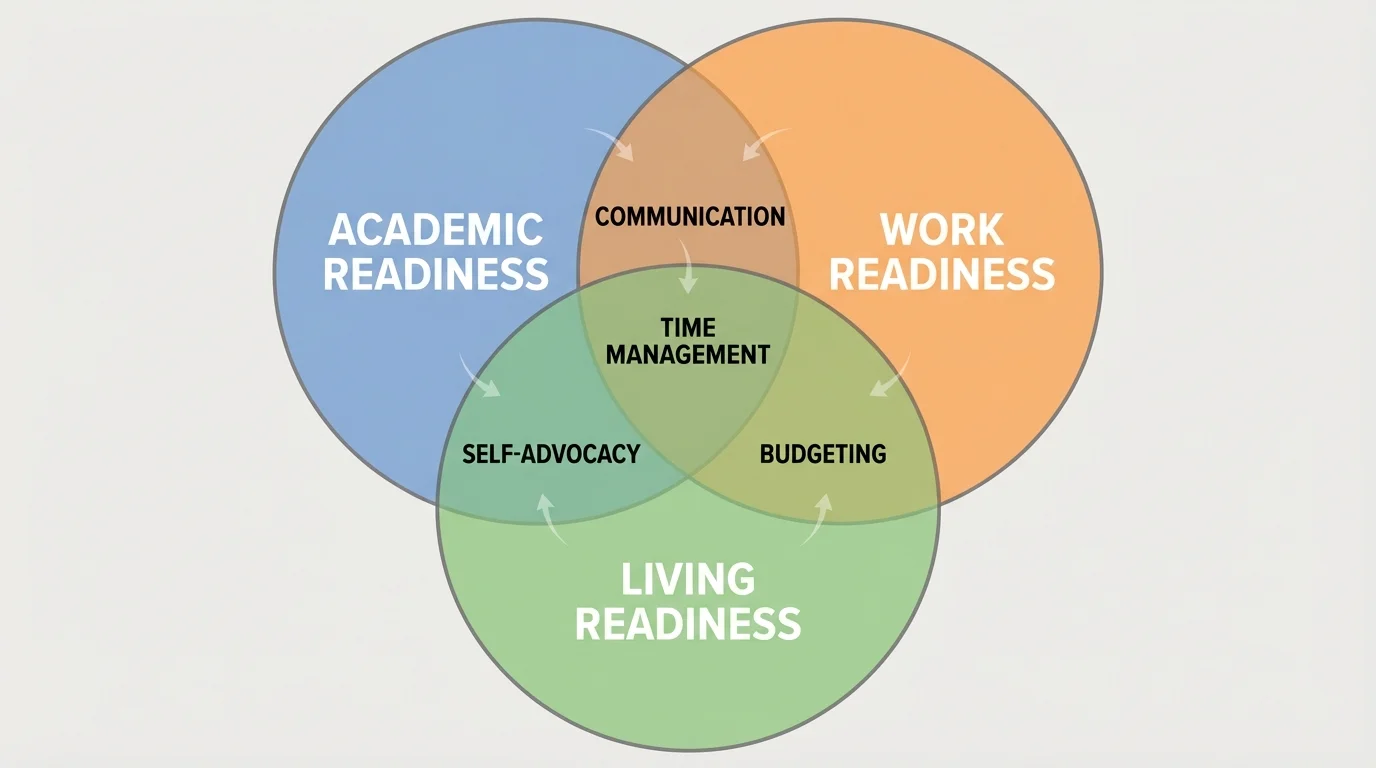
Think of readiness like a three-part system. Academic readiness is about learning and follow-through. Work readiness is about reliability, professionalism, and financial responsibility. Living readiness is about managing daily life safely and responsibly. Weakness in one area often creates stress in the others.
Many first-year college students say the hardest adjustment is not the class content. It is managing time, keeping track of deadlines, and handling life tasks without frequent reminders.
This is why a readiness check should be practical. Instead of asking only, "What do I want to do?" also ask, "What can I handle right now?" and "What do I need to practice before I commit to the next step?"
Academic readiness is not just about whether you can pass classes. It is about whether you can learn independently, stay organized, and communicate when problems come up. In online and post-secondary settings, people often expect you to read directions carefully, track deadlines yourself, and ask clear questions before a problem becomes urgent.
Ask yourself whether you can do the following consistently: meet deadlines without repeated reminders, keep digital files organized, participate professionally in email or course messages, study even when you do not feel like it, and recover after a setback instead of shutting down. If you struggle in these areas now, that does not mean college or training is impossible. It means you need a plan.
One major skill is self-advocacy. This means speaking up for what you need in a respectful and responsible way. For example, if you are confused by an assignment, self-advocacy is emailing the instructor early, explaining what you understand so far, and asking a specific question. It is not waiting until the last hour and saying, "I do not get any of this."
Practical example: academic readiness in action
You are considering a community college program that requires weekly discussion posts, quizzes, and reading assignments.
Step 1: Check your current habits.
Can you log in daily, track assignments in one place, and complete work even when nobody reminds you?
Step 2: Check your communication habits.
Can you write a polite message, attach a document correctly, and respond within a reasonable time?
Step 3: Check your persistence.
When work gets difficult, do you make a plan, ask for help, and keep going?
Step 4: Decide what needs improvement.
If your weak spot is organization, set up one calendar and one assignment tracker before classes start.
Academic readiness also includes understanding the path you are choosing. A four-year degree may offer one set of opportunities. A certificate or apprenticeship may get you into paid work faster. A smart decision is based on fit, not pressure. You should compare cost, time, required skills, expected schedule, and likely outcomes.
Another important factor is executive functioning, which includes planning, prioritizing, starting tasks, and controlling distractions. If you often procrastinate until the last minute, lose track of assignments, or jump between apps while studying, that is a readiness issue worth addressing now.
Work readiness is about more than getting hired. It is about keeping a job, growing in that job, and building habits that make employers trust you. The basic question is simple: if someone pays you, can they count on you?
That includes showing up on time, following directions, asking questions when needed, speaking respectfully, solving small problems independently, and managing your emotions under stress. These skills matter whether you work in retail, health care, construction, technology, food service, child care, or an office setting.
Your professionalism shows in small choices: the tone of your messages, whether you confirm schedules, how you dress for a video interview, and whether you admit mistakes instead of making excuses. A student who says, "I overslept, but I set two alarms now and it will not happen again," sounds more employable than someone who blames everything else.
It also helps to understand the basics of earning and managing money. If a job pays $15 per hour and you work for 12 hours each week, your gross weekly pay is approximately $180 because \(15 \times 12 = 180\). If you work 20 hours each week, your gross weekly pay is approximately $300 because \(15 \times 20 = 300\). Gross pay is not the same as take-home pay, since taxes and deductions reduce the amount you actually receive.
Reliability builds opportunity
Employers often promote and recommend the person who is consistent, not just the person who is talented. Reliability means doing what you said you would do, when you said you would do it, without constant chasing from someone else.
Work readiness also includes job-search skills. Can you write a clear resume? Can you fill out an online application carefully? Can you prepare examples of how you solved a problem, worked with others, or handled responsibility? Can you leave a professional voicemail and check your email regularly? These are everyday employability skills.
Try this: review your email address, voicemail greeting, and social media privacy settings. If a hiring manager saw them today, would they support your image or damage it?
Living readiness is the part students often underestimate. You may be smart and motivated, but if you cannot manage money, food, transportation, health, or personal safety, life becomes unstable fast. Independence does not happen because you turn a certain age. It happens because you learn systems.
Start with money. Can you track what comes in and what goes out each month? If you earn $800 in a month and spend $250 on transportation, $150 on your phone, $180 on food, and $120 on personal items, then your remaining amount is $100 because \(800 - 250 - 150 - 180 - 120 = 100\). If you do not know where your money goes, you are not fully ready to live independently.
A budget is simply a plan for your money before you spend it. It does not have to be complicated. What matters is that it is real. If you estimate low on food, transportation, or subscriptions, your plan will fail even if the math is correct.
| Living Skill | What Readiness Looks Like | What Happens If It Is Weak |
|---|---|---|
| Budgeting | Tracking income, expenses, and savings | Running out of money before the month ends |
| Food management | Planning meals, shopping, storing food safely | Overspending or skipping meals |
| Transportation | Knowing routes, costs, timing, backup plans | Late arrivals or missed commitments |
| Health care | Scheduling appointments, knowing medications, understanding insurance basics | Ignoring health issues or missing care |
| Personal safety | Protecting information, recognizing unsafe situations, setting boundaries | Higher risk of scams or harm |
Table 1. Practical living skills and the consequences of weak preparation.
Living readiness also means handling the boring but important details: laundry, cleaning, refilling prescriptions, replacing documents, checking account balances, and responding to official messages. Adult life is often won or lost on routine, not drama.
Another key skill is financial literacy. This means understanding how money works in everyday life, including bank accounts, debit cards, saving, credit, fees, and bills. If you do not understand a financial decision, pause before agreeing to it. Confusion is a signal to ask questions, not a reason to guess.
Practical example: first-month budget check
You are planning for a month with part-time income of $960.
Step 1: List fixed costs.
Phone bill $60, transportation $140, insurance contribution $80.
Step 2: Estimate flexible costs.
Food $220, personal spending $100, school or work supplies $70.
Step 3: Calculate planned spending.
Planned expenses are $670 because \(60 + 140 + 80 + 220 + 100 + 70 = 670\).
Step 4: Find what remains.
You have $290 left because \(960 - 670 = 290\). Part of that amount should stay unspent for emergencies or future needs.
The same pattern from [Figure 1] appears here too: weak living skills can hurt school and work. If you overspend, you may need extra shifts and lose study time. If your transportation plan is unreliable, you may miss class, work, or appointments.
[Figure 2] A practical readiness audit helps you stop guessing. The process is simple: list the skills that matter, rate yourself honestly, identify your weakest areas, and choose one action for each. This is not about judging yourself. It is about getting accurate enough to improve.
Use a rating scale from \(1\) to \(5\): \(1\) means "I cannot do this yet," \(2\) means "I need a lot of help," \(3\) means "I can do this sometimes," \(4\) means "I usually do this well," and \(5\) means "I can do this independently and consistently."
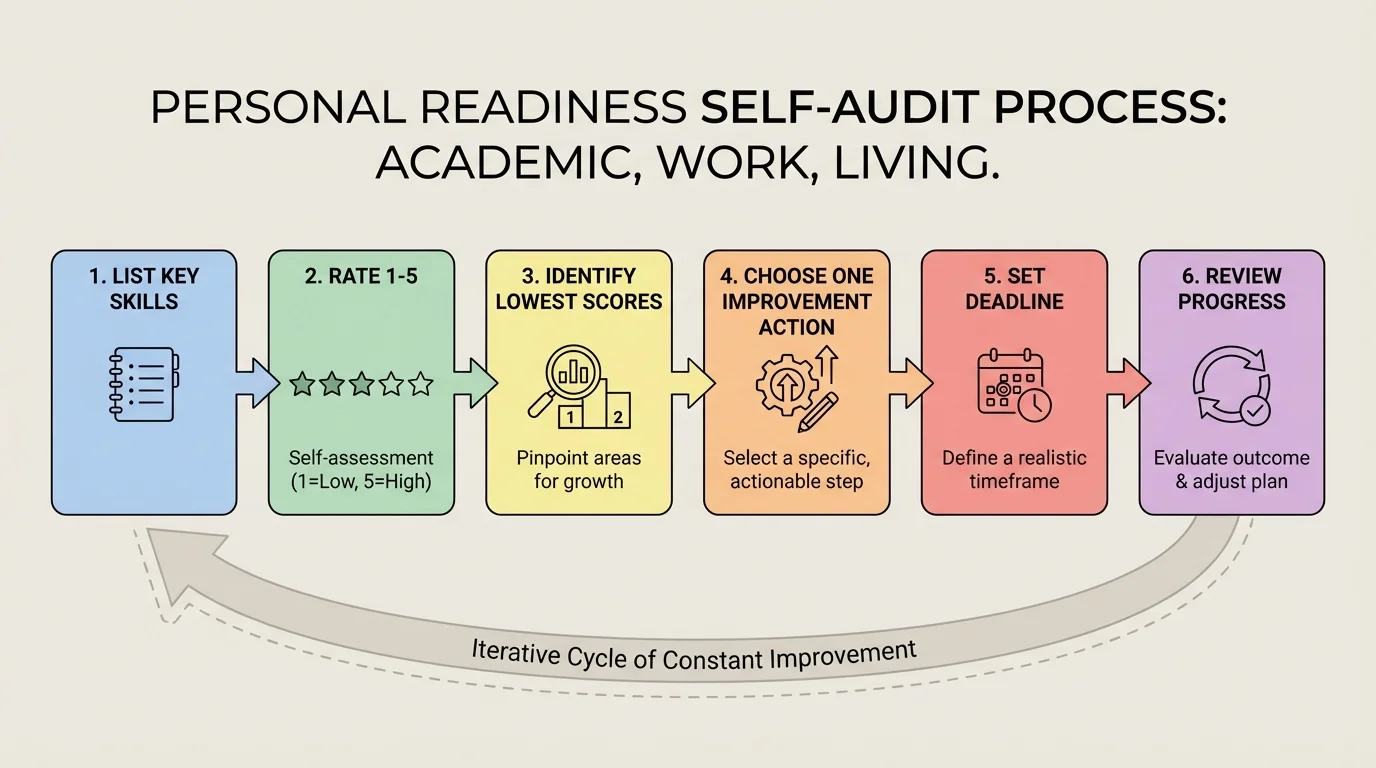
Create three lists: academic skills, work skills, and living skills. Under each list, include specific items instead of vague ideas. For example, write "submit tasks on time," "reply to email professionally," "arrive early," "track spending," and "schedule appointments." Specific skills are easier to improve than general feelings.
After rating yourself, look for patterns. Maybe your academic scores are high but your living scores are low. Maybe you are responsible at work but weak in communication. Maybe you have strong motivation but poor systems. This is useful information.
Then choose priorities. If you gave yourself twelve low scores, do not try to fix all twelve at once. Pick the two or three that create the biggest problems. For many students, the highest-impact areas are time management, budgeting, communication, and transportation planning.
Readiness audit case study
A student rates these skills: meeting deadlines \(2\), waking up on time \(3\), email communication \(4\), budgeting \(2\), cooking simple meals \(3\), job interview confidence \(2\).
Step 1: Identify the weakest scores.
The lowest scores are meeting deadlines, budgeting, and interview confidence.
Step 2: Pick one action per weak area.
For deadlines: use one calendar with alerts. For budgeting: track every expense for two weeks. For interviews: practice answering five common questions on video.
Step 3: Set a deadline.
Each action should have a review date within the next \(7\) to \(14\) days.
Try this: complete your audit in one sitting, but revisit it monthly. Readiness changes as your responsibilities change. A skill that felt strong during high school may become weak when your schedule gets busier.
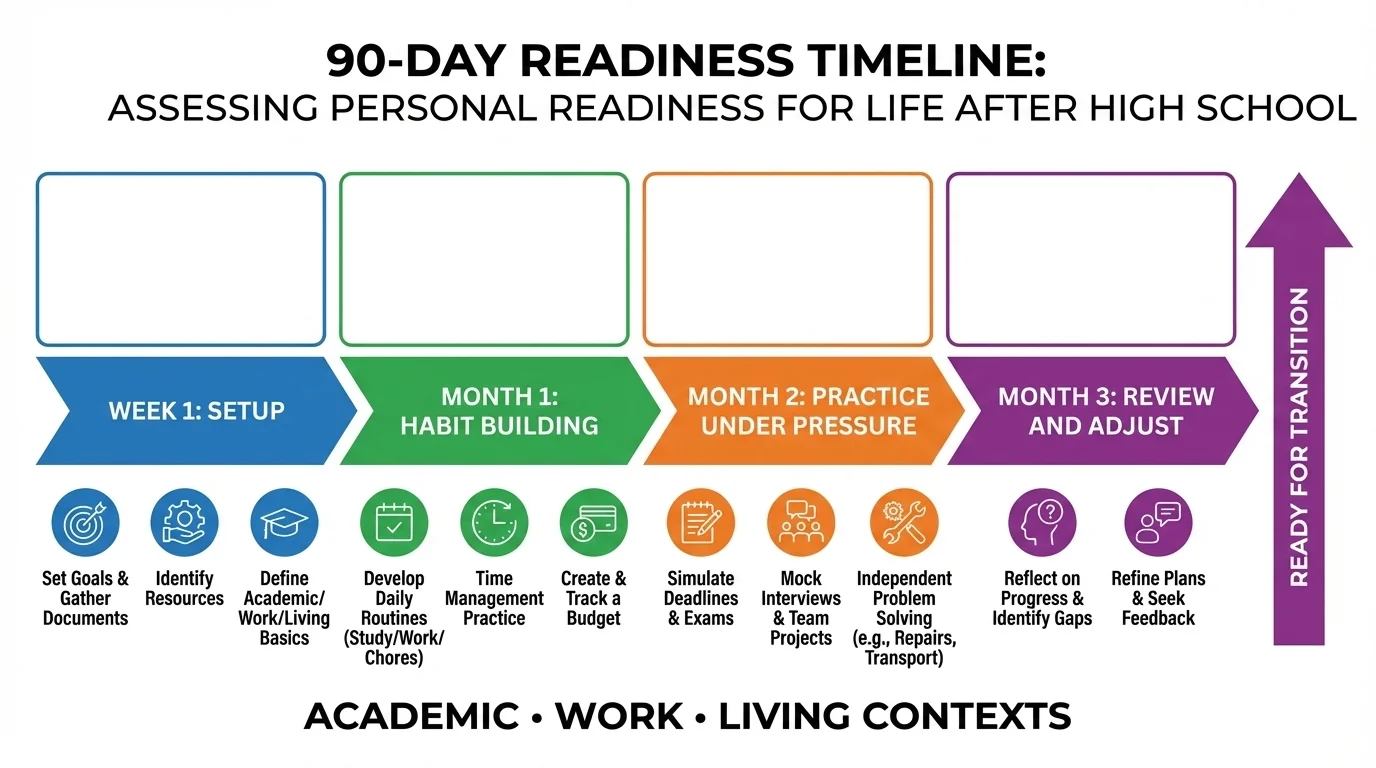
[Figure 3] Once you know your gaps, turn them into a short plan instead of a vague promise. A 90-day window works well because it is long enough to build habits but short enough to stay real. Breaking that period into the first week, first month, and following two months makes progress easier to manage.
In the first week, focus on setup. Build your calendar, gather important documents, update your resume, make a simple budget, and create a list of accounts, passwords, and deadlines in a secure system. In the first month, focus on repetition. Practice waking up on time, cooking a few low-cost meals, checking email daily, and tracking spending. In months two and three, focus on pressure testing. Handle a busy week, complete applications, attend interviews, and manage your routine without last-minute scrambling.
A strong plan uses actions that are visible and measurable. "Be more responsible" is too vague. "Check calendar at \(8\) a.m. and \(8\) p.m. every day" is measurable. "Save money" is vague. "Move $25 to savings each payday" is measurable.
You can also use a simple progress formula: completed actions divided by planned actions. If you planned \(10\) actions this month and completed \(7\), your completion rate is \(\dfrac{7}{10}\), which is \(70\%\). That number is not there to shame you. It tells you whether your plan is realistic and whether your habits are improving.
Small systems beat big motivation
Most adult responsibilities are handled by routines, reminders, and checklists, not by waiting to feel inspired. A simple system you use every day is more powerful than a perfect plan you ignore.
Later, when you review your progress, the timeline helps you see whether the problem happened during setup, habit-building, or follow-through under pressure. That matters because each problem has a different fix.
Being ready for adulthood does not mean doing everything alone. Strong adults know when to ask for help. The key is asking in a useful way. Instead of saying, "I do not know what I am doing," try, "I compared two training programs, but I need help understanding cost and schedule differences." Specific questions get better answers.
Your support system might include a parent or guardian, counselor, mentor, employer, older sibling, coach, or trusted community adult. Since you learn online, part of your network may also be digital: instructors, advisors, program staff, or professional contacts you communicate with by email or video call. What matters is that you know who you can contact for different problems.
Decision-making gets easier when you compare choices side by side.
| Option | Best For | Questions to Ask |
|---|---|---|
| Four-year college | Students ready for a longer academic path | Can I manage the workload, cost, and independence? |
| Community college | Students seeking lower cost or flexible entry | What support services and transfer options exist? |
| Trade or certificate program | Students wanting targeted job skills | What are the completion rate and job outcomes? |
| Work first | Students needing income or experience now | How will I keep learning and advancing? |
| Apprenticeship | Students who learn best by doing | What are the entry requirements and schedule demands? |
Table 2. Common post-high-school pathways and practical comparison questions.
Avoid two common mistakes. First, do not choose a path just because other people expect it. Second, do not avoid a good opportunity because you feel embarrassed about needing support. The smart move is the one that fits your goals and your current readiness level.
"Responsibility grows when you stop asking whether something is fair and start asking what your next step is."
Try this: choose one adult responsibility you still rely on others to manage for you, such as appointments, transportation planning, or tracking deadlines. Practice taking full ownership of that one responsibility for the next month.
You do not need a perfect life plan to move forward well. You need honesty, systems, and practice. If your readiness is strong in one area and weak in another, that is normal. The goal is not to compare yourself to someone else. The goal is to become more capable than you were last month.
Readiness grows when you pay attention to your habits, not just your intentions. The student who keeps one calendar, checks email daily, follows a budget, prepares for interviews, and asks for help early will usually be more successful than the student with big goals and no structure. Adult life rewards consistency.
Take your future seriously enough to examine it clearly. If you can assess yourself honestly, improve specific weak points, and keep adjusting, you are already practicing one of the most important skills of adulthood.
