Have you ever noticed that some teams seem to get a lot done even when no one is the "formal leader," while other teams get stuck even when everyone is talented? It's usually two habits: initiative and reliability. These habits change how people work together, how fast problems get solved, and whether a team feels stressful or strong.
In real life, teams show up everywhere. You might work with siblings to prepare for a family event, help organize a youth group activity, join an online gaming team, collaborate in a virtual club, or complete a shared project through an online platform. In all of these situations, the outcome depends on how people act together, not just on what each person can do alone.
A team can have smart, creative, skilled people and still struggle if no one starts important tasks, checks in, or follows through. On the other hand, a team with ordinary skills can do very well when members step up early and keep their promises. That is why understanding teamwork means looking at behavior, not just ability.
Initiative means noticing what needs to be done and taking useful action without always waiting to be told.
Reliability means being someone others can count on to do what you said you would do, on time and with care.
Teamwork outcomes are the results a team produces, such as finishing a task, solving a problem, meeting a deadline, or building trust.
These ideas matter because teamwork is not just about getting a task done. It also shapes feelings. When team members act with initiative and reliability, people usually feel calmer, more respected, and more motivated. When those habits are missing, people often feel annoyed, confused, or overwhelmed.
Initiative is not the same as bossiness. It does not mean you control every decision. It means you notice a need and respond in a helpful way. For example, if your group chat has gone quiet and a deadline is close, taking initiative might mean sending a clear message like, "I made a checklist so we can divide the tasks. I can take the intro section if someone else wants the images and editing."
Reliability is more than saying "I'll do it." It includes doing the task, doing it well enough to help the group, and doing it by the time you promised. If you agree to upload your part by Tuesday night, reliability means your teammates do not have to chase you down on Wednesday morning.
When you combine these two traits, you become the kind of teammate people trust. You do not wait forever, and you do not disappear after volunteering. You act, and then you follow through.
Teams often remember dependable people more than flashy people. A person who quietly finishes tasks, communicates clearly, and helps solve problems can become one of the most valuable members of any group.
This is one reason leadership is not only about titles. A person can lead a team forward simply by noticing what is needed and helping others move with confidence.
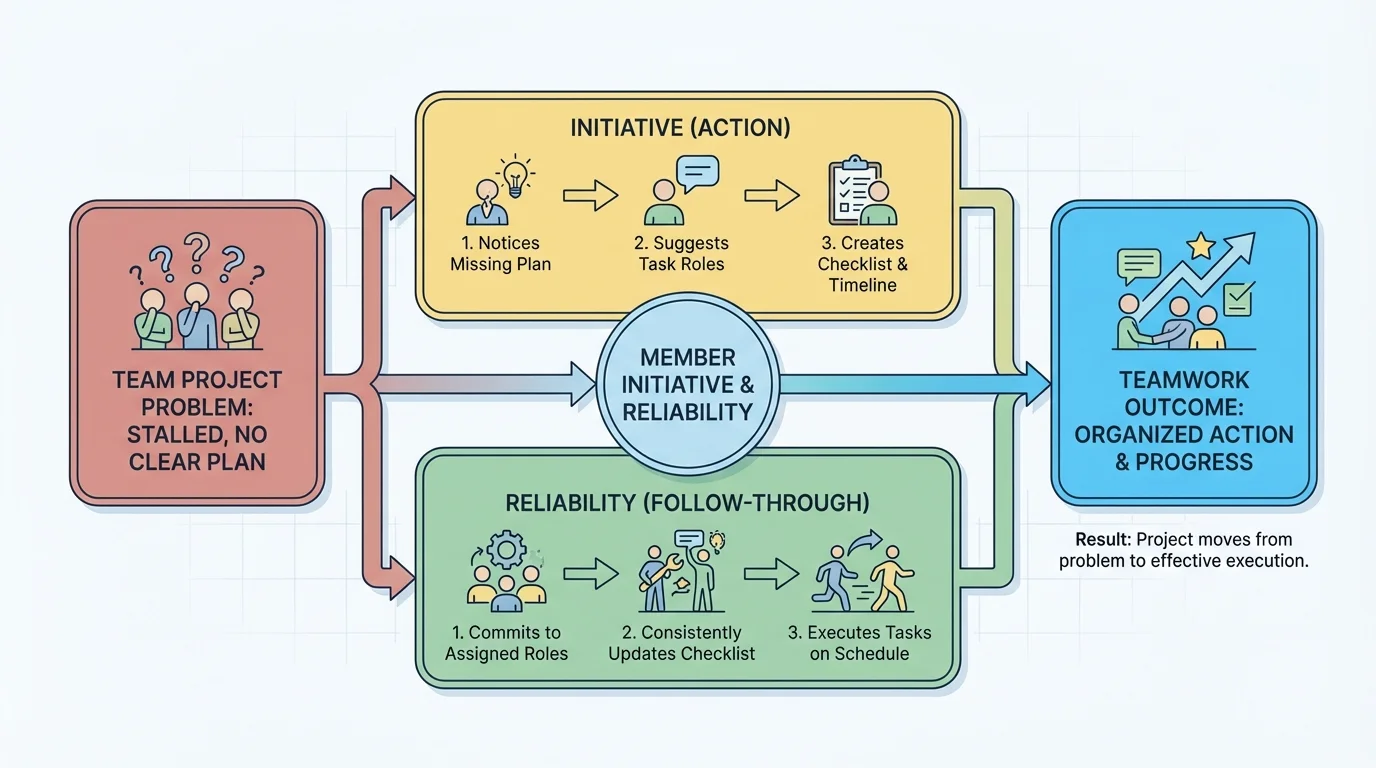
Momentum often begins when someone takes initiative, as [Figure 1] shows through a problem-to-action sequence. Teams often stall because everyone is waiting for someone else to begin. When one person starts with a useful step, the group has something real to respond to.
Initiative improves outcomes in several ways. First, it saves time. Instead of letting confusion grow, a team member asks a clarifying question, sets up a shared note, or suggests a plan. Second, it reduces stress because people know what is happening. Third, it can uncover problems early, before they become emergencies.
For example, suppose three students are creating a short video for a community contest. No one has chosen roles yet, and the deadline is in four days. A teammate with initiative might say, "I made a simple plan: script today, recording tomorrow, editing the next day, final review on the last day." That one action gives the team structure.
Initiative also helps when something goes wrong. If a file disappears, a speaker cannot attend, or a task turns out harder than expected, someone with initiative does not just complain. They think, "What can I do next?" That attitude keeps the team from freezing.
Still, initiative works best when it includes respect. Helpful initiative sounds like, "Here is an idea," "I can get us started," or "What if we split this job this way?" Unhelpful initiative sounds like, "I'm doing everything my way." The first builds teamwork. The second can damage it.
Initiative creates movement. Teams often lose energy when members are uncertain, passive, or waiting for instructions. A small useful action, like making a task list, sending a reminder, or offering a solution, can break the delay and help everyone start contributing.
Later, when your team faces another delay, the pattern in [Figure 1] still applies: one thoughtful action can turn a stuck group into a working group. This is why initiative is often the spark that starts progress.
Trust grows when teammates know they can depend on one another, and [Figure 2] shows how steady follow-through creates a very different pattern from missed tasks and late updates. Reliability is powerful because teamwork depends on connection. One person's unfinished task often slows everyone else down.
If you are editing a shared video, you may need another person's audio first. If you are making a digital poster, the person creating the images must finish before the person assembling everything can complete the final version. In teamwork, many jobs connect like links in a chain.
Reliable people make a team stronger because they reduce uncertainty. Their teammates do not waste time wondering, "Did they forget?" or "Should I do their part too?" That saved energy can go into better work instead of worry.
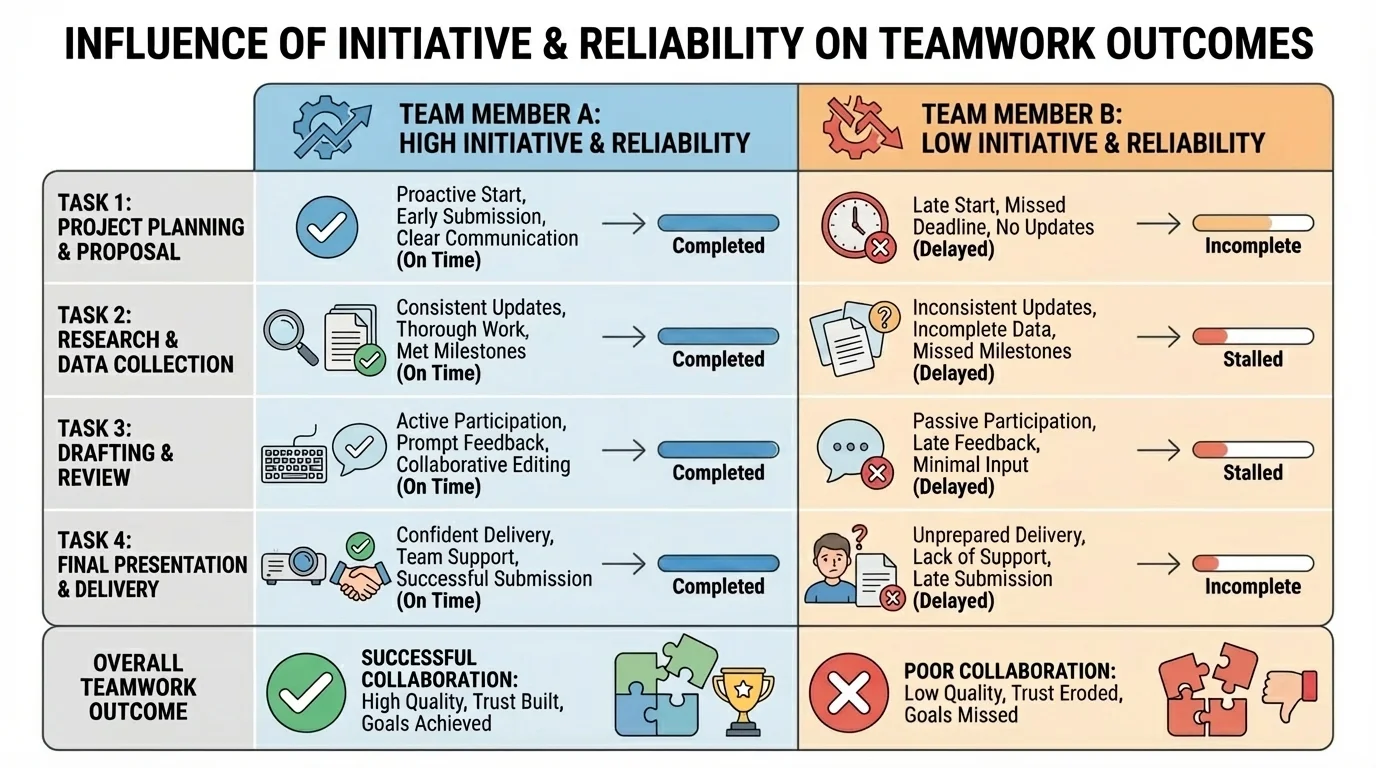
Reliability also builds reputation. People begin to think, "If they say they'll handle it, I believe them." That kind of trust can lead to more opportunities, more respect, and smoother teamwork in the future.
When reliability is missing, the opposite happens. Deadlines get missed. Teammates become frustrated. Someone else has to rush and cover the missing work. Even if the final project gets done, the process feels tense and unfair.
Case study: A reliable teammate vs. an unreliable teammate
Step 1: Two friends join a neighborhood clean-up planning team online. Each person agrees to design one flyer and send it by Thursday.
Step 2: The reliable teammate finishes early, asks if any edits are needed, and stays available. The unreliable teammate does not respond until Friday and says they were "going to do it."
Step 3: The organizer has to rush, redesign the second flyer, and delay posting the event.
The reliable teammate improves the team outcome by saving time and reducing stress. The unreliable teammate makes the whole team less effective, even without meaning to.
As the pattern in [Figure 2] makes clear, consistency matters more than one big effort. Teams usually prefer steady help over occasional bursts followed by silence.
It is possible to have initiative in the wrong way. A person might interrupt others, assign jobs without asking, or redo everyone's work because they do not trust the team. That can make teammates feel ignored. Good initiative solves problems while still respecting the group.
It is also possible to seem reliable without actually helping much. For example, someone may always respond quickly but do low-quality work that others must fix. True reliability includes both timeliness and care.
Here are common teamwork problems and what they often lead to:
| Behavior | What it looks like | Likely outcome |
|---|---|---|
| Low initiative | Waiting for others, not speaking up, noticing problems but saying nothing | Delays, confusion, missed chances to improve the project |
| Unhelpful initiative | Taking over, ignoring ideas, making decisions alone | Conflict, resentment, weaker teamwork |
| Low reliability | Missing deadlines, forgetting tasks, inconsistent quality | Stress, extra work for others, loss of trust |
| Strong initiative and strong reliability | Starting useful actions and finishing promised work | Better results, stronger trust, smoother process |
Table 1. Common teamwork behaviors and the outcomes they often create.
Notice that teamwork problems are not always about bad intentions. Sometimes people are disorganized, distracted, or afraid to speak up. That means these skills can be improved with practice.
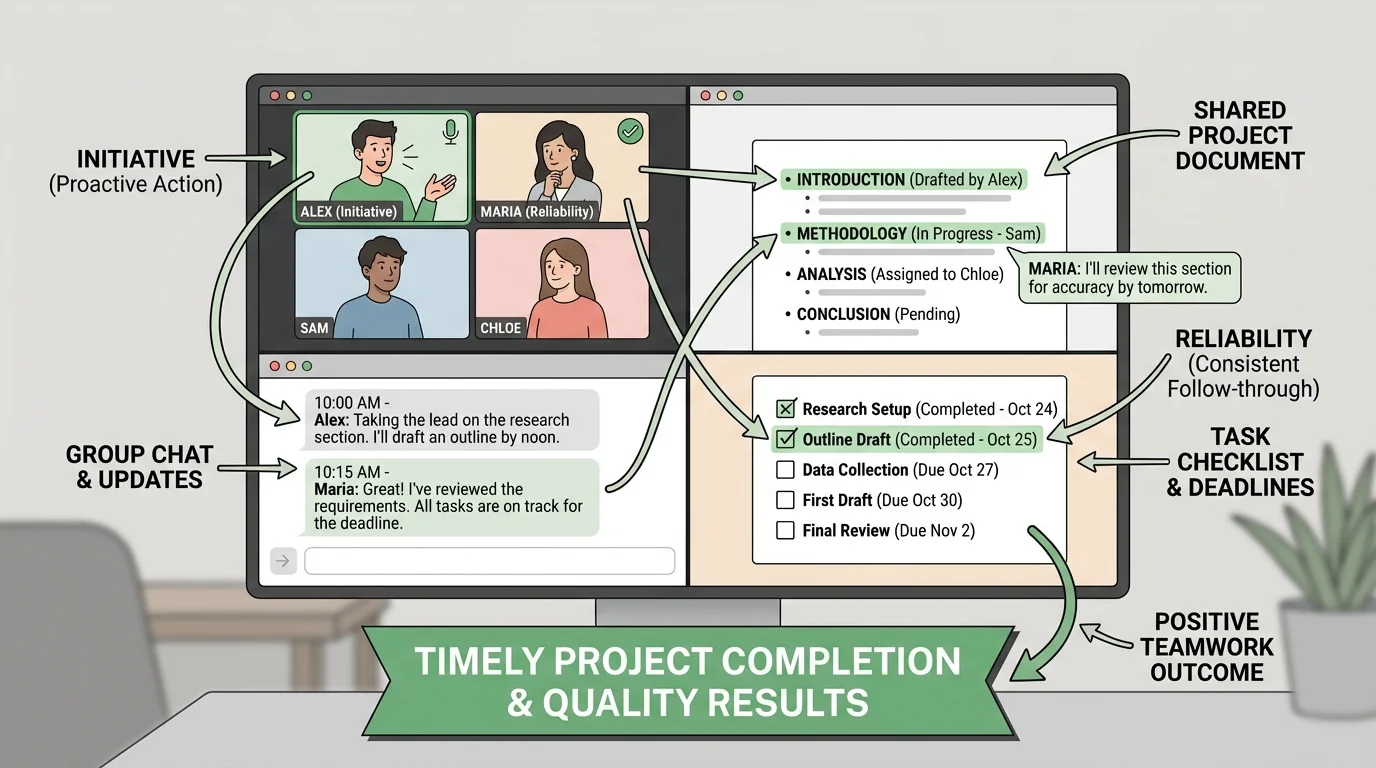
Online teamwork depends even more on visible communication and dependable follow-through, as [Figure 3] illustrates. When people are not in the same room, they cannot easily notice facial expressions, side conversations, or who is already working. This makes initiative and reliability especially important.
In online settings, initiative may look like starting a shared document, posting a clear deadline reminder, or asking a question before confusion grows. Reliability may look like replying within a reasonable time, labeling files clearly, or updating others when your part is done.
Suppose your team is planning a small fundraiser for an animal shelter. One person handles the digital poster, one writes the announcement, and one contacts local supporters. If the poster designer finishes but never uploads the file, the writer cannot match the wording to the design. If the contact person forgets to send messages, turnout may be low. Digital teamwork makes delays more visible because every missing step blocks another step.
Online communication also needs clarity. Messages like "I'll do it later" are not very helpful. Better messages say, "I can finish the draft by 7:00 tonight," or "I need one more day because I'm fixing the sound issue." Specific updates help teams plan around reality.
When you communicate online, people cannot read your mind. Clear messages, shared deadlines, and updates are part of being dependable, not extra details.
Later, if your group chat starts getting messy, think back to the system in [Figure 3]: a clear task list, visible deadlines, and updates in one place often solve problems before they grow.
You do not need a special role to act like a leader. You can show initiative in ways that help everyone. The key is to start action while still inviting others in.
Step 1: Notice what the team needs. Is there confusion about roles? Is a deadline close? Is an important question unanswered?
Step 2: Take one helpful action. Make a checklist, suggest a meeting time, summarize the next steps, or ask a clear question.
Step 3: Include the team. Try phrases like "What do you think?" or "Would this plan work for everyone?" This keeps your initiative cooperative.
Step 4: Stay flexible. If someone has a better idea, support it. Initiative is about helping progress, not protecting your own plan.
Helpful phrases for initiative
Step 1: Start the conversation: "I noticed we haven't picked roles yet. Want me to make a quick list?"
Step 2: Offer support: "I can take the first part if someone else wants the final review."
Step 3: Keep others included: "Does anyone want to change this plan before we lock it in?"
These phrases help you move the group forward without sounding controlling.
If you tend to stay quiet, remember that initiative does not require a huge speech. Often, one useful message is enough to improve the whole team's direction.
Reliability is a habit. People are not born organized or dependable. They build those habits through small choices repeated over time.
Here are practical ways to become more reliable:
Use one system. Keep your deadlines in one place, such as a planner, notes app, or calendar. If your tasks are spread everywhere, it is easier to forget them.
Break big tasks into small parts. "Finish the slideshow" may feel huge. "Choose images, write captions, check spelling, upload file" is easier to manage.
Under-promise and over-deliver. If you think a task will take two days, do not promise it in one day just to sound impressive.
Communicate early. If something is going wrong, tell the team before the deadline, not after it.
Check your work. Reliable work should be usable. A rushed job that needs to be redone still creates problems for the team.
Reliability is visible. Teammates judge reliability by patterns: meeting deadlines, sending updates, keeping quality steady, and being honest when plans change. Trust grows from repeated evidence, not from promises alone.
If you have been unreliable before, that does not mean people will never trust you again. Trust can be rebuilt by being honest, making smaller promises, and keeping them consistently over time.
To analyze teamwork well, look at the results and ask what behaviors likely caused them. Strong outcomes usually include finished tasks, fair workload sharing, fewer last-minute problems, and respectful communication. Weak outcomes often include confusion, rushed work, tension, and one or two people carrying too much of the job.
When a team succeeds, do not only say, "They worked hard." Be more specific. Maybe someone organized the steps early. Maybe everyone kept deadlines. Maybe a teammate noticed a problem and solved it before it spread.
When a team struggles, do not only say, "They were bad at teamwork." Look for clues. Did people fail to reply? Did no one start planning? Did someone take over so much that others stopped contributing? Good analysis connects behavior to results.
"Trust is built in drops and lost in buckets."
— Common leadership saying
This idea fits teamwork perfectly. A team may need many small reliable actions to build trust, but only a few missed promises to weaken it.
Consider two similar situations. In both, a group of teens is organizing a weekend food drive through an online community page.
Scenario A: One member creates a task list. Another confirms pickup locations. A third schedules reminder posts. Everyone checks in by the agreed time. The result is smooth planning, clear information, and strong attendance.
Scenario B: No one assigns roles. People assume others are handling key tasks. One person volunteers but does not complete their part. Another waits too long to speak up. The result is missing information, stress, and lower participation.
The difference is not luck. It is behavior. Scenario A shows initiative and reliability working together. Scenario B shows what happens when both are weak or inconsistent.
Analyzing a teamwork outcome
Step 1: Look at the result. Was the event organized well or poorly?
Step 2: Identify actions. Who started useful tasks? Who followed through?
Step 3: Connect actions to consequences. Early planning created clarity; missed tasks created delays.
This kind of analysis helps you understand not just what happened, but why it happened.
You can use this same thinking in sports teams, music groups, volunteer projects, family responsibilities, and part-time work later in life. The setting changes, but the habits stay important.
Some students think leadership belongs only to the loudest person or the one in charge. In reality, leadership often looks quieter. It may be the person who sends the reminder, notices missing details, stays calm under pressure, or completes their part every time.
Accountability matters here. Accountability means owning your role and your choices. If you miss a task, you admit it and fix what you can. If you promised help, you give that help. Teams become stronger when members stop making excuses and start taking responsibility.
Being dependable and proactive does not just improve one project. It shapes your character. People begin to see you as someone who can handle responsibility. That matters in friendships, community roles, future jobs, and leadership opportunities.
Try This: The next time you work with others, send one clear message early that helps the group move forward. Keep it short, specific, and useful.
Try This: Choose one promise this week, at home or in a group, and complete it before the deadline instead of right at the deadline.
Try This: If you cannot finish something on time, tell the other person as soon as you know. Honest early communication is more reliable than silence.
Try This: After any team activity, ask yourself two questions: "Where did someone show initiative?" and "Who was reliable?" This helps you notice the link between behavior and results.
