Walk into a grocery store or down a street lined with restaurants, and you may smell many different foods at the same time. You might find tortillas, noodles, rice, soup, bagels, curry, salsa, or cornbread. That is one clue that the United States is a country with many people, many families, and many stories.
The United States is made up of people from many places and backgrounds. Some families have lived here for a very long time. Some families came more recently from other countries. Some families are Native American, and their ancestors were here first. All of these families help make the country what it is today.
When we say a country is diverse, we mean it has many different kinds of people, ideas, and ways of living. People may speak different languages, eat different foods, celebrate different holidays, and tell different family stories. These differences make communities interesting and special.
Culture is the way a group of people may live, celebrate, cook, speak, sing, and share traditions. Traditions are special things families do again and again, such as making a certain food, telling stories, or celebrating a holiday.
Every family is important. Some families may have traditions that are like yours. Some may have traditions that are new to you. In the United States, we can learn from one another.
Culture can be seen in many parts of life. It can be in music, clothing, stories, art, and celebrations. One easy way to notice culture is through food. Families often cook foods that were taught by parents, grandparents, and other family members.
A tradition might be eating soup on a special day, baking bread together, making tamales for a holiday, or sharing noodles at a family dinner. These foods are more than something to eat. They can help families remember where they come from and who they are.
Some foods people think of as everyday American foods came from many different cultures. Pizza, tacos, bagels, and fried rice all have origins in the traditions of different cultures.
When families share foods with neighbors and friends, other people get to learn too. This is one way cultures meet and mix in the United States.
Foods can show the diversity in the community around us, and [Figure 1] shows how one table can hold foods from many cultures at the same time. A neighborhood may have a bakery, a taco shop, a pizza place, a market with rice and spices, and a restaurant that serves dumplings or curry.
Each food has a story. Tacos may connect to Mexican traditions. Dumplings may connect to Chinese or other Asian traditions. Pizza may connect to Italian traditions. Cornbread can connect to traditions in the American South. Fry bread may connect to Native American communities. Bagels may connect to Jewish family traditions.
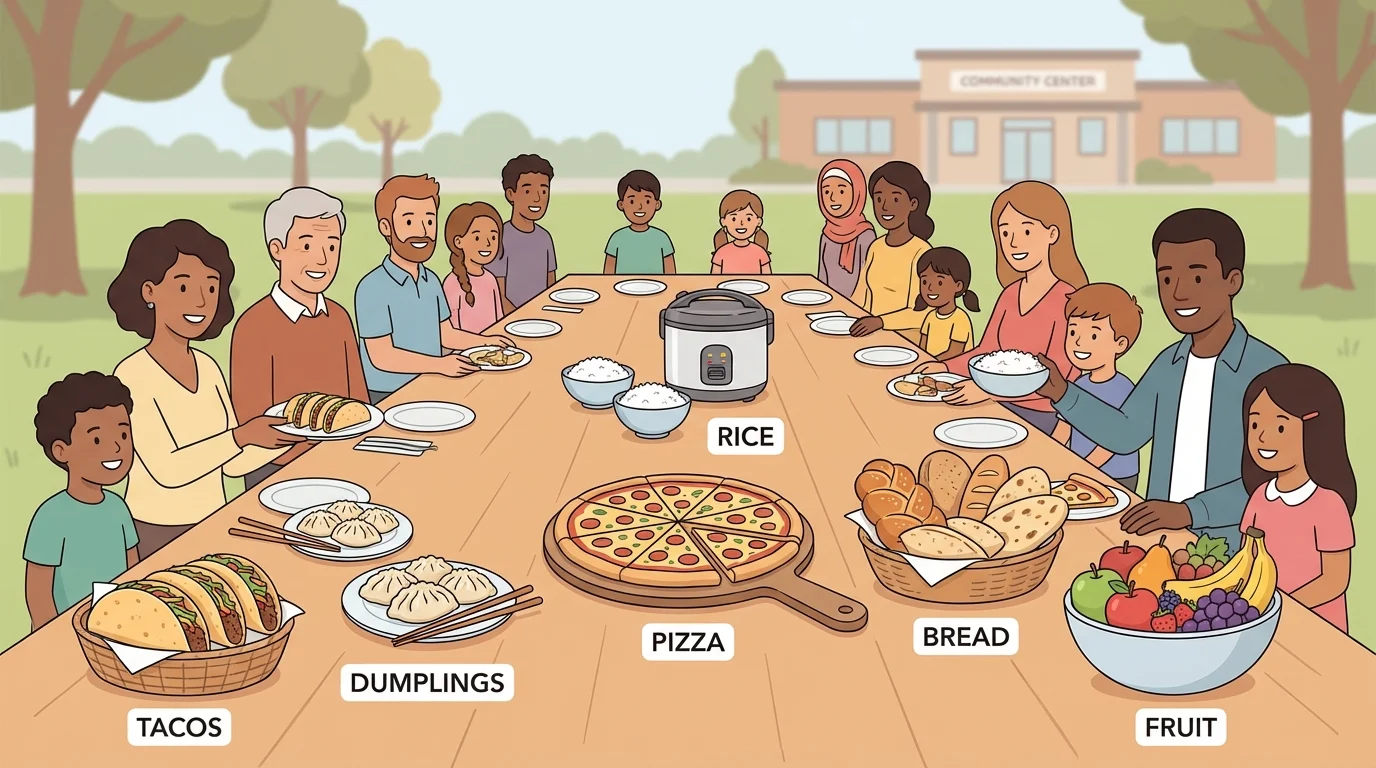
Sometimes foods change a little when families share them in new places. A recipe may use local fruits or vegetables. A family may mix two food traditions together. This shows that culture is alive and growing.
In many towns, people enjoy foods from cultures that are not their own. This helps neighbors learn about one another. Later, when we think again about the shared table in [Figure 1], we can see that food is one way people welcome others and build friendships.
In a local community, children may see many kinds of foods. One family might pack rice and beans for lunch. Another might bring a sandwich. Another might eat noodles, tortillas, chapati, soup, or fruit with cheese. None of these foods is the only right food. They are different, and that is okay.
Grocery stores often have foods from many places too. You may see tortillas, soy sauce, pasta, plantains, pita bread, beans, spices, and different kinds of rice. This shows that people in the United States enjoy foods from many cultures.
| Food | May connect to | What it shows |
|---|---|---|
| Tacos | Mexican traditions | Families share recipes and celebrations |
| Pizza | Italian traditions | Foods can become popular across the country |
| Dumplings | Chinese and other Asian traditions | Different cultures bring special cooking styles |
| Bagels | Jewish traditions | Family foods become part of community life |
| Cornbread | Southern traditions | Regional foods are part of U.S. diversity |
Table 1. Examples of foods that connect to different traditions in the United States.
When we notice these foods, we may also notice different perspectives. A perspective is a way of seeing and understanding the world. Families may choose foods for special meanings, memories, or celebrations.
The United States did not become what it is from just one group of people. It was shaped by many families from many cultures. Families brought recipes, songs, languages, holidays, and skills. They opened restaurants, farms, shops, and markets. They taught children and neighbors about their traditions.
How families shape a country
When families keep and share their traditions, the whole country changes and grows. New foods become part of daily life. New celebrations become known. People learn new ways to cook, talk, make art, and care for one another.
For example, one town may have a festival with music and foods from many cultures. Another town may have a market where families buy ingredients from around the world. These traditions help make the United States a place with many voices and many ideas.
History is about the past, but it also helps us understand today. The foods we see now in school lunches, stores, and neighborhoods are there because families shared their traditions over time.
Sometimes a food may look, smell, or taste new to us. We can still be kind and respectful. We do not need everyone to eat the same foods or celebrate in the same way. We can listen, ask polite questions, and learn.
Respect means understanding that different does not mean wrong. A classmate's lunch may be different from yours because their family has different traditions. That difference is part of the beauty of living in a diverse country.
Example: Seeing diversity in one neighborhood
A child walks with a parent down one street.
Step 1: They pass a bakery selling bagels.
Step 2: Next they see a restaurant serving tacos and rice.
Step 3: Then they notice a market with noodles, spices, and fruit from different places.
This street shows that many cultures live and share traditions in the same community.
When people share foods and traditions, they help others feel welcome. Communities become stronger when people are curious, kind, and open to learning.
[Figure 2] The history of the land that is now the United States began long ago with Native peoples, and over time many other families came and added their own traditions. This means U.S. history is a story of many groups of people, not just one.
Long ago, Native American peoples had their own foods, farming, languages, and traditions. Later, families came from Europe, Africa, Asia, Latin America, and many other places. They brought foods, ideas, and customs with them. Some people came by choice, and some people, especially many Africans, were forced here in terrible slavery. Their descendants still helped shape the country in powerful ways through food, music, art, work, and community life.
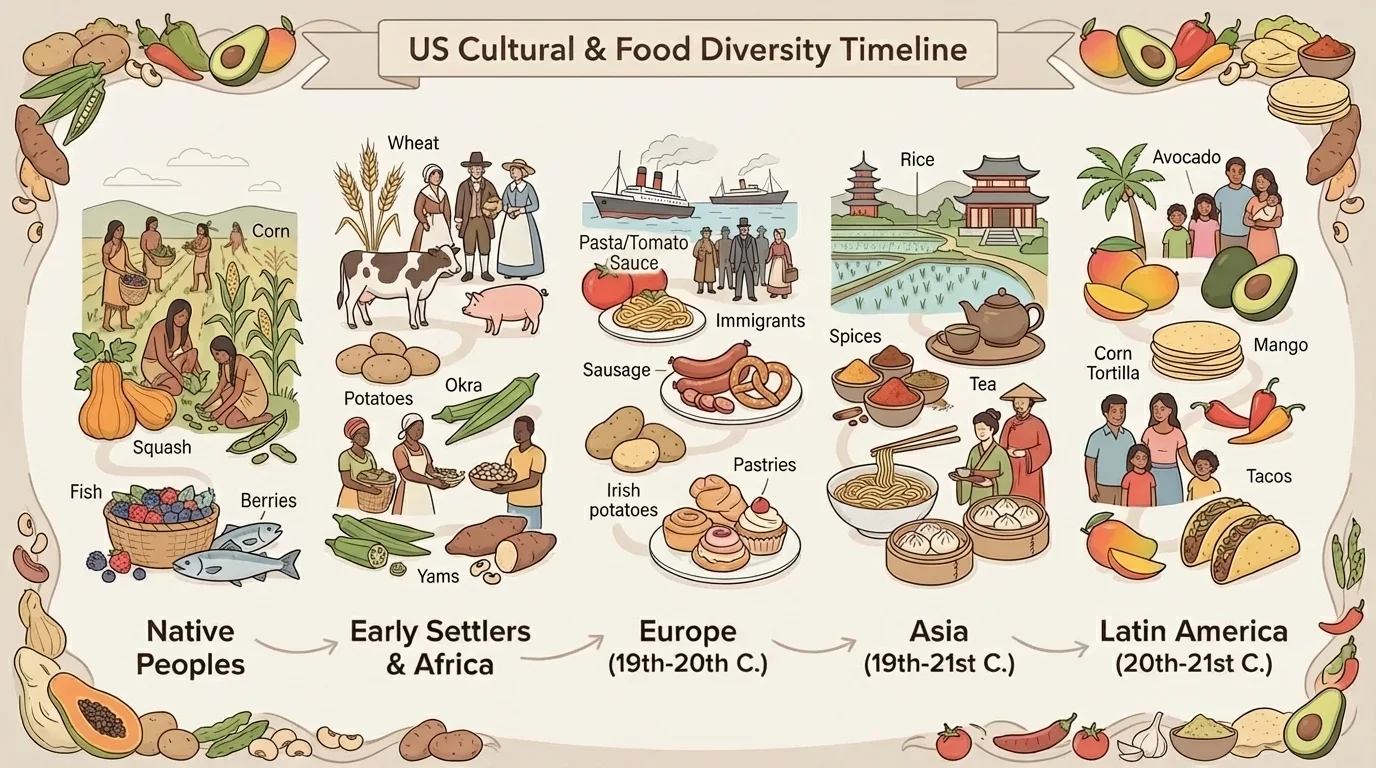
Today, the foods in our neighborhoods connect to that long history. A bowl of noodles, a piece of cornbread, a taco, or a bagel can remind us that many cultures have helped shape the United States.
When we look back at the timeline, we can understand that diversity did not appear all at once. It grew over time as families carried traditions with them and shared them with others.
"We all live with one another, and we all learn from one another."
The United States is stronger because many families and cultures are part of it. The foods in a local community are one clear, everyday example of that rich diversity.
