History can turn on moments that almost did not happen. A colony nearly fails, an army crosses an icy river at night, a war far from London changes life in the colonies, and a group of delegates argues through a hot summer to design a new government. These events were not random. Each had causes, and each created effects that shaped the future of the United States.
When historians study the past, they often ask two big questions: Why did this happen? and What happened because of it? A cause is a reason something happens. An effect is the result that follows. Sometimes one event has many causes and many effects.
For example, if a soccer team changes its plan during a game, there is usually a reason, such as the score or the weather. Then that decision leads to results, such as better defense or more scoring chances. History works in a similar way. People make choices because of problems, hopes, fears, and opportunities. Those choices can change the lives of many people.
Cause means the reason an event happens. Effect means what happens as a result. Historians also look for short-term effects, which happen soon after an event, and long-term effects, which may appear years later.
In early United States history, important events connected like links in a chain. The founding of colonies helped England gain a stronger presence in North America. Competition between European powers led to wars. Those wars increased tensions between Britain and its colonies. Later, after independence, the new nation needed a stronger government. Looking at causes and effects helps us see those connections clearly.
One helpful way to understand these events is to place them in order, as [Figure 1] shows. Seeing the sequence makes it easier to notice how earlier events influenced later ones.
In 1607, Jamestown was established as the first permanent English settlement in North America. From 1754 to 1763, Britain and France fought the French and Indian War. In 1776, during the American Revolution, George Washington crossed the Delaware River and attacked Trenton. In 1787, delegates met at the Constitutional Convention to create a stronger national government.
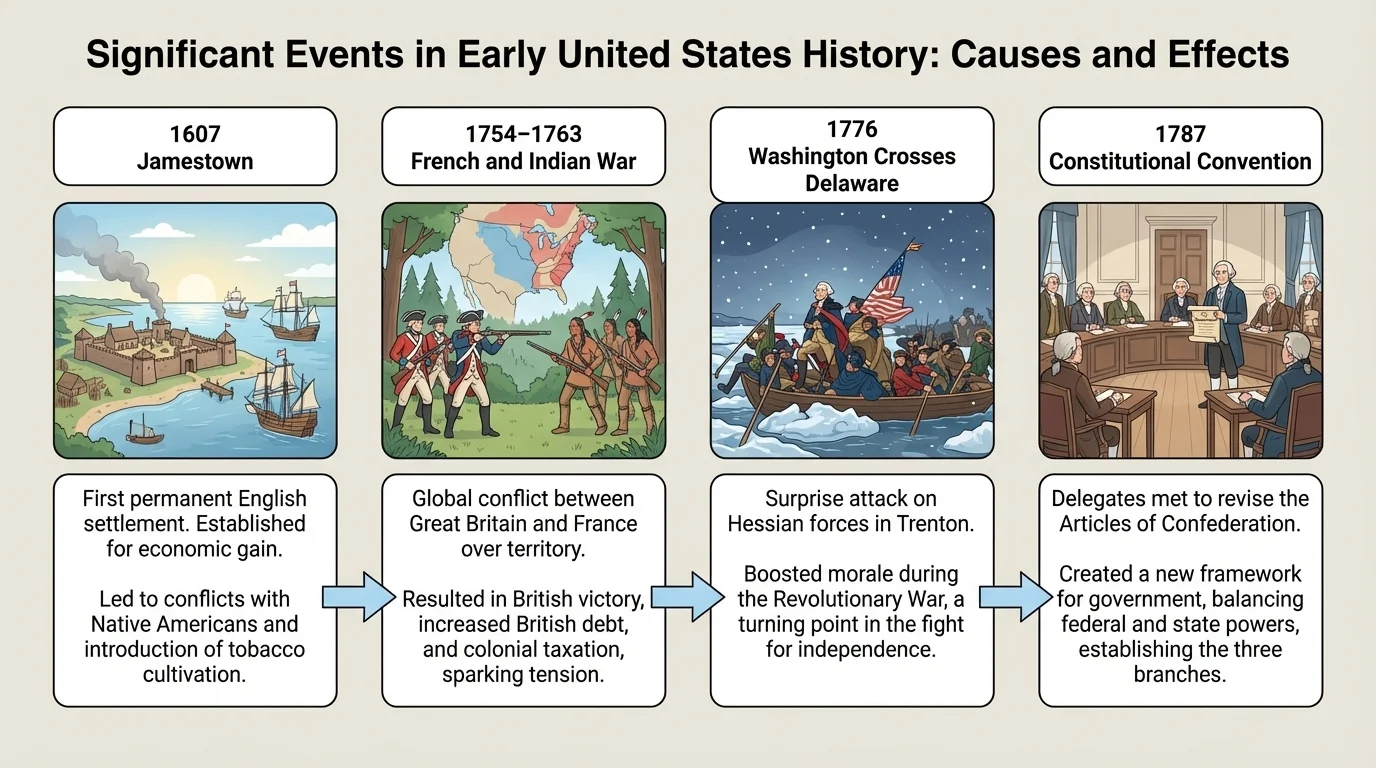
These events are spread out over many years, but they are connected. Colonies had to survive and grow before they could become powerful enough to resist Britain. Britain's victory in the French and Indian War led to debt and new taxes. Those tensions helped spark the Revolution. After the Revolution, the new country faced weaknesses that led to the Constitutional Convention.
| Year or Period | Event | Why It Matters |
|---|---|---|
| 1607 | Jamestown is founded | Begins permanent English settlement in North America |
| 1754–1763 | French and Indian War | Britain defeats France but gains heavy debt |
| 1776 | Washington crosses the Delaware | Boosts American hope during the Revolution |
| 1787 | Constitutional Convention | Creates a stronger United States government |
Table 1. Major early United States events discussed in this lesson and why each is important.
England founded Jamestown in Virginia in 1607 for several reasons, and its location and trading possibilities are easier to understand with [Figure 2]. English leaders wanted wealth, land, and power. They hoped to find gold, discover a route to Asia, and build a profitable colony. England also wanted to compete with Spain and other European countries that were already building empires in the Americas.
Jamestown was started by the Virginia Company, a business group that received permission from the king. Investors gave money because they believed the colony could make profits. This is an important cause: Jamestown was not only a place to live. It was also a business project.
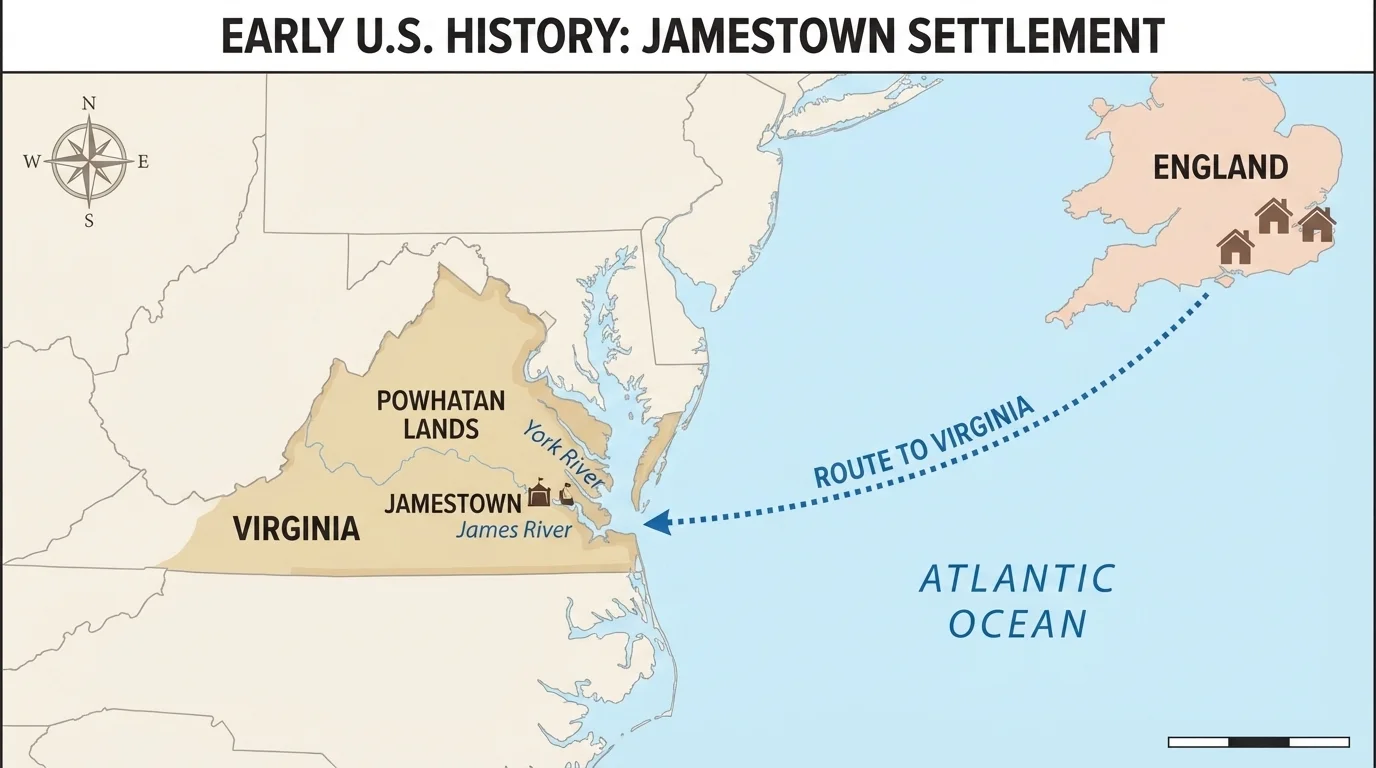
The settlers faced terrible difficulties. Many were not farmers or builders. The water near the settlement was often unhealthy. There were periods of drought, hunger, and disease. Some settlers spent too much time searching for gold instead of growing food. In the winter of 1609–1610, known as the "Starving Time," many colonists died.
Another important part of Jamestown's story involves the Powhatan Confederacy, a group of Native peoples living in the region. At times, the Powhatan people traded with the settlers. At other times, fighting broke out. The arrival of the English changed Native life by bringing conflict, competition for land, and new diseases.
Why Jamestown survived
Jamestown survived because conditions slowly changed. Leaders such as John Smith pushed colonists to work harder and trade for food. Later, John Rolfe helped the colony grow tobacco, which became a profitable cash crop. A cash crop is a crop grown mainly to sell for money. Tobacco brought wealth and encouraged more English settlers to come.
The effects of Jamestown were huge. It became the first permanent English settlement in North America, which opened the door to more English colonies. Tobacco farming increased the demand for labor. Over time, this helped expand systems of forced labor, including slavery. Jamestown also marked the beginning of lasting English political, economic, and cultural influence in the region.
Looking back at [Figure 2], we can see why geography mattered. Jamestown's position near rivers helped ships arrive, but the same environment also created serious health problems. A settlement's location can be both an advantage and a danger.
The French and Indian War began in 1754 and ended in 1763. It was the North American part of a larger global conflict called the Seven Years' War. The main cause was competition between Britain and France for land and control in North America, especially the Ohio River Valley.
Native American nations played major roles in the war. Many Native nations formed alliances with either the French or the British, depending on which side they believed would better protect their interests. The name "French and Indian War" comes from the British point of view because many Native groups fought alongside the French. This reminds us that names of events can reflect one side's perspective.
George Washington, who was still a young officer, was involved early in the war. Fighting spread across forts, forests, and frontier settlements. Britain eventually won because it had a larger navy, more resources, and stronger support over time.
Case study: Causes and effects of the French and Indian War
Step 1: Identify the causes.
Britain and France both wanted valuable land, rivers, and the fur trade. Colonists were also moving westward into areas where France and Native nations had strong interests.
Step 2: Identify the short-term effects.
Britain defeated France and gained more territory in North America. France lost most of its mainland possessions there.
Step 3: Identify the long-term effects.
The war left Britain deeply in debt. To raise money, Britain taxed the American colonies more heavily. Colonists grew angry, and those tensions helped lead to the American Revolution.
The effects of the war reached far beyond the battlefield. Britain gained Canada and other lands east of the Mississippi River. France lost much of its power in North America. But victory came at a price: Britain incurred heavy debt after the conflict. British leaders decided that the colonies should help pay for their protection.
That decision led to new taxes and stricter control, including acts that angered many colonists. Colonists began to ask hard questions: Should Britain tax them without their consent? Should distant leaders control their local affairs? In this way, the French and Indian War became one of the major causes of the American Revolution.
Some historians point out an interesting twist: Britain won the war, but that victory helped create the problems that led Britain to lose its colonies later. Sometimes winning one conflict can set up trouble in the future.
We can also connect this war back to Jamestown and the growth of English colonies. As those colonies expanded over time, they became more important and more crowded. Expansion increased competition over land, which made conflicts with France and Native nations more likely.
By late 1776, the American Revolution was going badly for the Patriots, and [Figure 3] shows the route of Washington's surprise attack. George Washington's army had suffered defeats in New York. Soldiers were tired, cold, and poorly supplied. Many enlistments were about to end, which meant soldiers might soon go home. One major cause of the crossing was simple: Washington needed a bold move to keep the army and the revolution alive.
On the night of December 25–26, 1776, Washington led his troops across the icy Delaware River from Pennsylvania into New Jersey. The weather was harsh, and the crossing was dangerous. After reaching the other side, the Americans marched to Trenton and launched a surprise attack against Hessian soldiers, who were German troops hired by Britain.
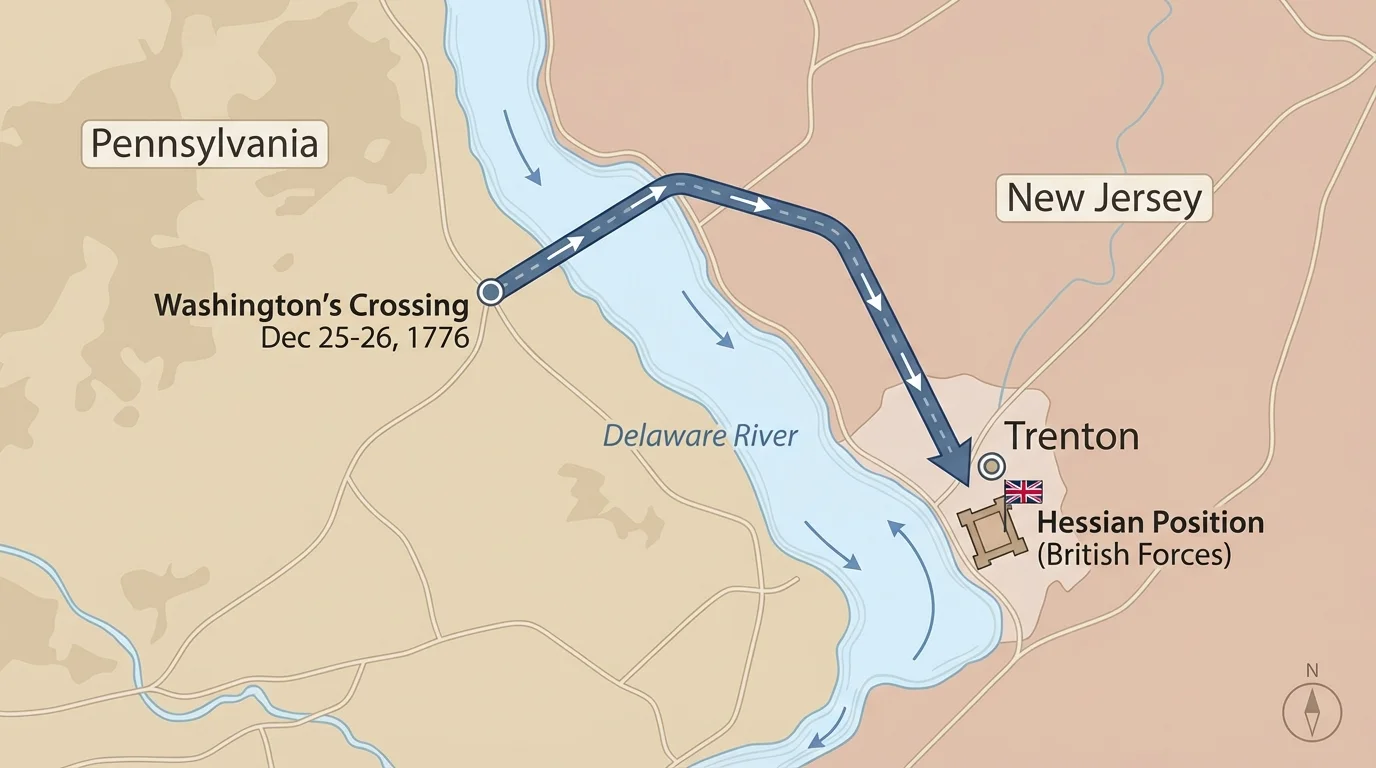
The attack succeeded. The Americans captured many Hessians and won an important victory. This was not the biggest battle of the war, but it had a powerful effect. It raised Patriot morale, encouraged soldiers to stay in the army, and showed that Washington could defeat enemy forces with careful planning.
This event matters because not all effects are about land or laws. Some effects are about confidence and belief. The victory at Trenton gave people hope. In war, hope can matter almost as much as supplies. If too many soldiers had quit, the Revolution might have collapsed.
"Victory or death."
— Password used by some of Washington's troops before the crossing
Washington's crossing also made him more respected as a leader. Later Americans remembered the event as a symbol of courage, determination, and smart decision-making. As with many historical events, the effect was both immediate and lasting.
Later in the war, people continued to remember how a risky plan could change everything. [Figure 3] shows the short route that led to a major boost in Patriot morale. A small path on a map can represent a very large change in history.
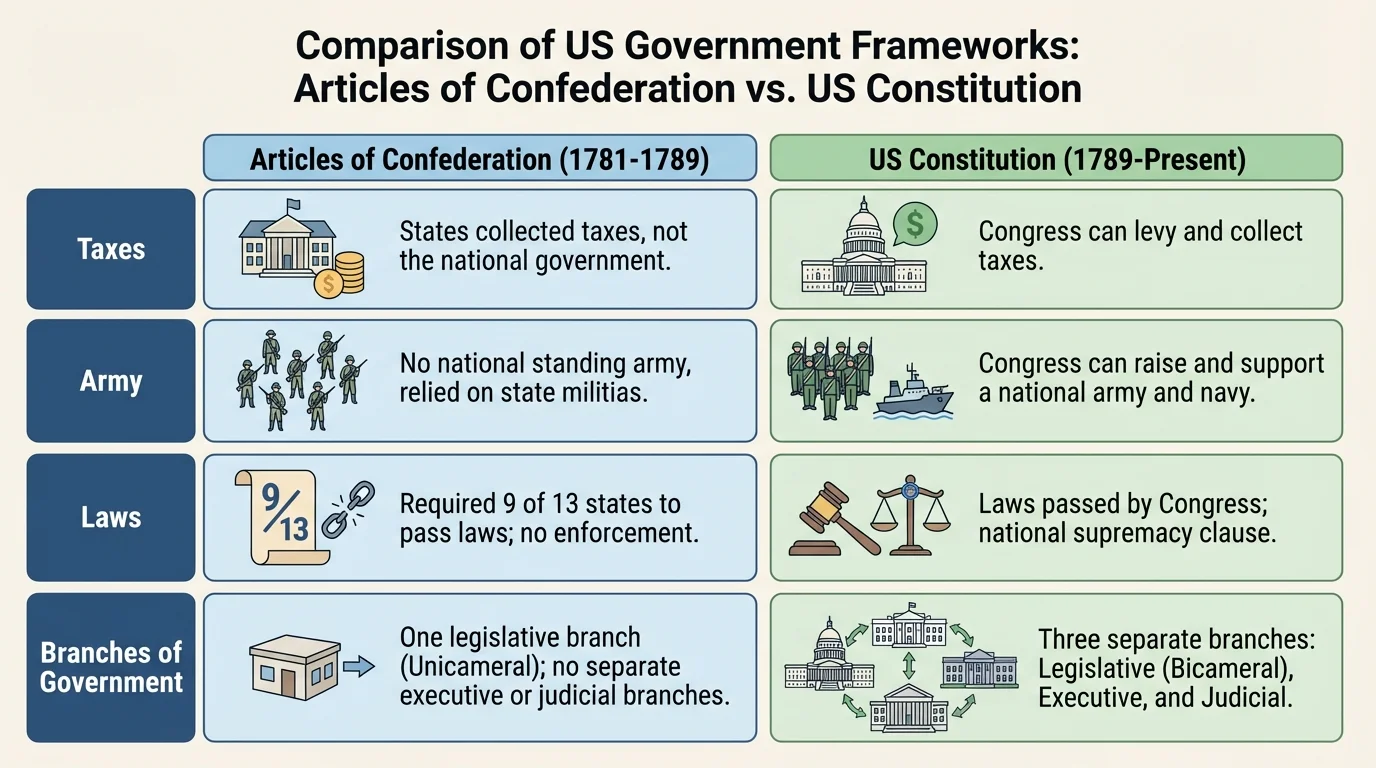
After the United States won independence, the new nation faced a serious problem. The government under the Articles of Confederation was too weak, and [Figure 4] compares those weaknesses with the stronger system created later. The national government could not collect taxes directly, regulate trade well, or easily enforce laws. This made it hard to solve national problems.
One cause of the Constitutional Convention was growing concern that the country might fall apart. States often acted like separate countries. Economic troubles and disputes between states increased worry. Shays' Rebellion, an uprising by farmers in Massachusetts in 1786–1787, frightened many leaders because it suggested that the government could not keep order.
In 1787, delegates from most states met in Philadelphia. Famous leaders there included George Washington, James Madison, and Benjamin Franklin. At first, they were supposed to revise the Articles of Confederation. Instead, they decided to create an entirely new plan for government: the Constitution.
The delegates debated many issues. Large states and small states argued about representation. Northern and Southern states argued about slavery and population counts. These disagreements led to compromises, including the Great Compromise, which created a two-house legislature with the Senate and the House of Representatives.
The effects of the convention were enormous. The Constitution created a stronger federal government with three branches: legislative, executive, and judicial. This system was designed to prevent any one branch from becoming too powerful. It also allowed the national government to collect taxes, regulate trade, and carry out laws more effectively.
Why the Constitution mattered
The Constitution did not solve every problem, and many people still disagreed about it. But it created a framework that helped the new nation survive. It balanced power between the national government and the states, and later the Bill of Rights was added to protect individual freedoms.
As [Figure 4] makes clear, the change from the Articles to the Constitution was not a small adjustment. It was a major shift in how the United States would govern itself. The convention's decisions still affect Americans today.
To study events like these, historians use evidence. A primary source is a document or object from the time being studied, such as a letter, map, speech, diary, or law. A secondary source is created later by someone explaining or analyzing the past, such as a textbook or documentary.
For Jamestown, a primary source might be John Smith's writings. For the French and Indian War, a primary source might be a letter from a soldier or a treaty. For Washington's crossing, paintings made later are often secondary sources unless they were created by witnesses at the time. For the Constitutional Convention, notes taken by James Madison are important primary sources.
When reading any source, ask who created it, when it was made, and why it was made. A source can contain valuable information while still showing one person's opinion or point of view.
Using both kinds of sources helps historians build a fuller picture. Primary sources give direct clues from the past. Secondary sources help organize and explain those clues. Together, they help us investigate causes and effects more carefully.
Early United States history is not just a list of separate facts. It is a story of connected events. Jamestown helped begin permanent English settlement. As colonies grew, England became stronger in North America. That growth increased rivalry with France, helping cause the French and Indian War.
After Britain won that war, it taxed the colonies more heavily. Colonists resisted, and the American Revolution began. During that war, Washington's crossing of the Delaware helped save Patriot morale and strengthen the fight for independence. After independence, the United States discovered that freedom alone was not enough; the nation also needed a government strong enough to function well. That need led to the Constitutional Convention.
This chain of events shows an important truth about history: one decision often leads to another. A colony can lead to conflict. A war can lead to taxes. Taxes can lead to revolution. Revolution can lead to a new government. When we study cause and effect, we learn not just what happened, but why it happened and why it mattered.
