One of the biggest differences between a free society and a dangerous one is not whether rules exist, but who must follow them. In some places, leaders can ignore the law whenever it helps them. In a constitutional system, the goal is different: the law stands above individual power. That idea may sound simple, but it is one of the strongest protections citizens have.
Think about everyday life. You probably expect traffic rules to apply to everyone, that a referee should apply the same rules to both teams, and that a school consequence should not depend only on whether a student is popular. These examples all connect to the idea of fairness through consistent rules. Governments work best when that same principle applies to public life.
The rule of law is not just about having many laws on the books. A dictatorship can have many laws. The important question is whether the laws are known, applied fairly, and used to limit power rather than protect the powerful. When students evaluate the strengths of the rule of law, they are really asking: How does this idea make a constitutional system stronger, safer, and more just?
Rule of law means that everyone, including leaders and government officials, must obey the law. Laws should be public, applied fairly, and enforced by institutions such as courts that are not controlled by one person.
Constitutional system means a system of government in which a constitution sets the basic rules, limits power, and protects rights.
Without rule of law, power can become personal. Leaders may reward friends, punish critics, or change rules whenever convenient. That creates fear and uncertainty. With rule of law, people have a better chance to know what the government can and cannot do.
[Figure 1] At its core, rule of law means that government power is limited and must be used according to established rules. A police officer, mayor, president, judge, or ordinary citizen is supposed to be subject to the same legal system. This does not mean everyone gets identical outcomes in every case. It means the law should apply through fair procedures instead of personal favoritism.
Another key idea is due process. This means the government must follow fair procedures before taking away someone's freedom, property, or rights. For example, if a person is accused of a crime, the government should not simply punish that person immediately. There should be evidence, a hearing or trial, and a chance to defend oneself.
Rule of law also depends on an independent judiciary. Courts should be able to interpret the law without being pushed around by powerful leaders. If judges fear punishment for making unpopular decisions, then the law stops being a neutral guide and becomes a tool of politics.
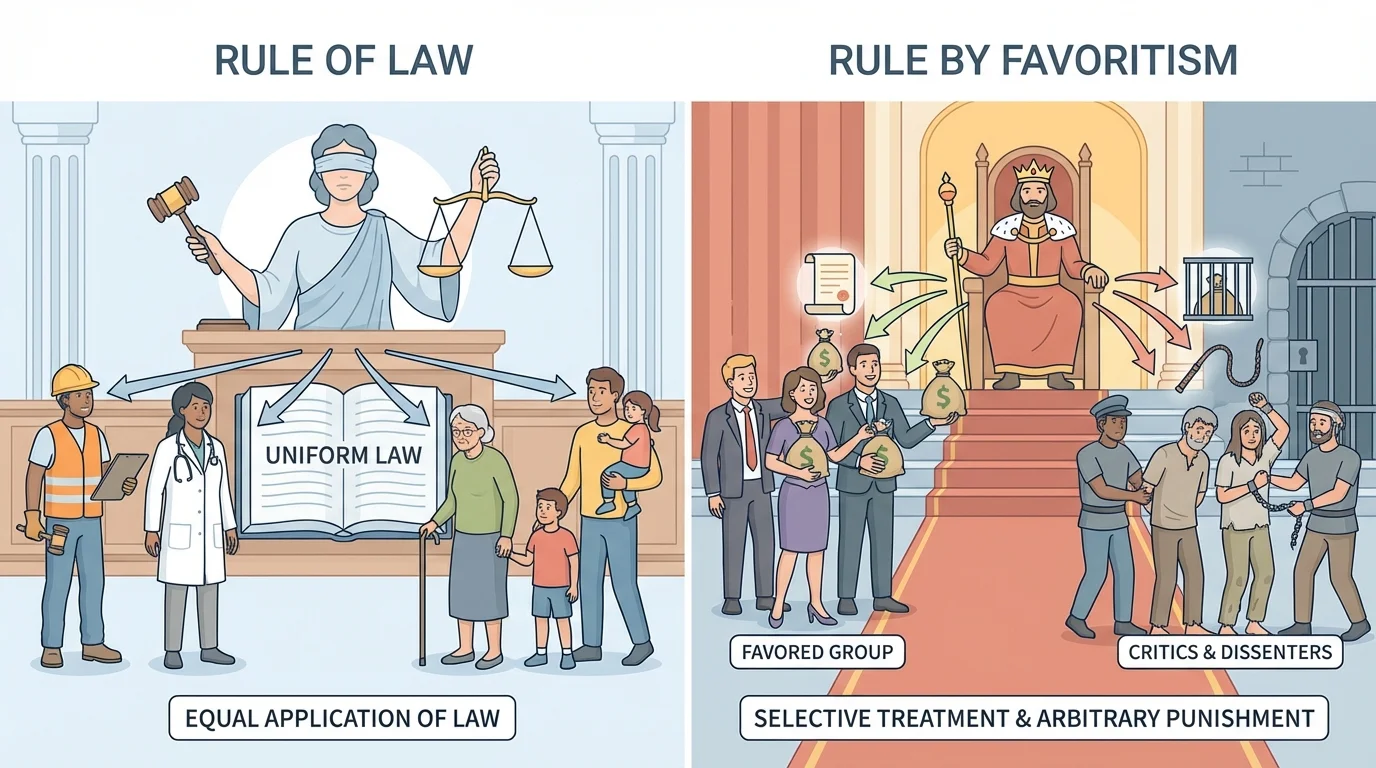
Notice that rule of law is different from "rule by law." Under rule by law, leaders use laws as weapons. They may write laws that target opponents while protecting themselves. Under true rule of law, laws are supposed to restrain power, not simply dress it up in official language.
The phrase "government of laws, not of men" became famous in American political thought because it captures the idea that no single person should be above the law.
This difference matters a lot. A country may have courts, police, and law books, yet still lack real rule of law if those institutions obey one leader instead of the constitution.
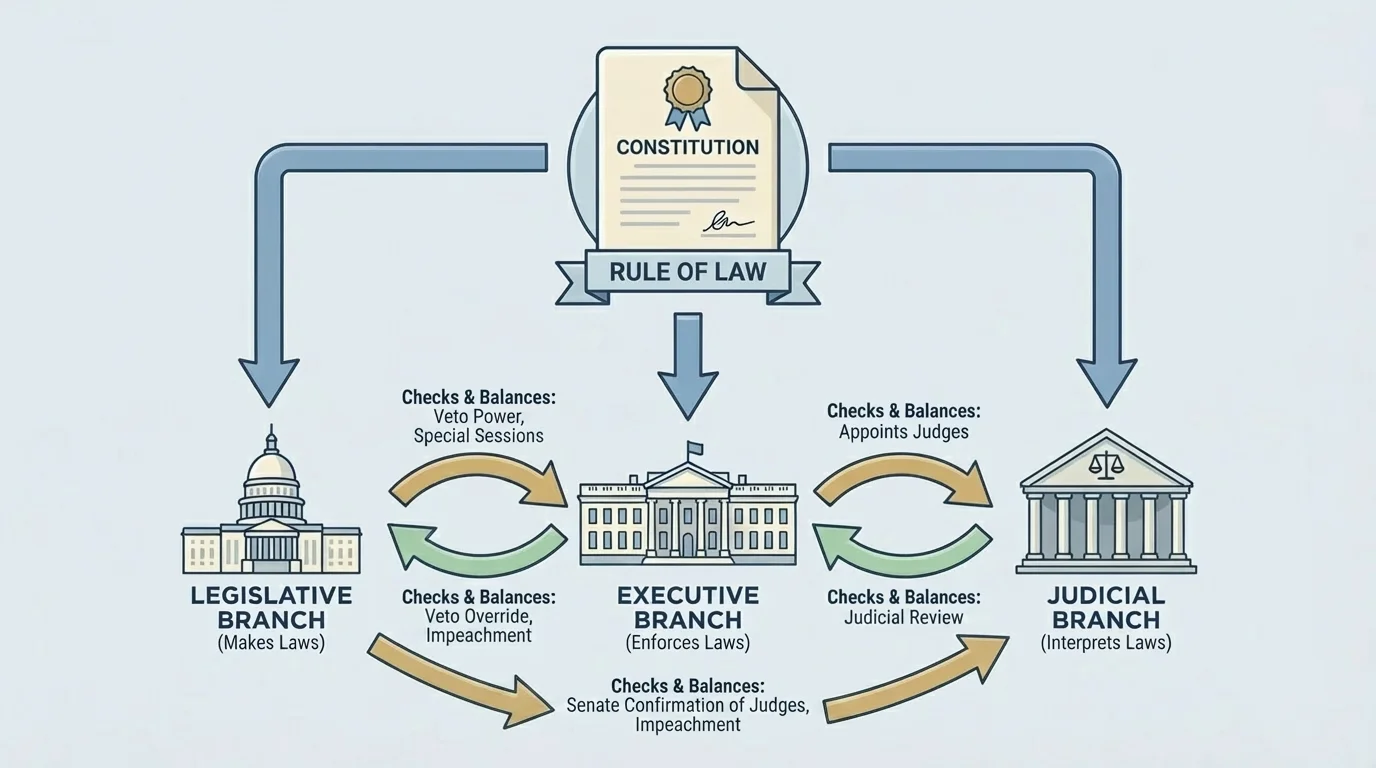
[Figure 2] In a constitutional system, the constitution is the highest legal authority. It sets out the structure of government, distributes power, and protects rights. The branches of government are connected, but each has limits. This is important because rule of law is not only a moral idea; it is built into institutions.
The separation of powers divides responsibilities among branches. Usually, the legislative branch makes laws, the executive branch carries them out, and the judicial branch interprets them. This division helps prevent too much power from collecting in one place.
Along with separation of powers comes checks and balances. Each branch can limit the others in certain ways. A legislature may pass a law, but courts can review whether it violates the constitution. An executive may enforce the law, but legislatures may investigate abuse of power. These limits strengthen rule of law because they make it harder for one person or group to act without restraint.
The constitution also protects civil liberties such as freedom of speech, religion, press, and assembly. Rule of law gives these rights practical force. If rights exist only on paper, they can disappear quickly. When courts, legal procedures, and public institutions enforce them, citizens have stronger protection.
This is why rule of law is central to constitutional government. A constitution without rule of law is like a rulebook that no referee uses. The words may be there, but they do not guide real decisions.
Why limited government is a strength
Rule of law makes government more trustworthy because officials must justify their actions using laws and constitutional limits. When leaders need legal reasons instead of personal wishes, citizens gain protection from arbitrary power.
Later, when people debate issues such as privacy, protests, or police searches, they often return to the same question we see in [Figure 2]: which branch has the authority to act, and what legal limits apply?
One major strength is fairness. People are more likely to accept decisions they dislike when they believe the process was fair. For example, a student athlete may disagree with a referee's call but still respect the game if the rules were applied to both teams equally. In government, fair legal procedures reduce the sense that decisions are based only on bias or power.
A second strength is predictability. Businesses, families, schools, and communities all work better when people know the rules ahead of time. If the government could seize property, arrest critics, or cancel agreements without warning, people would live in uncertainty. Rule of law supports stable expectations, which helps communities and economies function.
A third strength is accountability. Leaders and officials can be investigated, sued, removed from office, or punished if they break the law. This discourages corruption. It also sends a powerful message: public office is a responsibility, not a license to do anything.
A fourth strength is the protection of rights and liberties. Citizens need legal protection when they speak out, practice religion, publish opinions, or challenge the government. Rule of law gives people a way to defend themselves using courts and legal processes instead of relying only on whoever holds power at the moment.
A fifth strength is peaceful conflict resolution. In a society without trusted law, people may settle disputes through threats, revenge, or violence. Under rule of law, disagreements can go to courts, hearings, or other legal processes. That does not make every result perfect, but it provides a nonviolent path for resolving conflict.
| Strength | What it means | Why it matters |
|---|---|---|
| Fairness | Laws apply through consistent procedures | Builds respect for decisions |
| Predictability | Rules are known in advance | Creates stability for daily life |
| Accountability | Officials can be checked and punished | Limits abuse of power |
| Rights protection | Freedoms have legal support | Shields citizens from unfair government action |
| Peaceful resolution | Disputes are handled by law | Reduces violence and chaos |
Table 1. Major strengths of rule of law and why each one supports a constitutional system.
Another strength is public trust. People are more likely to cooperate with government when they believe rules are real and not just tools for the powerful. Trust encourages voting, jury service, taxpaying, and civic participation.
[Figure 3] History gives strong evidence for the value of rule of law through several turning points when legal limits on power grew stronger. In England, the Magna Carta in 1215 helped establish the principle that even the king was not completely above the law. That idea developed slowly, but it influenced later constitutional thinking.
In the United States, the Constitution created a government with limited powers and legal procedures. Over time, Supreme Court cases, constitutional amendments, and public movements have pushed the country closer to its rule-of-law ideals. This process has not been smooth or complete, but it shows that rule of law can be strengthened over generations.
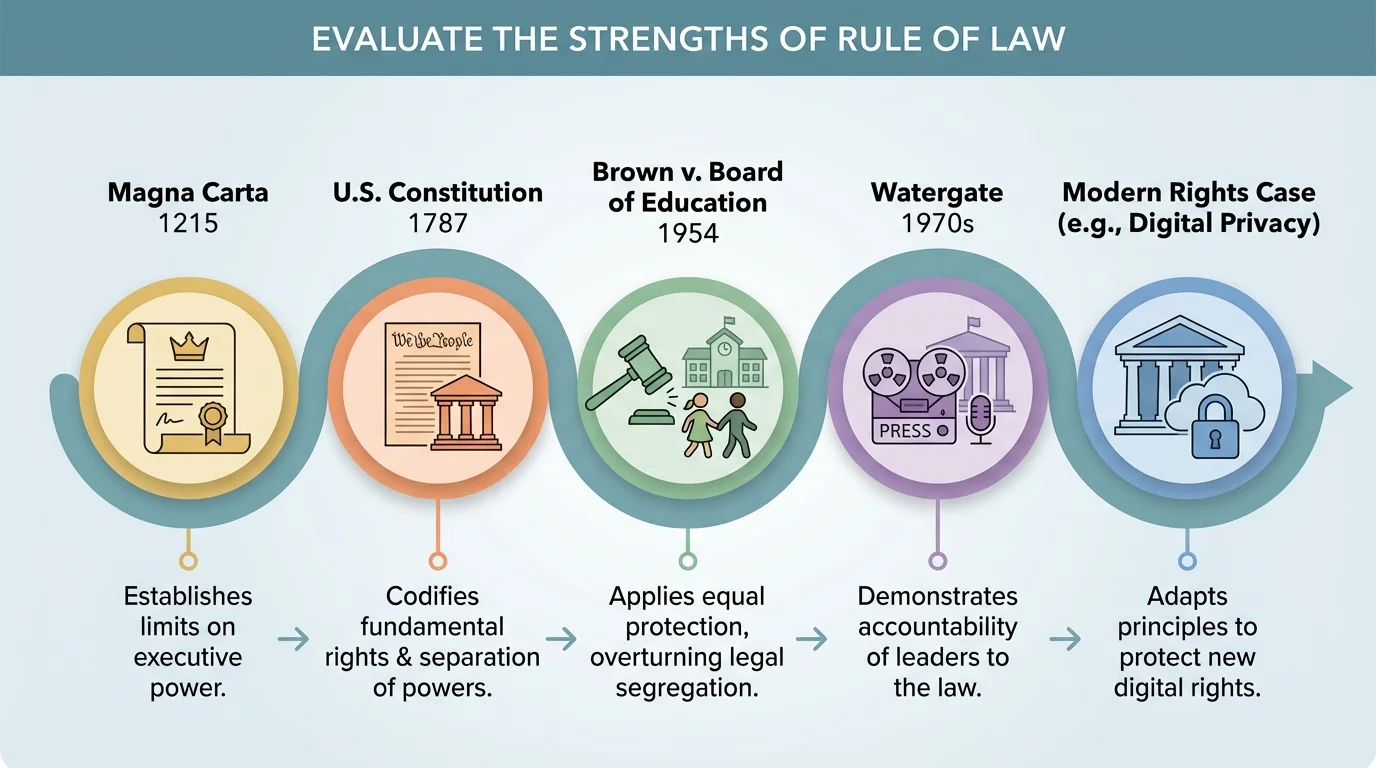
One important example is Brown v. Board of Education in 1954. In that case, the Supreme Court ruled that racial segregation in public schools was unconstitutional. The decision did not immediately end injustice, but it showed one strength of rule of law: legal institutions can challenge unfair practices and support equal rights.
Case study: Watergate and accountability
During the Watergate scandal in the 1970s, investigators, courts, Congress, and the press all played roles in uncovering abuse of power by President Richard Nixon's administration.
Step 1: Evidence was investigated rather than ignored.
Officials did not simply accept presidential power as unlimited.
Step 2: Courts required legal compliance.
The Supreme Court ruled that the president had to turn over recordings relevant to the investigation.
Step 3: Political leaders were held accountable.
Nixon resigned rather than face likely impeachment and removal.
This case is often used to show that rule of law is strongest when institutions can check even the highest office in government.
The civil rights movement also reveals both the strengths and the challenges of rule of law. Activists often demanded that the government live up to constitutional promises already written in law. Courts, federal action, and legislation such as the Civil Rights Act helped make those promises more real. At the same time, resistance and unequal enforcement showed that having laws is not enough by itself.
When students look back at the timeline in [Figure 3], they can see that progress often happens when societies move from personal power and exclusion toward stronger legal protection and broader equality.
Rule of law is not only about famous court cases. It affects daily life in ways people often overlook. If your family signs a lease, buys something online, or expects the police to follow search rules, you are seeing the importance of legal predictability and limits on power.
For example, contracts matter because people trust that agreements can be enforced. Property rights matter because people expect their homes and belongings cannot be taken without legal process. Free speech matters because students, journalists, and citizens need room to question leaders without fear of punishment simply for disagreeing.
Digital life raises new questions too. Can schools search a student's phone? Can the government collect private information? Can social media users criticize officials? These issues may sound modern, but they still return to old rule-of-law questions: What authority exists? What procedures must be followed? What rights must be respected?
Earlier lessons on constitutions and citizens' rights matter here. Rule of law is the bridge between written rights and real protection. Rights are strongest when institutions enforce them fairly.
Even at school, students usually want rules that are clear, announced in advance, and enforced consistently. That expectation reflects a basic rule-of-law value. People may disagree about specific rules, but they usually recognize the unfairness of secret rules or selective punishment.
Evaluating the strengths of rule of law does not mean pretending it always works perfectly. Sometimes laws themselves are unjust. Sometimes laws are fair on paper but enforced unfairly in practice. Sometimes courts are pressured, police powers are abused, or wealth and status influence who gets the best legal defense.
This is important because rule of law is stronger than arbitrary power, but it still depends on human institutions. Judges, legislators, police officers, voters, and citizens all affect whether the system works fairly. A country can claim to believe in rule of law while falling short in real life.
For that reason, one of the strengths of rule of law is also that it gives people tools to criticize injustice. Citizens can challenge unfair laws, demand equal protection, appeal decisions, and call for reform. In other words, rule of law is not only a system of order; it can also be a system for correcting wrongs.
"The law should govern."
— Basic principle of constitutional government
A good evaluation therefore includes both praise and caution. Rule of law is powerful because it limits power, protects rights, and supports fairness. But its benefits are strongest only when laws are just and enforcement is genuinely equal.
When you evaluate a government, look for signs of strength. Are laws public and understandable? Are officials investigated when they break rules? Can courts make decisions without political threats? Do people accused of crimes receive fair procedures? Are rights protected even for unpopular groups?
If the answer to these questions is mostly yes, rule of law is probably strong. If leaders act without limits, critics are punished unfairly, courts are controlled, or laws are applied differently based on wealth or politics, then rule of law is weak.
The strongest constitutional systems are not those with the most speeches about freedom. They are the ones where legal limits actually work in practice. That is why rule of law remains one of the most important strengths of any constitutional system.
