A tree can weigh hundreds of kilograms, yet most of that giant mass did not come from the ground the way many people first guess. That sounds strange at first. If a plant grows in soil all year, shouldn't the soil be where most of the plant comes from? Surprisingly, plants get the materials for most of their growth mainly from air and water. To understand that, we need to understand how matter moves into, out of, and within systems.
Everything around you is made of matter. Matter is anything that has mass and takes up space. Water in a bottle, the air in a balloon, the sugar in fruit, and the wood in a desk are all made of matter. Living things are made of matter too.
System means a set of parts that work together. A plant is a system because its roots, stem, leaves, and other parts each do a job and also work together.
Matter transport means matter moving from one place to another. It can move into a system, out of a system, or from one part of a system to another part.
Think about a plant as a system. Matter moves into the plant when water enters the roots and carbon dioxide enters the leaves. Matter moves within the plant when water and sugars travel through stems to different parts. Matter moves out of the plant when oxygen leaves the leaves or when water vapor escapes into the air.
This idea is not just about plants. Your body is also a system. Matter enters when you eat and drink, moves within your body in blood, and leaves as wastes and gases. Once you start looking for matter transport, you can see it everywhere.
When a plant grows taller, makes new leaves, or builds fruit, it needs more matter to build those parts. The plant cannot make new stems and leaves from nothing. The atoms needed to build plant material have to come from somewhere.
Many students think the matter comes mostly from soil. Soil is important, but it is not the main source of a plant's mass. Soil provides water and small amounts of minerals such as nitrogen, potassium, and calcium. These are important for healthy growth, but most of the mass of a plant comes from water and from carbon dioxide gas in the air, written as \(\textrm{CO}_2\).
The main idea is that plants build much of their bodies by combining matter from air and water. Sunlight helps power this process, but sunlight is energy, not matter. The actual material for growth comes mainly from \(\textrm{CO}_2\) and \(\textrm{H}_2\textrm{O}\).
That means a plant is constantly exchanging matter with its surroundings. It is not a closed object sitting still in one place. It is an active system, taking in materials, changing them, moving them around, and releasing some back into the environment.
[Figure 1] helps show that a plant takes matter in through different structures. The roots take in water from the soil. Dissolved minerals move in with that water. At the same time, leaves take in carbon dioxide from the air. So even though we often notice only the roots in soil, the leaves are also major entry points for matter.
The tiny structures on roots that help absorb water are called root hairs. They give roots more surface area, which means more space to take in water. If a plant does not get enough water, it wilts because water is needed both for support and for photosynthesis.
Leaves have tiny openings called stomata. These openings can open and close. When they are open, carbon dioxide enters the leaf. Oxygen and water vapor can also leave through them. Even though you usually cannot see stomata without a microscope, they are very important gates for matter moving in and out of the plant.
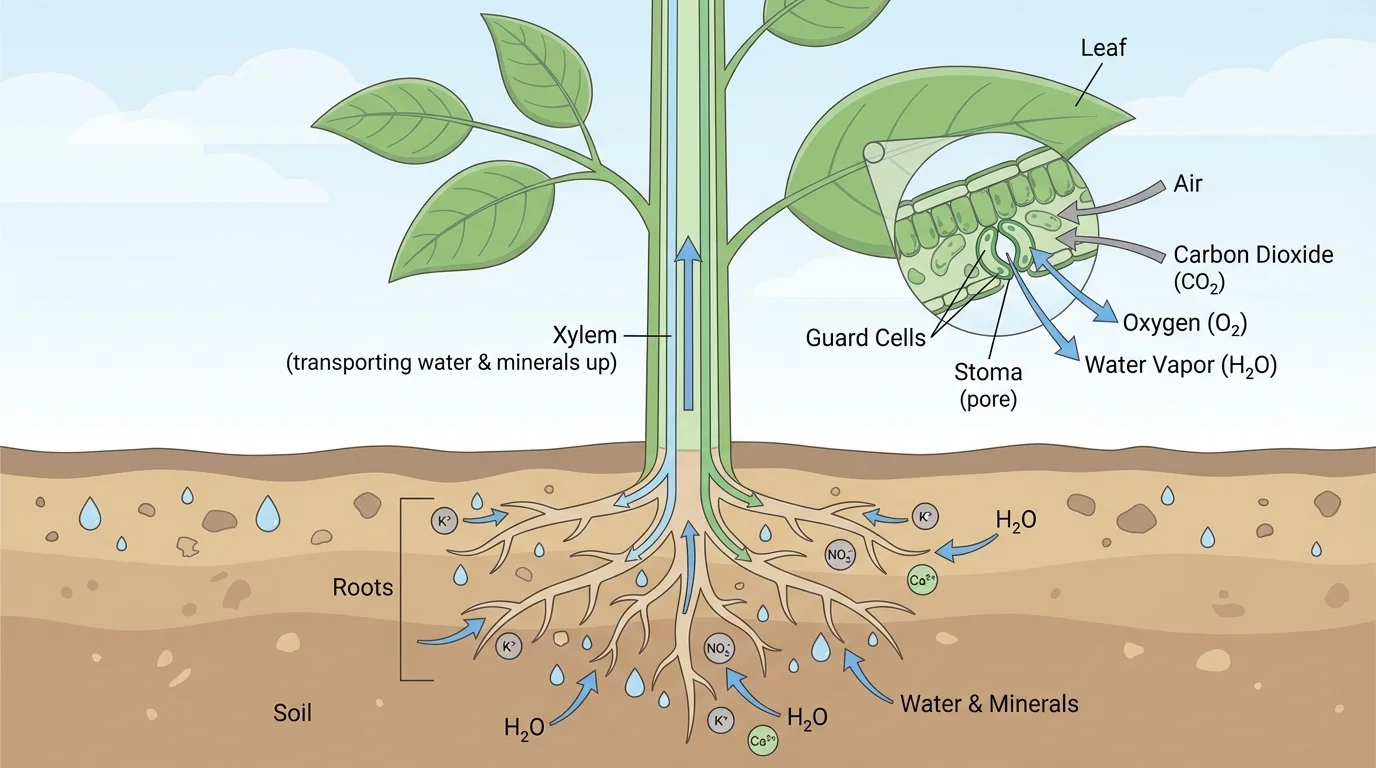
Notice that different materials enter in different places. Water usually enters through roots, while carbon dioxide enters through leaves. This is one reason plant parts have different shapes and jobs. Roots spread through soil to absorb water. Leaves spread through air and sunlight to exchange gases and collect energy.
In everyday life, you can see the results of this matter transport. A houseplant near a sunny window may need regular watering because water is entering through roots and also leaving through leaves. A plant in a sealed plastic bag may form droplets inside the bag because water has moved out of the leaves into the air.
[Figure 2] illustrates that after matter enters a plant, it does not stay in one place. It must move to where it is needed. Inside the plant, special tissues carry materials from one part to another. This internal transport allows roots, stems, leaves, flowers, and fruits to work together as one system.
One tissue is called xylem. Xylem carries water and dissolved minerals upward from the roots through the stem to the leaves. Another tissue is called phloem. Phloem carries sugars made in the leaves to other parts of the plant, including roots, stems, flowers, and fruits.
So a plant has a transport network. Water moves up to the leaves, and sugars move from the leaves to the rest of the plant. This is a major reason why leaves are described as sites of food production, while stems act as transport pathways.
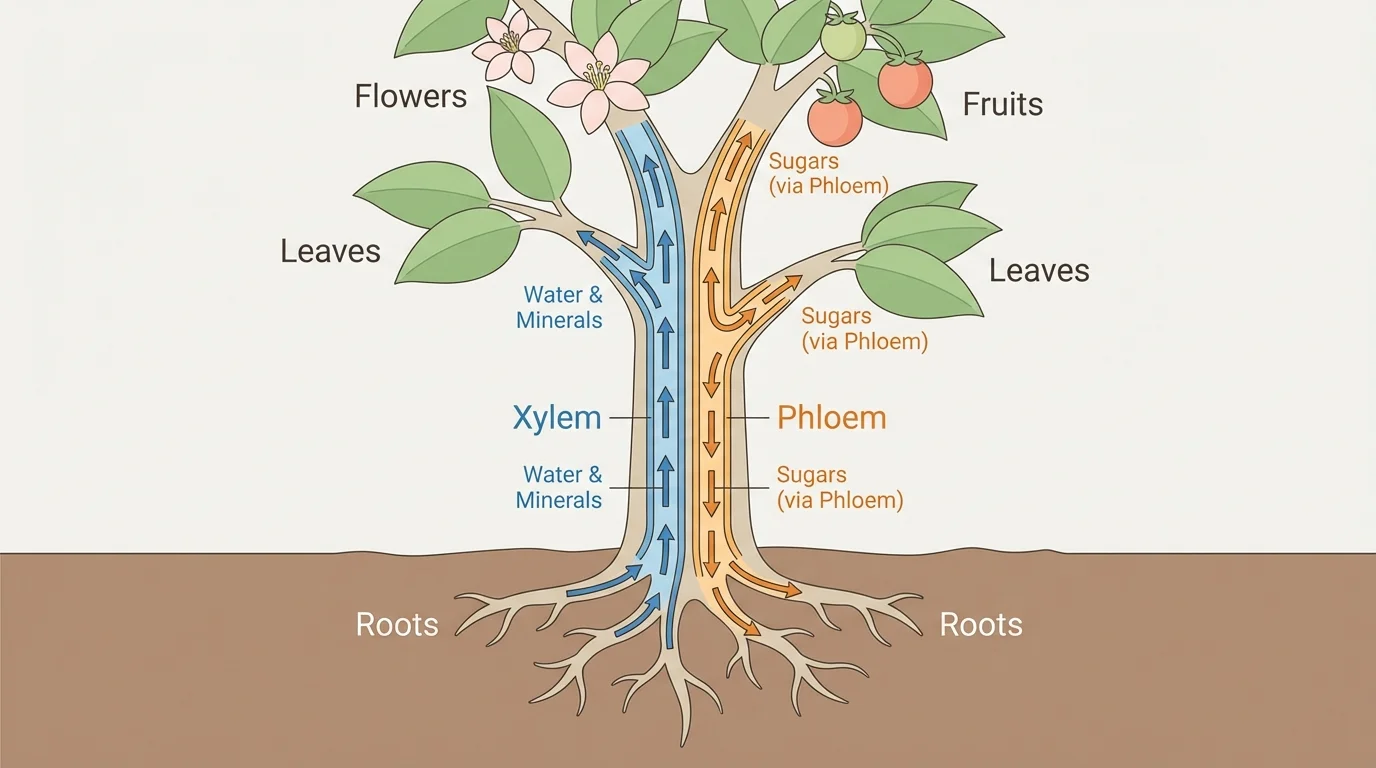
If an apple grows on a tree, the matter in that apple had to travel through the plant system. Water came in through roots. Carbon dioxide entered leaves. Sugars were made in leaves. Then those sugars moved through phloem to the developing apple. The apple did not simply appear at the branch tip; matter was transported there.
The same is true for roots. Even though roots absorb water, they also need sugars for energy and growth. Those sugars are made mostly in leaves and transported downward. This two-way movement of different materials helps explain why all plant parts depend on one another.
When you remember the pathways in [Figure 2], it becomes easier to explain why damage to a stem can seriously hurt a plant. If the transport tissues are broken, water and sugars may no longer reach the parts that need them.
[Figure 3] shows that inside green leaves, plants use incoming materials to make food. This process is called photosynthesis. During photosynthesis, plants use carbon dioxide from the air and water from the roots to make sugar. Light energy from the Sun powers the process.
A simple way to write photosynthesis is:
\[6\textrm{CO}_2 + 6\textrm{H}_2\textrm{O} \rightarrow \textrm{C}_6\textrm{H}_{12}\textrm{O}_6 + 6\textrm{O}_2\]
This equation means that six molecules of carbon dioxide and six molecules of water are changed into one molecule of glucose, written as \(\textrm{C}_6\textrm{H}_{12}\textrm{O}_6\), and six molecules of oxygen, written as \(\textrm{O}_2\). Glucose is a sugar the plant can use or store.
Reading the photosynthesis equation
Step 1: Identify the inputs.
The inputs are on the left side: \(6\textrm{CO}_2\) and \(6\textrm{H}_2\textrm{O}\).
Step 2: Identify the outputs.
The outputs are on the right side: \(\textrm{C}_6\textrm{H}_{12}\textrm{O}_6\) and \(6\textrm{O}_2\).
Step 3: Connect the equation to plant growth.
The carbon atoms in glucose come from \(\textrm{CO}_2\) in the air. Those carbon atoms can become part of wood, leaves, roots, and fruits.
This is one of the strongest clues that plant mass comes mainly from air and water.
Sunlight is essential, but it is not matter. It provides energy so the plant can rearrange atoms into new substances. The atoms themselves still come from carbon dioxide and water.
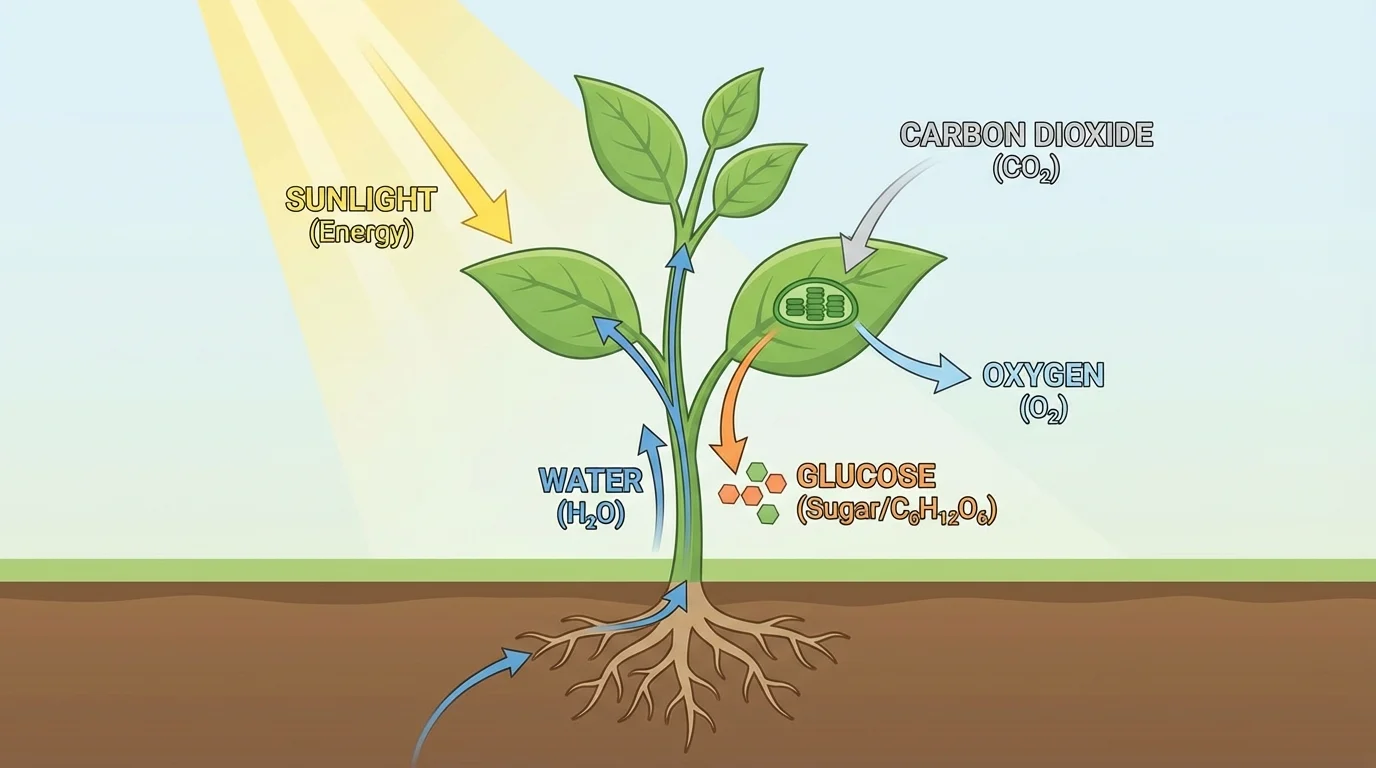
The oxygen released during photosynthesis leaves the plant through stomata. Animals, including humans, use that oxygen for respiration. So matter moving through plants also affects other living things.
When you think back to [Figure 3], notice how several kinds of transport happen together. Carbon dioxide enters, water moves upward, sugar is produced, and oxygen exits. One process connects movement into, within, and out of the system.
Plants do not only take in matter. They also release matter. Oxygen can move out through the stomata. Water can leave as water vapor. This loss of water vapor from leaves is called transpiration.
Transpiration matters because it helps pull water upward through the plant. As water evaporates from leaves, more water is drawn up from the roots through xylem. On a hot day, this movement can be especially strong.
A large tree can move huge amounts of water from the ground to the air each day. Forests do not just sit in the environment; they help shape it by moving matter and water through entire ecosystems.
Matter also leaves a plant when an animal eats it. A caterpillar eating a leaf takes plant matter into its own body. Later, decomposers such as fungi and bacteria break down dead plant material and return matter to the soil and air. So plant matter keeps moving through the larger system of an ecosystem.
[Figure 4] illustrates one important kind of evidence for the claim that plants obtain materials for growth mainly from air and water: measuring mass. If soil were the main source of plant growth, we would expect the soil mass to drop by a large amount as the plant grows.
But in careful investigations, the plant gains a lot of mass while the soil changes only a little. That means most of the new matter in the plant is not coming from the soil itself. Instead, it is coming mainly from carbon dioxide in the air and water taken in by the plant.
Long ago, a scientist named Jan van Helmont planted a small tree in a measured amount of soil. After several years, the tree had gained a lot of mass, but the soil mass had changed very little. His investigation was not perfect by modern standards, but it helped scientists ask a powerful question: where does plant mass really come from?
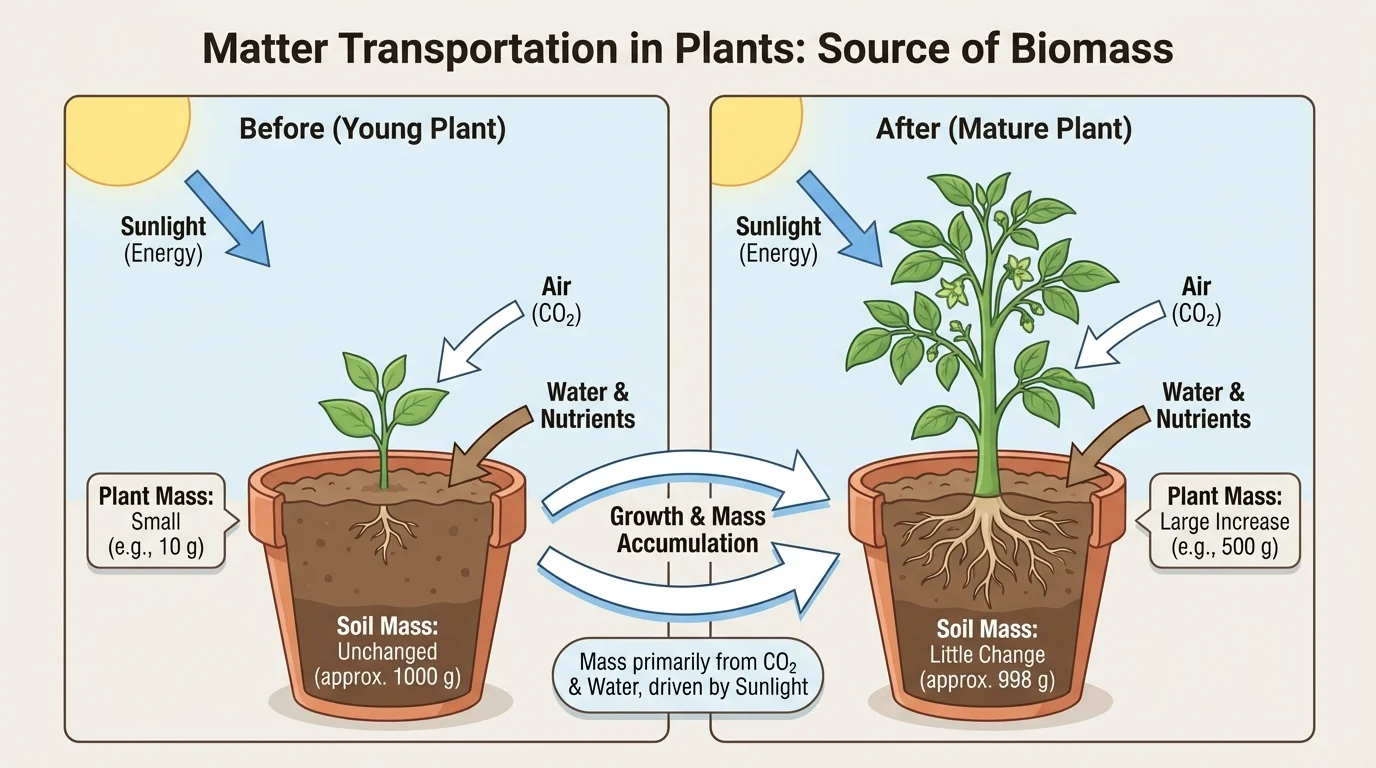
Modern science gives an even clearer answer. Plants take in \(\textrm{CO}_2\) from the air and \(\textrm{H}_2\textrm{O}\) from water. Through photosynthesis and other processes, they use these materials to build carbohydrates, cellulose, and many other substances in their bodies.
Suppose a seedling has a mass of \(10 \textrm{ g}\), and later the plant has a mass of \(100 \textrm{ g}\). The increase is \(100 - 10 = 90 \textrm{ g}\). If the soil mass changes only a tiny amount, that is strong evidence that most of the \(90 \textrm{ g}\) came from air and water, not from the soil.
Using evidence to support the claim
Step 1: Observe the change.
A plant grows much larger over time, but the amount of soil in the pot stays nearly the same.
Step 2: Ask where the added matter came from.
The plant cannot create matter from nothing, so the added matter must come from outside the plant.
Step 3: Use what we know about plant inputs.
Plants take in \(\textrm{CO}_2\) from air and \(\textrm{H}_2\textrm{O}\) from water. These supply the atoms needed to build new plant material.
This reasoning supports the argument that plants get materials for growth mainly from air and water.
Looking again at [Figure 4], the key idea is not that soil is useless. Soil is very important because it stores water and minerals and helps anchor the plant. But it is not the main source of the plant's mass.
Plant systems connect to many other systems. In a terrarium, water evaporates from soil and leaves, then condenses and falls again. Matter is moving in cycles. In a forest, carbon moves from air into trees, from trees into animals, and from dead organisms into decomposers.
Humans also depend on matter transport in plants. When you eat an apple, carrot, rice, or lettuce, you are eating matter that plants built using air and water. The carbon in those foods once existed as \(\textrm{CO}_2\) in the atmosphere.
| System | Matter Entering | Matter Moving Within | Matter Leaving |
|---|---|---|---|
| Plant | Water, minerals, \(\textrm{CO}_2\) | Water in xylem, sugars in phloem | \(\textrm{O}_2\), water vapor, plant parts eaten |
| Human body | Food, water, oxygen | Nutrients and gases in blood | \(\textrm{CO}_2\), wastes, water |
| Ecosystem | Sunlight energy, gases, water | Matter through food webs and cycles | Gases, waste, heat energy |
Table 1. Examples of matter moving into, within, and out of different systems.
This comparison shows that the same crosscutting idea appears in many places. Systems are not just collections of parts. They exchange and transport matter in organized ways.
Farmers and gardeners need to understand matter transport to grow healthy plants. If roots cannot absorb enough water, the plant cannot move materials where they are needed. If leaves are damaged, less carbon dioxide may enter, and less photosynthesis can happen.
Forests are especially important because they move huge amounts of carbon from the air into plant bodies. Wood, leaves, and roots store carbon that once floated in the atmosphere as \(\textrm{CO}_2\). This is one reason forests matter in discussions about Earth's climate.
You already know that solids, liquids, and gases are forms of matter. This lesson builds on that idea: matter in different forms can still move through systems. In plants, liquid water and gas molecules both become part of living tissue.
Understanding plant transport also helps explain why watering, sunlight, and air are all necessary. A plant kept in darkness may still have water, but it cannot use light energy to make enough food. A plant sealed away from fresh air may not get enough carbon dioxide. A plant in dry soil may not get enough water to carry materials through its tissues.
One of the most amazing ideas in life science is that a tall oak tree, a strawberry plant, and a blade of grass all build themselves using the same basic pattern: matter enters, matter moves, matter changes, and matter leaves. Growth is not magic. It is transport and transformation of matter in an organized living system.
