Here is a frustrating truth: most people do not fail long-term goals because they are lazy. They fail because they expect motivation to do the work of a system. If you want to save money, build a skill, improve your health, or prepare for your future, motivation may get you started for a few days. What keeps you moving months later is something stronger: planning, reflection, and revision.
These three habits work together. Planning gives your goal structure. Reflection shows you what is really happening, not what you hoped would happen. Revision helps you adapt instead of getting stuck. When you use all three, you stop treating goals like wishes and start treating them like commitments.
This matters far beyond school. The same habits help you save for a car, train for a sport, improve your sleep, build an online portfolio, prepare for a job, manage your time at home, or learn something difficult like coding, editing videos, or speaking confidently in interviews. Long-term progress is not usually dramatic. It is built from small actions repeated, checked, and adjusted.
Long-term goal means a result you want to achieve over a long period of time, usually weeks, months, or years.
Planning means deciding what steps, resources, and time you will use to work toward that goal.
Reflection means looking back honestly at your actions, results, and obstacles to learn what is working.
Revision means changing your plan, method, or timeline based on what you learned, while still staying committed to the goal.
A lot of people skip one or more of these steps. Some plan but never reflect, so they keep repeating weak strategies. Some reflect but never revise, so nothing changes. Some revise constantly without a clear plan, so they move in circles. Strong goal progress happens when all three are used together.
Long-term goals often feel exciting at the beginning because the future looks clean and simple. You picture the result: better grades, stronger fitness, more savings, better emotional balance, a driver's permit, a job, or a finished project. What you do not always picture is the middle: tired days, schedule problems, distractions, family responsibilities, low confidence, or slow results.
That middle is where many goals stall. If your goal depends only on feeling inspired, progress becomes inconsistent. You may work hard for three days, skip six, then feel guilty and avoid the goal completely. This creates a cycle of bursts and breaks instead of steady improvement.
Assessing goal progress means asking a practical question: Is my current approach actually moving me forward over time? That question is more useful than asking whether you feel motivated today. It shifts your focus from emotion alone to behavior, evidence, and responsibility.
[Figure 1] A solid plan helps you create a milestone-based path toward a distant result. You ask, "What will I do this week, what will I track, and what will success look like by the end of the month?"
Planning works best when it turns a large goal into smaller actions. A goal without smaller steps often feels overwhelming or vague. A plan breaks the goal into pieces you can actually do. If your goal is to save $600 in six months, you do not need to think about the entire amount every day. You can break it into monthly targets of $100, then into weekly actions that support that target.
Good planning also forces you to think about resources and obstacles. Do you need money, time, transportation, internet access, support from family, a calendar app, or a quiet workspace? What might get in the way: procrastination, gaming, overspending, poor sleep, inconsistent routines, or overcommitting? Planning does not remove every problem, but it makes problems easier to anticipate.
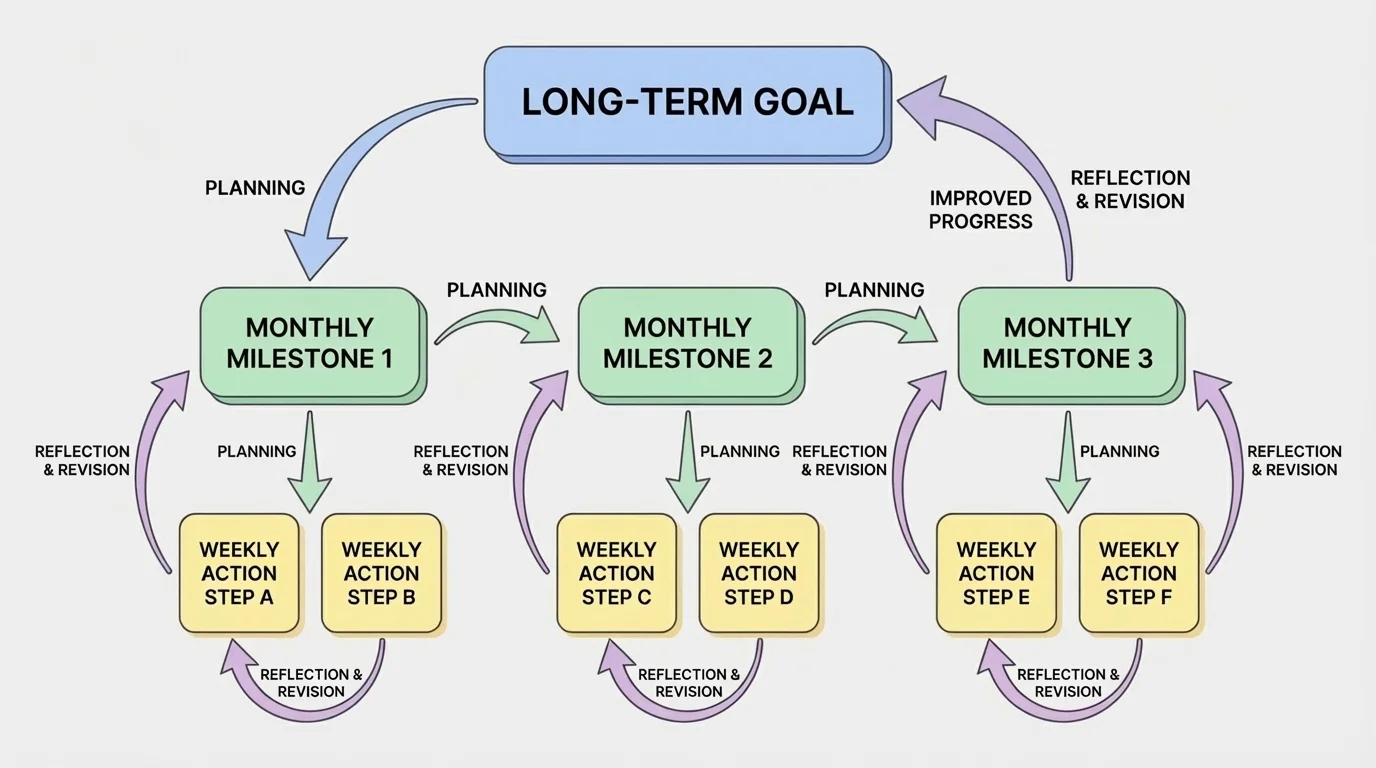
A useful plan usually includes five parts:
1. A clear outcome. Be specific. "Improve my math" is weak. "Raise my average by completing all assignments on time and practicing four evenings each week for the next eight weeks" is stronger.
2. A timeline. Set a realistic period. A plan needs deadlines, but not impossible ones. Unrealistic timelines often create discouragement, not discipline.
3. Action steps. Decide what you will actually do. If your goal is to build a portfolio, action steps might include watching one tutorial, creating one sample project every two weeks, and asking for online feedback.
4. Tracking. You need evidence. That can be a checklist, habit tracker, notes app, spreadsheet, or calendar. If you cannot tell whether you are progressing, your goal is too invisible.
5. Obstacle planning. Create backup moves. If your internet goes out, what can you do offline? If you feel tired, what is the minimum version of the task you can still complete?
Example: Planning a savings goal
You want to save $240 in three months to buy equipment for a hobby.
Step 1: Break the total into smaller targets.
Three months means a target of \(240 \div 3 = 80\) dollars per month.
Step 2: Break the monthly target into weekly actions.
If you use four weeks as an approximate month, that is \(80 \div 4 = 20\) dollars per week.
Step 3: Decide the source of the money.
You might save $10 by reducing snack spending, $5 from small online tasks, and $5 by setting aside part of gift money or allowance.
Step 4: Plan for obstacles.
If one week goes badly, the backup plan is to save $25 the next week and pause unnecessary spending.
The goal becomes less stressful because the plan makes the target visible and manageable.
Planning also protects your time. If you assign tasks to specific days, you are less likely to waste energy deciding what to do every time you sit down. That is one reason routines are powerful: they reduce repeated decision-making.
[Figure 2] Reflection reveals patterns in your behavior that are easy to miss when life feels busy. Without reflection, it is easy to make inaccurate statements such as "I am trying hard," "I never have time," or "Nothing is working." Reflection checks those statements against real evidence.
Reflection is not the same as self-criticism. It is not about attacking yourself for mistakes. It is about asking honest questions. What did I actually do? What results did I get? What kept getting in the way? When did the task feel easier? Which habits helped? Which choices made things worse?
When you reflect regularly, you start noticing useful patterns. Maybe you focus better earlier in the day. Maybe you overspend when you are stressed. Maybe you skip workouts when you try to make them too long. Maybe you complete more tasks when your phone is in another room. Reflection turns random experience into information.
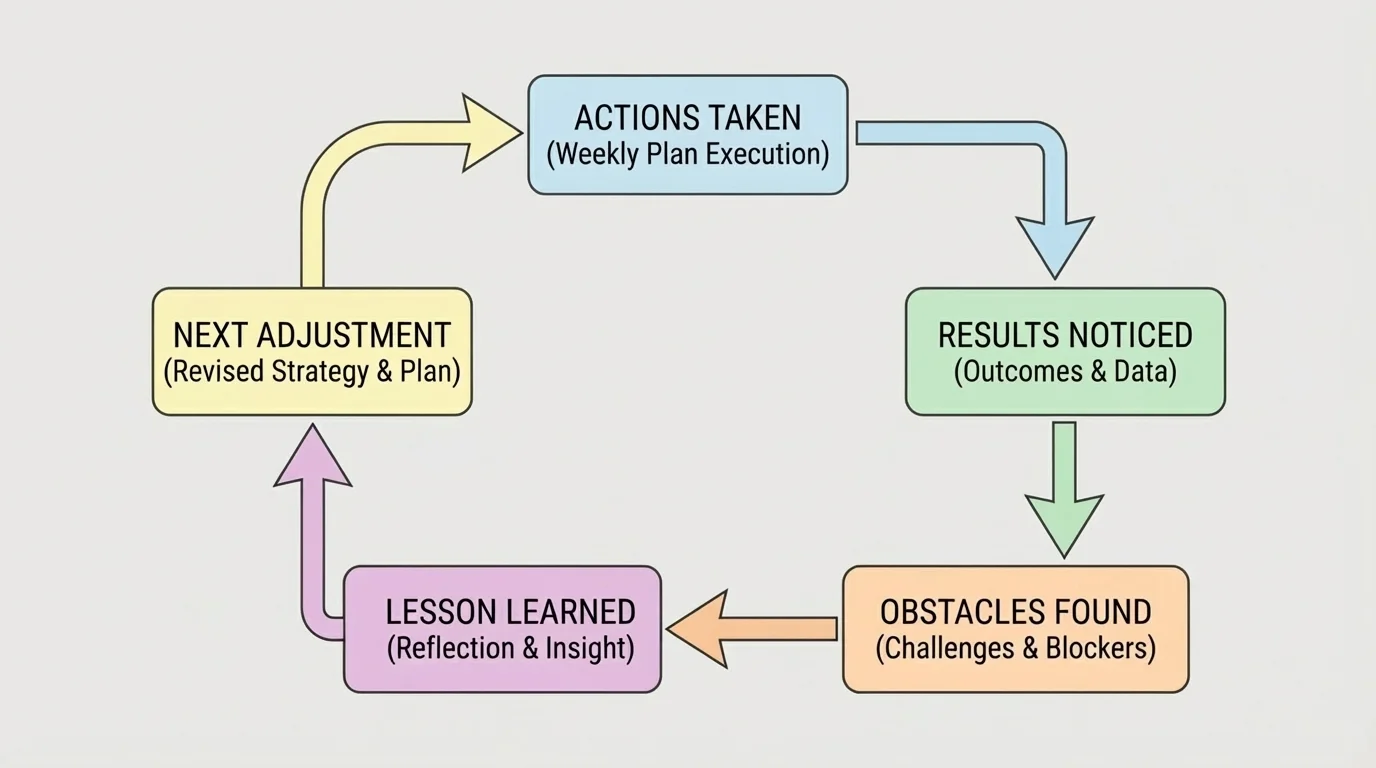
A simple weekly reflection can include questions like these:
What progress did I make? Name actions, not just feelings.
What got in the way? Be specific: time, mood, distractions, lack of preparation, or unrealistic planning.
What helped? Maybe a reminder app, a friend checking in online, a quieter workspace, or shorter work sessions.
What needs to change next week? This is where reflection starts leading into revision.
Reflection matters because long-term goals rarely improve in a straight line. Some weeks are strong. Some are messy. If you only judge yourself by one bad day, you may quit too early. If you ignore several weak weeks, you may drift too far off track. Reflection gives you a more accurate picture.
People often overestimate what they can do in a few days and underestimate what they can do in a few months. Reflection helps correct both mistakes by showing what your pace actually looks like over time.
It also helps with emotional control. When progress feels slow, reflection can remind you that small gains still count. If you practiced guitar for only 15 minutes on four days this week, that is still one hour of practice. The lesson is not "I failed." The lesson may be "Shorter sessions are realistic for me right now."
[Figure 3] Revision is the part many people misunderstand. They think changing a plan means they were weak or wrong. Revising your method is often the most responsible thing you can do. Keeping a bad plan just to prove you are committed is not discipline. It is stubbornness.
Revision means you use what reflection taught you. If your goal still matters, but your strategy is not working, you adjust the strategy. You might change the schedule, make the task smaller, ask for support, remove distractions, or extend the timeline.
Sometimes revision happens because life changes. Family responsibilities increase. Your part-time work hours change. A health issue affects your energy. A tool you depended on is no longer available. Responsible goal setting is not pretending life never changes. It is adapting without losing direction.
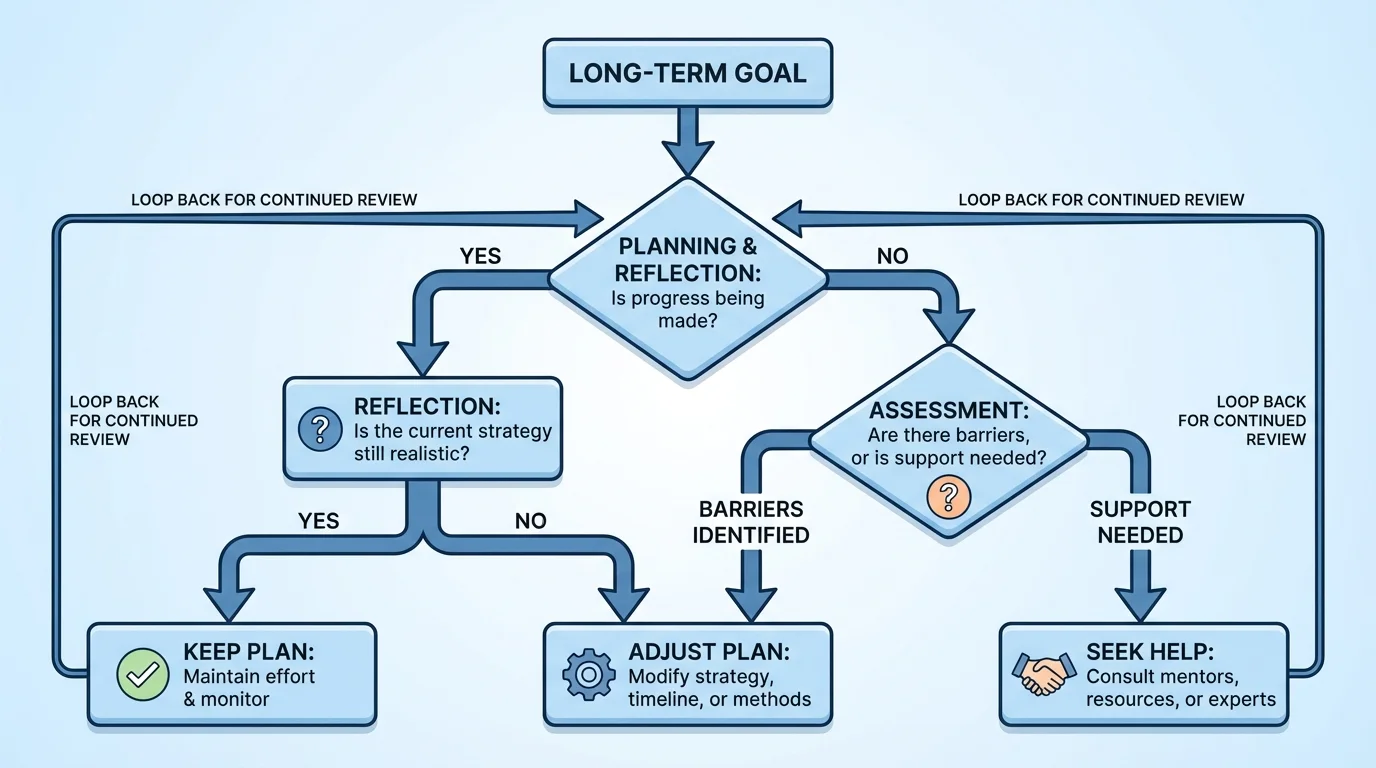
Here are examples of healthy revision:
Same goal, different schedule: You planned to study every night, but evenings are too distracting. You switch to early afternoons.
Same goal, smaller task size: You planned to exercise for 45 minutes, but keep skipping it. You revise to 20 minutes five times a week.
Same goal, better support: You wanted to learn coding alone, but keep getting stuck. You join an online beginner community and watch structured tutorials instead of random videos.
Same goal, longer timeline: You hoped to save $500 in two months, but your income source is inconsistent. You revise to four months and reduce optional spending.
Revision does not mean abandoning standards every time something feels difficult. The key question is whether you are making a smart adjustment or just escaping discomfort. If the task is difficult but realistic, you may need consistency, not a new plan. If the task is unrealistic or poorly designed, revision is necessary.
The goal stays steady while the method stays flexible. Strong long-term goal progress depends on holding onto your purpose while being willing to change your approach. This is one of the most practical forms of responsibility because it replaces excuses with problem-solving.
That flexibility is especially important when working from home. Home can offer freedom, but it can also blur boundaries. You may need to revise your plan if your environment keeps interrupting your progress. Maybe you work better with headphones, website blockers, shorter sessions, or a visible checklist near your computer.
You do not need a complicated productivity system. You need a repeatable one. The cycle is simple: plan, act, reflect, revise, and repeat. Over time, this creates steady growth.
Step 1: Choose one meaningful goal. Do not start with five large goals at once. Pick one that genuinely matters to your health, future, money, skill, or responsibility.
Step 2: Break it into milestones. A milestone is a short-range target that shows your goal is moving. Each action step should be small enough to complete this week.
Step 3: Put actions on a schedule. If you only keep goals in your head, they stay optional. Put them in a planner, app, or digital calendar.
Step 4: Track what you actually do. Checking boxes may seem simple, but it builds awareness. You are collecting evidence.
Step 5: Reflect weekly. Review progress, obstacles, and patterns. This is where the reflection loop in [Figure 2] becomes practical, because you move from noticing problems to learning from them.
Step 6: Revise monthly or when needed. Use the decision process shown in [Figure 3] to decide whether to continue, reduce, reschedule, or get support.
Step 7: Keep going without needing a dramatic restart. Missing a day is not the same as failing a goal. Restart quickly and calmly.
Example: A weekly review for a study goal
You planned four study sessions this week and completed three.
Step 1: Measure the result.
You completed \(3 \div 4 = 0.75\), or \(75\%\), of your plan.
Step 2: Identify the reason for the missed session.
You scheduled one session too late at night, when you were already tired.
Step 3: Reflect on what worked.
The afternoon sessions were completed on time and felt easier.
Step 4: Revise the plan.
Next week, move the late-night session to the afternoon and shorten it by 10 minutes if needed.
The important point is not that the week was perfect. The important point is that the week gave you useful information.
[Figure 4] The same cycle works in very different situations. Planning gives direction, reflection gives feedback, and revision improves the system. The details change, but the pattern stays the same.
Fitness example: You want to improve your stamina over three months. Planning means choosing workouts, days, and a realistic start level. Reflection shows that you skip sessions when they are too long. Revision means shortening them and increasing intensity slowly. The goal stays the same, but the method becomes realistic.
Money example: You want to stop impulse spending and save for something important. Planning means setting a target and deciding where the money will come from. Reflection shows that most unplanned spending happens when you are bored and scrolling online. Revision means deleting saved payment info, using a waiting period before purchases, and setting transfer reminders.
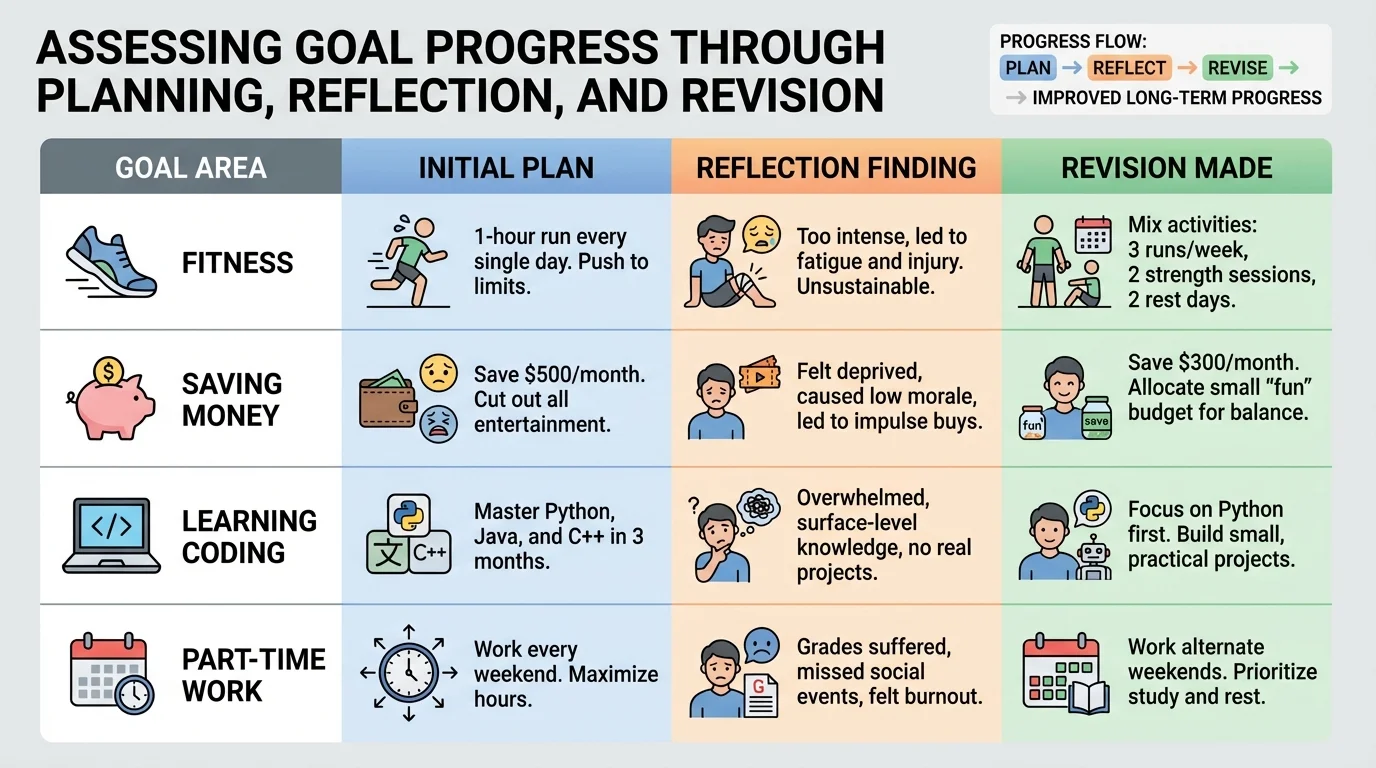
Skill example: You want to learn video editing for freelance work in the future. Planning means choosing software, tutorials, and a weekly practice schedule. Reflection reveals that watching tutorials feels productive, but you improve more when you edit actual clips. Revision means spending less time watching and more time creating.
Work responsibility example: You have a part-time job or volunteer role and want to become more reliable. Planning means tracking shifts, deadlines, and preparation time. Reflection shows that you are usually late when you start getting ready too close to the deadline. Revision means preparing clothes, materials, or messages the night before.
Well-being example: You want better sleep so you can function better during online learning and daily responsibilities. Planning means choosing a bedtime routine and reducing screen use before bed. Reflection shows that late-night scrolling breaks the routine. Revision means charging your phone outside the bedroom or using app limits.
| Goal Area | Planning Question | Reflection Question | Revision Move |
|---|---|---|---|
| Saving money | How much do I need and by when? | Where did my money actually go? | Cut triggers and automate savings |
| Fitness | What routine can I keep weekly? | When do I skip and why? | Shorten or reschedule workouts |
| Study habits | When will I do focused work? | What times help me focus best? | Move sessions to better times |
| Skill building | What will I practice each week? | Am I consuming or creating? | Increase hands-on practice |
Table 1. A comparison of how planning, reflection, and revision apply across common long-term goal areas.
Notice that none of these examples depend on perfection. They depend on adjustment. That is why the milestone structure from [Figure 1] remains useful even when plans change. You still need smaller checkpoints, even after a revision.
Mistake 1: Setting goals that are too vague. If you do not know what action counts as progress, you will struggle to stay consistent. Replace vague goals with clear actions.
Mistake 2: Planning the ideal week instead of your real week. A good plan fits your actual life. If you know you have family duties, limited energy, or shared space, build around that honestly.
Mistake 3: Treating one setback like proof you cannot do it. One missed day is information, not identity. Reflection helps you respond instead of overreacting.
Mistake 4: Refusing to revise. If a plan repeatedly fails, repeating it harder is not always the answer. Sometimes the plan itself needs work.
Mistake 5: Revising too quickly. Not every uncomfortable moment means the plan is wrong. Give a strategy enough time to show whether it works.
"The best plans are not the ones that never change. They are the ones that keep moving you forward."
Mistake 6: Tracking nothing. Memory is unreliable. You may feel like you are doing much more or much less than you really are. Simple tracking gives you evidence.
These habits are not just about personal success. They are also about responsibility. When you plan well, reflect honestly, and revise wisely, you become more dependable. You manage commitments better. You waste less time. You learn from mistakes faster. You become someone others can trust.
This matters in community settings too. If you help with family responsibilities, volunteer, work with a sports team, participate in online groups, or contribute to a local project, other people are affected by whether you follow through. Long-term goals are personal, but their results often affect others.
Future planning depends on this mindset. Careers, finances, health, and relationships all require long-term thinking. Very few important goals happen instantly. They require repeated action over time. A person who can assess progress honestly and adapt well has a major advantage.
Responsibility is not just about having good intentions. It is about following through, checking results, and making better choices when the first plan does not work.
If you learn this now, you are building a skill that will keep helping you long after one specific goal is finished. You will know how to recover from setbacks, make realistic plans, and improve your approach instead of giving up.
Long-term progress is rarely loud. It usually looks like quiet repetition, honest reflection, and smart revision. But that is exactly how strong futures are built.
