Colorado became a state in 1876, but its story began thousands of years earlier. Long before railroads, ski resorts, and busy cities, people lived, hunted, farmed, traded, and traveled across the land we now call Colorado. To understand that story, historians use a timeline, which is a line that shows events in the order they happened. A timeline helps us see what came first, what came next, and how one event led to another.
A timeline is more than a list of dates. It helps us notice chronological order, or the order in which events happen over time. When you build a timeline of Colorado history, you can see how early Native peoples lived on the land, how explorers and settlers arrived later, and how Colorado changed from a region into a territory and then a state.
Timelines also help us connect Colorado history to the history of the United States. For example, Colorado became a state in the same year that the United States celebrated its 100th birthday. That is why Colorado is sometimes called the Centennial State.
Timeline is a tool that places events in the order they happened, using dates or time periods.
Chronological order means arranging events from earliest to latest.
Statehood means becoming an official state in the United States.
When historians make a timeline, they choose major events that show change. They do not include every small event. Instead, they pick the events that had a big effect on people, land, government, or daily life.
Early Colorado history stretches back thousands of years, as [Figure 1] shows in a simple sequence from ancient cultures to later explorers. Long before Europeans arrived, many Native peoples lived in the area. Among them were the ancestors of the Ancestral Puebloans, who built homes and communities in the southwestern part of what is now Colorado, especially at Mesa Verde.
Other Native nations also shaped Colorado history. The Ute people have lived in the Rocky Mountain region for a very long time. Apache, Arapaho, Cheyenne, and Comanche peoples also lived in or traveled through parts of Colorado during different times. These groups hunted, traded, formed alliances, and adapted to the land in different ways.
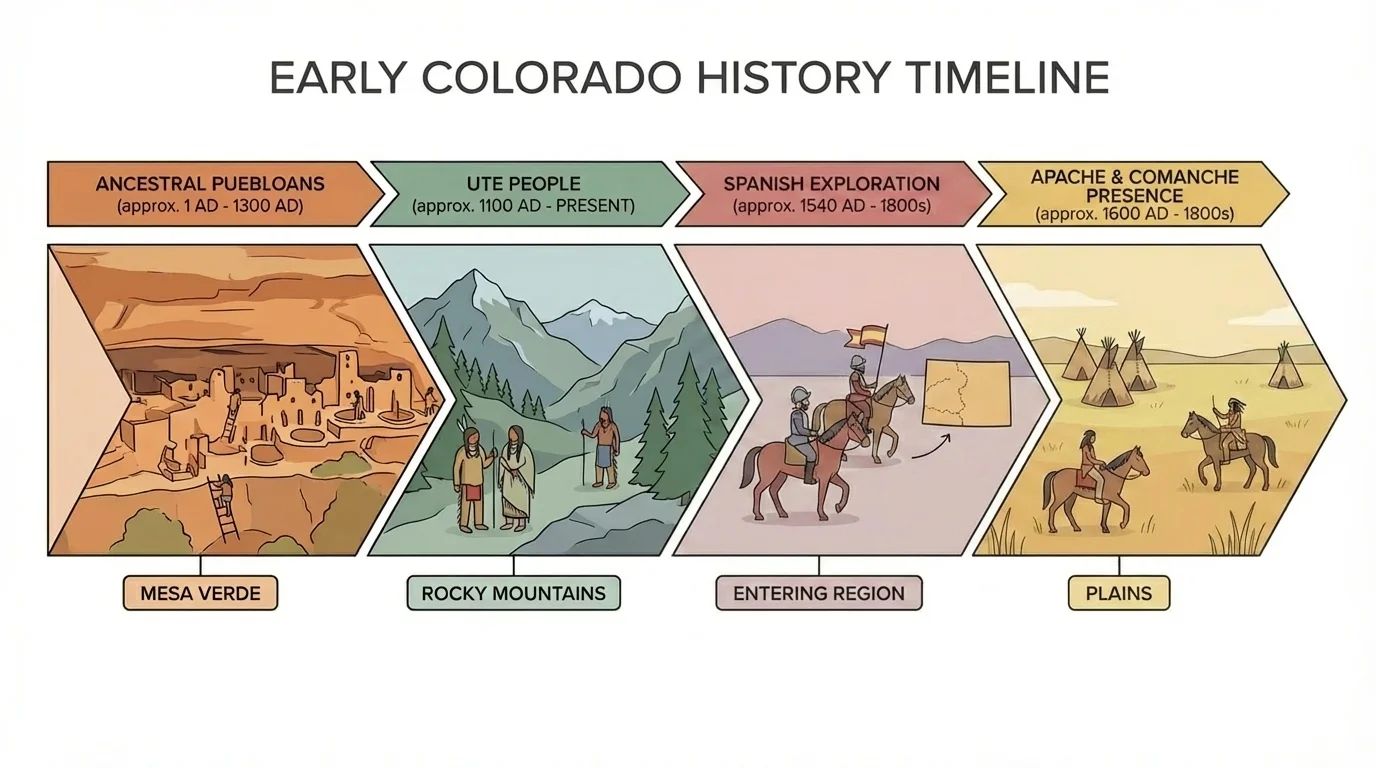
In the 1500s, Spanish explorers entered parts of the American Southwest. Although they did not fully settle Colorado, their journeys were part of the larger Spanish exploration of North America. This connects Colorado history to a wider story happening across the continent, where European nations were claiming land and searching for wealth.
The early timeline of Colorado should begin with these first people and cultures because they were here long before borders or state lines existed. Colorado history does not begin with statehood. It begins with human communities, traditions, and knowledge of the land.
Mesa Verde is famous for cliff dwellings built by Ancestral Puebloans. These stone homes help historians learn how people lived, farmed, and built communities hundreds of years ago.
The long span of time in [Figure 1] reminds us that Colorado's history began with Native peoples whose cultures still matter today. Their languages, traditions, and connections to the land are an important part of Colorado's story.
In the late 1700s and early 1800s, more outsiders entered the region. Some came as traders, trappers, and explorers. Fur traders wanted animal pelts, especially beaver fur, which was valuable at the time. These people traveled through mountains, rivers, and plains, meeting Native groups and trading goods.
Colorado was also affected by changes in national borders. After the United States made the Louisiana Purchase in 1803, the nation claimed a huge amount of land, including part of present-day Colorado. Later, other parts of Colorado became part of the United States through additional land agreements and wars, including land gained after the Mexican-American War.
This means Colorado did not come under United States control all at once. Different parts of the state came under United States control at different times. A good timeline can show these changes by adding important national events that affected Colorado, even if those events happened far away in Washington, D.C., or other regions.
Colorado and the United States
Colorado history is part of United States history. When the United States expanded westward, built new transportation routes, and encouraged settlement, Colorado changed too. A strong timeline shows both local events in Colorado and national events that influenced them.
Trails and trade routes brought more people west. [Figure 2] Some were searching for business opportunities. Others were moving to new homes. Step by step, the region became more connected to the rest of the country.
A few fast-moving years changed Colorado dramatically. In 1858, gold was discovered near Cherry Creek, close to present-day Denver. News spread quickly, and many people rushed to the area hoping to get rich. This event is often called the Gold Rush in Colorado.
Mining camps and towns grew quickly. Some people found gold, but many others made money by selling tools, food, clothing, and services to miners. Denver began to grow into an important city because it was a supply center for nearby mining areas.
As more settlers arrived, the federal government organized the land more formally. In 1861, the Colorado Territory was created. This was an important step because it gave the region an official government under the United States, even though it was not yet a state.
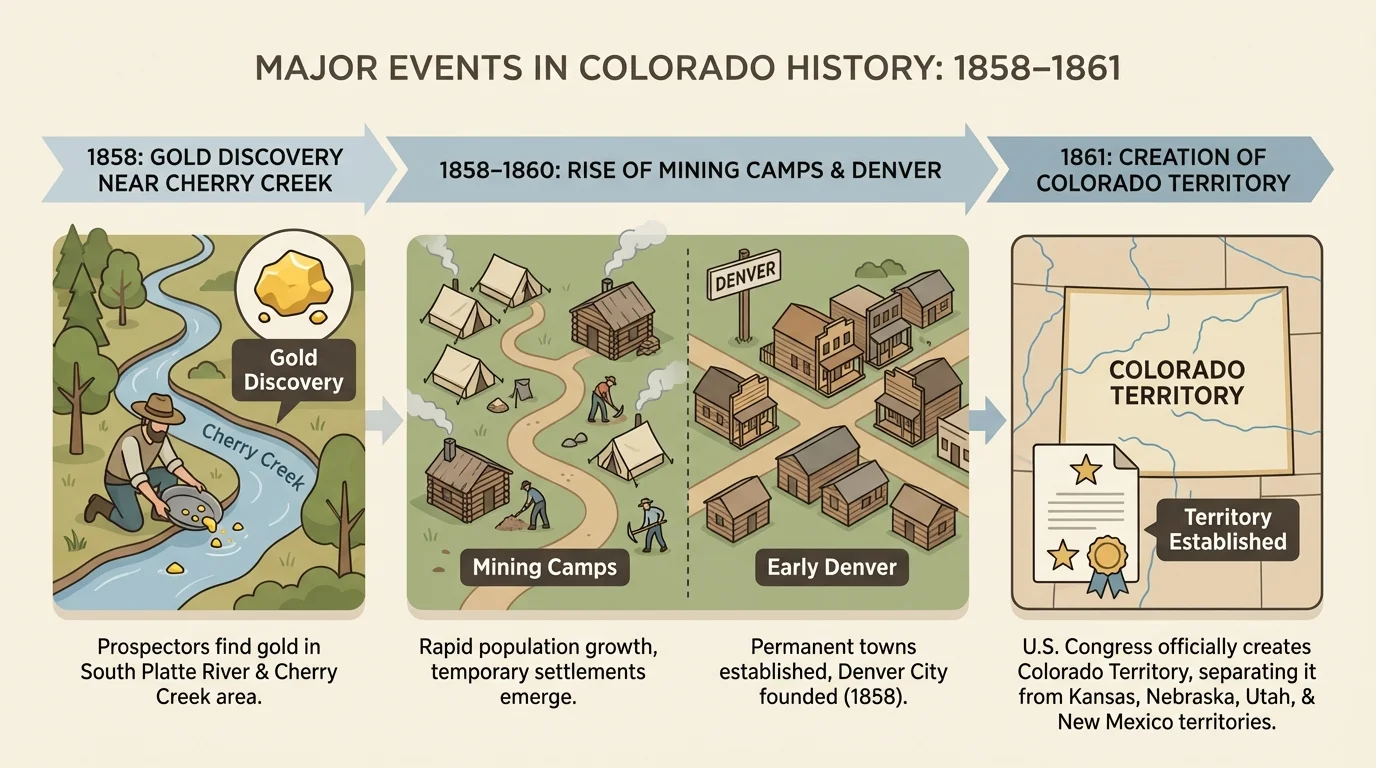
The creation of the territory happened during the period of the American Civil War. Colorado was far from many major battles, but the war still affected the region. Gold and other resources from the West mattered to the Union. The same years that brought fighting in the eastern United States also brought political change to Colorado.
A timeline for this period should include the gold discovery, the growth of mining towns, and the creation of the territory. These events show how natural resources, migration, and government worked together to change Colorado quickly.
Example: Choosing key events for a timeline
If you can only choose three events from this period, pick the ones that caused the biggest changes.
Step 1: Start with the gold discovery in 1858.
This event brought many newcomers to the region.
Step 2: Add the growth of mining camps and Denver.
This shows how people built towns because of the search for gold.
Step 3: End with the creation of Colorado Territory in 1861.
This event shows that the area now had organized government under the United States.
These three events fit together because one led to the next.
Later in the lesson, the pattern seen in [Figure 2] helps explain why population growth and government change often appear side by side on a history timeline.
[Figure 3] Transportation linked distant parts of Colorado through rail lines and growing towns. After the Civil War, railroads became extremely important. Railroads carried people, supplies, mined ore, cattle, and farm products. They helped towns grow and connected Colorado to the national economy.
Colorado became a state in 1876. This moment of statehood is one of the most important dates on any Colorado timeline. Because it happened 100 years after the Declaration of Independence in 1776, Colorado earned the nickname the Centennial State.
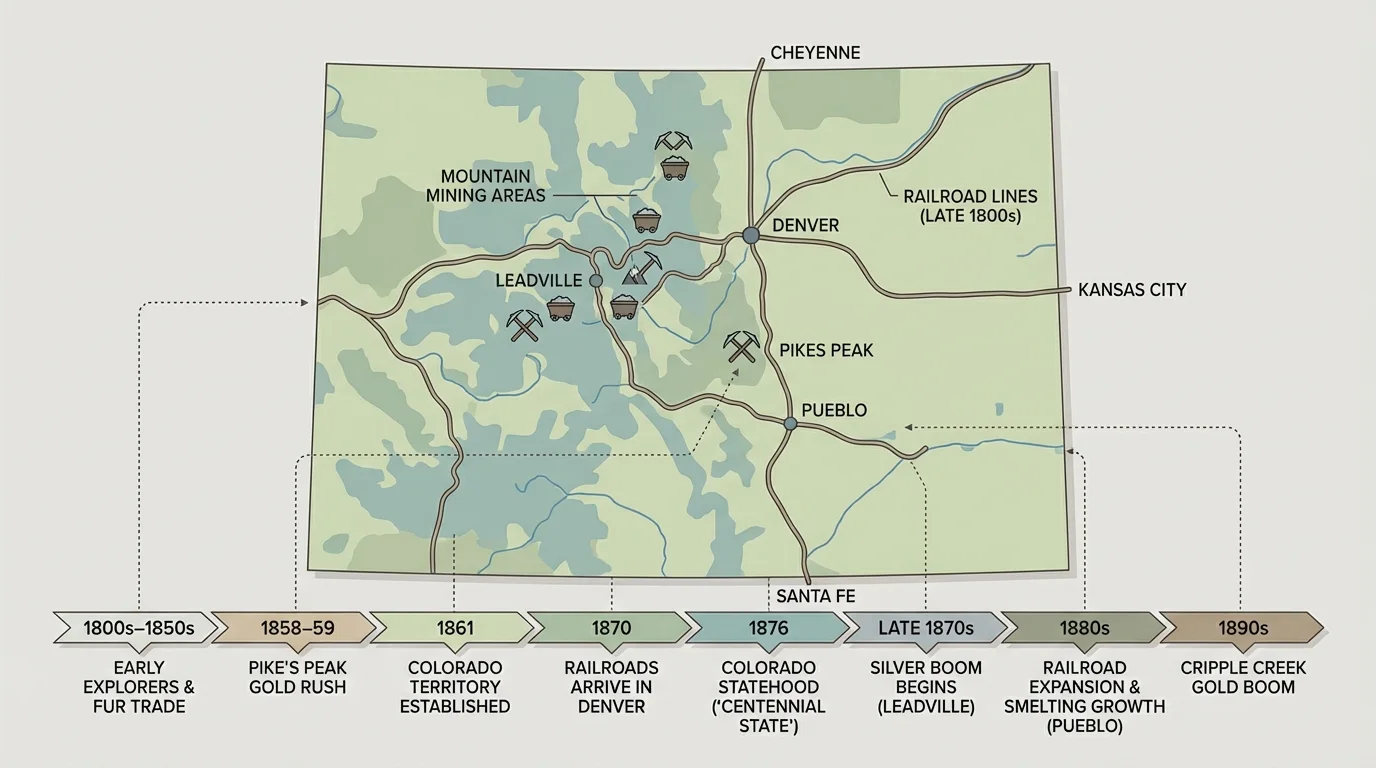
[Figure 4] During the late 1800s, mining remained important, but ranching, farming, and industry grew too. Cities such as Denver and Pueblo became larger. Leadville became famous for silver mining. Irrigation projects helped farmers grow crops in a dry climate.
Colorado's growth matched larger national trends. Across the United States, railroads expanded, industries grew, and more settlers moved west. Colorado was part of this wider change, but it also had its own special mix of mountains, mining towns, plains farms, and fast-growing cities.
| Year | Event | Why It Matters |
|---|---|---|
| Before the 1500s | Native peoples live across the region | Shows Colorado's earliest communities and cultures |
| 1500s | Spanish exploration reaches the broader region | Connects Colorado to European exploration in North America |
| 1803 | Louisiana Purchase affects part of present-day Colorado | Begins U.S. control over some Colorado land |
| 1858 | Gold discovered near Cherry Creek | Starts major migration and town growth |
| 1861 | Colorado Territory created | Organizes the region under U.S. government |
| 1876 | Colorado becomes a state | Makes Colorado an official state in the Union |
Table 1. Major early events that should appear on a Colorado history timeline.
The railroad network helps explain why some places grew faster than others. Towns connected by transportation often gained more people, trade, and political influence.
The 1900s brought both hardship and change. One important event was the Ludlow Massacre in 1914. This happened during a coal miners' strike in southern Colorado. The conflict between workers and the Colorado National Guard turned violent, and people were killed, including children. This event is remembered as part of the struggle over workers' rights in the United States.
In the 1930s, the Dust Bowl and the Great Depression affected Colorado. Dry weather, dust storms, and economic troubles made life very hard for many families, especially farmers. Some people left, while others came searching for work and a new start.
During World War II, Colorado became important for military training and defense work. Army bases and other military sites brought jobs and new people to the state. After the war, Colorado's cities continued to grow.
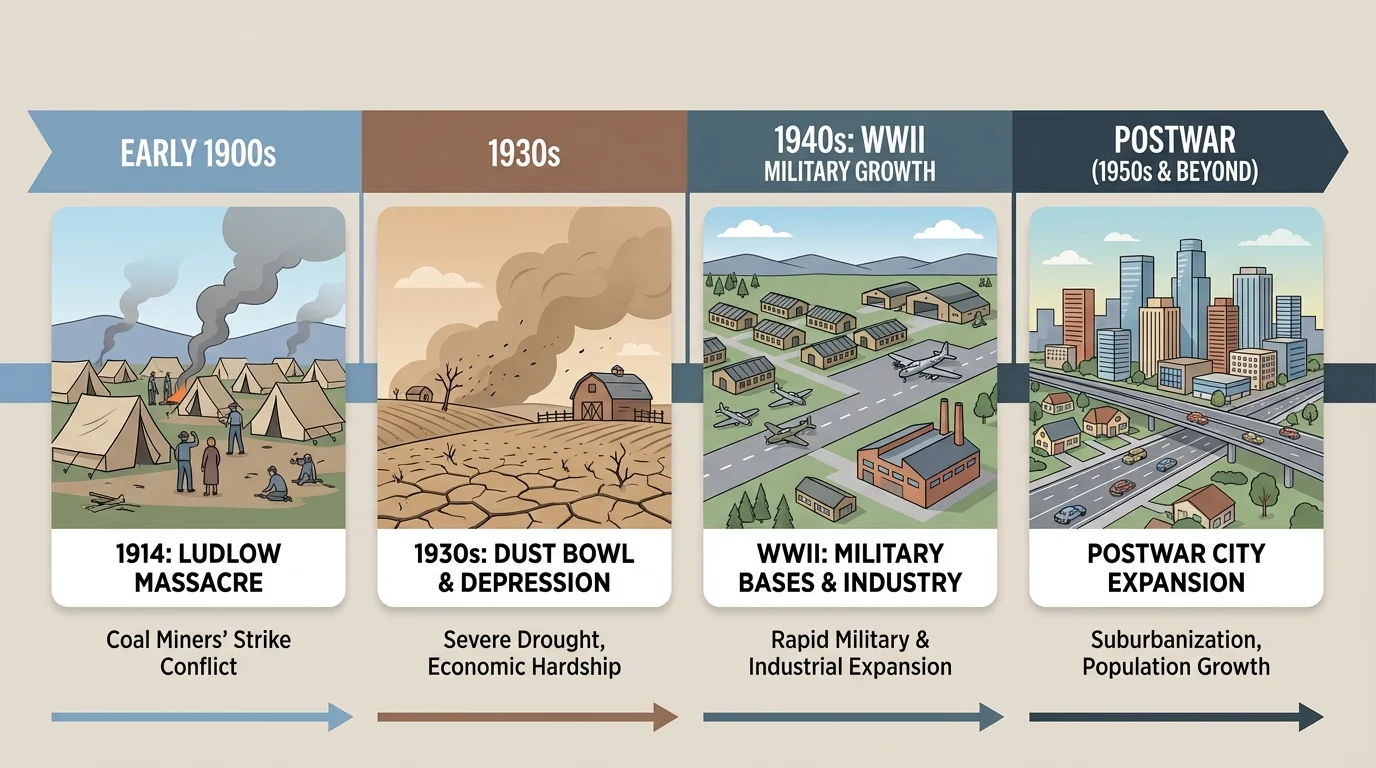
In the second half of the 1900s, Colorado changed again. Highways, suburbs, tourism, and outdoor recreation became more important. Ski areas grew famous. Technology and government jobs also helped shape the modern economy, especially around Denver, Boulder, and Colorado Springs.
When you place events on a timeline, look for cause and effect. For example, railroads helped towns grow in the 1800s, and later highways helped cities and suburbs grow in the 1900s.
The sequence in [Figure 4] shows that history is not only about success and growth. It also includes conflict, disaster, and hard choices that affected real people.
Today, Colorado is known for mountains, outdoor recreation, farming, cities, science, military bases, and diverse communities. Its population has grown a great deal. People continue to move to Colorado for jobs, schools, nature, and new opportunities.
Modern Colorado history also includes important questions about water, land use, wildfire, and the environment. These topics matter because Colorado's natural resources support farms, cities, wildlife, and recreation. A timeline of recent history might include population growth, major wildfires, and efforts to protect land and water.
Native nations, including the Ute Mountain Ute Tribe and the Southern Ute Indian Tribe, remain an important part of Colorado today. Their presence reminds us that the history of Colorado did not stop in the past. It continues into the present.
"History is who we are and why we are the way we are."
— David McCullough
A strong timeline should show that Colorado is always changing. New events will continue to shape the state, just as mining, railroads, farming, labor struggles, and migration shaped it before.
A timeline should not just list dates, but should also show connections through short labels and arrows between events. Begin with the earliest major events and move toward the present. Keep each entry short, but choose events that truly matter.
You can organize a Colorado timeline by asking three helpful questions: [Figure 5] What happened? When did it happen? Why does it matter? If you answer all three, your timeline will be much clearer.
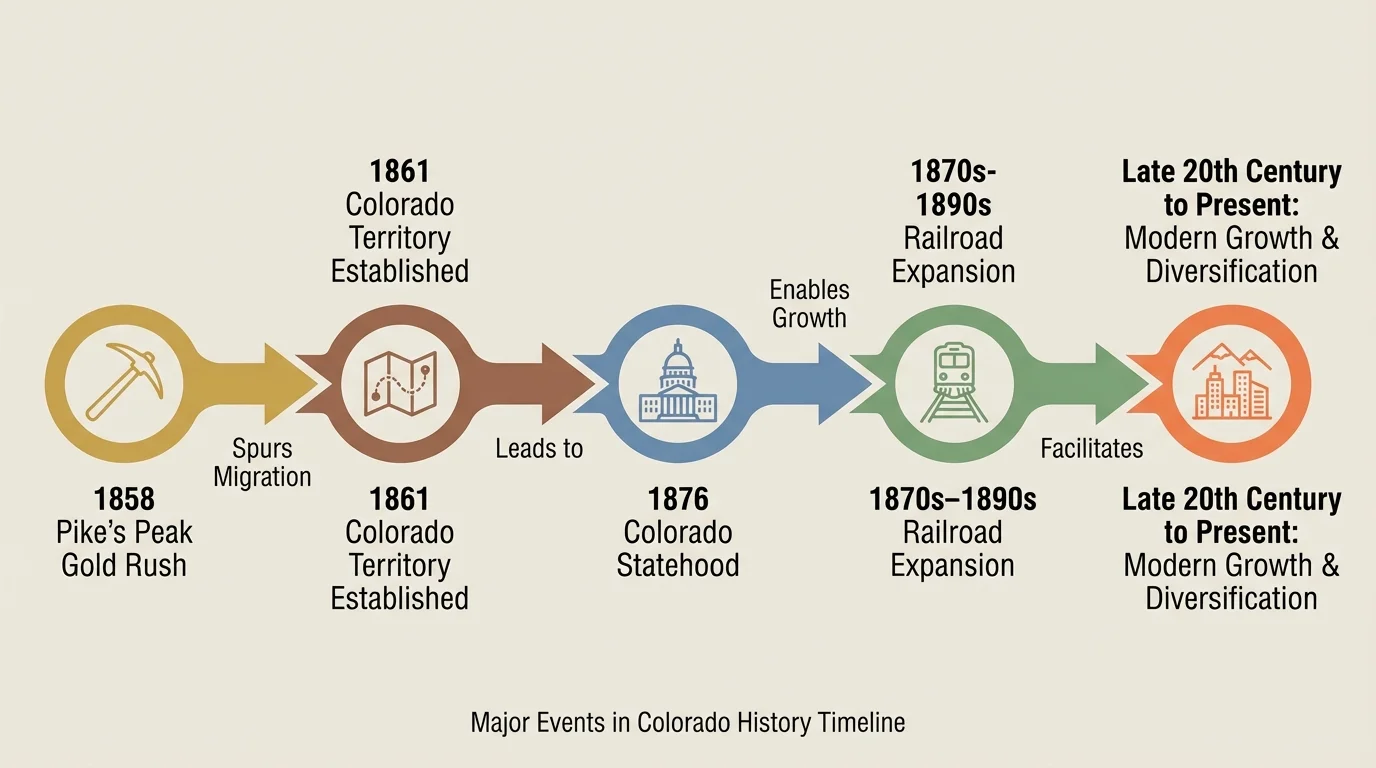
It also helps to group events into eras, or large periods of time. One era might be early Native history. Another might be exploration and trade. Another could be the Gold Rush and territorial period. Then come statehood, industrial growth, and modern Colorado.
When you choose events, be careful not to focus on only one kind of history. A good timeline includes Native peoples, explorers, miners, farmers, workers, leaders, and everyday families. It includes politics, economics, culture, and the environment.
This organization works well because it mixes dates with meaning. That helps you see not only when something happened, but also how it changed Colorado.
Sample sequence for a Colorado history timeline
Step 1: Start with Native peoples and early cultures.
Include Ancestral Puebloans, Ute people, and other Native nations connected to the region.
Step 2: Add exploration and changing borders.
Include Spanish exploration and later United States expansion.
Step 3: Add the Gold Rush and Colorado Territory.
These events explain why population and government changed quickly.
Step 4: Add statehood in 1876 and railroad growth.
These events show Colorado becoming more connected and organized.
Step 5: Add key 1900s and modern events.
Include labor conflict, the Dust Bowl, wartime growth, and modern environmental issues.
This sequence creates a timeline that is clear, balanced, and historically accurate.
When you study Colorado history in order, you can see a big pattern: people used the land in different ways over time, new groups arrived, government changed, and Colorado became connected to national events across the United States. That is what makes a timeline such a powerful history tool.
