What comes first when you get ready for bed: putting on pajamas or brushing your teeth? The order matters. If we mix up the order, the story sounds silly. Time words help us tell things in the right order so other people understand what happened.
Every day has a beginning, a middle, and an end. We wake up, play, learn, eat, and sleep. We use time words to talk about these parts of the day. Time words help us talk about the present, which is happening now, and the future, which will happen later.
Present means now. Future means later, after now. Past means before now, something already happened.
If you say, "I am eating lunch," that is happening now. That is the present. If you say, "I will go home later," that is the future. When we talk about the past, we tell things that already happened.
Some time words name parts of time. As [Figure 1] shows, we can compare what is happening now with what will happen later. We use day to name one full day, week for seven days, month for one of the twelve parts of a year, and year for twelve months together.
We can say, "Today is Monday." We can also say, "Next week we will visit Grandma," or "My birthday is in a different month," or "Last year I was younger." These words help us know when something happens.
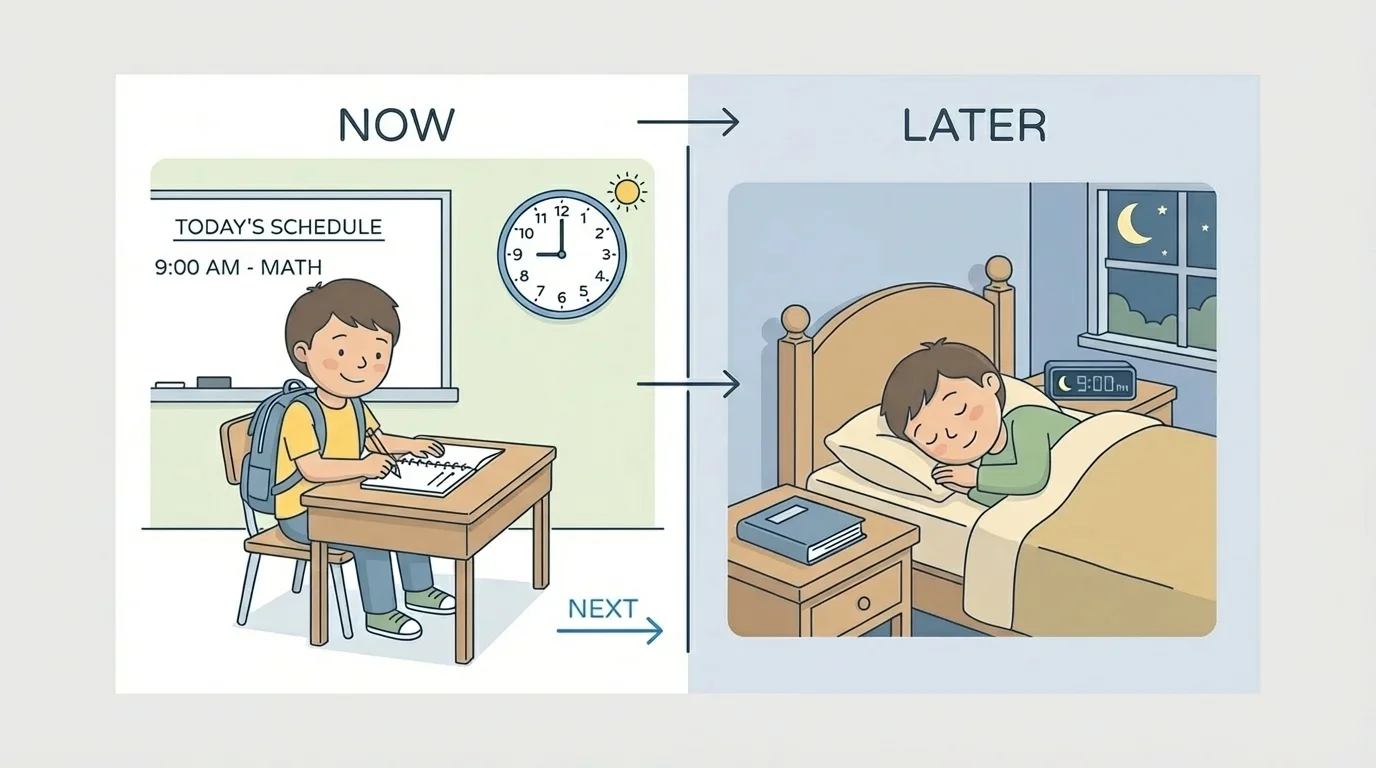
The words days, weeks, months, and years help us measure time in larger and larger units. A day is short. A week is longer. A month is longer than a week. A year is longer than a month.
A year has seasons in many places. That means a lot can happen in one year, like growing taller, learning new words, and celebrating holidays.
When we talk about the past, these words help us be clear. Instead of saying only "a long time ago," we might say "last week," "last month," or "last year."
Some words tell the order of events. First tells what happens at the beginning. Next tells what happens after that. Last tells what happens at the end.
Listen to this order: First we wash our hands. Next we eat lunch. Last we clean up. That makes sense because the events are in the right order.
Order helps a story make sense. If we say events in the wrong order, a listener may get confused. Saying what happened first, next, and last helps us tell a clear story about something that happened.
We also use before and after. Before tells about something earlier. After tells about something later. "We put on socks before shoes." "We go home after school."
These words can work together. "First I got my backpack. Next I lined up. Last I went outside." Or, "I ate breakfast before school and played after school."
When we talk about history, we tell about things that already happened. As [Figure 2] illustrates, the order of events helps us understand the past. If someone says, "I was a baby, then I started school, then I had a birthday," we can picture the order.
The past is important because it tells us what happened before now. We can talk about our own past, like "Last year I was in a different class." We can also talk about family history, like "Before I was born, my parents were children too."
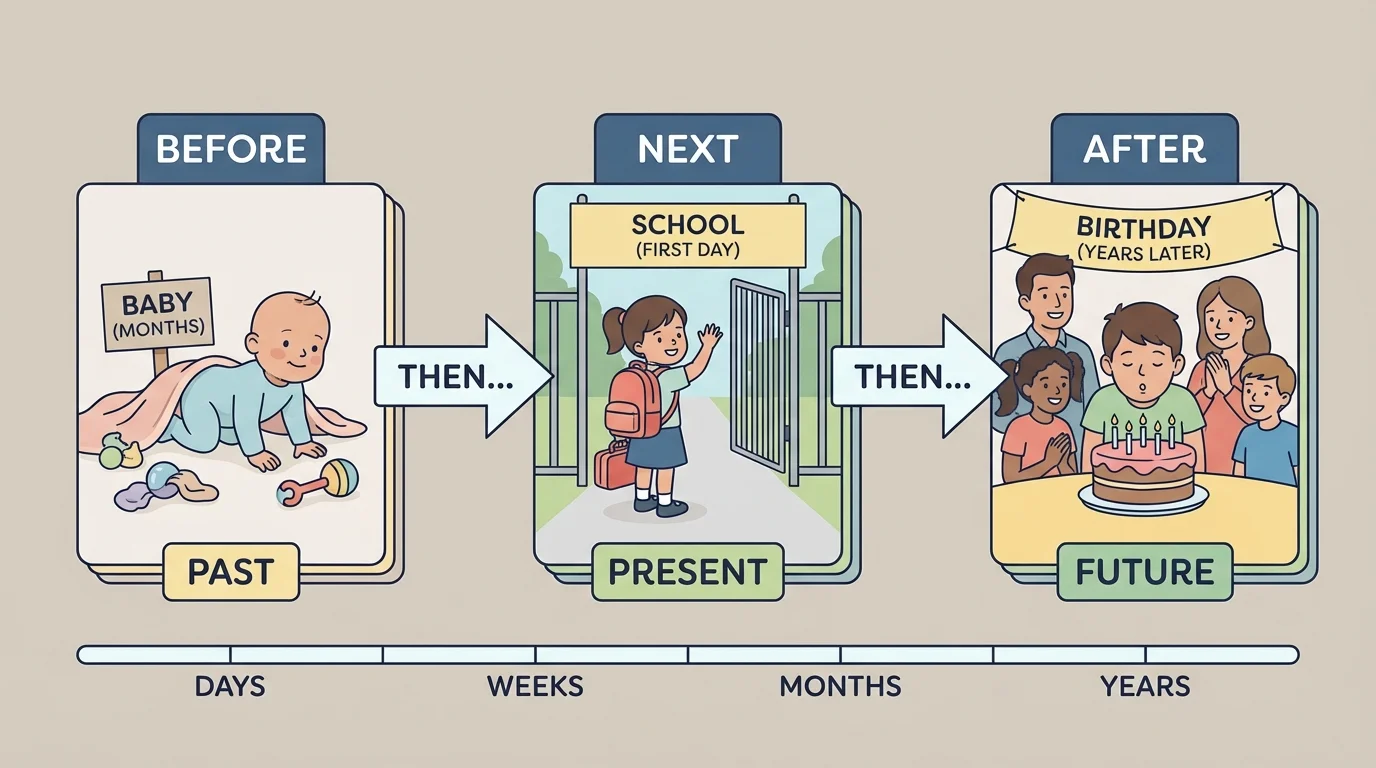
People use order words to tell true stories about the past. A family might say, "First we moved to a new house. Next we met our neighbors. Last we planted flowers." The order helps us understand what happened.
Example: Telling a past event clearly
Step 1: Start with what happened first.
First, Maya woke up early.
Step 2: Tell what happened next.
Next, she went to the park.
Step 3: Tell what happened last.
Last, she went home for dinner.
This story is easy to understand because the events are in order.
When we learn about the past, we do not want to mix up what happened before and after. If we did, the story would not make sense. That is why the sequence of events is important in history.
A timeline is a line that shows events in order over time. The event on the left happened earlier. The event on the right happened later.
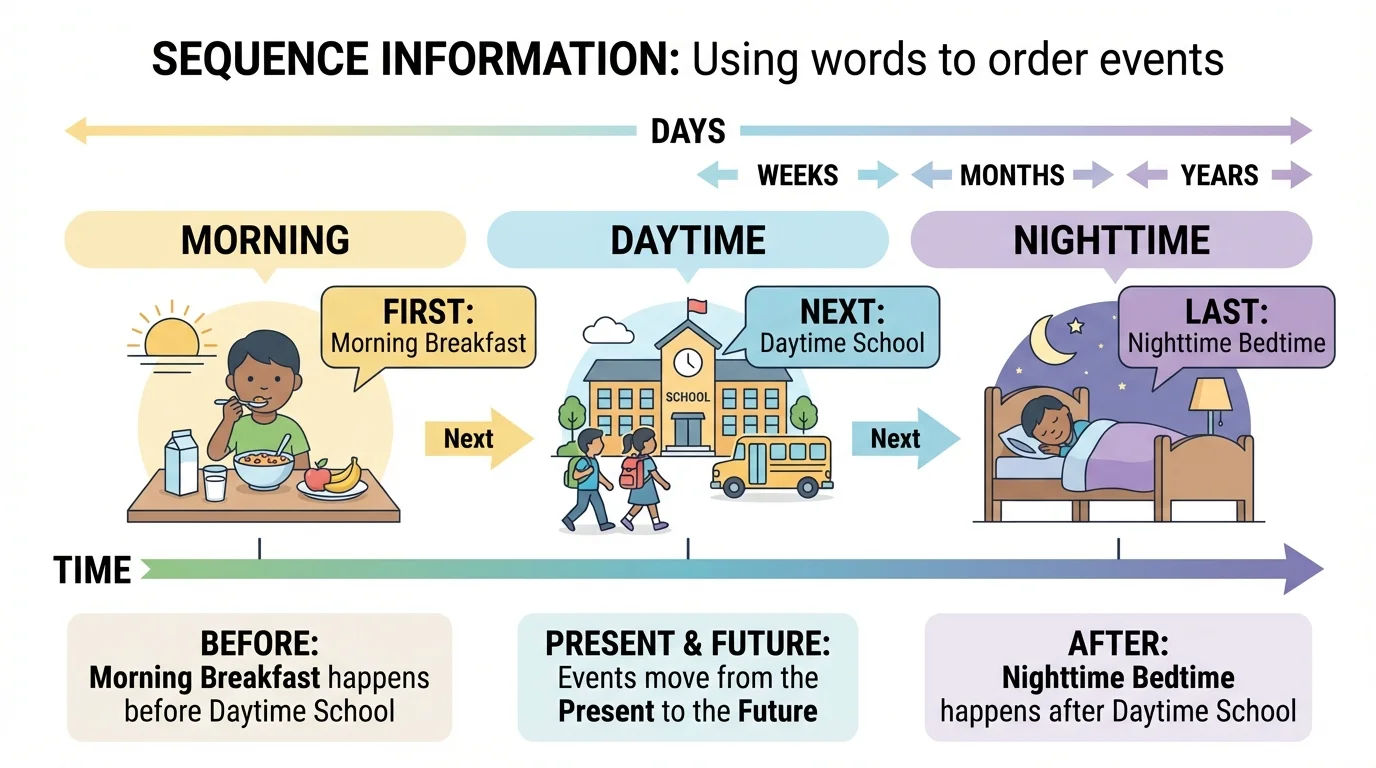
A timeline can help us talk about one day, one week, or even many years. For very young learners, a timeline can be as simple as three pictures in order: wake up, eat lunch, go to sleep.
Later, when we talk about our own lives or family stories, a timeline still helps. Just like the pictures in [Figure 2], a timeline keeps events in the right order.
| Time word | What it tells us | Example |
|---|---|---|
| present | now | I am at school now. |
| future | later | I will play later. |
| before | earlier | We eat before recess. |
| after | later than something else | We go home after school. |
| first | beginning | First, I put on my coat. |
| next | the step that comes after another | Next, I zip it. |
| last | end | Last, I go outside. |
Table 1. Time and order words with simple meanings and examples.
Here are some ways sequence words help in real life. In the morning, you may eat breakfast before school. At school, you may listen first, work next, and clean up last. At night, you may take a bath before bed.
Plants grow in order too. First, someone plants a seed. Next, the seed gets water and sunlight. After that, a small plant grows. Last, it becomes bigger. Sequence words help us tell that story clearly.
When you use time words, think about one big question: What happened earlier, and what happened later? That question helps you choose words like before, after, first, next, and last.
We can even use the same idea for birthdays. Last year you were younger. This year you are older. Next year you will be older still. That is another way time moves forward, just like the now-and-later picture in [Figure 1].
When we describe the past, we need the right order. If we say, "After I blew out the candles, I lit them," that sounds wrong. The correct order is, "First we lit the candles. Next I made a wish. Last I blew them out."
