A soccer ball that is kicked on the playground falls back down every time. A puddle after rain dries up day after day. Seeds sprout when they get what they need. These things may seem ordinary, but they are actually powerful clues about how science works. Scientists look at events in the world, gather evidence, and build explanations. They trust that the natural world follows patterns that are dependable. That is why people can study what happened long ago, understand what is happening now, and make good predictions about what may happen next.
Science is not just about knowing facts. It is about explaining why and how things happen. A good scientific explanation is based on evidence that is valid and reliable. That evidence may come from books, articles, observations, measurements made with tools, or a student's own experiment. When scientists explain something, they connect what they observed to ideas about how the natural world works.
A scientific explanation tells what happened, gives evidence for it, and connects the evidence to a science idea. For example, if a plant near a sunny window grows taller than a plant in a dark corner, a scientific explanation does more than say, "The sunny plant is taller." It explains that plants need light to make food, and the evidence supports that idea.
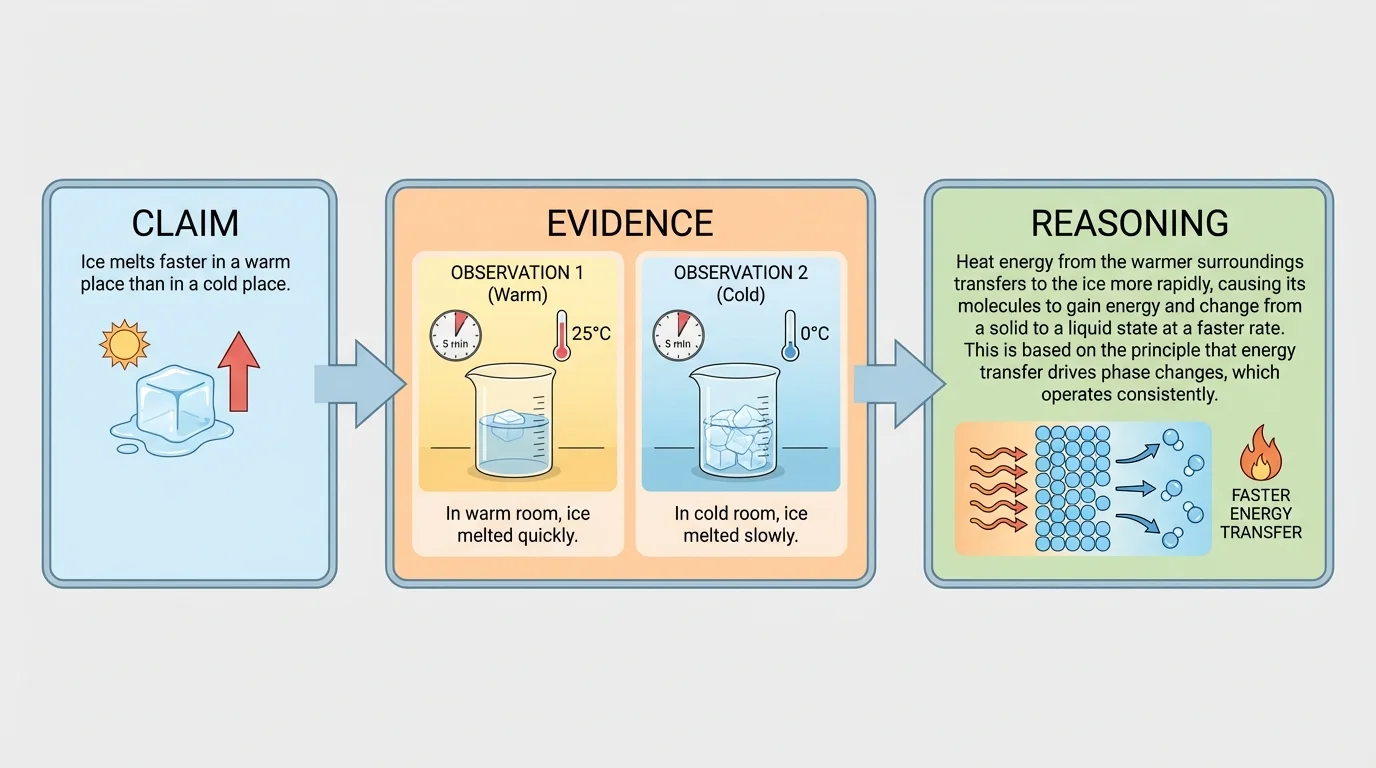
Scientists often organize explanations with three parts: a claim, evidence, and reasoning. The claim is the answer or explanation. The evidence is the information that supports the claim. The reasoning explains why the evidence fits the claim using science ideas.
Claim is a statement that answers a question or explains what happened.
Evidence is the data, observations, or information that supports a claim.
Reasoning is the thinking that links the evidence to the claim using science ideas.
Suppose students test which surface makes a toy car move farther: tile, carpet, or wood. If the car rolls farthest on tile, the explanation is not complete until the students use evidence from their measurements and connect it to the idea of friction. A complete explanation says that the tile surface has less friction than carpet, so the car keeps rolling longer.
Evidence can come from many places. Students may gather it by observing, measuring, timing, comparing, or testing. Scientists also use information from other trustworthy sources, such as science books, museum materials, published reports, and data collected by other scientists.
An observation is something noticed with the senses or with tools. Seeing that ice shrinks on a warm day is an observation. Measuring the amount of water left after the ice melts is also an observation, but it is made with a tool. Measurements are often especially helpful because they give exact information. If one plant is 5 centimeters taller than another, that is more precise than just saying it is "a little taller."
Different sources of evidence can work together. A student may observe that a shadow changes size during the day, then read in a scientific source that Earth's movement and the Sun's position in the sky affect shadows. Using both personal investigation and trustworthy outside sources can make an explanation stronger.
You already know that scientists ask questions, make observations, and look for patterns. Constructing an explanation is the next step: using those observations and patterns to answer the question clearly.
Not every source is equally strong. As [Figure 1] helps show, a careful measurement from repeated trials is usually stronger than a guess. A peer-reviewed scientific source is stronger than a random opinion. In science, the goal is not to pick the loudest answer. The goal is to support the best answer with the best evidence.
Good science depends on valid evidence and reliable evidence. In a fair test, scientists try to change only one thing at a time and keep other conditions the same. If students are testing whether sunlight affects plant growth, they should use the same kind of seed, the same size pot, the same amount of water, and the same type of soil. Then the independent variable is the amount of sunlight.
Evidence is valid when it truly matches the question being studied. If the question is about sunlight and plant growth, measuring pot color will not help much. Measuring plant height, number of leaves, or growth over time will help more. Evidence is reliable when it can be trusted because it is collected carefully and often gives similar results again and again.
Repeating a test matters. One result might happen by accident. If a student rolls a toy car down a ramp once, that single trial may not tell the full story. But if the student rolls it several times and gets similar distances, the evidence becomes stronger. Scientists often look for patterns across many trials, not just one.
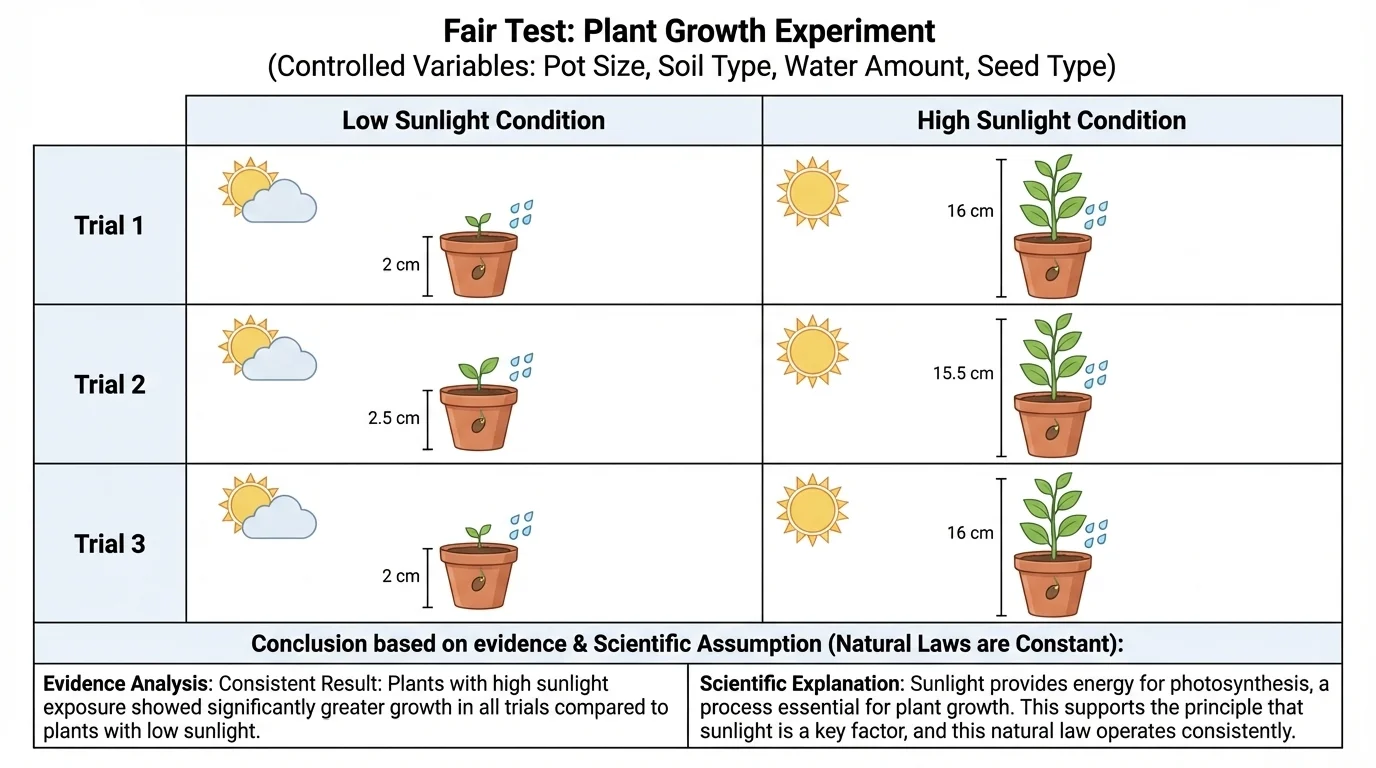
Careful measuring also improves reliability. If one group uses a ruler and another group just guesses, the ruler data is stronger. Time, length, mass, and temperature can all be measured with tools. Sometimes scientists average results to see the overall pattern. For example, if three plant heights are measured as 8 centimeters, 9 centimeters, and 10 centimeters, the average height is \[\frac{8 + 9 + 10}{3} = \frac{27}{3} = 9\] centimeters. This average helps show the center of the results.
Scientists also watch out for mistakes. A scale might not be set to zero. A timer might start late. Someone might pour more water into one cup than another. Reliable evidence does not mean perfect evidence. It means the evidence is gathered as carefully and fairly as possible.
| Type of evidence | Stronger when... | Weaker when... |
|---|---|---|
| Observation | It is detailed and recorded carefully | It is based on memory only |
| Measurement | It uses tools and exact numbers | It is guessed or estimated roughly |
| Experiment | It is a fair test with repeated trials | Many things change at once |
| Source information | It comes from trusted science materials | It comes from unsupported opinion |
Table 1. Comparison of stronger and weaker kinds of scientific evidence.
Science depends on an important idea: the natural world works in dependable ways. Gravity pulls objects down today, and scientists expect gravity to have pulled objects down in the past and to keep doing so in the future. The pattern of changing shadows, shown in [Figure 2], also follows regular rules connected to the Sun's position in the sky.
This does not mean everything stays the same. Weather changes. Seasons change. Living things grow. But the patterns in nature and the scientific ideas that describe these events stay dependable. Water freezes when it gets cold enough and melts when it gets warm enough. Seeds need the right conditions to grow now just as seeds did long ago.
Why this assumption matters [Figure 3]
If the rules of nature changed all the time for no reason, science would not work well. People could not use what they learn today to explain old fossils, predict eclipses, or build safe bridges. Scientists assume that the same natural patterns continue over time because this assumption matches what they repeatedly observe.
This idea helps scientists study the past. For example, they can examine rocks and fossils and use what they know about erosion, weathering, and living things to explain what happened long ago. It also helps them predict the future. If dark clouds, dropping air pressure, and radar data often lead to storms, meteorologists can warn people before the storm arrives.
The same principle helps in everyday life. When cooks heat water, they expect it to boil under the right conditions. When drivers press brakes, they expect friction to help the car slow down. When builders design playgrounds, they rely on forces and materials behaving in dependable ways.
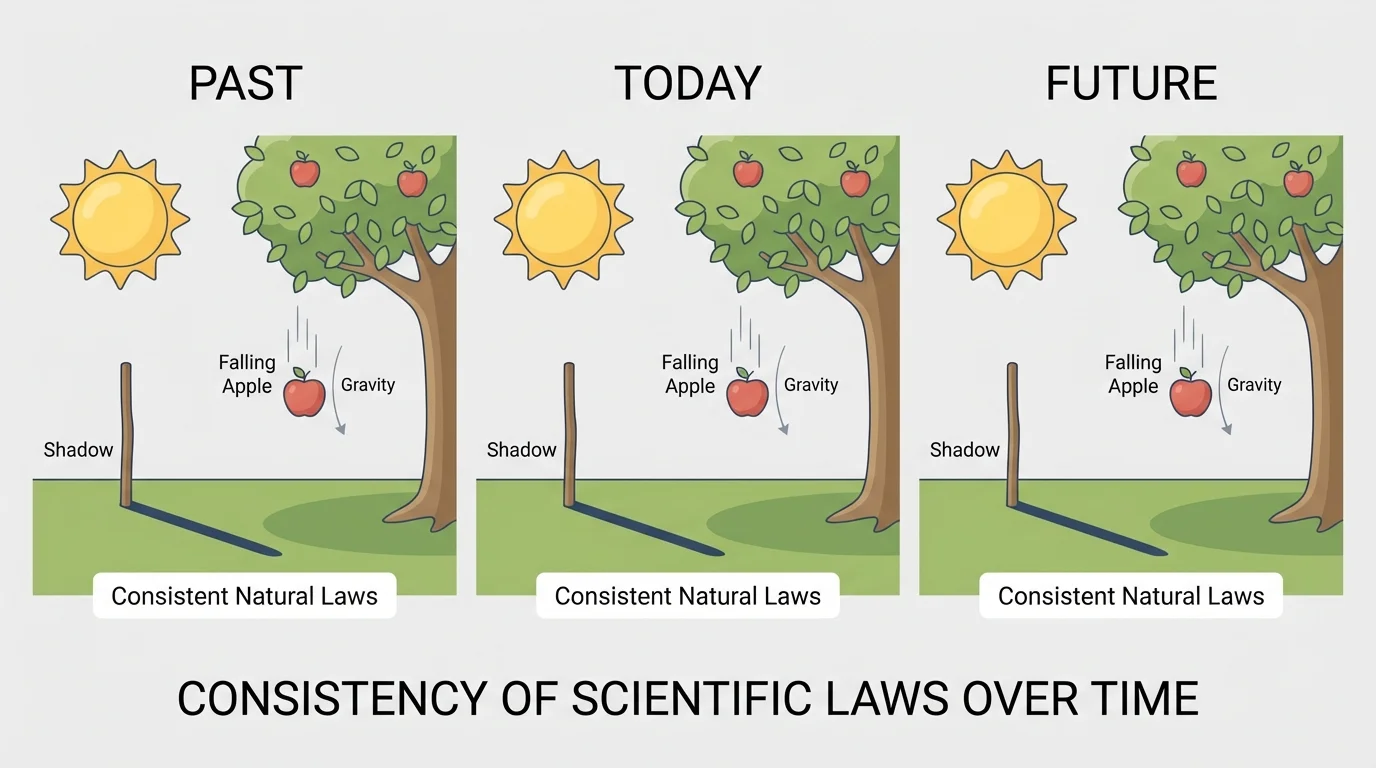
Even when science ideas improve, the natural world is not changing to match the new idea. People are getting better at organizing and improving their explanations of what was already happening. That is an important difference. Science grows because evidence grows.
Scientists often build explanations using a structure that starts with a claim, adds evidence, and then gives reasoning. This structure helps make thinking clear. It stops explanations from becoming just opinions.
First, state the claim clearly. Next, choose the evidence that best supports the claim. Then explain why that evidence matters. The reasoning part connects the evidence to science ideas like force, energy, light, weather, or life processes.
Example: Why did ice melt faster on a metal tray than on a foam tray?
Step 1: State the claim.
The ice melted faster on the metal tray because metal transfers heat better than foam.
Step 2: Give evidence.
After 10 minutes, the ice on the metal tray lost more mass and made a larger puddle than the ice on the foam tray.
Step 3: Add reasoning.
Heat moved into the ice more quickly through the metal. Because the ice got energy faster, it melted faster.
Notice that the explanation uses more than a result. It also explains the science idea behind the result. A strong explanation answers the question, supports the answer, and shows the thinking.
Sometimes students collect lots of data, but not all of it belongs in the final explanation. Good scientists select the most useful evidence. If the question is about why one object floated and another sank, the shape, mass, and material may matter more than the color.
Scientists may also compare evidence from several sources. A classroom experiment might show that plants bend toward light. A science book may explain that plants respond to light to help them get energy for making food. Together, those pieces can make the reasoning stronger.
[Figure 4] Consider a classroom test about ramps. Students release the same marble from ramps of different heights. They measure how far the marble rolls after leaving the ramp. If the marble rolls farther from the taller ramp in repeated trials, students may explain that a higher ramp gives the marble more kinetic energy by the time it reaches the bottom.
That explanation becomes stronger when the experiment is fair. The same marble should be used. The surface should stay the same. The release point should be measured carefully. This connects back to the fair-testing idea in [Figure 1], where only one main factor changes at a time.
Another example is evaporation. Students can also use evidence to explain natural processes. Suppose students place one cup of water in sunlight and another in shade. After the same amount of time, the sunny cup has less water left. A good explanation is that the warmer conditions in sunlight helped water change into water vapor more quickly.
Scientists often become more confident in an explanation when different kinds of evidence point to the same answer. A pattern seen in an experiment, in nature, and in trusted science sources is especially powerful.
A third example involves seeds. If seeds in moist paper towels sprout while seeds in dry towels do not, students can explain that water is necessary for germination. If they repeat the test and get the same result again, the evidence becomes more reliable.
Sometimes evidence does not support the first idea. That is normal in science. A group may predict that larger paper airplanes always fly farther, but the data may show that shape matters more than size. Then the explanation should change to fit the evidence. In science, changing your mind because of evidence is a strength, not a weakness.
Science and engineering are closely connected, but they are not exactly the same. Science focuses on explaining how the natural world works. Engineering focuses on solving problems and designing things that work well. This difference is clear: science explains why a bridge bends, while engineering uses that information to improve the design.
If students build a paper bridge, science helps them explain why some shapes bend more and why folded paper can be stronger. Engineering uses that evidence to create a better bridge. Students might test flat paper, folded paper, and paper with support beams, then choose the design that holds the most mass.
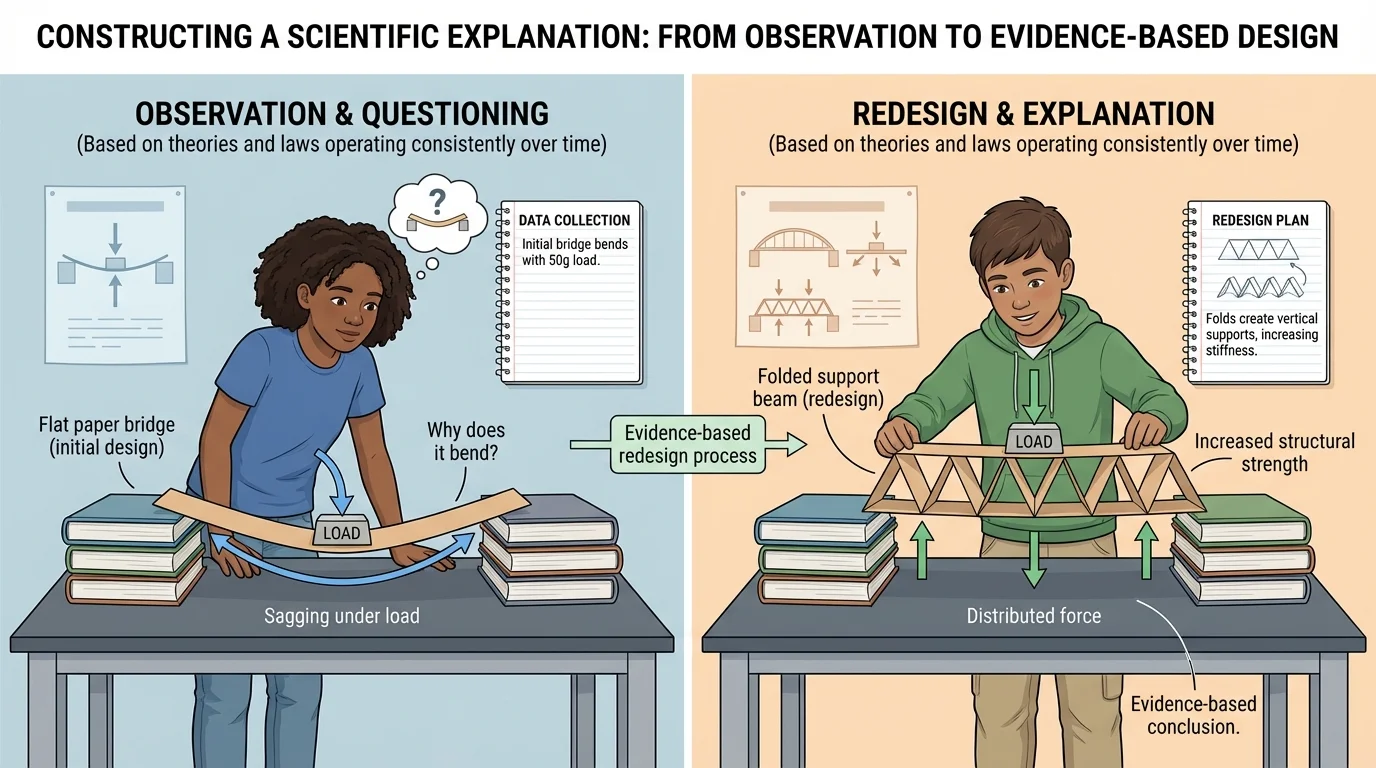
Both science and engineering depend on evidence. An engineer should not choose a design just because it "looks nice." The design should be tested. If one bridge holds 20 blocks and another holds 35 blocks, the second design has stronger evidence behind it. The improvement can then be explained using ideas about shape, strength, and support.
Engineers also use the same assumption about dependable natural rules. They trust that materials, forces, and motion will behave in regular ways. Without that trust, it would be impossible to build airplanes, playgrounds, bicycles, or water systems safely.
Scientists must be careful not to let wishes replace evidence. If someone wants one seed to grow best, they might pay more attention to that seed and ignore the others. This is one reason scientists record data carefully and often share their methods so others can test the same question.
Bias means a leaning or preference that can affect judgment. Scientists work to reduce bias by measuring carefully, repeating tests, and comparing results with others. They know that evidence should lead the explanation, not personal opinions.
"Science is a way of thinking much more than it is a body of knowledge."
— Carl Sagan
Sometimes two groups get different results. That does not mean science failed. It means more checking is needed. Maybe the temperature was different, maybe one group measured more carefully, or maybe more trials are needed. Discussion and retesting help scientists improve explanations.
Scientists also know that explanations can change when new evidence appears. Long ago, people had fewer tools to study weather, space, and tiny living things. As tools improved, explanations improved too. The natural world stayed the same, but human understanding became more accurate.
Scientific explanations help in many parts of life. Doctors and medical researchers explain how diseases spread and how treatments work. Farmers explain which conditions help crops grow best. Weather scientists explain storm patterns to keep people safe. Builders use explanations about forces and materials when making homes, schools, and bridges.
Environmental scientists study pollution, habitats, and climate patterns. They gather evidence from water samples, air measurements, satellite images, and field observations. Then they explain what is happening and what may happen next if conditions change.
Space scientists observe planets, stars, and moons. Because they trust that the same natural laws work everywhere, they can explain craters, orbits, and seasons on other worlds by using what they know about motion, gravity, and light here on Earth. The same dependable patterns we noticed earlier with gravity and shadows in [Figure 2] help scientists understand much larger systems too.
Even simple classroom investigations prepare students for this kind of thinking. Measuring, comparing, repeating, and explaining are not just school skills. They are the tools people use to understand the world and make wise decisions in it.
