People are persuaded every day by speakers they never meet in person: creators on livestreams, job candidates on video calls, activists speaking at town meetings, and teens explaining an idea to family members or a community group. The difference between a message that gets ignored and one that gets support usually is not just the idea itself. It is how clearly, confidently, and thoughtfully the idea is presented.
Persuasive speaking is not about tricking people. It is about helping others understand your point of view, trust your reasoning, and care enough to respond. You use this skill when you ask for more responsibility at work, explain your opinion in a group chat, present an idea during an online club meeting, or speak up about an issue that matters to you.
Strong persuasive speakers do three things well: they know what they want to say, they know who they are saying it to, and they deliver their message in a way that feels real. If any one of those is missing, the message weakens. A great argument with poor delivery can be ignored. A confident delivery with no evidence can sound shallow. A lot of facts without connection to the audience can feel forgettable.
Claim is the main point you want your audience to accept.
Evidence is the support for your claim, such as facts, examples, expert sources, or personal experience.
Audience is the person or group you are trying to reach.
Counterargument is an opposing view that you respond to fairly and clearly.
When you understand those four ideas, persuasive speaking becomes much easier to build on purpose instead of just "winging it."
You may think of speeches as something adults do in politics or business, but persuasion shows up in ordinary moments. You might explain to a parent why a later curfew makes sense, tell a team captain why a practice schedule should change, record a video for a youth organization, or answer an interview question like, "Why should we choose you?" In each case, you are asking someone to believe, decide, or act.
When you speak persuasively, you increase your chances of being taken seriously. People are more likely to listen when your message feels organized, respectful, and supported. On the other hand, if you ramble, sound defensive, or give opinions with no support, even a good idea can lose impact.
Many professional speakers spend more time preparing the order of their points than writing fancy wording. Clear structure often matters more than sounding impressive.
This is also a relationship skill. Persuasion works best when people feel respected, not pressured. If you can disagree without becoming rude, explain your reasons without attacking someone, and answer questions without shutting down, you become easier to trust.
Persuasion works when several elements connect together, as [Figure 1] shows: purpose, audience awareness, evidence, and delivery all support each other. This is why effective speakers often look natural even when they are highly prepared. They are not just talking. They are making deliberate choices.
First, effective speakers are clear about their purpose. Before they speak, they know the answer to one question: What do I want my audience to think, feel, or do? That purpose shapes everything else. If your goal is vague, your message will probably sound vague too.
Second, effective speakers build credibility. Credibility is the sense that you are trustworthy, informed, and sincere. You do not need to be an expert to have credibility. You can build it by being honest, prepared, respectful, and specific. Saying "I looked at three local volunteer programs and compared their schedules" sounds stronger than "I just think this is a good idea."
Third, they make their message easy to follow. They do not bury the main point under too much background. They guide the listener with simple verbal signals like "My main point is…," "There are two reasons…," or "The biggest concern is…."
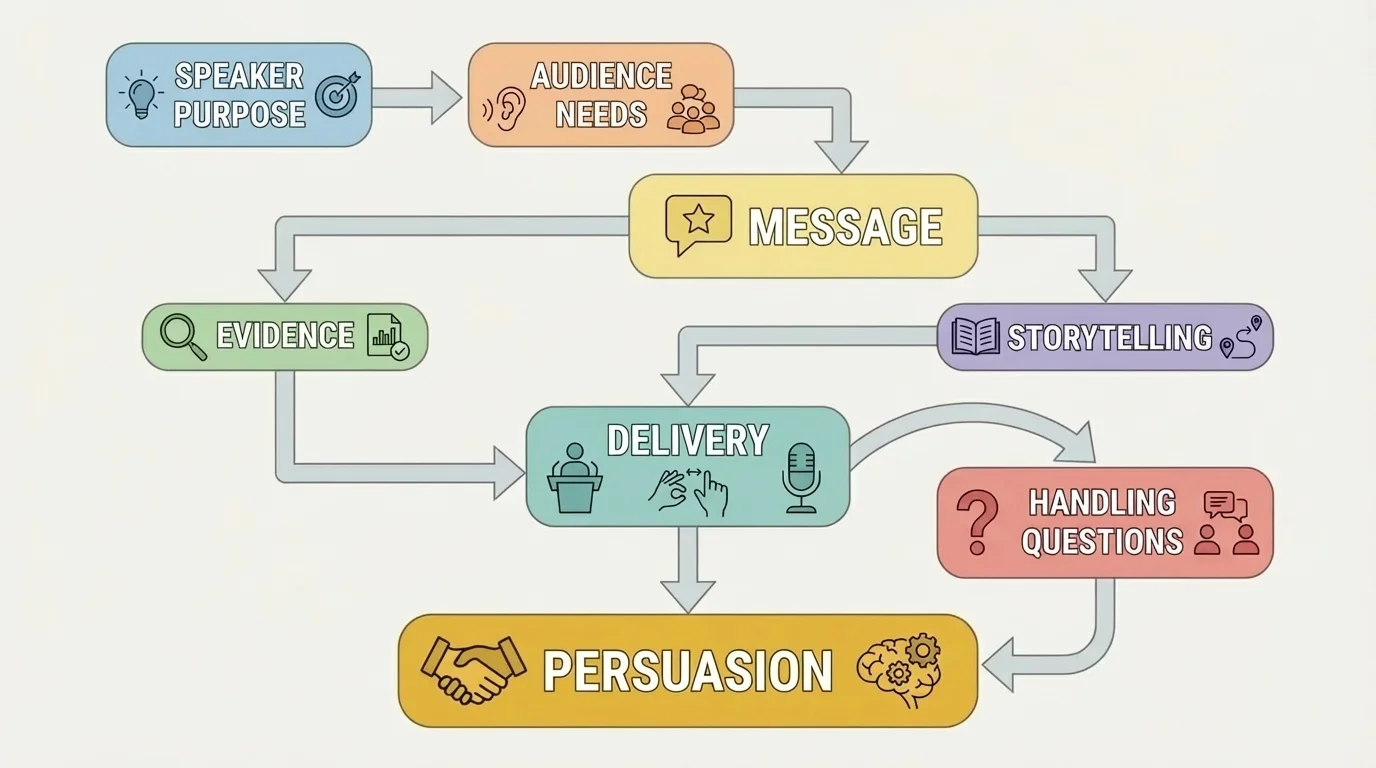
Fourth, they control pace and tone. They pause at important moments. They avoid sounding flat, rushed, or aggressive. In video calls, this matters even more because technical delay and screen distance can make weak delivery feel weaker. A steady pace and clear voice help your audience stay with you.
Finally, they sound human. They are not perfect robots. They may use notes, pause to think, or adjust when something is unclear. That often makes them more persuasive, not less, because it feels genuine.
Why authenticity matters
People usually notice when a speaker sounds copied, exaggerated, or fake. Persuasion becomes stronger when your words match your real values and experience. You do not need to use big vocabulary or dramatic phrases. You need to sound like someone who actually means what they are saying.
The same system from [Figure 1] applies whether you are making a short comment in a meeting or giving a longer presentation. Purpose, audience, evidence, and delivery still work together.
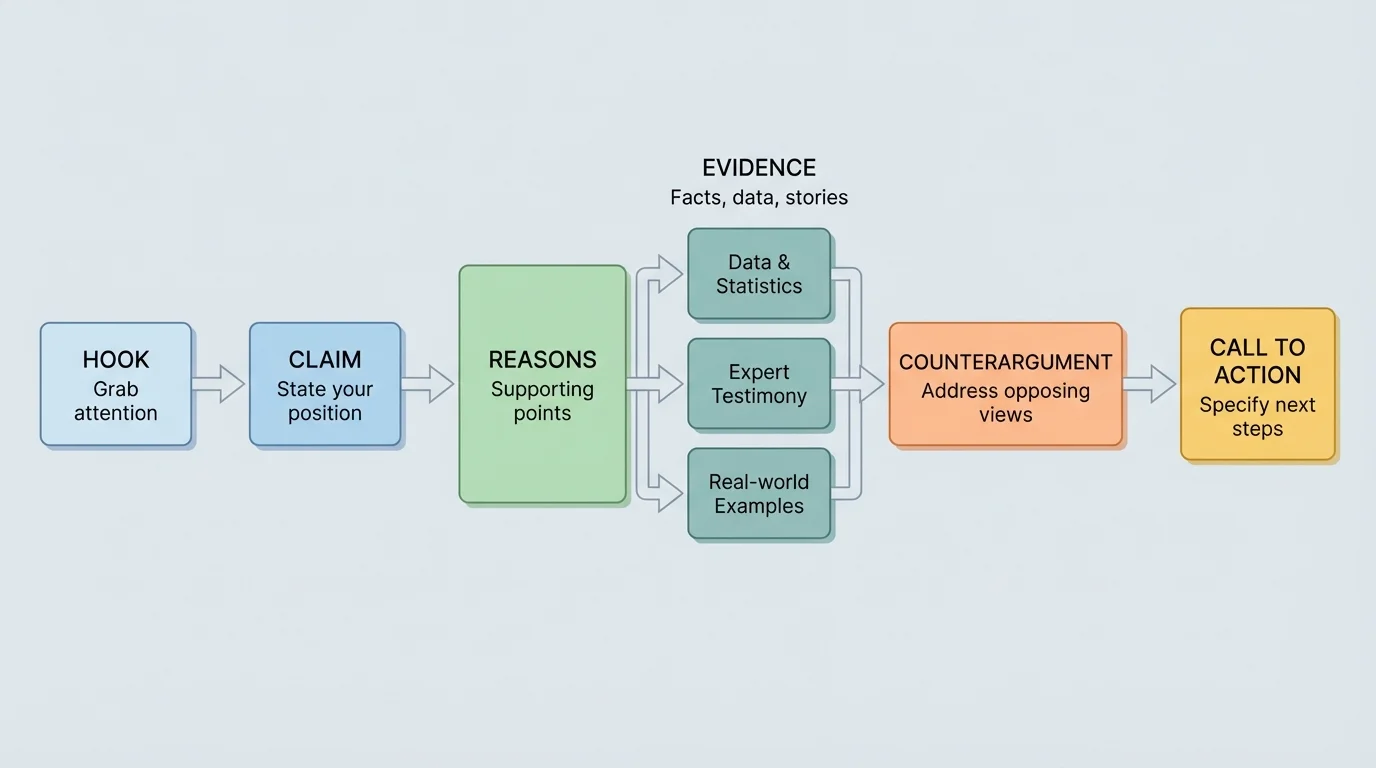
A persuasive argument is easier to trust when it is easy to follow. As [Figure 2] illustrates, a strong structure gives your audience a path from your opening to your conclusion instead of forcing them to guess where you are going.
A practical structure has six parts: hook, claim, reasons, evidence, counterargument, and close.
Hook: Start with something that earns attention. This could be a surprising fact, a short story, a sharp question, or a clear real-world problem. The hook should connect directly to your topic, not distract from it.
Claim: State your main point early. Do not make people wait too long. A clear claim sounds like: "Our neighborhood should add more evening volunteer options for teens," or "Students should prepare for interviews by practicing responses out loud, not just thinking about them."
Reasons: Give the main reasons your claim makes sense. Most short arguments are strongest with two or three reasons, not six. Too many reasons can actually weaken your focus.
Evidence: Support each reason with proof. This might include a statistic, an example, a comparison, a quote from a reliable source, or a relevant personal observation.
Counterargument: Show that you understand the other side. This makes you sound mature and fair. For example: "Some people worry that evening volunteer programs would need extra supervision. That is a valid concern, but local libraries and community centers already run supervised evening activities successfully."
Close: End clearly. Restate the point and leave the audience with a next step, a takeaway, or a strong final line.
If your argument feels messy, the problem is often structure, not intelligence. You may know your topic well but present it in the wrong order. Good structure makes your thinking visible.
Example: Turning a weak argument into a stronger one
Weak version: "I think our community center should stay open later because that would be better and people would probably like it."
Step 1: Make the claim specific
"The community center should stay open until 8:00 p.m. on weekdays."
Step 2: Add reasons
"Later hours would help students with after-work schedules and give families more time to use the space."
Step 3: Add evidence and a response to concerns
"A survey of local residents showed strong interest in later access, and nearby centers with similar hours report steady evening use. While staffing is a concern, the center could test the change on two weekdays first."
The second version sounds more persuasive because it is specific, supported, and realistic.
When you later answer questions, the structure in [Figure 2] helps you stay grounded. If you know your claim, reasons, and evidence, you are less likely to get lost under pressure.
The same idea can succeed or fail depending on how well it matches the audience, and [Figure 3] makes that difference visible. Adapting does not mean changing your core belief. It means choosing the tone, examples, and level of detail that will make sense to the people listening.
Ask yourself four questions before you speak: Who are they? What do they care about? What might they worry about? What tone will help them listen?
If you are speaking to friends, your tone might be casual and direct. If you are speaking to a parent, employer, or community leader, you may need to sound more formal and organized. The idea can stay the same while the wording changes.
For example, suppose you want support for taking a first aid class. To a friend, you might say, "It is useful, and it could actually help in an emergency." To a parent, you might say, "It would build practical safety skills and show responsibility." To a community organization, you might say, "Training more teens in first aid increases local preparedness and youth leadership."
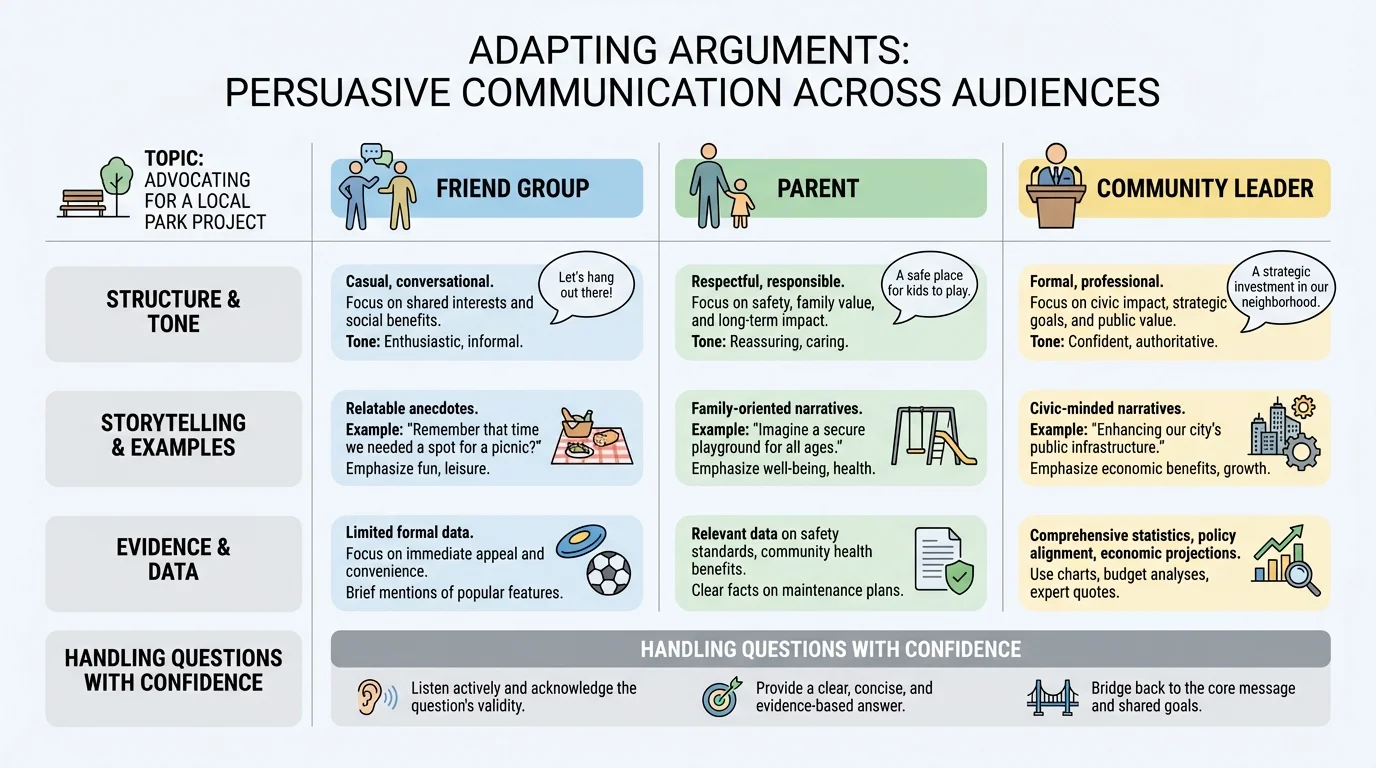
This kind of adjustment is not manipulation. It is good communication. You are translating your message into terms the listener can understand and value.
One mistake people make is speaking to everyone the same way. Another is assuming the audience already knows why the topic matters. If you skip that connection, listeners may not reject your idea because it is bad. They may reject it because you never linked it to their priorities.
| Audience | Best Tone | What to Emphasize | What to Avoid |
|---|---|---|---|
| Friend or peer group | Natural, direct | Shared experience, practical benefits | Overly formal language |
| Parent or guardian | Respectful, calm | Responsibility, safety, long-term value | Sounding dismissive |
| Employer or interviewer | Professional, confident | Reliability, initiative, problem-solving | Rambling or slang-heavy wording |
| Community leader | Clear, solution-focused | Impact, feasibility, benefit to others | Complaints without solutions |
Table 1. Audience differences that affect persuasive tone and message choices.
Audience awareness also affects length. A busy adult may need a short, direct version. A discussion group may welcome more detail. Adapting means respecting both attention and context.
A powerful argument often includes both emotion and proof. If you use only evidence, you may sound cold or forgettable. If you use only emotion, you may sound unsupported. The strongest persuasive speakers combine a relevant story with solid support.
A anecdote is a short personal story or example that helps people care about your point. A story gives your audience something concrete to picture. It turns a general issue into a human one.
For example, if you are arguing for better access to tutoring, you might start with a brief story: "Last year, a student I know was working part-time and caring for younger siblings. They wanted help in math but could never make the available hours." That story creates connection. Then you add evidence: local tutoring demand, scheduling limits, or results from flexible online support programs.
Story first, proof next
A useful pattern is to open with a short story, state the lesson from that story, and then back it up with evidence. The story gets attention. The evidence earns trust. Together, they make your point memorable and credible.
Not all evidence is equal. Strong evidence is relevant, current, and comes from a source that makes sense for the topic. For a health topic, a public health organization is stronger than a random social media post. For local issues, community surveys or official announcements may be more useful than national averages.
Be careful not to overload your audience with too many facts. Three strong pieces of evidence usually beat ten weak ones. Choose evidence that clearly answers the audience's likely question: Why should I believe this?
Also, explain your evidence. Do not just drop in a statistic and move on. If you say, "Only one out of five local teens uses the current program," then add why that matters. Maybe the hours are inconvenient, the sign-up process is confusing, or the service is not reaching the people who need it.
Example: Story and evidence working together
Suppose you are encouraging a youth group to create a quiet study night once a week.
Step 1: Open with a short, relevant story
"A student in our group said they often try to study at home while younger siblings are watching TV in the same room."
Step 2: State the claim
"Our group should offer one quiet study night each week."
Step 3: Support it with evidence
"The community room is unused on Thursdays, several members said they would attend, and similar programs in nearby groups increased participation."
Step 4: Connect the evidence to the need
"This is a low-cost change that solves a real problem for students who do not have a quiet place to work."
This approach feels both human and practical.
The audience chart in [Figure 3] still matters here, because the kind of story and evidence you choose should match the people you are speaking to.
Even a strong argument can lose power if the delivery makes you seem uncertain, rushed, or disconnected. Confidence does not mean acting fearless. It means showing control of your message even if you feel nervous.
Start with your voice. Speak a little slower than feels natural when you are nervous. Anxiety often makes people speed up. Use short pauses after important points. Pausing makes you sound more in control, and it gives your audience time to process what you said.
In online speaking situations, camera habits matter. Look at the camera sometimes instead of only at your own image. Sit or stand in a stable position. Keep your notes where you can glance at them without obviously reading line by line. Good lighting and clear audio strengthen your message because they reduce distractions.
Your body language still matters on screen. Sit upright. Keep your face engaged. Avoid fidgeting with objects out of frame if it affects your voice or focus. If you are speaking in person at a community event, grounded posture and purposeful gestures help the same way.
Nerves are normal. Instead of trying to eliminate them, prepare for them. Rehearse your opening line several times. Know your first reason well. Practice out loud, because silent practice in your head does not reveal awkward wording, weak transitions, or places where you run out of breath.
Confidence usually comes from preparation, not personality. Many calm speakers still feel nervous before they begin. Their advantage is that they know what they want to say and have practiced saying it.
A helpful rule is this: do not memorize every word unless the speech is very short and must be exact. Memorizing can make you panic if you forget a line. Instead, memorize your structure: opening, claim, key reasons, strongest evidence, response to objections, close.
"Speak clearly, if you speak at all; carve every word before you let it fall."
— Oliver Wendell Holmes Sr.
Clear delivery also supports relationships. When you speak with steadiness and respect, even disagreement feels easier for others to hear.
Questions do not automatically mean your argument failed. Often, questions mean people are paying attention. A repeatable response process, shown in [Figure 4], helps you answer without sounding defensive or lost.
Start by listening fully. Do not interrupt. Many speakers get nervous and answer too early, then realize they responded to the wrong question. Let the person finish.
Next, pause. A short pause makes you seem thoughtful, not weak. Then restate or clarify the question if needed: "If I understand you correctly, you are asking how this would be funded." This does two things. It gives you a second to think, and it shows respect for the question.
Then answer directly. Lead with the main answer, not a long warm-up. After that, add one or two supporting reasons. If you need to, connect back to your main claim.
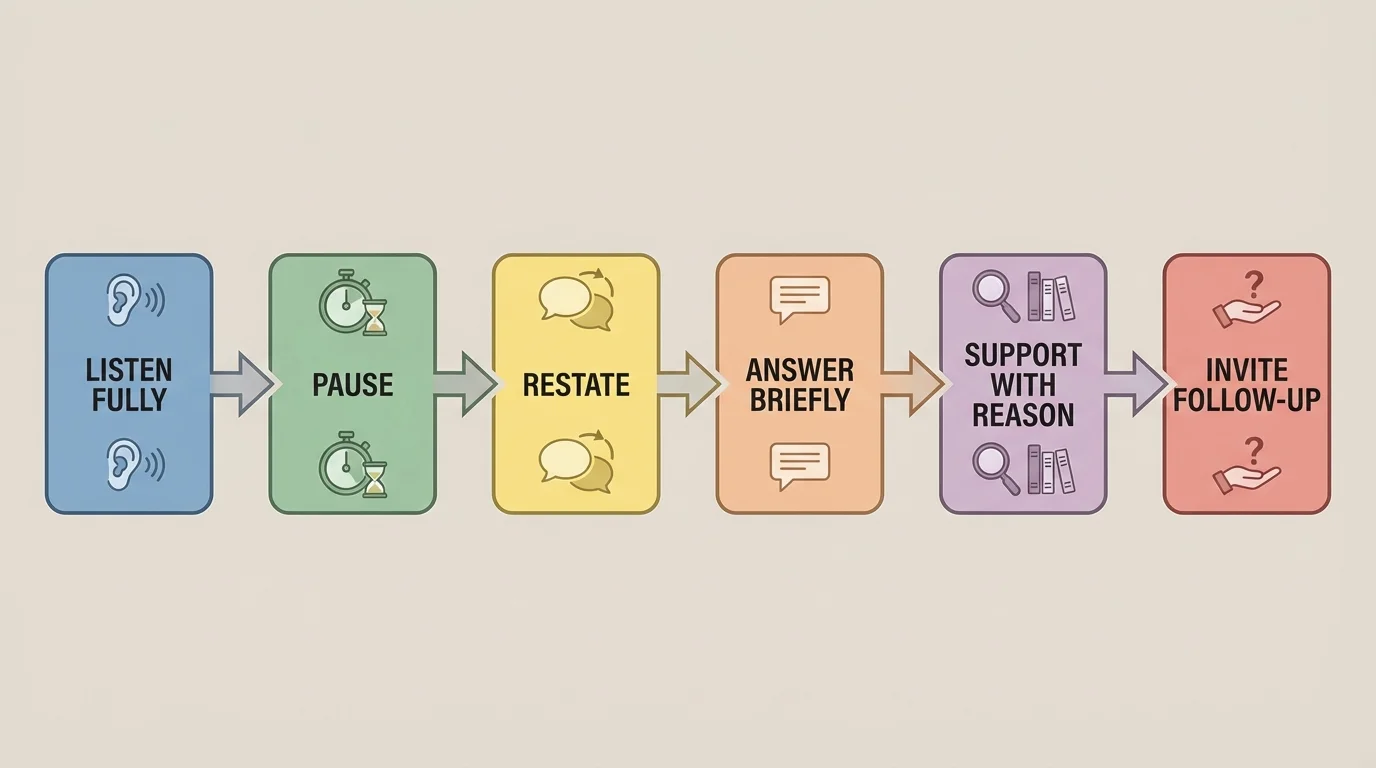
If you do not know something, be honest. Saying "I do not have that number right now, but that is an important point and I would want to check it" is far better than pretending. Honesty strengthens your ability to respond to a counterargument and protects your credibility.
Some questions are really disagreements in disguise. That is okay. Stay calm and separate the tone from the content. You can respond with phrases like "I see that concern," "That is a fair question," or "I agree that this part needs careful planning." Agreement on one point can make it easier to defend your main point.
When a question feels hostile, do not mirror the hostility. Your goal is not to win a fight. Your goal is to stay steady and persuasive. The response process in [Figure 4] keeps you from reacting emotionally in the moment.
Example: Answering a challenging question
Claim: A local youth center should offer more evening programs.
Step 1: Listen and clarify
Question: "How do you expect them to pay for that?"
Step 2: Answer directly
"The best starting option is a small pilot program, not a full weekly expansion."
Step 3: Add support
"That lowers cost, makes it easier to measure turnout, and gives the center data before making a larger commitment."
Step 4: Stay open
"If funding is still the main issue, partnerships or volunteer-supported sessions could also be explored."
This response stays calm, practical, and focused on solutions.
You do not need to have a perfect answer to every possible question. You need to show that you can think clearly under pressure.
Consider four places where persuasive speaking matters for you right now.
On a video call: You may need to explain an idea to a club, youth group, or volunteer organizer. In this setting, concise structure matters because attention can fade quickly online. Lead early with your claim and use clear transitions.
In a job or volunteer interview: Many interview answers are really persuasive mini-arguments. When you explain why you are dependable, adaptable, or a strong fit, you are making a claim and supporting it with examples. Your credibility from [Figure 1] becomes especially important here.
In family discussions: Emotional history can make persuasion harder. If you want a yes to something important, avoid sounding entitled. Show that you have thought about concerns, consequences, and responsibility.
In community situations: If you speak about a local issue, people often care most about whether your idea is realistic. That is why evidence, cost awareness, and responses to objections matter as much as passion.
Across all these situations, the same pattern repeats: clear purpose, audience awareness, strong structure, good evidence, calm delivery, and respectful responses.
You do not need an advanced system to prepare well. You need a repeatable one.
Step 1: Write your goal in one sentence. What do you want the audience to believe or do?
Step 2: Write your claim in one clear line.
Step 3: List two or three reasons.
Step 4: Match one good piece of evidence or one relevant example to each reason.
Step 5: Predict two questions or objections.
Step 6: Choose the right tone for the audience.
Step 7: Practice out loud at least twice.
Step 8: Trim anything that sounds repetitive, vague, or overly dramatic.
Step 9: Strengthen your opening and closing, because those are often remembered most.
Step 10: Before speaking, breathe slowly and focus on being useful, not perfect.
Shorter arguments are often more persuasive than longer ones when the audience is busy or skeptical. Clarity beats length.
Try This: Before your next important conversation, record a one-minute version of your argument on your phone or computer. Listen for three things: Is your claim obvious? Do your reasons sound specific? Do you sound calm enough to be trusted?
Try This: Take one opinion you already have and rewrite it for three audiences: a friend, an adult decision-maker, and a group leader. Notice how the examples and tone change.
Try This: Practice answering one difficult question with the process from [Figure 4]: listen, pause, restate, answer, support, and stay open.
