Some of the most important decisions you make will never appear dramatic. No spotlight. No audience. Just a text you could ignore, a shift you could show up late for, a bill you could avoid, a rumor you could repost, or a private detail you could share because "it's not a big deal." Those small choices shape your reputation, your relationships, and your future. Ethics is not only about major scandals or obvious right-and-wrong situations. It is about how you live when you are managing your own life.
As you move toward adulthood, you gain more freedom. You also gain more responsibility. Independent living means handling money, time, commitments, and personal decisions without someone constantly checking on you. Work means people rely on you. Community participation means your actions affect others, whether that happens in a neighborhood group, a volunteer project, an online forum, a team, or a local event. An ethical approach helps you use freedom well.
Ethics is about the standards you use to decide what you should do, not just what you can do. A strong ethical framework helps you act consistently even when a situation is stressful, inconvenient, or tempting. It protects your trustworthiness. Trust is one of the most valuable things you can build, because once it is damaged, it often takes much longer to repair than people expect.
Think about three different situations. You borrow money from a family member and promise to pay it back on Friday. Your manager asks whether you completed a task that you actually forgot. A community organizer shares a private story in confidence during a planning call. In each case, your next move says something about your character. People may remember your choices long after they forget your excuses.
"Character is what you do when nobody is watching."
— Common ethical principle
Having an ethical framework does not mean you will never make mistakes. It means you have a reliable way to think before you act, repair harm when you fall short, and keep growing into the kind of person others can count on.
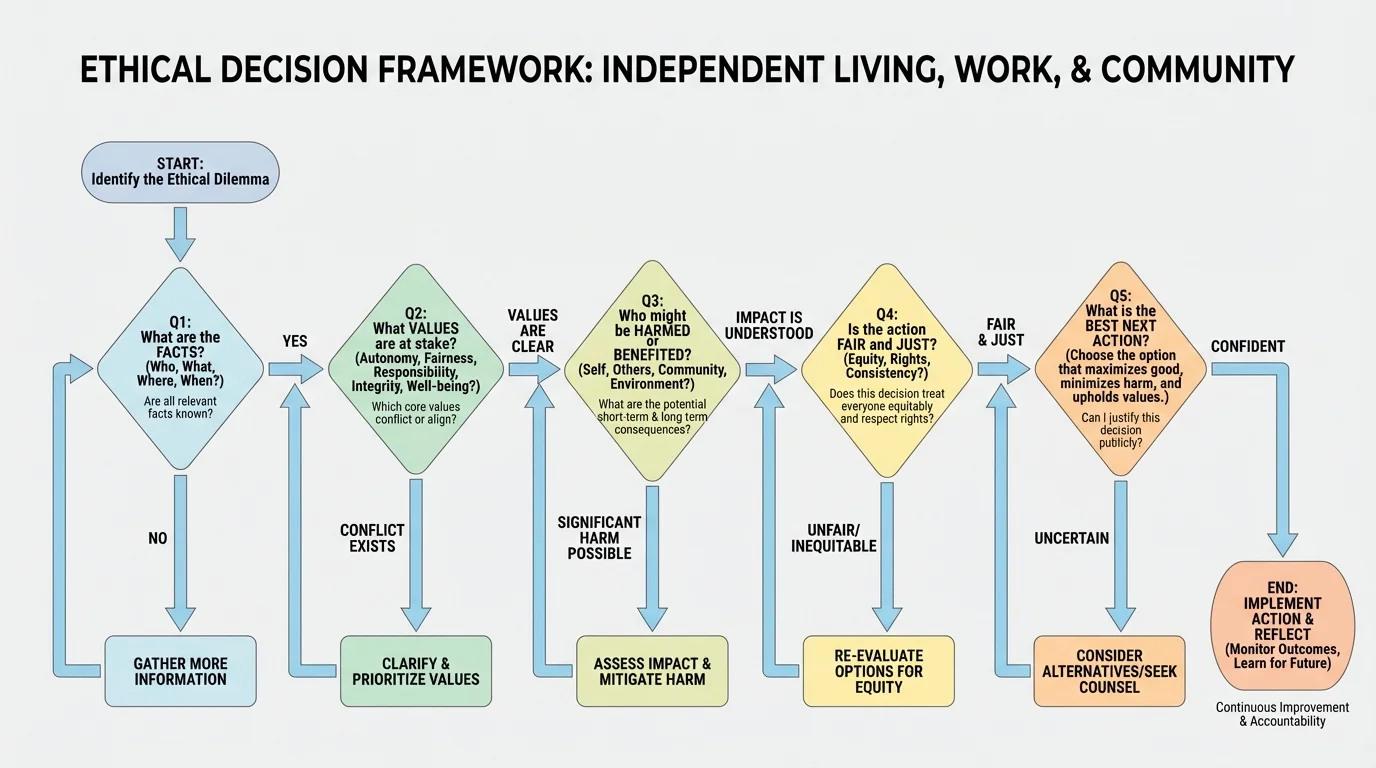
An ethical framework is a set of values, questions, and habits that guides your decisions. Instead of reacting only to mood, pressure, or convenience, you use a framework to slow down and choose on purpose, as [Figure 1] illustrates through a simple decision path. This matters because many poor choices are not caused by ignorance alone. They happen because someone acts too fast, avoids discomfort, or only thinks about the short-term result.
A useful framework usually includes four parts: your core values, the facts of the situation, the likely consequences, and your responsibility to other people. If one of those parts is missing, your judgment gets weaker. For example, if you focus only on consequences, you may justify dishonest behavior that "works." If you focus only on your own feelings, you may ignore how your choice affects others.
Values are the qualities you believe matter most, such as honesty, fairness, respect, and responsibility.
Principles are the rules or standards that grow out of those values, such as telling the truth, keeping commitments, protecting privacy, or giving credit for other people's work.
Accountability means accepting responsibility for your choices and their impact, instead of blaming others or making excuses.
Your framework should be practical. If it only sounds good in theory but does not help you when you are tired, angry, rushed, or under pressure, it is not strong enough yet. A strong framework works on ordinary days and hard days.
Several values show up again and again in adult life. One is integrity, which means your actions match your stated beliefs. If you say honesty matters but lie when it becomes inconvenient, your integrity is weak. Another key value is responsibility, which means managing your duties, choices, and obligations without waiting for someone else to rescue you.
Fairness matters too. Fairness does not always mean everyone gets the exact same thing. It means you avoid favoritism, exploitation, and selfish rules that only benefit you. Respect means treating people as fully human, even when you disagree with them. It includes respecting time, boundaries, privacy, identity, and shared spaces.
Another value that becomes more important as you become independent is self-control. Freedom without self-control often turns into chaos. If you cannot manage impulses, you may overspend, lash out online, miss deadlines, or break promises. Ethical living is not only about what you believe. It is about whether your habits support those beliefs.
| Value | What it looks like in daily life | What happens if it is ignored |
|---|---|---|
| Honesty | Telling the truth, giving accurate information, admitting mistakes | People stop trusting you |
| Responsibility | Paying bills, meeting deadlines, following through | Others must carry your load |
| Respect | Listening, honoring boundaries, protecting privacy | Relationships become unsafe or tense |
| Fairness | Sharing credit, using consistent rules, avoiding exploitation | Resentment and conflict grow |
| Accountability | Owning outcomes and repairing harm | Mistakes repeat and trust erodes |
Table 1. Core ethical values and their practical effects in everyday life.
Try This: Write down the three values you most want people to associate with your name. Then ask yourself whether your recent choices actually support those values. If not, that gap is useful information.
Independent living starts with everyday choices that may seem private but still have ethical weight. If you share a home with family, relatives, roommates, or future housemates, your behavior affects other people. Leaving messes, using items without permission, failing to contribute, or avoiding agreed responsibilities is not just annoying. It is unfair.
Money is one of the clearest examples. Suppose you agree to pay part of a phone bill or streaming plan and then keep "forgetting." The ethical issue is not only the unpaid amount. It is that someone else is carrying a burden you accepted. Even if the amount seems small, repeated irresponsibility sends a message: your convenience matters more than your word.
Case study: Paying your share
You owe $25 toward a shared monthly expense, but you want to spend that money on entertainment instead.
Step 1: Identify the obligation
You already agreed to contribute, so this is not optional spending. It is a commitment.
Step 2: Check the ethical question
Ask: "Am I shifting a cost I agreed to carry onto someone else?" If the answer is yes, the choice is unethical.
Step 3: Choose the action that protects trust
Pay the $25 first. If you truly cannot pay, communicate early, explain honestly, and propose a real plan to repay it.
The right choice protects both the relationship and your reputation as someone who keeps agreements.
Privacy is another major area. Reading someone's messages, sharing private family information in a group chat, or posting photos without permission can cause harm fast. If you would not want someone doing it to you, do not assume it is fine when you do it to them.
Personal independence also includes health and safety decisions. For example, if you drive while overly tired, ignore medication instructions, or mix substances with no understanding of risk, the issue is not just personal freedom. It can become harm to you and to others. Ethical independence includes taking care of yourself in ways that reduce preventable harm.
Whether you have a part-time job, freelance online, volunteer, or are preparing for employment, ethical behavior at work matters because people judge your character through everyday habits. A workplace usually does not need perfection. It needs reliability. If people cannot trust you to be honest, prepared, respectful, and careful with information, opportunities shrink.
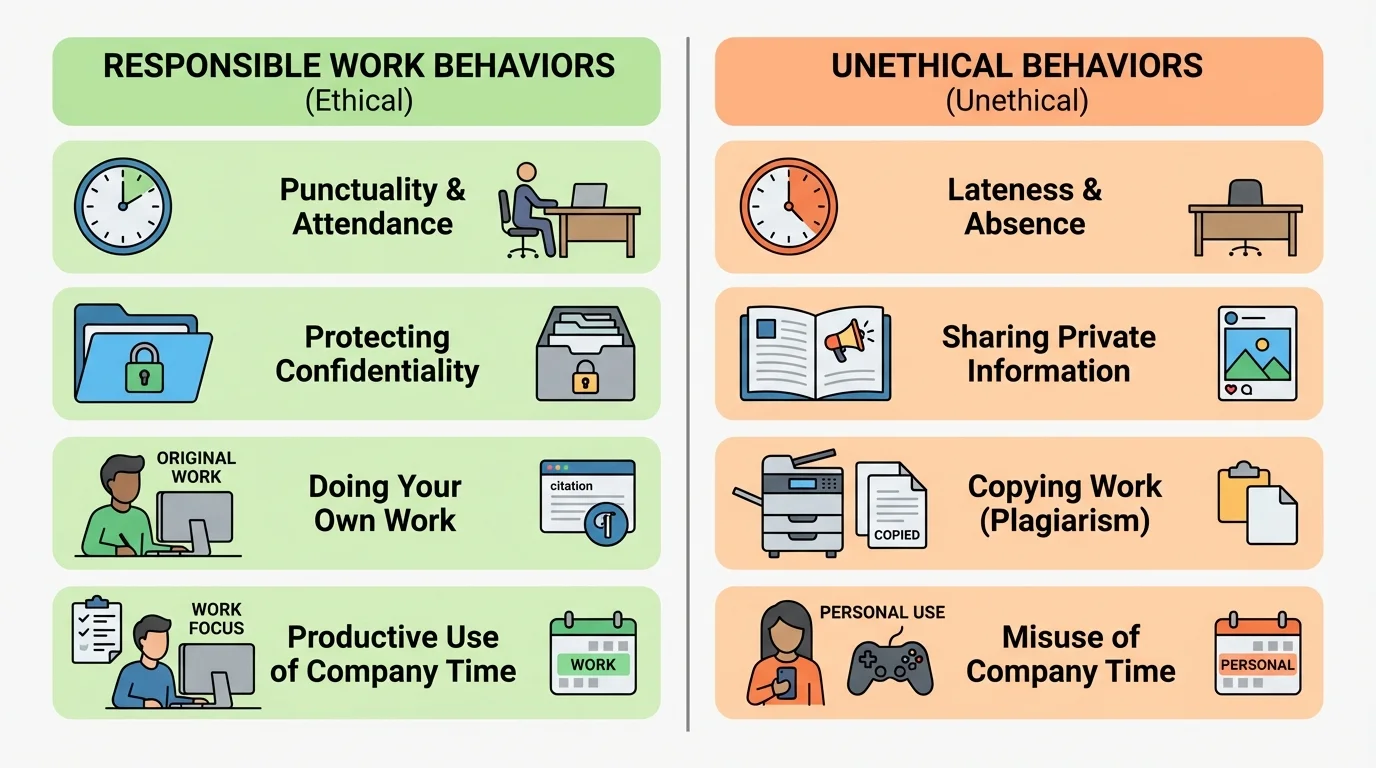
[Figure 2] One important term is confidentiality. This means keeping private information private when you are trusted with it. If you work with customer information, team discussions, or internal documents, sharing them casually can damage other people and may even create legal consequences. Another term is conflict of interest, which happens when your personal benefit could interfere with doing what is fair or expected in your role.
Ethics at work also includes honesty about time and effort. If you are on the clock but spending most of your shift scrolling, gaming, or pretending to work, that is a form of misusing paid work time. If you copy another person's writing, design, code, or ideas and present them as your own, that is plagiarism or misrepresentation. If you use AI tools, the ethical issue is not automatically using them. The ethical issue is whether you use them transparently, follow the rules of the job or assignment, and still take responsibility for the final result.
Professional communication matters too. If you will miss a deadline, say so early. If you made an error, report it instead of hiding it. If a message sounds rude when typed quickly, revise it before sending. Online communication leaves a record. A careless message can affect references, promotions, and trust long after the moment passes.
Ethics and reputation at work
Employers often notice patterns more than single events. One late shift may be forgiven. A pattern of lateness suggests unreliability. One corrected mistake may show honesty. A pattern of excuses suggests low accountability. Your daily choices build a professional reputation long before you apply for a full-time career.
Try This: Before sending any work-related message, use a quick check: Is it accurate? Is it respectful? Is it necessary? Would I be comfortable if this message were forwarded to a supervisor or client?
Being part of a community means more than "not causing problems." It means contributing in ways that support trust, safety, and inclusion. Community can mean your neighborhood, a volunteer group, a faith community, a recreational team, an online interest group, or a local organization. In each one, your behavior affects the climate around you.
Civic responsibility means acting in ways that support the common good. That can include following community rules, participating respectfully in local issues, helping others when appropriate, and not spreading misinformation. A strong community depends on people who think beyond themselves.
Inclusion is also an ethical issue. If someone is ignored, mocked, excluded, or targeted because they are different, and others stay silent to avoid discomfort, harm grows. Respect is not only private politeness. It is also public courage. Sometimes ethical behavior means speaking up calmly when a joke, post, or comment crosses a line.
Online communities often develop trust faster than people expect. That means dishonesty, cruelty, or gossip online can damage your reputation just as seriously as behavior in a physical setting.
Social media creates special challenges because it rewards speed, reaction, and attention. Ethical participation means checking facts before reposting, avoiding pile-ons, refusing to share humiliating content, and remembering that a person on a screen is still a person. If a post gets attention by embarrassing someone, that does not make it harmless.
As with work choices, the habits shown in [Figure 2] apply here too: reliability, respect for privacy, honesty, and consistent follow-through matter in communities because other people depend on them.
When a choice is easy, values feel simple. When a choice is messy, your framework needs structure. Use this process when you are unsure.
Step 1: Pause. If you are angry, embarrassed, tempted, or rushed, do not decide at top speed unless safety requires immediate action. A pause protects judgment.
Step 2: Get the facts. What actually happened? What do you know for sure? What are you assuming? Ethical mistakes often grow from incomplete information.
Step 3: Identify who is affected. Think beyond yourself. Who benefits? Who could be harmed? Who has a right to be informed or protected?
Step 4: Name the values involved. Is this mainly about honesty, fairness, safety, loyalty, privacy, respect, or responsibility? Most ethical problems involve several values at once.
Step 5: Consider your options and consequences. What are the likely short-term and long-term results of each option? Which choice causes the least harm while protecting what matters most?
Step 6: Test your decision. Ask: Would I be okay if this were made public? Would I advise someone I respect to do this? Does this match the kind of person I want to become?
Step 7: Act and own it. Once you know the ethical choice, follow through. If the choice is hard, that does not make it wrong.
The decision path in [Figure 1] is useful because it turns abstract values into practical questions you can use under pressure.
Scenario: Your friend asks you to lie
A friend wants you to tell their manager they had a family emergency, but you know they simply overslept and do not want consequences.
Step 1: Get clear on the conflict
You care about your friend, but honesty and trust are also involved.
Step 2: Identify the harm
Lying could damage your credibility and enable your friend to avoid responsibility.
Step 3: Choose a response
You can refuse to lie while still being supportive: "I care about you, but I'm not going to make up a story. I can help you write an honest message and own the mistake."
This response protects both truth and support.
Some ethical choices are not between good and bad. They are between two goods or two difficult options. For example, loyalty to a friend may conflict with honesty. Privacy may conflict with safety. Compassion may conflict with fairness if helping one person puts an unfair load on others.
Gray areas are where people often start making excuses. Common warning signs include: "Everyone does it," "No one will know," "It's just this once," "I deserve it," or "I had no choice." Those phrases do not automatically prove a choice is wrong, but they often signal self-justification.
Pressure can come from friends, supervisors, family, or online groups. Authority pressure can be especially hard because people fear losing approval or opportunity. But "I was told to" does not erase your responsibility. If someone asks you to break rules, hide harm, harass someone, falsify information, or misuse private data, you still have a duty to think ethically.
Try This: Make a short list titled "My red-flag phrases." Include the excuses you are most likely to use when you want to avoid responsibility. Knowing your weak points helps you catch them faster.
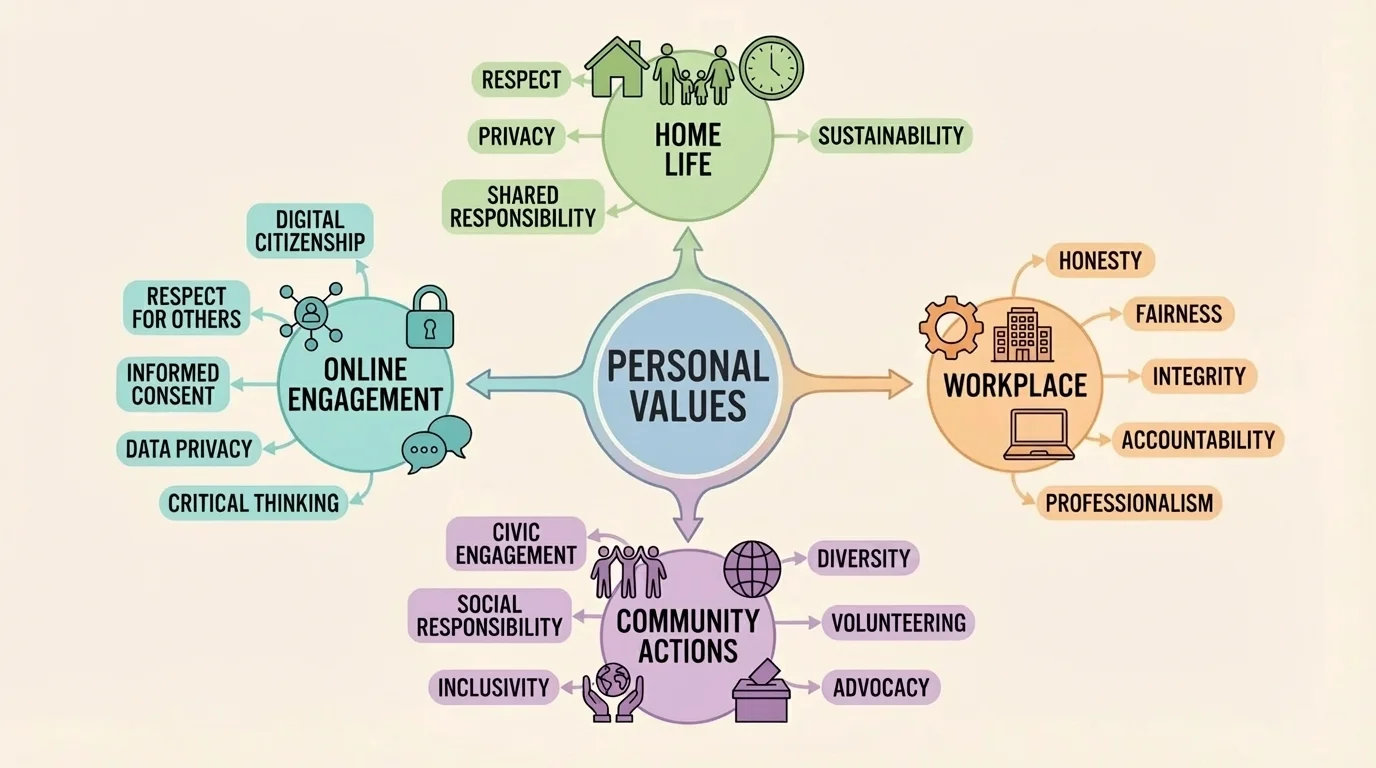
Your personal ethics should not change completely depending on where you are. The same basic values should guide your home life, work life, online behavior, and community role. You may apply them differently in different settings, but your character should not become unrecognizable from one context to another.
[Figure 3] Building a personal code means writing out the principles you want to live by. Keep it short enough to remember and specific enough to use. For example: "I tell the truth even when it is uncomfortable. I keep my word or communicate early when I cannot. I protect other people's privacy. I do not take credit for work that is not mine. I repair harm instead of hiding from it."
A personal code matters because stress narrows your thinking. In a difficult moment, you may not have time to invent your values from scratch. A written code gives you a stable starting point.
How to create your personal code
Step 1: Choose your top values
Select about three to five values, such as honesty, respect, responsibility, fairness, and courage.
Step 2: Turn values into rules
Write one sentence for each value. Example: "Because I value respect, I ask before sharing photos or private information."
Step 3: Apply them to real settings
Ask how each rule looks at home, at work, online, and in community spaces.
Step 4: Review and revise
If your code is too vague to guide behavior, rewrite it in clearer language.
A good personal code is simple, specific, and usable under pressure.
Later, when you face a hard choice, return to the structure shown in [Figure 3]. If a decision fits one part of your life but violates the values you claim in another, that inconsistency deserves attention.
Most people do not fail ethically because they never heard good principles. They fail because they do not build habits that support those principles. If you want to be honest, answer messages instead of avoiding them. If you want to be responsible, use reminders and calendars. If you want to respect privacy, pause before forwarding, posting, or repeating. Ethics becomes real through systems.
Reflection helps too. At the end of the week, ask yourself: Where did I keep my word? Where did I cut corners? Where did I avoid a hard truth? What repair is needed? This is not about shaming yourself. It is about becoming more accurate and more trustworthy over time.
Good character is built through repeated choices. One strong decision matters, but patterns matter more. A habit of responsible action is more dependable than a burst of good intentions.
When you do make a mistake, repair matters. A meaningful repair usually includes four parts: admit what happened, avoid excuses, address the harm if possible, and change the behavior that caused it. Saying "sorry" without changed behavior is not accountability. Real accountability costs something: pride, comfort, time, or effort. That cost is part of rebuilding trust.
Ethical living supports independence because it makes you someone others can rely on. It supports work because reliability, honesty, and respect create opportunity. It supports community participation because trust and fairness make groups stronger. The person you become is shaped by what you repeatedly choose.
