What makes an online classroom feel safe and happy? It is not fancy computers or a big desk. It is the way you act. When you tell the truth, use kind words, and do what you are supposed to do, learning goes better for everyone.
In your online classroom, you are learning from home, but you are still part of a group. Your teacher and classmates need to trust you. Three big ideas help with that: honest, respectful, and responsible behavior.
Honest means telling the truth and doing your own work.
Respectful means being kind, listening, and caring about other people's feelings.
Responsible means doing what you need to do, following directions, and taking care of your things.
These behaviors are like three helpers. They help you learn, help your teacher teach, and help other children feel good in class.
Sometimes honesty is simple. If your teacher asks, "Did you finish your work?" honest behavior means telling the truth. If you need help, honest behavior means saying, "I need help." If you made a mistake, honest behavior means saying, "I made a mistake," instead of hiding it.
In online school, honesty also means doing your own work. You can listen to directions and try your best. A grown-up can help you understand, but your answers should be independent work when the teacher wants you to do it yourself.
Honest choices
Step 1: You do not know an answer.
You say, "I'm not sure yet."
Step 2: You ask for help.
You say, "Can you help me understand?"
Step 3: You keep trying.
You learn more because you told the truth.
If you are not honest, people may not know when you really need help. When you are honest, people can trust you. Trust is important in every classroom.
Respect means treating people kindly during class, even on a screen. Respectful behavior in an online classroom includes listening, waiting for your turn, and using a calm voice. It also means looking at the speaker when you can and not talking over other people.
As [Figure 1] shows, you can be respectful with your words. You can say, "Please," "Thank you," and "I like your idea." You can also be respectful with your face and body by staying calm and paying attention and using good manners.
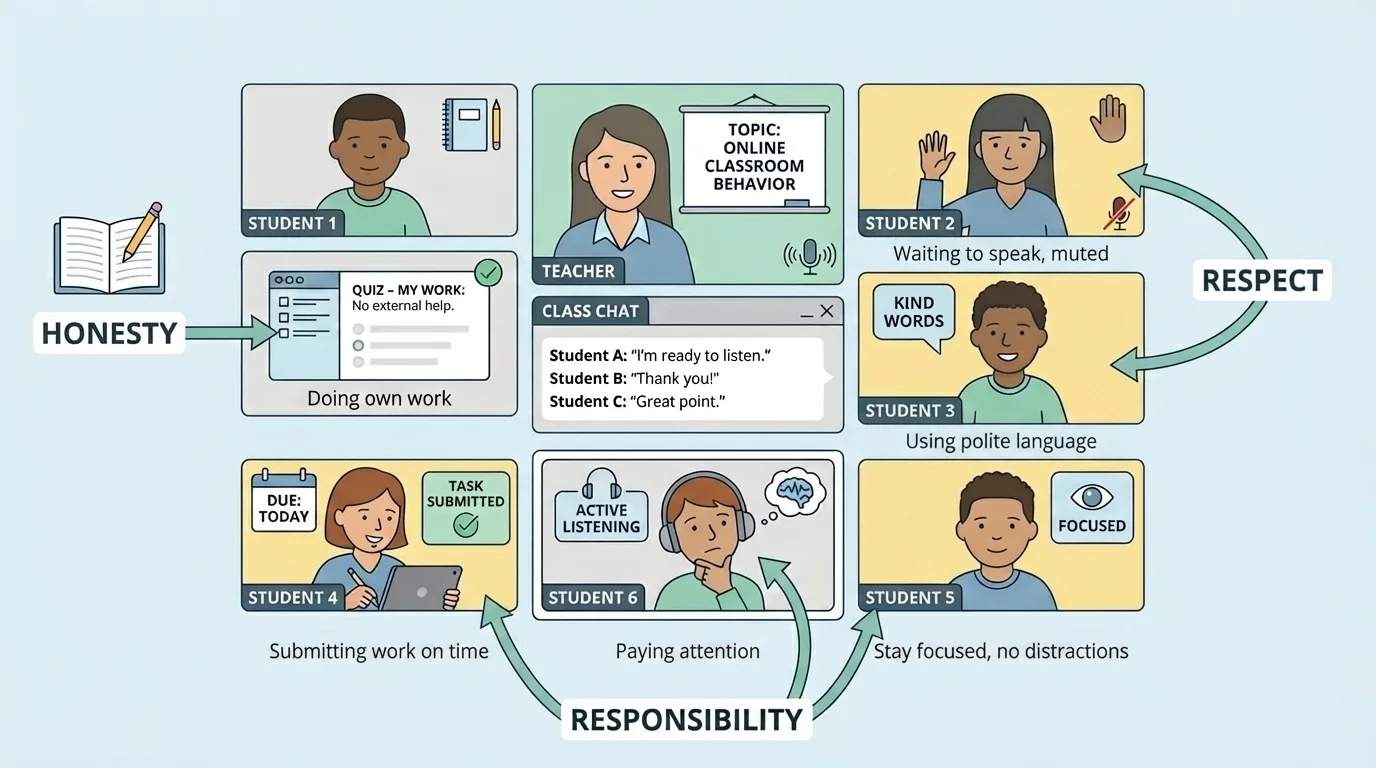
Respectful behavior online also means using tools the right way. If your microphone is on, use it only for class discussion. If another child is speaking, you wait. If you want to share, you can raise your hand or use the class signal your teacher taught you.
Respect matters in other situations too. If someone makes a mistake, you do not laugh. If someone is shy, you let them have time. Later, when you remember the turn-taking in [Figure 1], it becomes easier to notice that respect helps everyone feel safe enough to speak.
Kind words can help people feel ready to learn. When children feel safe and included, it is easier for them to listen, think, and try.
Respectful behavior also includes caring for your learning space at home. You do not need a perfect room. You just need to try to keep it calm and ready for class.
Responsibility means being ready and doing your job as a student. In online school, that can mean having your device ready, sitting in your learning spot, and getting your pencil or paper before class starts.
As [Figure 2] shows, responsible behavior means following directions the first time when you can. It means logging in on time, listening for what to do next, and finishing your work as best as you can.
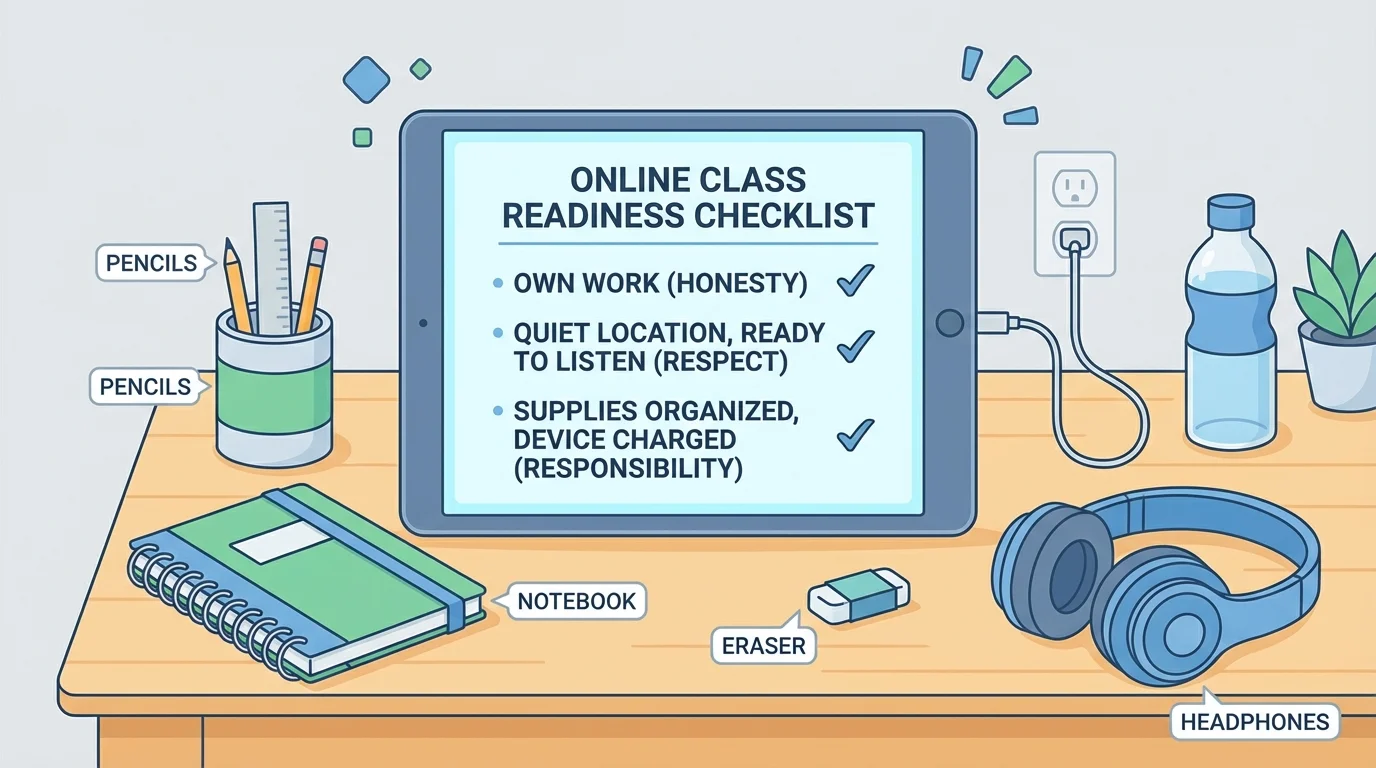
You can also be responsible with your things. Carry your device carefully. Put crayons, books, and papers back where they belong. Ask a grown-up if something is broken instead of pretending nothing happened.
Being responsible does not mean being perfect. Everyone forgets sometimes. Responsible students try again. The readiness habits in [Figure 2] help you remember what to do each day.
Why responsibility helps
When you are ready for class, you can start learning faster. When you follow directions, the class stays calm. When you take care of your things, you can use them again tomorrow.
A simple class routine can help: sit down, check your device, get your supplies, listen, and begin. Small jobs done every day make a big difference.
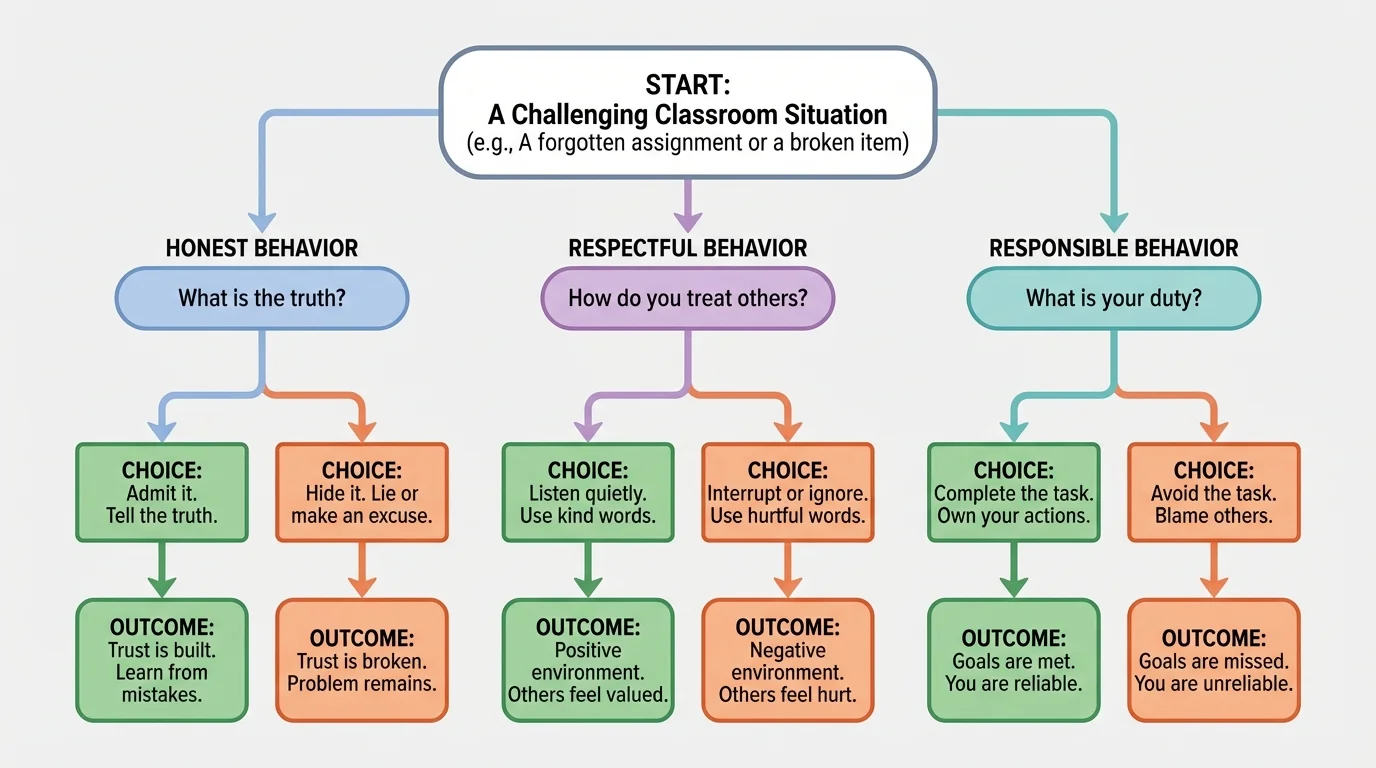
Sometimes you may feel unsure. Maybe you want to speak while someone else is talking. Maybe you forgot your paper. Maybe you made a mistake and feel worried. A simple choice check can help: stop, think, and ask yourself three questions.
As [Figure 3] illustrates, ask: "Is it true?" "Is it kind?" "Is it helpful?" If the answer is yes, your action is probably a good one. If the answer is no, stop and choose again.
Use the choice check
Step 1: Stop.
Take a quiet moment before you act.
Step 2: Think.
Ask if your words are true, kind, and helpful.
Step 3: Choose.
Pick the action that helps learning and helps people feel safe.
If you forgot to do something, an honest and responsible choice is to tell the truth and ask what to do next. If someone else is talking, a respectful choice is to wait. The steps in [Figure 3] give you a simple way to pause before acting.
Good behavior has real results. When you are honest, adults know they can trust you. When you are respectful, people feel calm and included. When you are responsible, learning time is not wasted.
Poor choices also have results. If you interrupt, others may feel sad or frustrated. If you are not honest, people may not know how to help you. If you do not take care of your things, you may not have what you need for class.
"Be kind, be truthful, and do your job."
— A strong classroom rule
Every day gives you a new chance to practice. You do not have to get everything right the first time. You just need to keep trying, keep learning, and keep making caring choices.
