Have you ever noticed how many different workers you see in one day? A teacher may greet you at school, a farmer may help grow your breakfast, and a doctor may help someone feel better. People do many kinds of jobs. They work to earn money, and they also help other people. When we learn about jobs, we can ask two smart questions: What is good about this job? and What is hard about this job?
People work to earn an income. Income is money people get from doing a job. They use that money to buy things they need and want, like food, clothes, and a home. Jobs also help the whole community. Workers teach, build, grow food, drive buses, and care for others.
Different people choose different jobs. Some people like helping children learn. Some like growing plants. Some like caring for sick people. A job can match what a person likes, what a person is good at, and what a community needs.
Benefit means something good about a choice. Cost means something a person gives up, something hard, or something they must do when they make a choice. With jobs, a benefit might be helping people or earning money. A cost might be long hours, hard work, or less time for other things.
When we compare jobs, we do not say one job is good and another job is bad. Instead, we look at the benefits and costs of each one. Every job has both.
A benefit can be something a worker enjoys. A teacher may enjoy seeing children learn to read. A farmer may enjoy growing food. A doctor may enjoy helping people get well. Benefits can also include earning money for a family.
A cost is not always money. A cost can mean hard work, danger, time, or tiredness. A farmer may work in hot sun or rain. A doctor may need to work late. A teacher may spend many hours helping students and planning lessons. Costs are the things that make a job more difficult.
Many jobs fit together like puzzle pieces. Farmers grow food, truck drivers move the food, store workers sell the food, and cooks prepare the food people eat.
Now let us compare some job choices and think about the good parts and the hard parts of each one.
A teacher works at a school and helps children learn. A teacher reads stories, teaches math, asks questions, and helps students solve problems. A teacher also helps students learn how to be kind and work together. A classroom scene like this helps us see that teachers guide many kinds of learning during the day.
One benefit of being a teacher is helping children grow and learn. Another benefit is building a caring classroom. Teachers can feel proud when students learn something new. Teachers also earn income for their work.
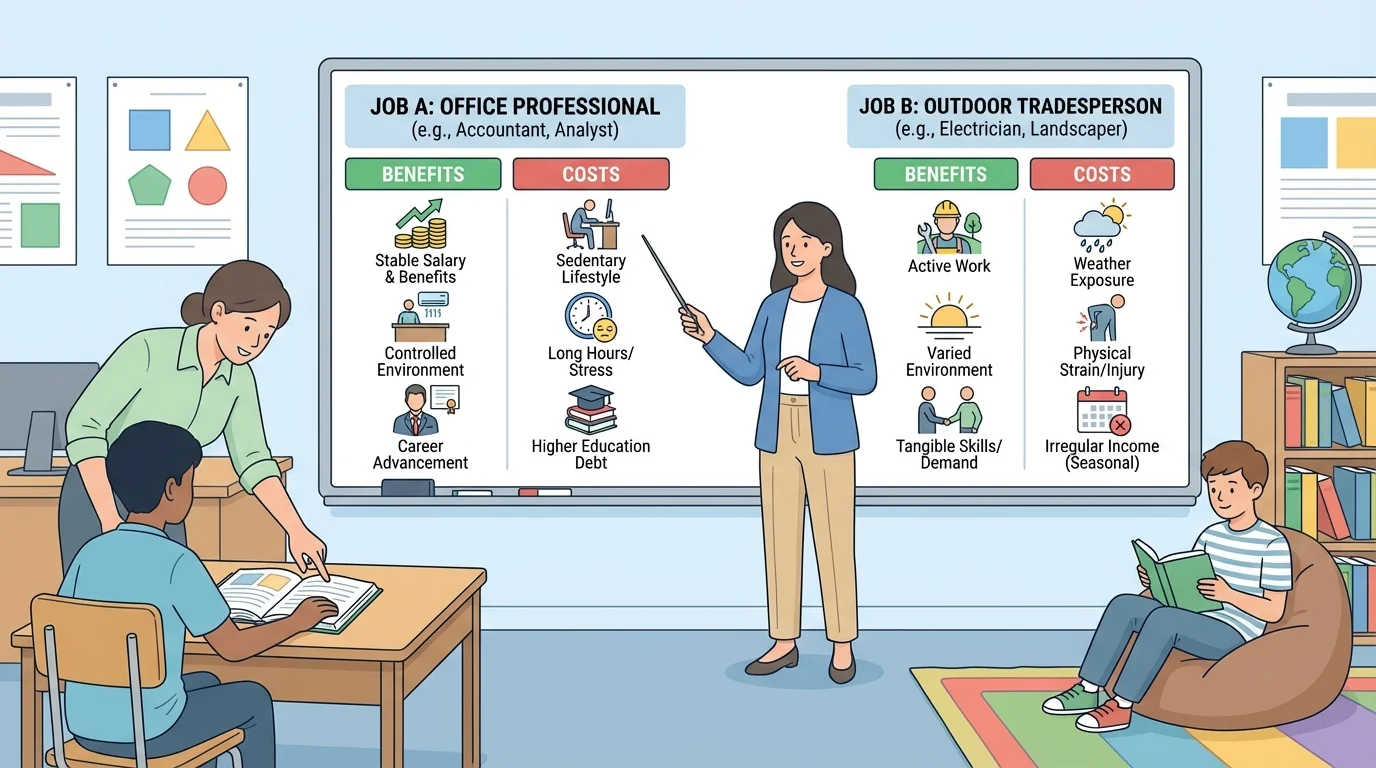
One cost of being a teacher is that the work can be very busy. Teachers help many students, and that takes time and energy. They may need to plan lessons, check work, and get the classroom ready. Sometimes a teacher may feel tired after a long day.
So, the teacher job has benefits, such as helping children and earning income, and costs, such as long, busy days. Later, when we compare jobs again, we can remember the classroom work we saw in [Figure 1].
A farmer grows crops and may care for animals. Farmers help make food for many people. They may plant seeds, water crops, feed animals, and collect food when it is ready. Outdoor farm work shows that this job connects closely to nature and weather.
One benefit of being a farmer is growing food people need. Farmers can feel proud because their work helps families eat. Another benefit is working outside and caring for plants or animals. Farmers also earn income from their work.
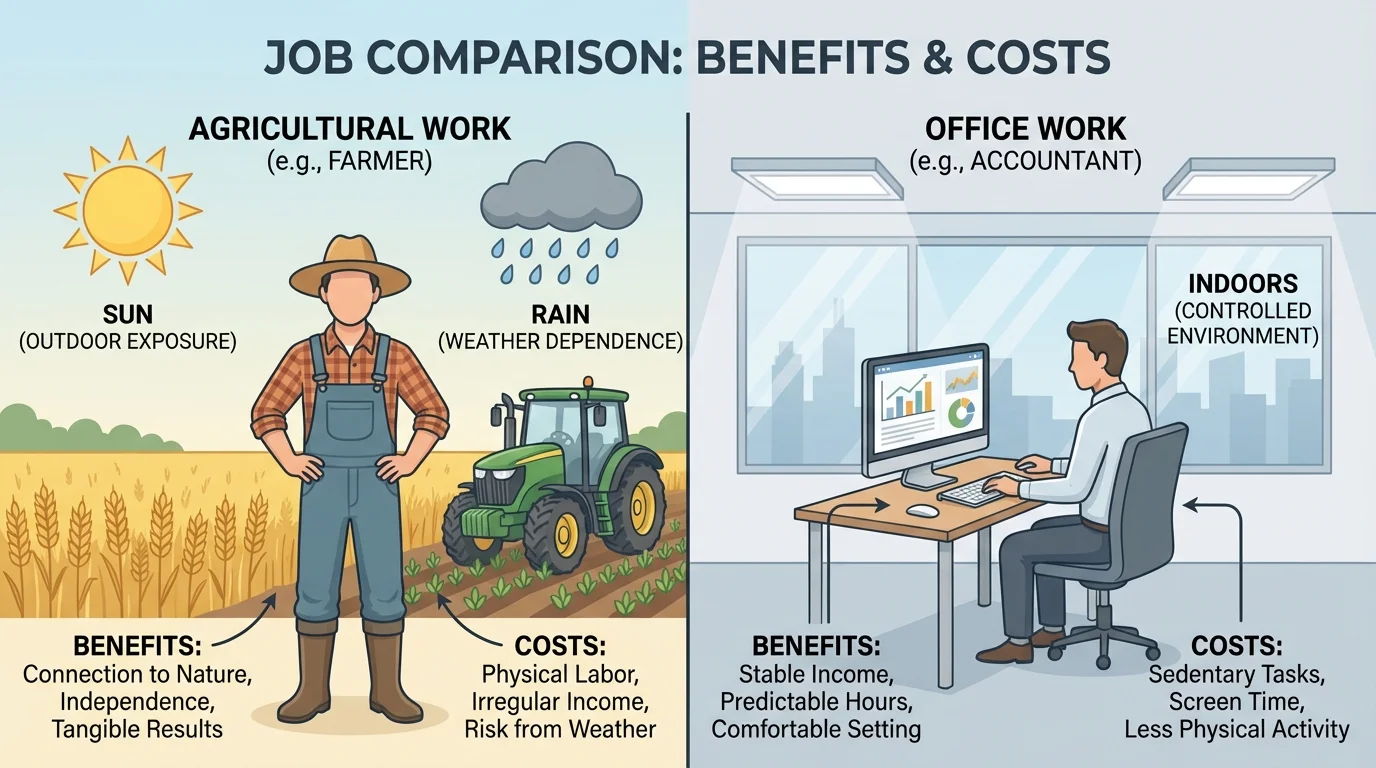
One cost of being a farmer is that the job can be hard in different weather. It may be hot, rainy, or cold. Another cost is that growing food takes patience and a lot of work. Plants and animals need care every day. That means a farmer may have less time to rest.
The farmer job has benefits, such as helping feed people and working with nature, and costs, such as hard outdoor work. The weather details we notice in [Figure 2] remind us that some jobs depend on conditions outside.
A doctor helps people who are sick or hurt. Doctors listen to patients, check bodies, and try to help people feel better. A clinic scene makes it easier to picture how doctors care for people.
One benefit of being a doctor is helping others stay healthy. Doctors can make a big difference in people's lives. Another benefit is earning income for this important work. Many people respect doctors because they help their community.
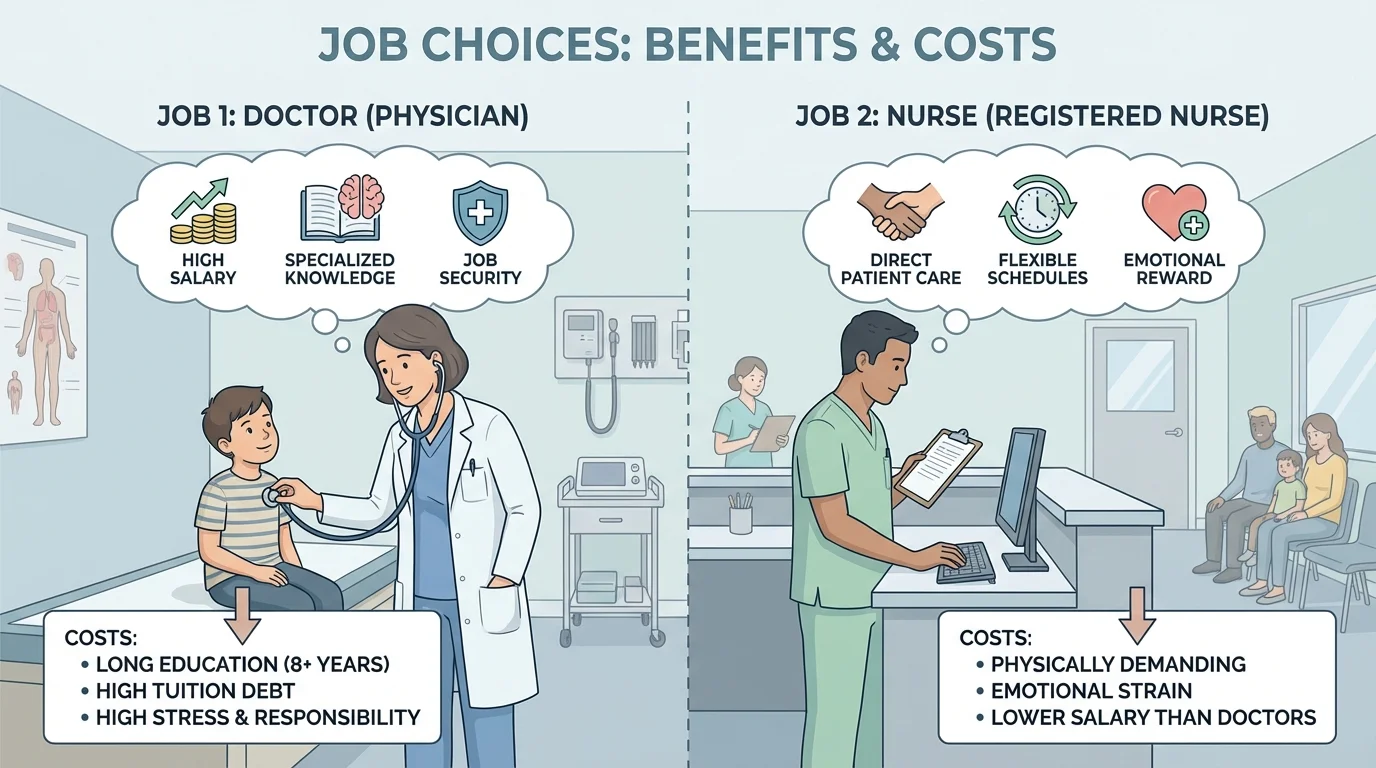
One cost of being a doctor is that the job can be very hard and serious. Doctors may need to work when others are resting. They may see very sick people, which can feel sad or stressful. They also need to learn a lot to do the job well.
The job of a doctor has benefits, such as helping sick people and earning income, and costs, such as long hours and serious responsibilities. The clinic tools and careful work in [Figure 3] show why this job needs skill and care.
Teachers, farmers, and doctors are different in many ways, but they are also alike. All three jobs help people. All three jobs let workers earn income. All three jobs also have costs because work takes time, effort, and energy.
| Job | What the worker does | Benefits | Costs |
|---|---|---|---|
| Teacher | Helps children learn | Helps students, earns income | Busy days, lots of planning |
| Farmer | Grows food, cares for animals | Feeds people, works outside, earns income | Hard weather, daily work |
| Doctor | Helps sick or hurt people | Helps people feel better, earns income | Long hours, serious work |
Table 1. A comparison of three jobs, including what workers do and the benefits and costs of each job.
This chart helps us compare choices. A person might choose to be a teacher because they love school and children. Another person might choose farming because they love plants, animals, and outdoor work. Someone else might choose to be a doctor because they want to care for people's health.
Job choices are about trade-offs. A trade-off means choosing one thing and accepting that it comes with something else. If a person wants the benefit of helping many people as a doctor, they may accept the cost of long hours. If a person wants the benefit of outdoor work as a farmer, they may accept the cost of hot or rainy days.
People do not all make the same choice because people are different. They have different talents, interests, and goals. Communities also need many kinds of workers, not just one kind.
When adults choose jobs, they often think about questions like these: What am I good at? What do I enjoy? How can I help others? What costs am I willing to accept? These questions help people make careful choices.
For example, a person who loves reading and helping children may choose teaching. A person who loves land, plants, and animals may choose farming. A person who wants to care for health may choose medicine. Each choice has benefits and costs, and each choice matters.
Comparing two job choices
Let us compare a teacher and a farmer.
Step 1: Say one benefit of each job.
A teacher helps children learn. A farmer helps grow food.
Step 2: Say one cost of each job.
A teacher may have a very busy day. A farmer may work in hot sun or rain.
Step 3: Tell how they are alike.
Both jobs help people, and both jobs let workers earn income.
This comparison shows that different jobs can both be important, even when the work is not the same.
As children grow, they learn more about jobs and the people who do them. Understanding benefits and costs helps us respect all kinds of work. A community needs teachers, farmers, doctors, and many other workers every day.
