What happens when you put a coin in a piggy bank, buy a snack, lend a book, or trade crayons with a friend? These are all different ways people move things from one person to another. Grown-ups do this every day, and children do it too. Learning these actions helps us make smart choices with money and with the things we have.
A transaction is when something is given, taken, traded, bought, shared, or returned. A transaction can use money, or it can happen without money. People make transactions at home, at school, in stores, and in banks.
Transaction types are different ways people exchange money, goods, or help. Some common types are deposit, purchase, borrow, donate, and barter.
Each type has a special meaning. When we know the meaning, we can understand what is happening. We can also decide if we are spending, saving, or sharing.
A deposit means putting money into a safe place to save it. This can be a piggy bank at home or a bank account. If Ana has $3 and puts in $1, she still has money saved. We can say she saved one dollar, or in math, she moved part of her money into savings: \(3 - 1 = 2\) dollars left to spend or save.
Depositing helps people save for later. In [Figure 1], the child puts coins into a piggy bank instead of spending them right away. Maybe a child wants a book that costs $5. If the child deposits or saves $1 each week, then after \(5\) weeks the child has $5 saved. A deposit is not buying. A deposit is keeping money for the future.
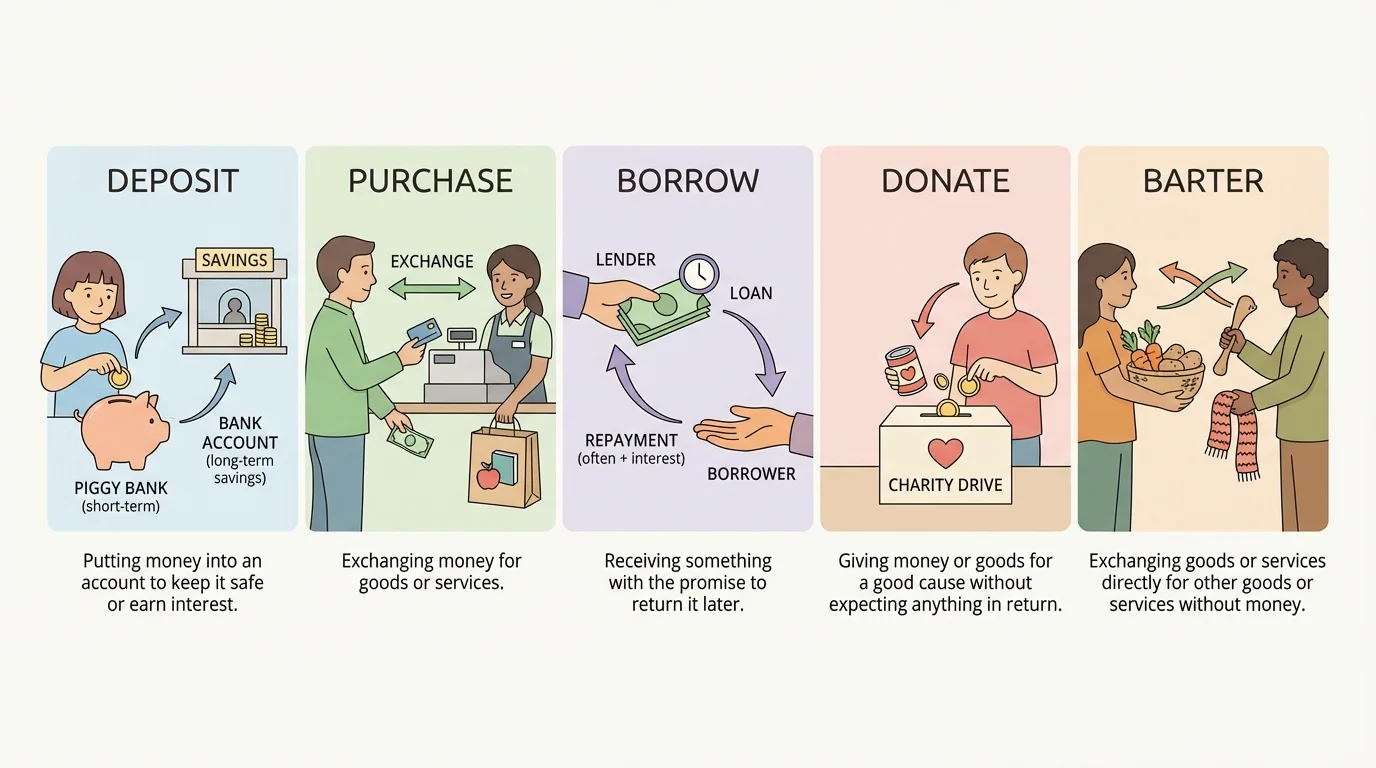
People deposit money because they want to be careful. Saving can help with a future need or a future want. When we think before we spend, we make thoughtful money choices.
Some people make tiny deposits again and again. Even small amounts can grow into a bigger savings total over time.
A deposit is part of saving. Saving means keeping money now so you can use it later. That is different from spending money right away.
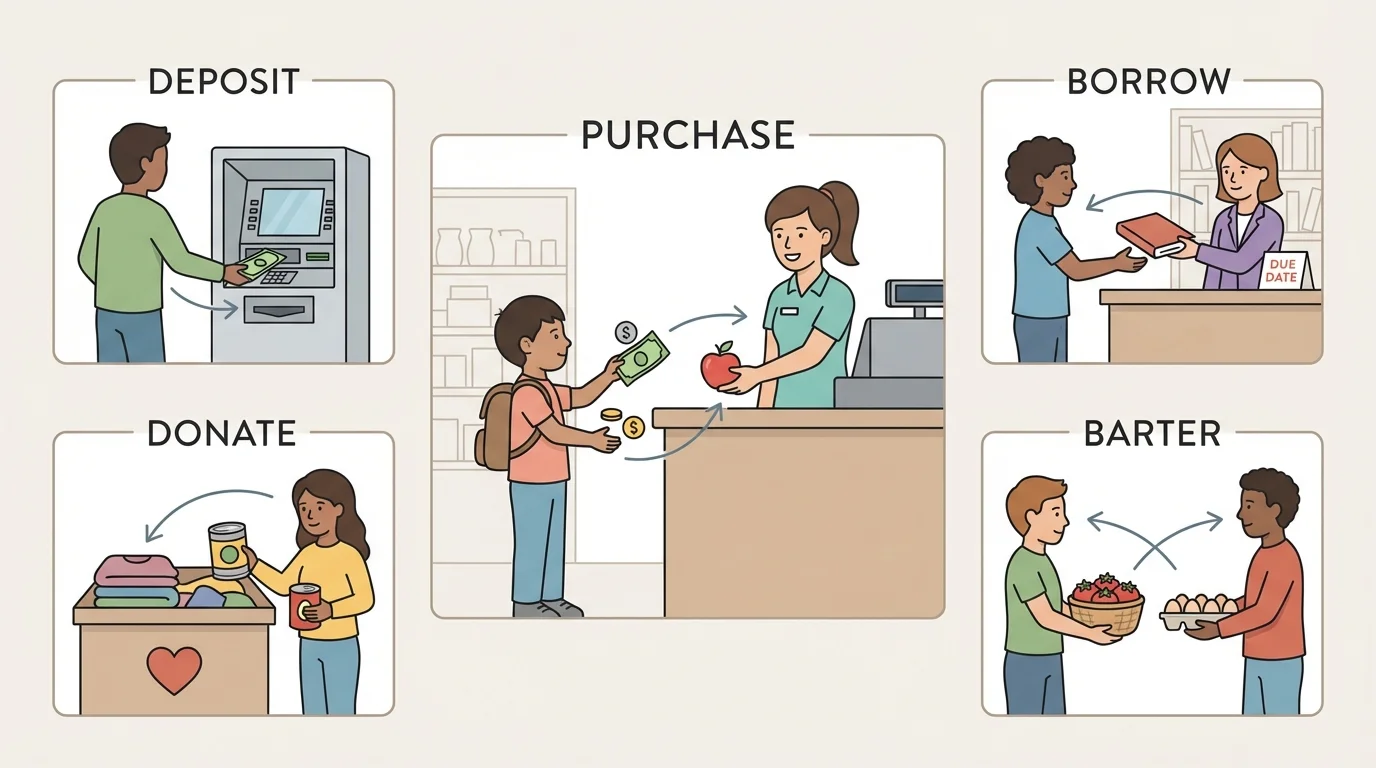
A purchase means buying something with money. The child gives money to the cashier and gets an apple. The money goes one way, and the item comes back the other way. If a pencil costs $2 and you pay $2, then the purchase is complete. In math, the amount you had goes down by the amount you spent. If you had $5 and bought the pencil for $2, then \(5 - 2 = 3\). You have $3 left.
In [Figure 2], the child makes a purchase by paying for an apple. People make purchases for things they need and things they want. Food, shoes, and school supplies can be needs. A toy or sticker might be a want. It is smart to think before a purchase: "Do I need this now? Do I want to save my money instead?"
A purchase uses money. That helps us tell it apart from barter. It also helps us tell it apart from borrowing, because when you buy something, it is yours. You do not have to return it later.
To borrow means to take something for a while and give it back later. You might borrow a library book, a pencil, or a game. When you borrow, you are not buying the item. You are using it for a short time.
If Leo borrows a book on Monday and returns it on Friday, that is borrowing. The book still belongs to the library or another person. Borrowing means being responsible. You should take care of the item and return it when you are supposed to.
Borrowing is temporary. This is the big idea to remember. A purchase means the item becomes yours. Borrowing means the item belongs to someone else, and you must return it.
Sometimes people borrow money too, but first graders often see borrowing with objects more often. No matter what is borrowed, the idea is the same: use it now, return it later.
To donate means to give money or items to help others and not get something back. You might donate canned food, clothes, books, or coins. A class may collect supplies for a shelter or toys for children.
Donating is a way to share. If Mia gives $1 to help animals at a shelter, that dollar is a donation. She is not buying a toy. She is helping. Donations show kindness and caring.
People can donate one item or many items. Even a small donation matters. Sharing with others is an important part of using money wisely, because money is not only for spending on ourselves.
Real-life example: class donation jar
Step 1: Three students each put in $1.
Step 2: Add the donations: \(1 + 1 + 1 = 3\).
Step 3: The class donation jar has $3 to help others.
This is a donation because the money is given to support a good cause.
When we donate, we choose to share what we have. That can be money, food, books, or clothing.
A barter is a trade without money. One child gives a toy car and gets crayons. The other child gives crayons and gets the toy car. Both people exchange items. No coins or bills are used.
In [Figure 3], two children barter by trading a toy car for crayons. Long ago, many people bartered more often. Today, people usually use money, but barter can still happen. Two children may swap stickers. One child may trade an orange for a banana at lunch if the rules allow. That is barter because one item is exchanged for another item.
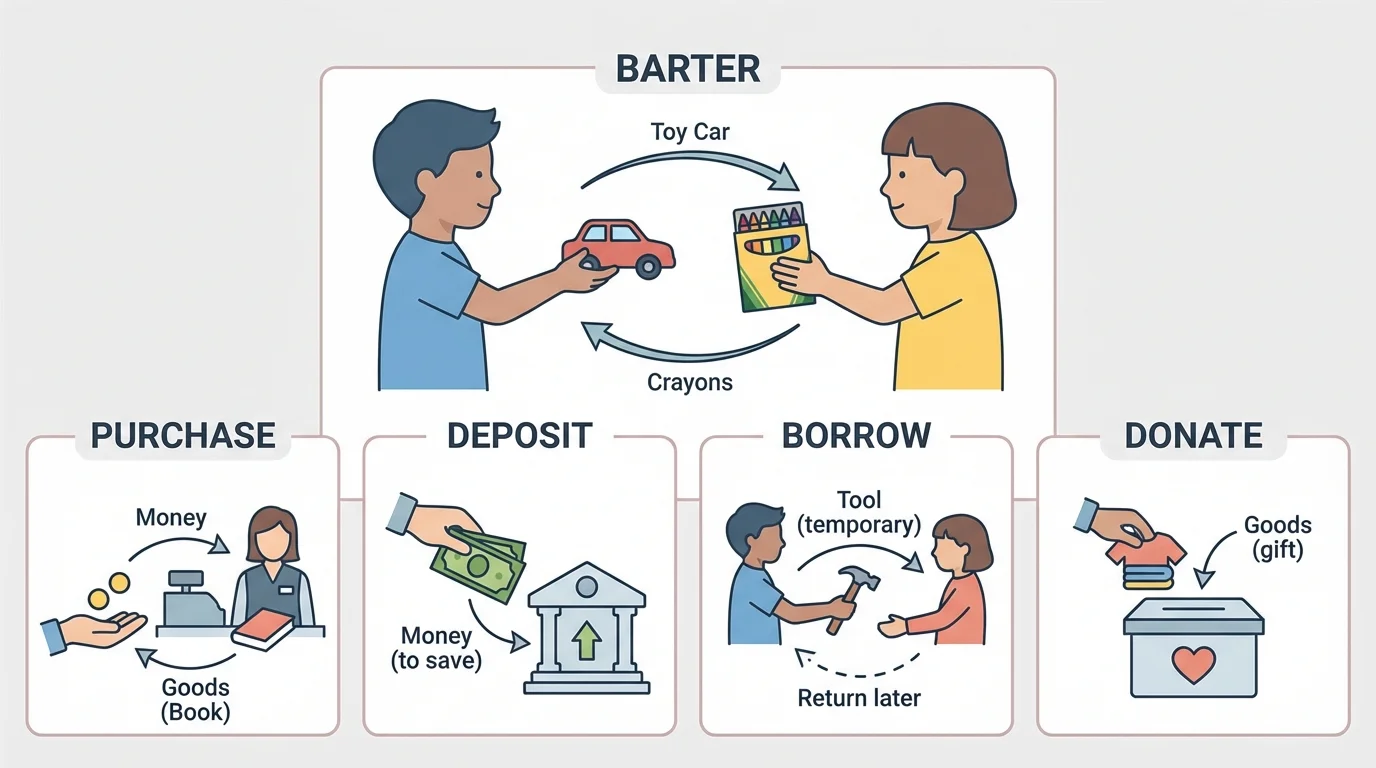
Barter is different from a purchase. In a purchase, money is used. In barter, items or services are swapped. As we saw in [Figure 3], both people give something and get something, but no money changes hands.
These transaction types help us understand three big money ideas: spend, share, and save. A purchase is usually spending. A donation is sharing. A deposit is saving.
Borrowing and bartering are a little different. Borrowing lets you use something without buying it. Bartering lets you trade without money. Both can help people get what they need in a different way.
| Transaction | What happens? | Money used? | Main idea |
|---|---|---|---|
| Deposit | Put money into savings | Yes | Save |
| Purchase | Buy something | Yes | Spend |
| Borrow | Use and return later | No, not always | Temporary use |
| Donate | Give to help others | Sometimes | Share |
| Barter | Trade one thing for another | No | Exchange |
Table 1. A comparison of five common transaction types and how they relate to spending, sharing, and saving.
Notice that the same person can use different transaction types in one week. A child might deposit birthday money, purchase a notebook, borrow a library book, donate canned food, and barter cards with a friend. These are all transactions, but they are not the same kind.
Good money choices begin with understanding what you are doing. If you want to keep money safe for later, make a deposit, like the saver in [Figure 1]. If you want to buy and keep an item, make a purchase, like the shopper in [Figure 2]. If you only need something for a short time, borrowing may make sense. If you want to help someone, donating is a caring choice. If two people want to swap items, barter can work.
Knowing these words helps you talk clearly about money and choices. It also helps you understand what is happening in real life. When children learn how people deposit, purchase, borrow, donate, and barter, they begin to build strong habits for using money wisely.
