A surprising truth about history is that one voyage across the Atlantic changed food, languages, governments, ecosystems, and even the air people breathed. The Western Hemisphere did not develop in isolation. From the Arctic to the Andes, from the Caribbean to the Amazon, people traded, fought, migrated, shared beliefs, and adapted to new conditions. These interactions created the modern Americas we know today.
The Western Hemisphere includes North America, Central America, South America, and the Caribbean. It is a huge region with many climates, languages, and cultures. Over time, people in this hemisphere became connected not only to one another but also to Europe, Africa, and Asia. When people, goods, diseases, technologies, and ideas moved, they changed societies in powerful ways.
Long before Europeans crossed the Atlantic, the Americas were home to millions of people. Indigenous communities built cities, roads, terraces, temples, and trading networks. Some lived in small villages; others were part of large empires. These societies were not all the same. They had different languages, religions, art styles, farming methods, and political systems.
People often adapt to geography, and the Western Hemisphere offered many environments. In the Andes Mountains, people built farms on steep hillsides. In Mesoamerica, farmers grew maize, beans, and squash. In the Caribbean, coastal peoples used the sea for travel and fishing. In the Amazon, communities learned how to live in and manage rainforest environments. Geography connected people and also separated them, shaping trade routes, alliances, and conflicts.
Indigenous peoples are the original peoples of a place. In the Americas, Indigenous peoples lived across the hemisphere long before European colonization and developed many different societies and traditions.
Colonization is the process of one country taking control of another land and its people, often to gain wealth, power, or resources.
Even before 1492, ideas moved from group to group. Crops, tools, artistic patterns, and religious practices spread through trade and contact. This matters because history is not only about battles and rulers. It is also about everyday exchanges that connect people over time.
Major civilizations flourished in the Americas. The Maya built cities and studied astronomy. The Aztec Empire controlled a large region in central Mexico. The Inca Empire created roads across the Andes and connected distant communities. In North America, powerful societies such as Cahokia grew through trade and farming. Smaller nations and communities also played important roles, even if they are mentioned less often in textbooks.
These societies had skilled farmers, builders, leaders, healers, and artists. They developed calendars, forms of writing or record keeping, and systems of government. Primary sources such as codices, carvings, oral traditions, and archaeological remains help historians learn about them. Secondary sources, including history books and articles written later, help explain the meaning of this evidence.
It is important to remember that the Americas were already full of movement and interaction. European arrival did not begin history here. It changed a history that was already rich and complex.
Maize, or corn, began as a plant shaped by Indigenous farmers over many generations. Today it is one of the world's most important crops, which shows how knowledge from the Americas spread far beyond the hemisphere.
When students eat foods like corn, potatoes, chocolate, tomatoes, or peanuts, they are seeing the lasting influence of Indigenous American agriculture. Foods that may seem ordinary today are part of a much bigger story of global connection.
After 1492, a huge movement of plants, animals, people, diseases, and ideas linked the Americas with Europe, Africa, and Asia. This process is called the Columbian Exchange, and [Figure 1] shows that the exchange moved in several directions across the Atlantic rather than only one way. It transformed diets, economies, and environments on both sides of the ocean.
From the Americas, foods such as potatoes, tomatoes, maize, cacao, and cassava spread to other parts of the world. These crops helped feed growing populations in Europe, Africa, and Asia. From Europe, Africa, and Asia to the Americas came horses, cattle, pigs, wheat, sugarcane, and new technologies. New plants and animals changed landscapes and ways of life.
Diseases were also part of the Columbian Exchange, and they were among its most devastating parts. Smallpox, measles, and influenza spread rapidly among Indigenous peoples, who had no immunity to these diseases. Enslaved Africans were also forcibly brought across the Atlantic, adding another major and tragic human movement to this exchange.
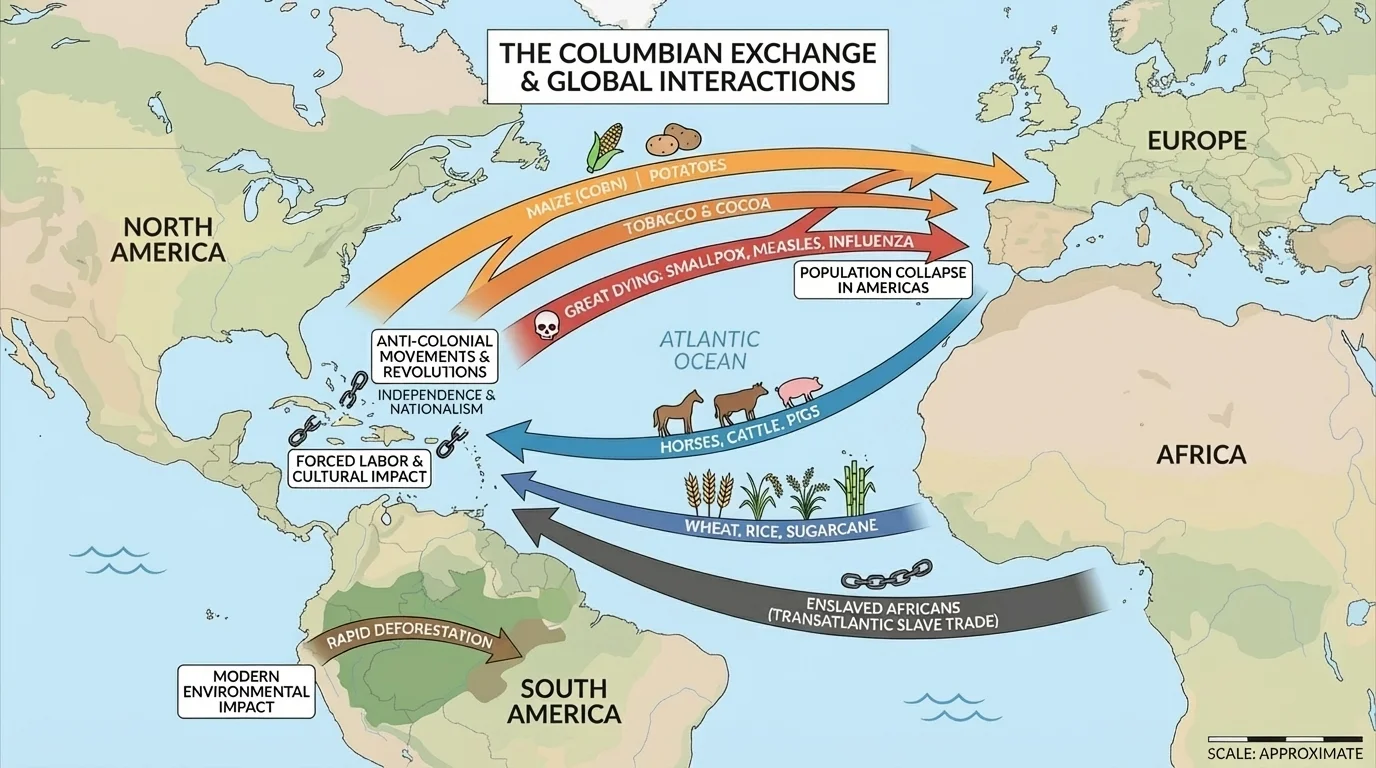
The Columbian Exchange created both gain and loss. Some regions gained new foods and animals. But entire communities were destroyed by disease, conquest, and slavery. Because of this, historians study the Columbian Exchange as a major turning point in world history.
One easy way to see its effects is through food. Italian tomato sauce depends on tomatoes from the Americas. Chocolate comes from cacao first cultivated in the Americas. Horses, often linked with life on the Great Plains in later centuries, came from Europe. As we saw in [Figure 1], these exchanges mixed regions together in ways that still shape daily life.
| From the Americas | To the Americas | Major Effects |
|---|---|---|
| Maize | Horses | Changed farming and transportation |
| Potatoes | Cattle | Changed diets and land use |
| Tomatoes | Wheat | Changed foods in many regions |
| Cacao | Sugarcane | Supported plantation economies |
| Tobacco | Smallpox and measles | Brought wealth to some, death to many |
Table 1. Examples of major transfers during the Columbian Exchange and some of their effects.
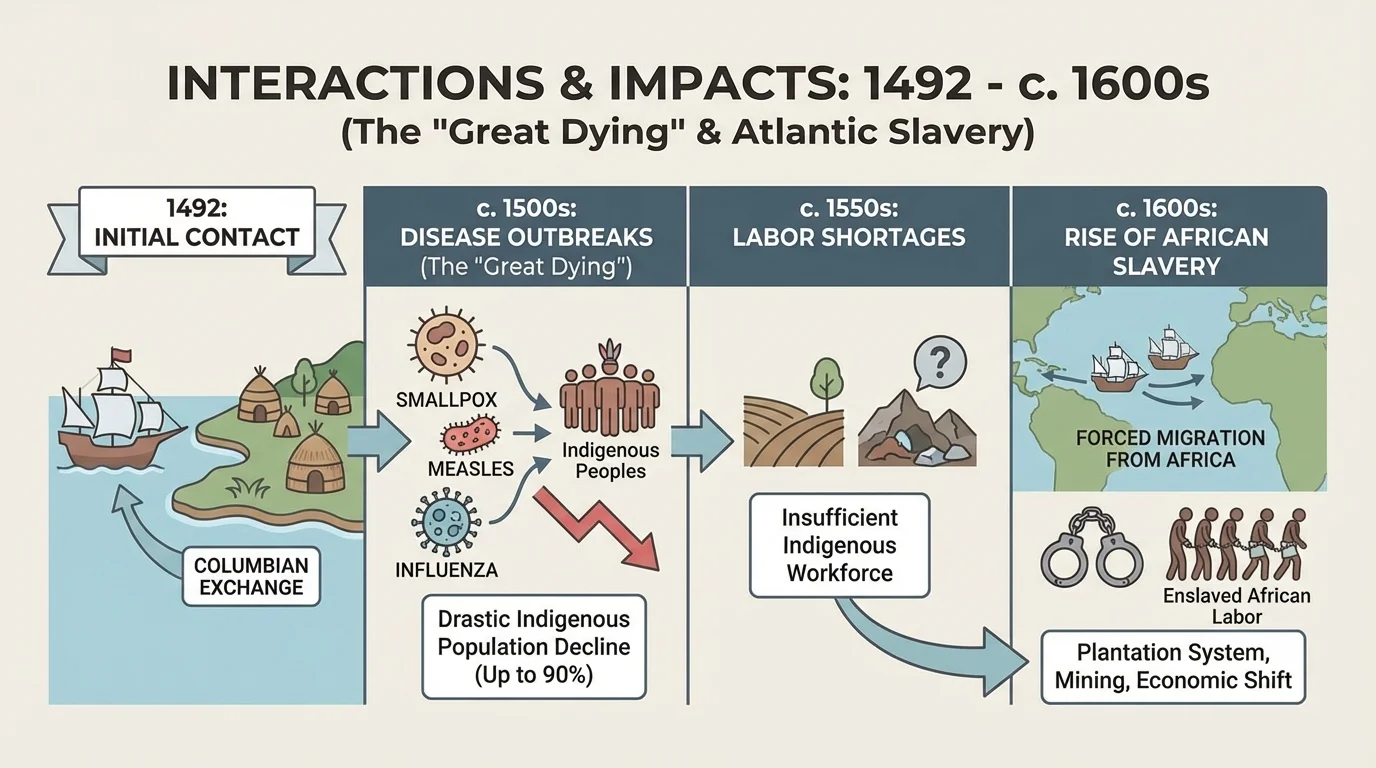
One of the most tragic events in the history of the Western Hemisphere was the Great Dying, the massive death of Indigenous peoples after European arrival. As [Figure 2] illustrates, this was not one single event but a long crisis caused by disease, violence, forced labor, and social collapse. In many places, populations fell sharply during the 1500s and 1600s.
Diseases such as smallpox spread faster than people could respond. Communities lost elders, leaders, healers, and knowledge keepers. At the same time, colonizers often forced Indigenous people to work in mines, fields, and settlements. War, displacement, and hunger made the disaster even worse.
The consequences were enormous. Land was taken more easily when populations collapsed. European empires gained more control. Colonizers demanded labor for plantations and mines, and in many areas this helped increase the Atlantic slave trade. Millions of Africans were captured, transported, and enslaved in the Americas. This created new societies shaped by violence, resistance, and cultural blending.
The Great Dying also changed the environment. In some areas, abandoned farmland returned to forest because so many people had died. Historians and scientists study whether this large reforestation affected the amount of carbon dioxide, written as \(CO_2\), in the atmosphere. This is one example of how human history and environmental history are connected.
Why the Great Dying mattered so much
When a population drops suddenly, the effects spread outward. Families lose knowledge, governments weaken, labor systems change, land use shifts, and outside powers can take control more easily. That is why the Great Dying changed politics, economics, and the environment all at once.
The effects did not end in the 1600s. Many Indigenous nations survived, adapted, and resisted. Their descendants remain important political and cultural communities today. Still, the losses in population, land, language, and power shaped later inequality across the hemisphere. The pattern of change shown in [Figure 2] helps explain why colonial systems became so strong.
European empires such as Spain, Portugal, Britain, and France built colonies in the Americas. They extracted silver, sugar, tobacco, and other resources. Colonies made wealth for empires, but they also depended on labor from Indigenous peoples, enslaved Africans, and poor settlers. Colonial rule created strict social hierarchies, often based on ancestry, birthplace, and race.
At the same time, colonies became places of cultural blending. Languages mixed. Religions changed as people combined old traditions with new ones. Music, food, clothing, and art often reflected Indigenous, African, and European influences. This process is called cultural diffusion, the spread and mixing of cultural traits from one group to another.
People did not simply accept colonial rule. Indigenous groups fought to protect land and autonomy. Enslaved Africans resisted through rebellion, escape, preserving traditions, and creating new communities. Women, though often left out of older history books, also carried culture, organized families, and sometimes played direct political roles in resistance movements.
"I have undertaken to be free, and I am resolved to succeed."
— Attributed to Toussaint Louverture
This quote captures the spirit of many struggles in the Americas. Freedom movements were not just about changing rulers. They were about dignity, rights, and control over land, labor, and identity.
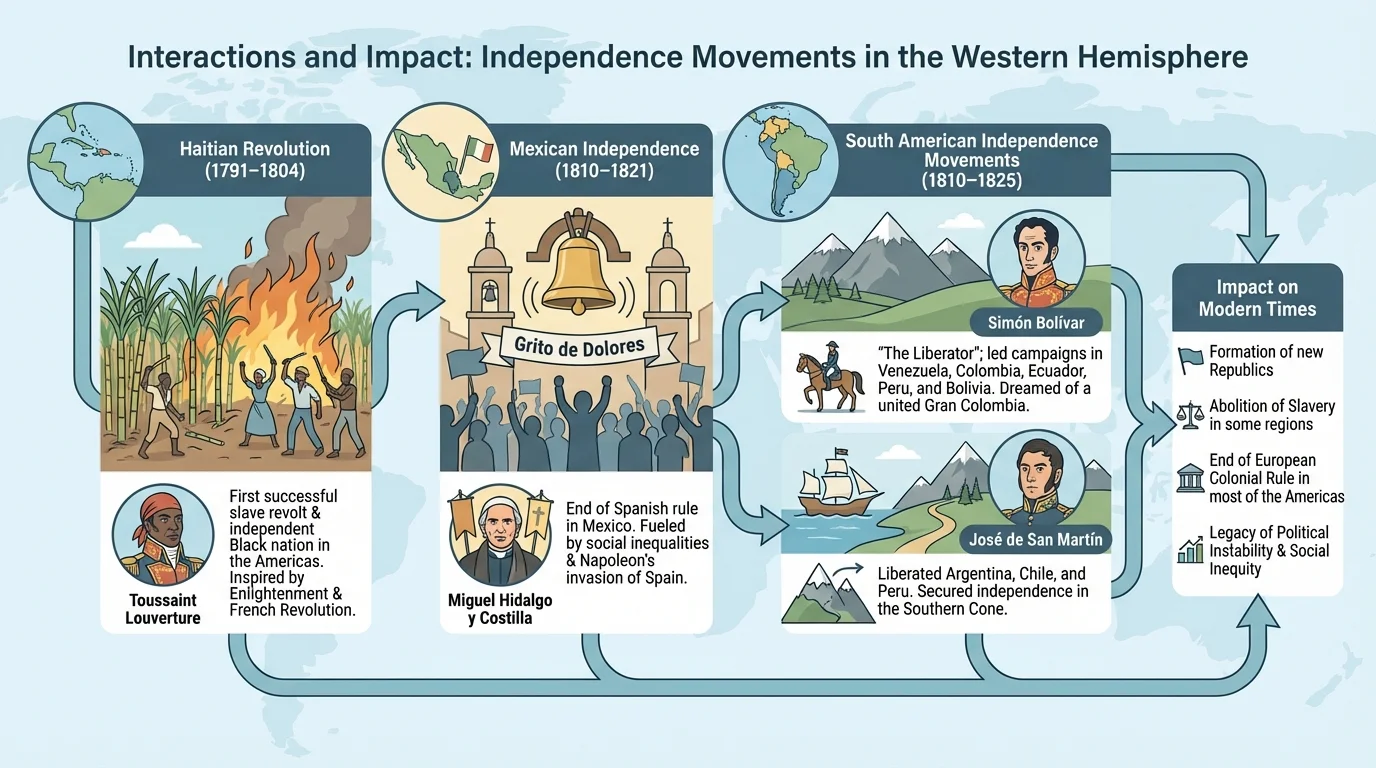
By the late 1700s and early 1800s, anti-colonial and nationalist movements spread across the Western Hemisphere, and [Figure 3] traces several of the most important ones over time. People in the colonies questioned empire and demanded self-rule. Some were inspired by Enlightenment ideas about liberty and rights. Others were reacting to unfair taxes, racial injustice, and political exclusion.
The Haitian Revolution was one of the most important of these movements. Enslaved people in the French colony of Saint-Domingue rose up and eventually created Haiti, the first independent Black republic in the modern world. This event frightened slaveholders and inspired oppressed people across the Americas.
In Spanish America, leaders such as Simón Bolívar and José de San Martín helped lead independence struggles. Mexico also fought for independence from Spain. In the United States, independence from Britain had happened earlier, but debates over freedom and equality continued, especially because slavery remained.
Revolution means a major and often sudden change in government or society. Not all revolutions are the same. Some are violent, while others are more political. Some create broader freedom, while others mainly shift power from one elite group to another. Historians compare revolutions to ask who truly benefited.
After independence, new nations still faced big problems. They had to create governments, settle borders, build economies, and decide who counted as a full citizen. Indigenous peoples, enslaved people, and poor farmers were often still excluded. So independence did not erase inequality. As [Figure 3] suggests, political change can happen quickly, but social change often takes much longer.
| Movement | Where | Main Goal | Why It Matters |
|---|---|---|---|
| Haitian Revolution | Caribbean | End slavery and colonial rule | Created Haiti and challenged slavery |
| Mexican Independence | North America | Break from Spain | Started a new nation with ongoing struggles over power |
| South American independence movements | South America | End Spanish rule | Created several new republics |
Table 2. Selected anti-colonial and nationalist movements in the Western Hemisphere.
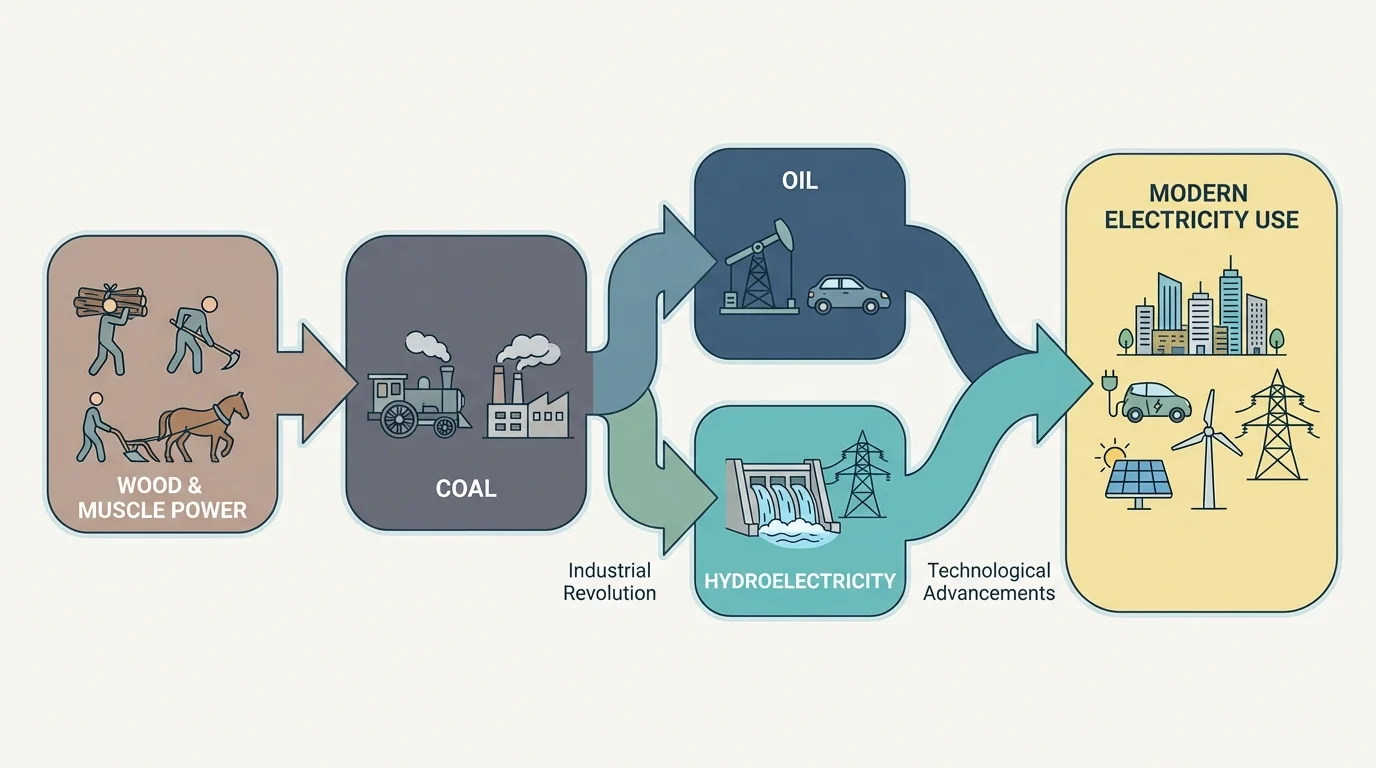
History is also shaped by how people get power for work, transportation, and daily life. [Figure 4] shows how energy revolutions changed the Western Hemisphere from a world powered mostly by human labor, animal strength, wind, and wood to one powered by coal, oil, hydroelectricity, and electricity. When energy sources changed, cities, factories, trade, and the environment changed too.
At first, many societies relied on muscle power, firewood, and watermills. Later, coal powered steam engines. Oil helped run cars, trucks, ships, and airplanes. Hydroelectric dams produced electricity by using moving water. These shifts made travel faster and industry larger, but they also caused pollution and encouraged resource extraction.
In the Americas, energy change affected where people lived and worked. Coal and oil helped factories grow. Railroads connected distant regions. Cars and highways reshaped cities. Oil wealth made some countries richer, but it also created conflict over land, money, and political power. Energy history is really about people making choices about resources.
Energy revolutions are not only about machines. They are also about the environment. Burning fossil fuels releases gases including \(CO_2\), which contribute to climate change. This means that a decision made to improve transportation or industry can also affect weather patterns, forests, oceans, and farming far away.
Today many countries in the Western Hemisphere debate renewable energy, such as solar and wind power, because they want electricity without as much pollution. Looking back at [Figure 4], we can see that each energy shift solves some problems but creates others.
Case study: How one invention can change society
The spread of railroads in the Americas shows how energy and technology connect to history.
Step 1: Steam engines powered trains using coal.
This allowed people and goods to move farther and faster than before.
Step 2: Faster movement connected farms, mines, ports, and cities.
Regions that had once felt distant became part of larger national economies.
Step 3: Railroad building changed land and power.
It often encouraged settlement, business growth, and government expansion, but it could also displace Indigenous communities.
This is why an energy change is never only a science story or only an economics story. It is also a human story.
Students can connect this to modern life by thinking about phones, buses, online shopping, and electricity at home. All depend on energy systems built over time. Modern convenience has a history behind it.
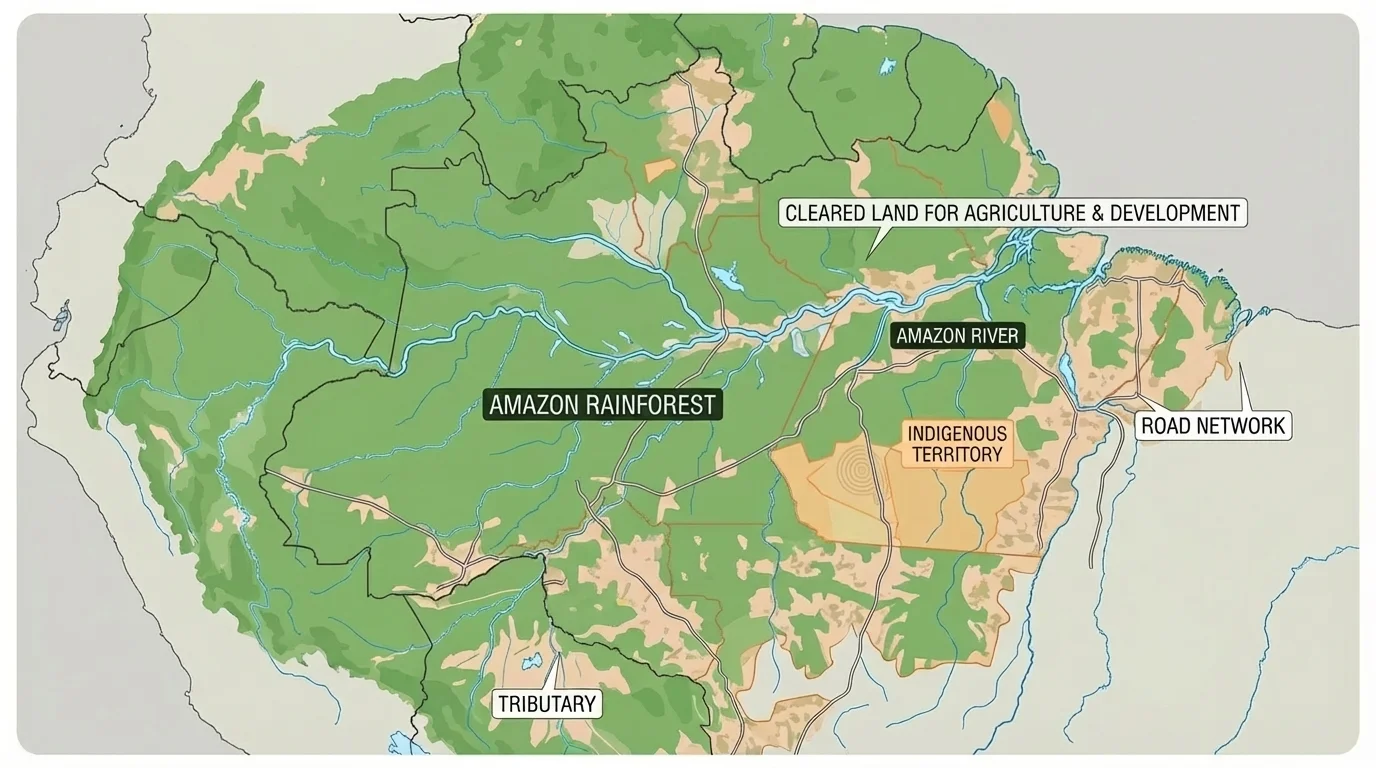
The deforestation of the Amazon is one of the clearest modern examples of interconnection in the Western Hemisphere. The Amazon rainforest stretches across several South American countries, especially Brazil, and [Figure 5] maps where this vast forest lies and where clearing is taking place. What happens there affects Indigenous communities, wildlife, rivers, climate, and people far beyond South America.
The Amazon is important because forests store carbon, produce moisture, and support an enormous variety of plants and animals. Many Indigenous groups have lived there for generations and have deep knowledge of the land. But logging, mining, road building, ranching, and farming have cleared large areas of forest.
When trees are cut and burned, more \(CO_2\) enters the atmosphere. Animals lose habitats. Soil can become weaker. Rainfall patterns may change. Some cleared land is used for cattle or crops that are sold in global markets, which means that consumer choices in one country can affect forests in another.
The Amazon also shows that history did not stop in the past. Colonial ideas about taking land for profit still influence modern policies. At the same time, Indigenous activists, scientists, and environmental groups work to protect the forest. Their efforts remind us that people continue to shape history through action and debate.
When we return to [Figure 5], we can see that deforestation is not just a local issue. It connects land use, economics, government decisions, and the global climate. The Amazon is a modern example of how environment and human history are tightly linked.
Geography matters in history. Forests, mountains, rivers, and coasts influence where people live, how they travel, what they grow, and what conflicts or partnerships develop.
The Amazon also teaches an important lesson about time. Some historical changes happen suddenly, like a revolution. Others build slowly, like forest loss or climate change. Both kinds of change matter.
Modern life in the Western Hemisphere is filled with signs of past interaction. Languages such as Spanish, Portuguese, English, French, and hundreds of Indigenous languages reflect migration and empire. Foods on dinner tables show the Columbian Exchange. Music and religion reveal blending among Indigenous, African, and European traditions. Political borders and inequalities often come from colonial history.
Ideas continue to move too. Democracy, nationalism, human rights, and environmentalism have spread through speeches, books, protests, schools, and technology. Some ideas unite people; others divide them. The key point is that ideas can travel just as powerfully as goods.
Historians use many sources to understand these connections. A primary source might be a letter from a conquistador, an Indigenous oral history, a plantation record, or a speech by Simón Bolívar. A secondary source might be a historian's book explaining how those sources fit together. By comparing sources, students can better understand different perspectives.
Interconnection means cause and effect across places
When one event changes many regions at once, historians look for interconnection. The Columbian Exchange linked continents. The Great Dying reshaped labor and empire. Nationalist movements changed governments. Energy revolutions transformed economies and environments. Amazon deforestation connects local land use to global climate.
The story of the Western Hemisphere is not a story of isolated countries. It is a story of linked peoples and places. Choices made centuries ago still affect land ownership, wealth, language, identity, and the environment today. Understanding these links helps us understand the modern world more clearly.
