One of the most powerful forces in history is invisible: an idea. A book, a sermon, a speech, or a philosophical argument can outlast kings, armies, and empires. The belief that people have natural rights helped inspire revolutions. The belief that society should be organized around economic equality fueled mass political movements. Religious faith has united communities, created works of art and learning, shaped laws, and also contributed to conflict. To understand the modern world, we have to study not only what people did, but what they believed and why those beliefs spread.
Ideas matter because they shape how people answer basic questions: Who should rule? What gives life meaning? What duties do people owe one another? How should wealth be distributed? What is truth, and how can humans know it? Philosophical movements and religions do not remain frozen in time. They change as they encounter new cultures, technologies, states, and crises. That is why historians study both continuity and change: some core teachings stay recognizable for centuries, while other parts adapt to new historical conditions.
Belief system means an organized set of ideas about life, morality, reality, and human purpose. A philosophical movement is a set of connected ideas about knowledge, society, and ethics. A political ideology is a system of beliefs about power, government, and how society should be organized.
Historians also look for cause and effect. New ideas often arise in response to real problems: corruption in religious institutions, inequality during industrialization, or demands for political participation. At the same time, ideas have complex consequences. A movement may expand freedom for some people while excluding others. A religion may encourage compassion and social service while also being used by states to justify control. Studying history means resisting simple answers.
From the Renaissance onward, growing literacy, trade, urban life, and new technologies such as the printing press allowed ideas to circulate much faster than before. This changed the scale of history. In earlier centuries, many beliefs spread mainly by oral tradition, local teachers, and religious institutions. After print culture expanded, arguments could move across borders, influencing people who had never met one another. In some ways, this was an early version of how ideas spread online today: faster communication increased both intellectual creativity and controversy.
Ideas can create unity and diversity at the same time. Shared beliefs can bind large communities together, but different interpretations can produce debate, reform, and division. Christianity, Islam, Buddhism, and other traditions all include internal diversity. Political ideologies do too. Not all socialists agree, not all Enlightenment thinkers agreed, and not all humanists defined human nature in the same way. Historical understanding requires attention to this complexity.
Beginning in parts of Europe during the late Middle Ages and Renaissance, humanism emphasized the study of classical Greek and Roman texts, the dignity of the individual, and the value of human reason and education. Humanists did not necessarily reject religion. Many were devout Christians. But they shifted attention toward human potential in this world, not only salvation in the next.
Thinkers such as Petrarch, Erasmus, and Pico della Mirandola promoted education in history, rhetoric, moral philosophy, and languages. Artists such as Leonardo da Vinci and Michelangelo reflected humanist interests through close observation of nature and realistic portrayals of the human body. This marked an important change from earlier medieval traditions, though there was also continuity: many Renaissance scholars still worked within religious institutions and drew on Christian ideas.
Humanism mattered politically because it encouraged educated elites to think critically about ethics, civic life, and leadership. In city-states such as Florence, humanist education was connected to public service. It also helped prepare the ground for later intellectual developments by promoting textual analysis, skepticism toward unquestioned authority, and confidence in human inquiry.
The word renaissance means "rebirth." It refers to a renewed interest in classical learning, but the period was not simply a copy of ancient Greece and Rome. Scholars reshaped older ideas to fit new social and political conditions.
Humanism had limits. Renaissance learning was often centered on elite men, and many women and poorer people had limited access to education. This is an example of how a movement can be historically important while still reflecting inequalities of its time.
In the Enlightenment, which developed mainly during the 17th and 18th centuries, thinkers argued that reason, observation, and debate could improve society. As [Figure 1] shows, Enlightenment ideas developed through the work of several major thinkers and later influenced political revolutions on both sides of the Atlantic. These philosophers challenged absolute monarchy, defended rights, and asked whether governments existed to serve people rather than rule them by divine right.
John Locke argued that people possess natural rights, including life, liberty, and property. Montesquieu supported separation of powers so that government authority would be limited. Voltaire criticized intolerance and defended freedom of thought. Jean-Jacques Rousseau explored the idea of a social contract, in which political authority depends on the collective will of the people. Enlightenment ideas were also shaped by scientific advances associated with figures such as Isaac Newton, whose work encouraged confidence that rational laws could explain the world.
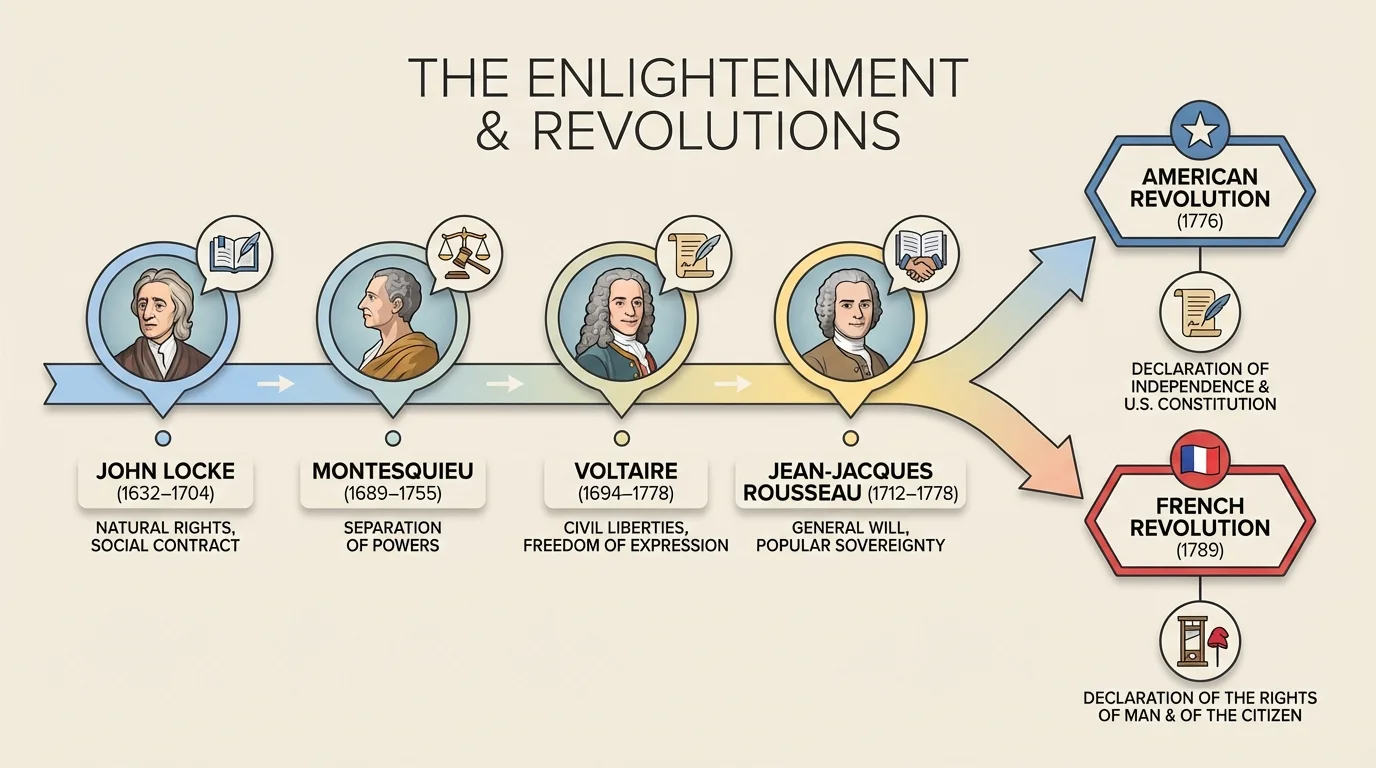
These ideas helped inspire the American Revolution and the French Revolution. The language of natural rights appears clearly in documents such as the Declaration of Independence and the Declaration of the Rights of Man and of the Citizen. Yet the application of Enlightenment ideals was uneven. Enslaved people, women, Indigenous peoples, and the poor were often excluded from full political rights. This gap between ideals and reality became one of the major tensions of modern history.
"Man is born free, and everywhere he is in chains."
— Jean-Jacques Rousseau
The Enlightenment also had global effects beyond Europe. Reformers in Latin America, the Caribbean, and other regions adapted its language to local struggles. The Haitian Revolution, led by formerly enslaved people, pushed the logic of rights further than many European elites were willing to go. Later activists for abolition, constitutional reform, and women's rights also drew on Enlightenment principles. When historians evaluate the Enlightenment, they must recognize both its revolutionary power and its contradictions.
Primary sources such as Locke's Two Treatises of Government or Voltaire's writings show how these thinkers argued in their own words. Secondary sources by historians help explain how these texts were received, debated, and transformed by political movements. Looking at both kinds of sources reveals that ideas are never static; they are interpreted and contested over time.
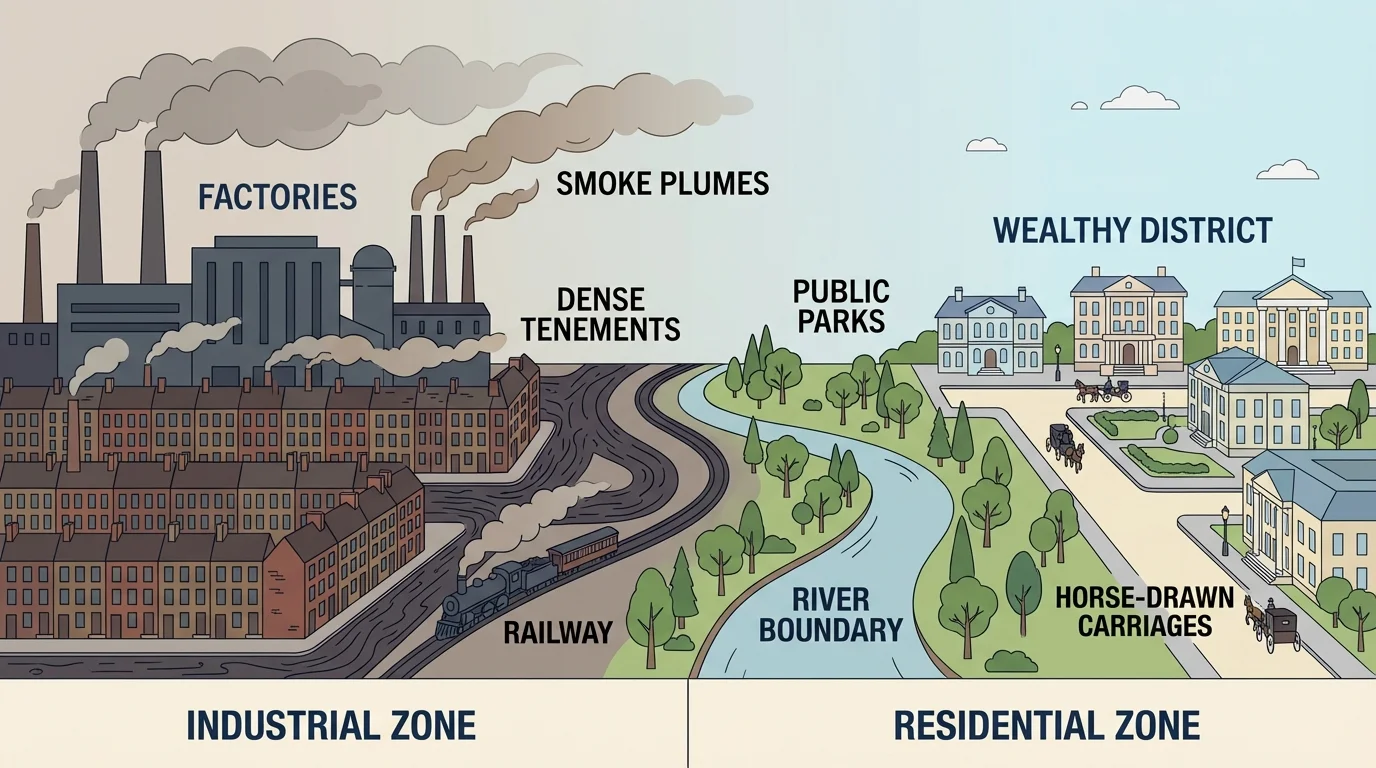
The Industrial Revolution transformed economies and daily life, but it also created harsh working conditions, crowded cities, child labor, and extreme inequality. These conditions, illustrated in [Figure 2], led many people to question whether political freedom meant much without economic security. Out of this context grew modern socialism and communism.
Socialism is a broad set of ideas favoring greater social ownership or public control of the economy and a more equal distribution of wealth. Some socialists believed change should happen gradually through elections, unions, and reform laws. Others thought capitalism was so unequal that only revolution could end it. Early socialist thinkers such as Robert Owen and Charles Fourier proposed cooperative communities, while later democratic socialists supported labor protections, public education, health systems, and welfare policies.
Karl Marx and Friedrich Engels developed a more radical critique in works such as The Communist Manifesto. They argued that history was shaped by class struggle between economic groups, especially between the bourgeoisie, who owned the means of production, and the proletariat, who sold their labor. In Marxist theory, capitalism would eventually collapse because of its internal contradictions, leading to a classless, stateless communist society.
Why socialism and communism appealed to many people
These movements promised answers to real problems: unsafe factories, poverty wages, unemployment, and the concentration of wealth in the hands of a small minority. For workers and peasants, radical ideas were not just abstract theories; they were responses to everyday hardship.
In practice, socialism and communism developed in different ways. Social democratic parties in parts of Europe worked within parliamentary systems and helped create modern welfare states. Communist revolutions took place in Russia in 1917, China in 1949, and elsewhere. Leaders such as Vladimir Lenin, Joseph Stalin, and Mao Zedong claimed to build communist societies, but the results were mixed and often devastating. Some governments expanded literacy, industrialization, and basic health care. At the same time, many communist states became authoritarian, limited freedom of speech, used violence against opponents, and caused famine or mass suffering through forced policies.
The history of communism shows the importance of evaluating both ideals and outcomes. The promise of equality attracted millions, especially where monarchy, colonialism, or extreme poverty had discredited older systems. But concentration of state power often produced repression rather than liberation. During the Cold War, communist and capitalist blocs competed globally, influencing wars, revolutions, and development policies. Even after the collapse of the Soviet Union in 1991, debates about inequality, workers' rights, and the role of government remained central in world politics. The contrasts first introduced in [Figure 2] still help explain why these movements emerged so forcefully.
Although humanism, Enlightenment thought, socialism, and communism are different, they all responded to major historical changes and asked what kind of society humans should build. Their differences become clearer when compared side by side.
| Movement | Historical Context | Core Ideas | Major Figures | Historical Impact |
|---|---|---|---|---|
| Humanism | Renaissance Europe | Classical learning, dignity of the individual, education, critical reading | Petrarch, Erasmus, Pico | Influenced art, education, civic thought |
| Enlightenment | 17th–18th centuries | Reason, rights, liberty, limits on power, tolerance | Locke, Montesquieu, Voltaire, Rousseau | Inspired revolutions, constitutions, reform movements |
| Socialism | Industrial age | Economic justice, collective welfare, public responsibility | Owen, Fourier, later labor leaders | Labor laws, welfare states, reform politics |
| Communism | 19th century theory; 20th century revolutions | Class struggle, abolition of private ownership of major productive resources, revolutionary change | Marx, Engels, Lenin, Mao | Revolutions, one-party states, Cold War, major social change |
Table 1. Comparison of major political and intellectual movements from the Renaissance to the modern era.
Diaspora is central to the history of Judaism, one of the world's oldest monotheistic religions. Judaism traces its origins to the ancient Israelites and the covenant tradition associated with figures such as Abraham and Moses. From antiquity onward, Jewish communities lived across the Middle East, North Africa, and Europe, often maintaining shared religious texts, laws, rituals, and identity despite geographic separation.
That continuity is historically remarkable. Jewish communities preserved traditions through the Torah, synagogue life, festivals, and rabbinic scholarship. At the same time, there was diversity: Ashkenazi, Sephardic, and Mizrahi Jewish communities developed distinct cultural practices while remaining connected through religion. This is a strong example of unity and diversity within one belief system.
The Jewish experience was also deeply shaped by persecution, including expulsions, restrictions, pogroms, and the Holocaust, in which Nazi Germany murdered six million Jews during World War II. The Holocaust changed global politics, ethics, and memory culture. It also influenced support for the establishment of the state of Israel in 1948, an event of great significance that also became linked to continuing conflict in the Middle East. Modern Judaism includes Orthodox, Conservative, Reform, and other branches, showing both continuity and change across time.
Christianity began in the 1st century with the life and teachings of Jesus of Nazareth and the early Christian communities of the Roman Empire. At first, Christians were a minority and at times faced persecution. A major turning point came when Emperor Constantine legalized Christianity in the 4th century. Later, it became the dominant religion of much of Europe.
Christianity expanded through missionary activity, imperial support, monastic communities, and later through colonization. During the medieval period, the Church became a major social, political, and cultural institution. Cathedrals, universities, hospitals, and charitable organizations were often connected to Christian institutions. But Christianity also experienced internal division. The Great Schism of 1054 contributed to the split between the Roman Catholic and Eastern Orthodox churches.
Another major change came with the Reformation in the 16th century. Reformers such as Martin Luther and John Calvin challenged church corruption and certain doctrines, helping create Protestant traditions. The Reformation reshaped European politics, education, literacy, and warfare. It also encouraged rulers to assert more independence from papal authority.
As European empires expanded, Christianity spread to the Americas, sub-Saharan Africa, Asia, and the Pacific. Missionaries sometimes promoted education and medical care, but Christian expansion was also entangled with empire, cultural suppression, and forced conversion in some settings. Today Christianity is one of the world's largest religions and includes enormous diversity, from Catholicism and Orthodoxy to many Protestant and independent churches.
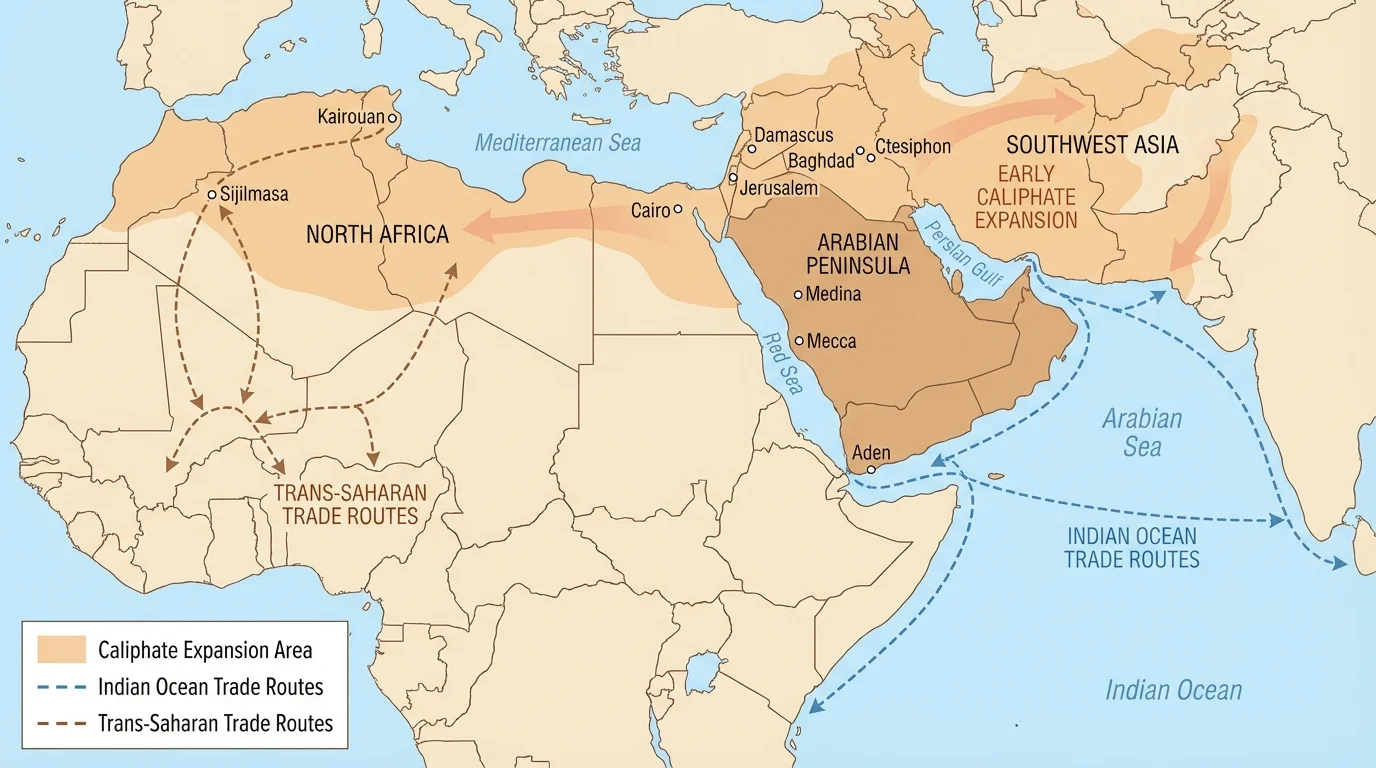
Islam began in the 7th century in Arabia with the revelations received by the Prophet Muhammad. As [Figure 3] illustrates, Islam spread rapidly through a combination of conquest, trade, migration, and missionary activity, creating one of the largest connected cultural zones in world history. The Qur'an and the example of Muhammad became foundational to Muslim belief and practice.
After Muhammad's death, Muslim leadership continued under the caliphs, and Islamic rule expanded across the Middle East, North Africa, parts of Europe, and Central and South Asia. The early caliphates helped create networks of exchange in goods, knowledge, and institutions. Cities such as Baghdad, Cairo, and Córdoba became centers of learning. Scholars in the Islamic world made major contributions to mathematics, medicine, astronomy, philosophy, and literature.
Islam developed major branches, especially Sunni and Shia, partly because of disagreements over leadership after Muhammad's death. Yet Muslims across regions also shared common practices such as prayer, fasting during Ramadan, and pilgrimage to Mecca. Islamic empires such as the Umayyads, Abbasids, Ottomans, Safavids, and Mughals shaped law, architecture, trade, and statecraft across vast territories.
Case study: Trade and the spread of Islam
Islam did not spread only by armies. Trade played a major role across the Indian Ocean and trans-Saharan routes.
Step 1: Merchants carried more than goods.
Muslim traders moved between East Africa, Arabia, South Asia, and Southeast Asia, bringing religious practices and legal customs with them.
Step 2: Local rulers sometimes adopted Islam for political and economic reasons.
Conversion could strengthen trade relationships and diplomatic ties with other Muslim regions.
Step 3: Islam blended with local cultures.
In places such as Indonesia and West Africa, Islamic belief developed alongside earlier traditions, producing distinctive regional forms.
This case shows why historians describe religious expansion as a complex process rather than a single event.
Modern Islamic history includes anti-colonial movements, reform efforts, revivalist movements, and debates about law, modernity, and political power. The broad reach visible in [Figure 3] helps explain why Islam developed such rich regional diversity while retaining common religious foundations.
South and East Asia produced several major traditions whose origins span many centuries, as [Figure 4] shows. These belief systems differ in doctrine and practice, but all have shaped philosophy, ethics, politics, and cultural life across large regions.
Hinduism is not a single founder-based religion but a diverse family of traditions rooted in ancient South Asia. It includes beliefs and practices connected to the Vedas, dharma, karma, reincarnation, and liberation. Hindu traditions are extraordinarily varied, including devotion to different deities, philosophical schools, ritual practices, and social customs. Hinduism has shown strong continuity over time while also changing through reform movements, interaction with Islam and colonialism, and modern nationalism.
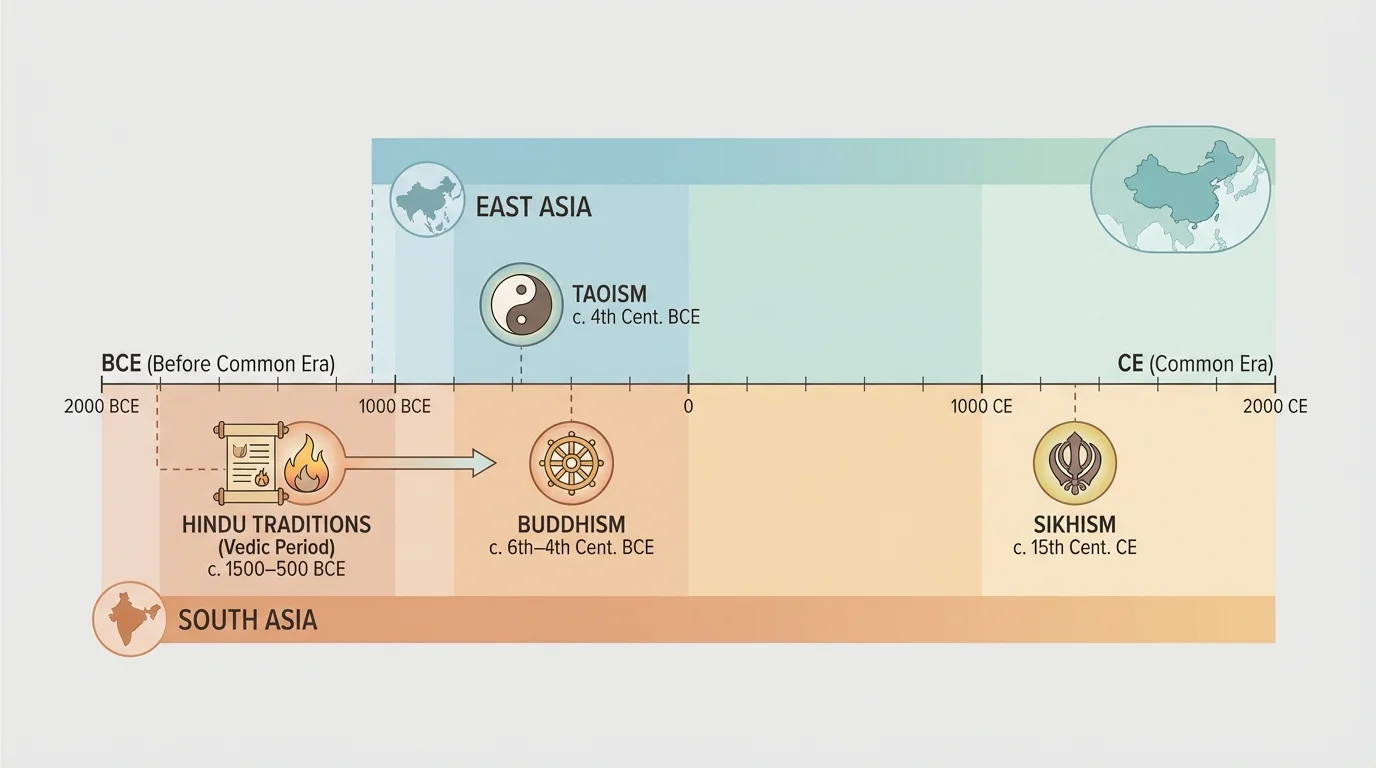
Buddhism began in northeastern India with Siddhartha Gautama, the Buddha, who taught about suffering, desire, and the path to enlightenment. Buddhism spread through missionary work, trade routes, and state support, especially under Emperor Ashoka. Over time it developed major branches such as Theravada, Mahayana, and Vajrayana. It declined in much of India but flourished in Sri Lanka, Southeast Asia, Central Asia, China, Korea, Japan, and Tibet.
Sikhism emerged in the Punjab region in the 15th century. Founded by Guru Nanak and shaped by the Sikh Gurus, it emphasized devotion to one God, equality, honest work, and service to others. Sikhism developed in a region influenced by both Hindu and Islamic traditions, but it formed a distinct religion with its own scripture, institutions, and identity. The Khalsa tradition became especially important in Sikh history.
Taoism, rooted in ancient China and associated with texts such as the Tao Te Ching, emphasizes harmony with the Tao, often translated as "the Way." Taoist thought influenced Chinese philosophy, medicine, art, and attitudes toward nature and governance. It existed alongside Confucianism and Buddhism, sometimes competing with them and sometimes blending with them in Chinese religious life.
These traditions show that religious development is rarely linear. Buddhism changed as it moved into East Asia. Hinduism contained many strands from the beginning. Sikhism emerged in a zone of cultural interaction. Taoism influenced both elite philosophy and popular religion. The long chronology summarized in [Figure 4] helps explain why each tradition developed multiple forms across time and place.
When historians compare philosophical movements and religions, several major patterns appear. First, ideas spread through networks: schools, trade routes, empires, missionary activity, conquest, migration, print culture, and now digital media. Second, ideas change when they move. A belief system entering a new region often adapts to local language, law, art, and social structure.
Third, no major movement is completely unified. Internal disagreements are normal, not accidental. Protestantism contains many denominations; Islam includes multiple legal and theological traditions; Buddhism contains several major schools; socialism ranges from reformist to revolutionary forms. Diversity within unity is one of the most important themes in world history.
Fourth, ideas can empower people and justify power at the same time. Religious institutions built schools, preserved knowledge, and inspired charity, but they could also support hierarchy or persecution. Enlightenment ideas defended liberty, yet some Enlightenment thinkers tolerated empire or exclusion. Socialist and communist movements sought justice, yet communist states often concentrated power in dangerous ways. Historical evaluation requires balance.
When judging historical significance, think about scale, duration, and consequences. Ask how many people were affected, how long the effects lasted, and whether the movement changed politics, culture, economics, or daily life.
Another major pattern is the interaction between belief and material conditions. The Enlightenment was linked to scientific change and political conflict. Socialism and communism grew out of industrial capitalism. Religious reform often responded to corruption, crisis, or expansion. Ideas do not float above history; they emerge within it.
To evaluate these movements means more than listing facts. It means weighing evidence and judging significance. Humanism helped create new educational ideals and confidence in human creativity. The Enlightenment influenced constitutions, rights language, and modern democratic thought. Socialism pushed societies to confront inequality and inspired labor reform. Communism transformed states and global politics, but often at immense human cost.
Religions have had equally deep impact. Judaism preserved identity across centuries of displacement and persecution. Christianity shaped institutions, ethics, art, and empire on a global scale. Islam created vast networks of faith, trade, scholarship, and empire. Hinduism, Buddhism, Sikhism, and Taoism have profoundly influenced ethics, philosophy, governance, social life, and cultural expression across Asia and beyond.
The most accurate historical judgment is not that one idea "caused everything," but that ideas interact with power, geography, economics, and human choices. That is what makes history both challenging and fascinating. The modern world is built not only from borders and battles, but from arguments about freedom, justice, truth, duty, and the meaning of human life.
