One of the most important choices in a democracy is not just who wins elections, but how the political system organizes competition in the first place. In some democracies, two major parties dominate almost everything. In others, several parties regularly win seats and share power. That difference shapes what laws get passed, whose voices are heard, how governments are formed, and even whether voters feel represented at all.
Political parties are not just election machines. They connect citizens to government. They recruit candidates, organize campaigns, propose policies, and help turn public demands into laws. When people vote, volunteer, donate, attend meetings, speak out on issues, or join advocacy groups, they influence parties and the institutions those parties control. Because of that, understanding party systems helps explain how democratic government works in everyday life.
In a democracy, citizens are free to form groups that compete for political power. A political party brings together people with similar goals about government, the economy, rights, education, security, or other issues. Parties simplify politics by giving voters recognizable choices. Instead of studying every individual candidate from scratch, voters can use party labels as a guide to general beliefs and priorities.
Parties also matter inside government. In legislatures, party members often work together to pass laws. In executive branches, party leaders may shape budgets, appointments, and national priorities. This means that the structure of a party system affects more than elections; it affects whether government is efficient, responsive, divided, or inclusive.
Two-party system means a political system in which two major parties dominate elections and government, even if smaller parties exist.
Multiparty system means a political system in which three or more parties have a realistic chance to win seats and influence government.
Coalition government is a government formed when two or more parties cooperate to gain a majority and govern together.
It is important to remember that a party system is not the same thing as democracy itself. Both two-party and multiparty systems can exist within democracies, as long as elections are competitive, rights are protected, and citizens can participate freely. The key question is not whether one system is automatically democratic and the other is not. The better question is how each system affects representation, stability, and policymaking.
In a two-party system, two major parties consistently win most elections and hold most public offices. Smaller parties may still appear on ballots, but they rarely win enough seats to control government. The United States is the most familiar example. Democrats and Republicans dominate national politics, even though third parties such as the Libertarian Party or Green Party sometimes influence debate.
In a multiparty system, several parties can win meaningful numbers of seats. No single party may win a majority on its own, so parties often negotiate alliances. Germany, Israel, the Netherlands, and India are examples of democracies with multiple important parties, although each has its own rules and political culture.
These systems are not identical in every country. Some states with two dominant parties still have influential smaller regional parties. Some multiparty systems have one large party and several medium-sized ones. Party systems exist on a spectrum rather than in perfectly fixed categories.
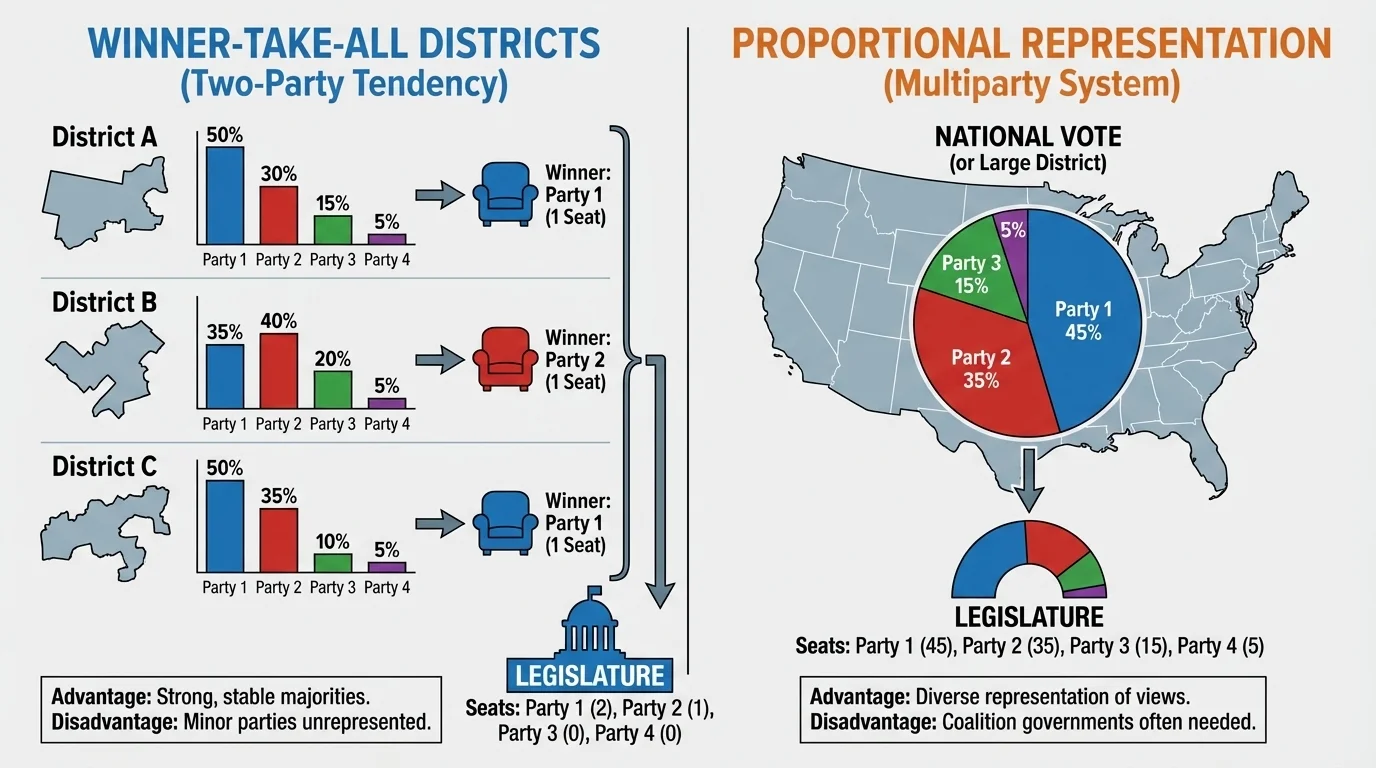
Party systems do not appear by accident. Election rules strongly influence them, as [Figure 1] shows through the difference between winner-take-all and proportional seat allocation. In many countries, the way votes become seats determines whether voters feel safe supporting smaller parties or whether they pressure themselves to choose between only the biggest competitors.
In a plurality voting system, the candidate with the most votes wins, even without a majority. In single-member districts, this often rewards large parties and punishes smaller ones. If a small party wins only a modest share of votes in many districts, it may still gain no seats at all. Voters may then switch to a major party to avoid "wasting" their vote.
By contrast, systems using proportional representation are more likely to produce multiple viable parties. If a party wins roughly 20 percent of the vote, it may receive about 20 percent of the seats. That makes it easier for smaller or more specialized parties to survive and represent particular viewpoints.
This does not mean election rules explain everything. History, social divisions, regional identities, and political culture matter too. Still, institutions create incentives. If rules reward broad coalitions before an election, fewer parties may dominate. If rules reward ideological or regional specialization, more parties may flourish.
Institutions shape choices
Citizens participate in politics within rules designed by constitutions, election laws, and courts. Those rules shape party competition. A voting system that discourages small parties may push citizens to work inside major parties, especially through primaries, party conventions, and issue caucuses. A system that allows smaller parties to win seats may encourage voters to organize around specific ideas, identities, or regional concerns.
This connection between institutions and behavior is a major theme in civics. Political participation is not only about individual opinions. It is also about the structures through which those opinions enter government.
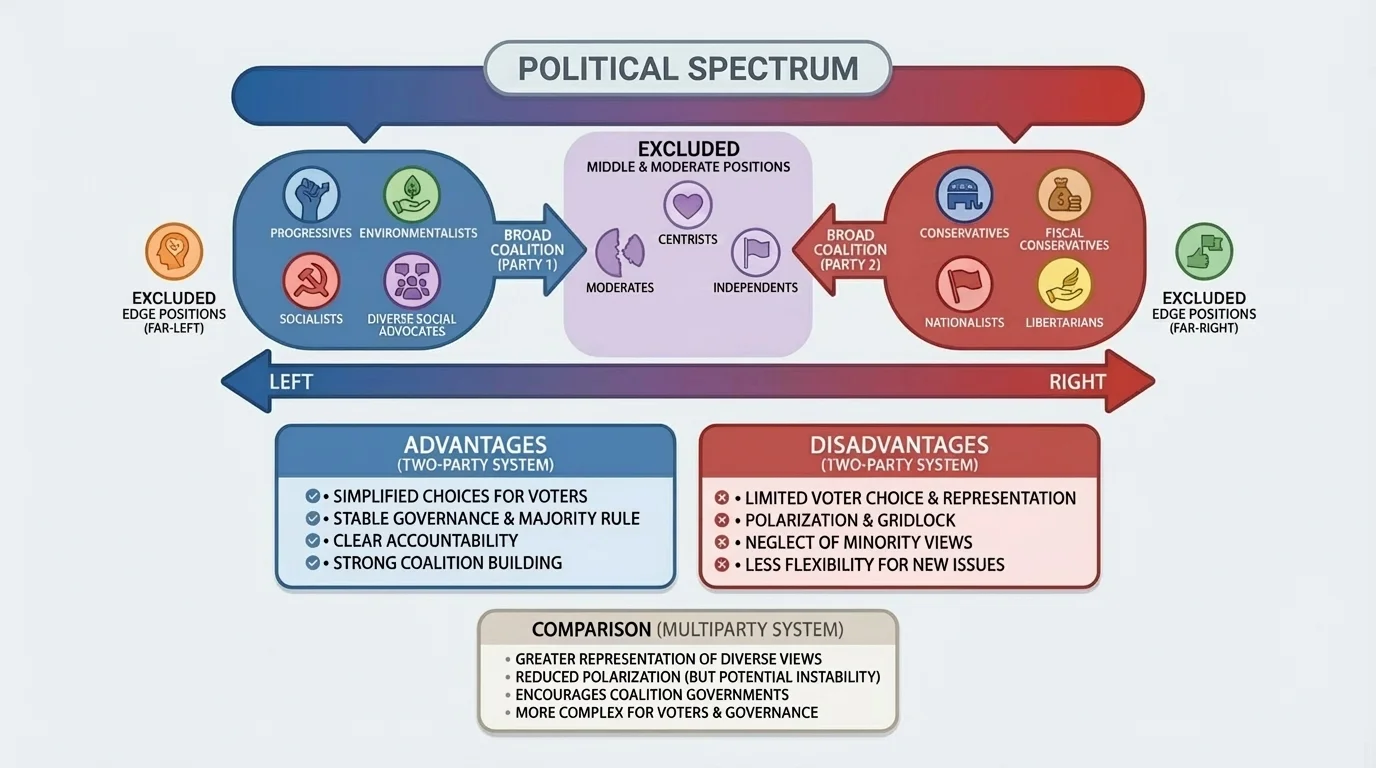
Supporters of a two-party system argue that it provides stability and clarity. Because two major parties compete for broad support across society, they often build large coalitions of voters with different priorities, as [Figure 2] illustrates. That can force parties to moderate their positions in order to appeal to the center as well as to their core supporters.
A two-party system can make elections easier for voters to understand. Instead of choosing from a long list of parties with overlapping positions, citizens often face a more direct contest. This simplicity may encourage participation among voters who do not closely follow politics.
Another advantage is easier governing. If one of the two main parties wins control of the legislature and executive branch, it may be able to pass policies more efficiently. Responsibility is also easier to assign. If the government succeeds, voters know whom to reward. If it fails, voters know whom to replace.
Supporters also claim that two-party competition can reduce legislative fragmentation. When lawmakers are organized into two main blocs, bargaining may be more predictable. Governments may last longer because they do not depend on fragile coalitions among multiple parties.
The same features that create stability can also create exclusion. A two-party system may force many citizens into broad camps that do not fully reflect their views. A voter may agree with one party on economics but with the other on social issues and feel genuinely unrepresented.
Smaller viewpoints can be squeezed out, especially when broad coalitions absorb many interests but still prioritize only the most politically useful ones. As shown in [Figure 2], many groups may be pushed into just two large alliances, even when their beliefs differ sharply from one another.
Another disadvantage is polarization, the widening distance and hostility between major political camps. In a strongly divided two-party system, compromise may become harder because each party treats the other not as a rival with different ideas, but as an enemy to defeat. This can make institutions less effective even if only two parties dominate them.
Two-party systems can also encourage strategic voting. Instead of voting for the candidate or party they truly prefer, people may vote for the "lesser of two evils" or the candidate they think can actually win. Over time, that may weaken public trust and discourage innovation in policy ideas.
Third, barriers to entry are often high. New parties may struggle to gain media attention, fundraising support, debate access, and ballot access. As a result, the system can become resistant to change, even when many citizens want new approaches to major issues.
Case study: The United States
The United States is often described as a two-party democracy, but that label hides a lot of complexity.
Step 1: National elections strongly favor the Democratic and Republican parties because of single-member districts and plurality voting.
Step 2: Third parties often influence the conversation by raising issues such as environmental reform, budget policy, or ballot access, even when they do not win many offices.
Step 3: Many conflicts that might create separate parties in other countries are instead fought inside the two major parties through primaries, conventions, and factional debates.
This means citizen participation often changes policy by reshaping major parties rather than by building successful new national parties.
That point is important: in a two-party system, activism often works through internal party pressure. Protest movements, youth organizing, labor groups, business associations, and civil rights campaigns may try to influence one or both major parties rather than replace them.
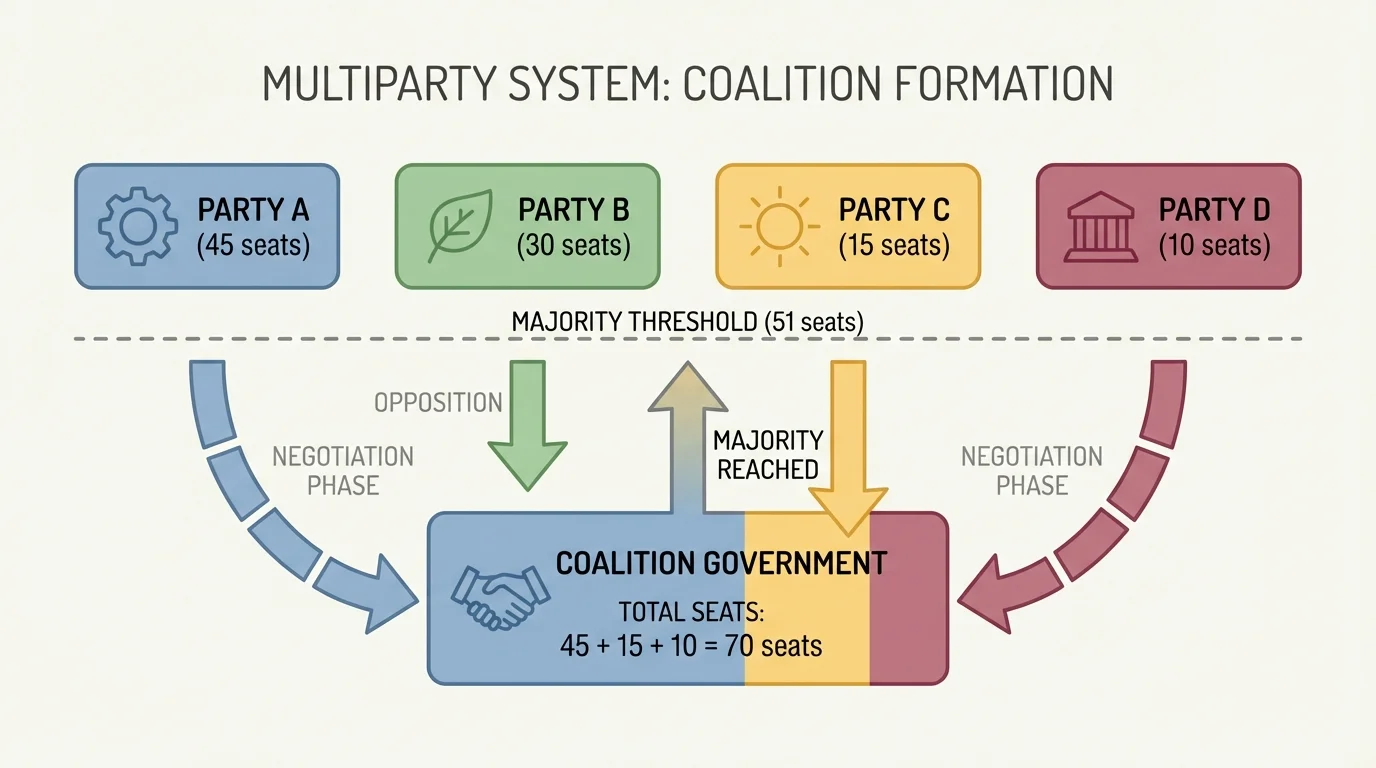
Supporters of a multiparty system argue that it offers broader and more accurate representation. Several parties can speak for different ideologies, regions, ethnic groups, religious communities, or policy priorities. After elections, these parties may negotiate to govern together, as [Figure 3] illustrates through coalition formation.
This can give voters more meaningful choices. Instead of selecting between two broad umbrellas, they may choose a party closer to their actual beliefs. A labor-focused party, a green party, a conservative party, a liberal party, or a regional autonomy party may all compete separately.
Multiparty systems can also promote compromise in a different way. Since no single party may control government alone, parties often must bargain and cooperate. This can encourage negotiation and coalition-building rather than simple winner-versus-loser politics.
Another advantage is that new ideas may enter the political system more easily. If citizens care intensely about climate policy, anti-corruption reforms, farmer rights, or digital privacy, a new party may gain seats and push established parties to respond. This can make the system more flexible and more responsive to changing public concerns.
Multiparty systems may also lower the pressure for strategic voting. Voters can support a party they genuinely prefer without always fearing that the vote will be wasted. This may strengthen political participation by making citizens feel that their views have a direct channel into government.
However, broader representation can come with costs. One major challenge is instability. If no party wins a majority, coalition governments may be difficult to build and easy to break. A small dispute over budgets, taxes, foreign policy, or leadership can cause the governing alliance to collapse.
When coalitions are fragile, policymaking may slow down. Laws can take longer to pass because several parties must agree. In a crisis, that delay may frustrate voters who want quick action. In some countries, repeated coalition failures lead to early elections, creating uncertainty.
Another criticism is that small parties may gain disproportionate influence. If a coalition needs just a few extra seats to reach a majority, a small party may demand major policy concessions in exchange for support. Critics argue that this can give too much power to parties backed by a relatively small share of voters.
Multiparty politics can also be confusing. More parties mean more platforms, more negotiations, and more combinations of possible governments. Voters may not know exactly what coalition will emerge after the election. A citizen may vote for one party and then see it join with another party it criticized during the campaign.
Germany combines multiparty competition with institutional safeguards such as a minimum vote threshold for representation. That rule is designed to allow pluralism while limiting extreme fragmentation.
So while a multiparty system can represent society more fully, it can also make government more complicated and less predictable.
Different democracies show that party systems are shaped by rules and history together. The United States has a strong two-party pattern. The United Kingdom is often described as mostly two-party at the national level, but regional and smaller parties can still matter. Germany has a stable multiparty system with frequent coalition governments. Israel has many parties and often complex coalition negotiations. India has national parties plus influential regional parties, making it a rich example of democratic diversity.
| Country | Usual party pattern | Common effect on government |
|---|---|---|
| United States | Two major parties dominate | Clear accountability, but limited third-party success |
| United Kingdom | Two large parties with smaller influential parties | Often stable government, but regional variation matters |
| Germany | Multiparty with coalition tradition | Broad representation with negotiated governing alliances |
| Israel | Highly multiparty | Wide representation, but coalition instability can be high |
| India | Multiparty with strong regional parties | Diverse representation across a large, varied society |
Table 1. Comparison of party patterns and common governing effects in selected democracies.
These examples show that no system produces exactly the same result everywhere. A multiparty system in one country may be quite stable if parties are used to coalition bargaining. A two-party system in another country may still become highly polarized and difficult to govern.
The impact of party systems becomes clearest when we look at civic participation. Citizens do not simply observe party systems; they shape them. In a two-party system, participation often takes the form of primary voting, campaigning inside major parties, lobbying officeholders, or building movements that pressure major parties to adopt new policies. In a multiparty system, citizens may instead help create, strengthen, or expand smaller parties that directly represent their concerns.
This affects public policy, meaning the laws, decisions, and government actions that address public problems. For example, a strong environmental movement in a multiparty democracy may help a green party enter parliament and influence climate legislation. In a two-party system, the same movement may try to push one major party to add stronger environmental proposals to its platform.
Civic participation also affects political institutions. When citizens vote in high numbers, join organizations, contact representatives, and engage in informed debate, they can pressure institutions to become more responsive. If participation declines, party leaders and organized elites may gain more influence relative to ordinary voters.
Participation changes institutions from the inside and outside
Inside institutions, citizens influence candidate selection, party platforms, and legislative priorities. Outside institutions, protests, media campaigns, petitions, and social movements can shift what issues government must address. Whether the system is two-party or multiparty, active citizenship remains essential to democratic accountability.
Consider civil rights movements, youth voting drives, labor mobilization, and anti-corruption campaigns. These efforts often do not begin as party projects. Yet they can reshape party agendas, alter election results, and lead to institutional reforms such as voting-rights protections, transparency laws, or new campaign regulations.
Party systems therefore affect how demands enter government, but participation determines which demands become too powerful to ignore. That is why evaluating a party system requires more than counting parties. It requires asking: Who can organize? Who can be heard? Who can realistically turn ideas into law?
There is no perfect answer that fits every democracy. A two-party system may work well when a country values stable governments, broad coalitions, and straightforward accountability. A multiparty system may work well when a country wants to reflect many identities and viewpoints in government and is willing to accept more negotiation.
The strongest evaluation depends on democratic goals. If the top priority is efficient governing, some may prefer a two-party structure. If the top priority is representation of diverse beliefs, some may prefer multiparty competition. Most democracies try to balance both values, even though the balance is difficult.
Institutional design matters greatly. Election rules, constitutional protections, federalism, legislative procedures, and political culture all influence whether a party system functions well. A two-party system without compromise can become gridlocked. A multiparty system without stable coalition norms can become chaotic.
"Democracy is not just the counting of votes, but the making of citizens."
— A civic principle reflected in democratic theory
Ultimately, the health of a democratic government depends not only on how many parties compete, but also on whether citizens participate, whether institutions remain fair, and whether political leaders respond to public needs. A democracy with active, informed citizens can pressure either kind of party system to become more accountable. A democracy with weak participation may struggle under either model.
