Have you ever wondered if a child far away gets ready for the day the same way you do? Some children ride to school, some walk, and some learn very close to home. Children in many places can be alike in big ways and different in interesting ways too.
A community is a place where people live, work, and help one another. A community can be a neighborhood, a town, a city, or a village. Students live in many kinds of communities.
Children in different communities are people too, with feelings, families, and needs. They need food, water, shelter, love, and care. They also learn, play, rest, and grow.
Similar means things are alike in some way. Different means things are not the same. Environment means the land, water, weather, plants, and animals in a place.
Even when children live far apart, they may still enjoy stories, games, songs, and time with people they love. Looking for both similarities and differences helps us understand the world better.
Many students wake up, get dressed, eat food, and spend time learning. They may have teachers, family members, or other grown-ups who help them. They may draw, sing, count, listen, and play with friends.
Students in one place may live in houses, and students in another place may also live in houses or apartments. They may eat different foods, but everyone needs healthy meals. They may speak different languages, but they all use words, sounds, signs, or pictures to communicate.
Many children help at home too. One child may feed a pet. Another may help carry groceries. Another may help put toys away. These jobs can be different, but helping is something many children do.
Children around the world often play games, but the games are not always the same. Some kick balls, some jump rope, and some play chasing games with different names.
It is important to remember that children in other communities are not completely different from us. They laugh, learn new things, solve problems, and care about people just as we do.
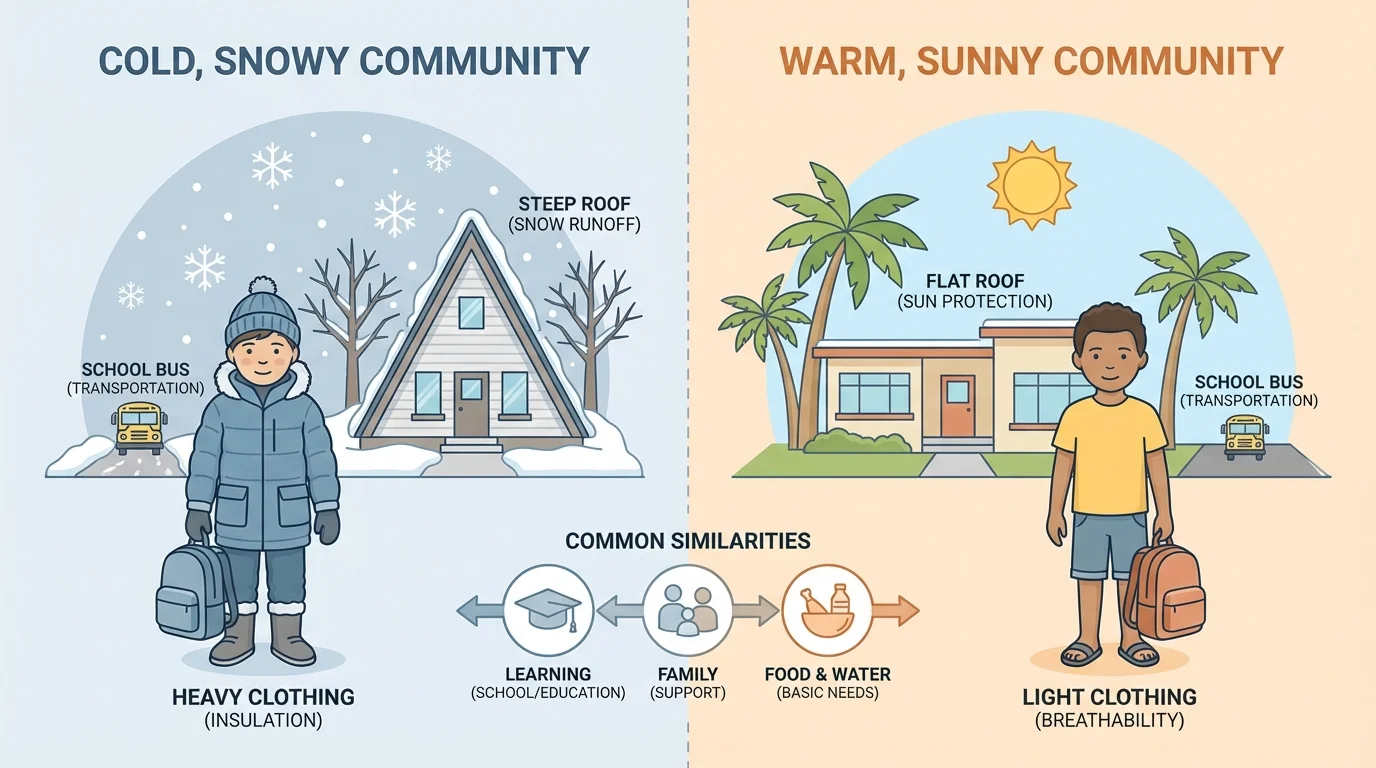
The weather in a place can change what students wear and how they travel. In a cold place, children may wear coats, hats, and boots. In a hot place, children may wear light clothes to stay cool.
Homes can look different too, as shown in [Figure 1]. In rainy or snowy places, some roofs are shaped so rain or snow can slide off. In warm places, homes may have big windows or open spaces to let air move through.
Students also travel in different ways. Some walk on sidewalks. Some ride in cars or buses. Some may travel by boat if they live near water. Others may ride bicycles on roads or paths.
Daily routines can be different. A child in a busy city may hear cars and sirens. A child in the countryside may hear birds, cows, or tractors. One child may live close to many tall buildings, while another lives near fields or forests.
Food can be different from place to place. One student may eat rice, another may eat bread, and another may eat corn or fish. The foods may change, but all children need nourishment to grow.
The environment includes the land, water, plants, animals, and weather in a place. It affects how people live. People make choices that fit the place where they live.
In a place with lots of water, people may fish, use boats, or build near rivers, lakes, or oceans, as shown in [Figure 2]. In a dry place, people may save water carefully. In a cold place, people may need warm clothes and warm homes. In a hot place, people may rest in shade and drink plenty of water.
In farming areas, families may live near fields and animals. Some students might see tractors and barns often. In large cities, families may live near stores, schools, buses, and many neighbors. There may be tall buildings and busy streets.
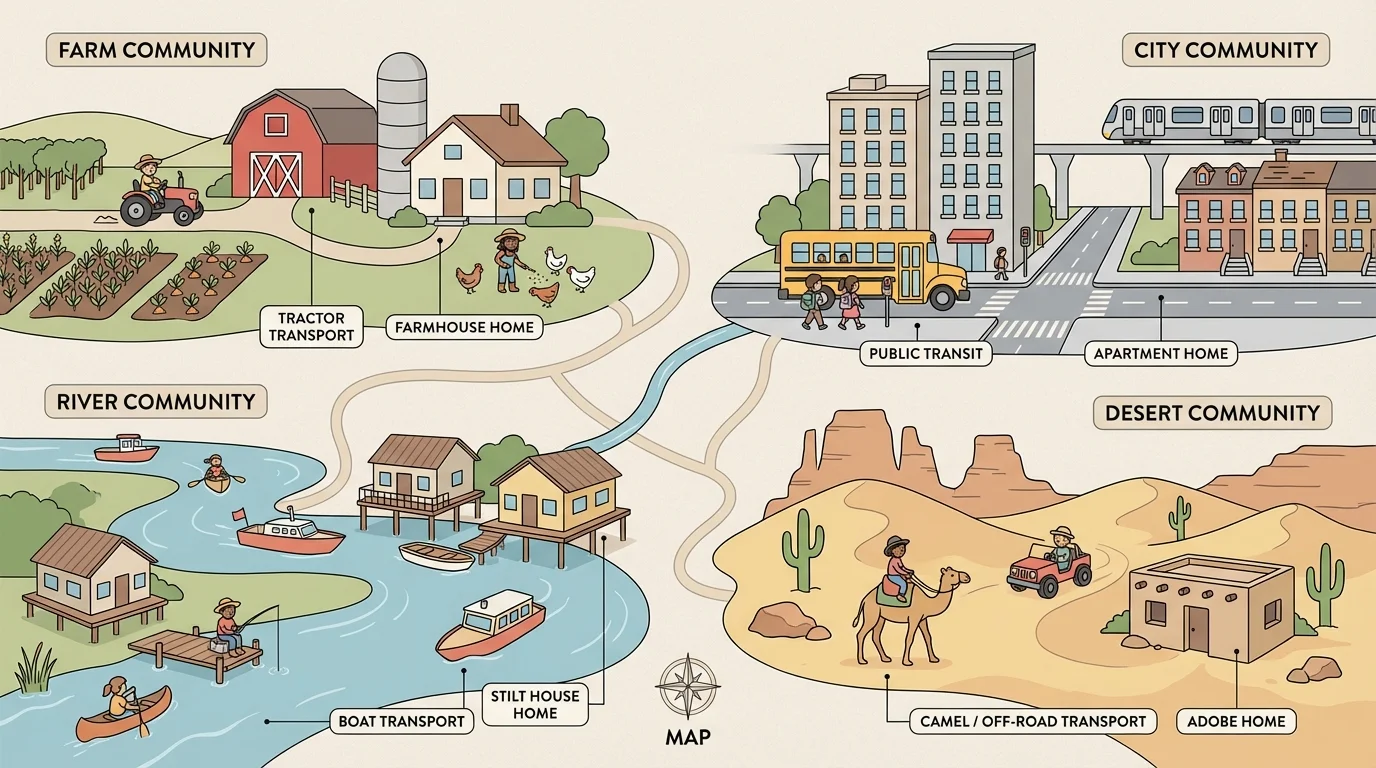
Children who live near mountains, deserts, beaches, forests, or plains may each have different experiences. Their clothing, homes, jobs in the community, and ways to travel may connect to the place around them.
We can think back to [Figure 1] and notice that weather helps explain why children dress differently. We can also use [Figure 2] to see that water, roads, farms, and buildings can shape everyday life in a community.
Place shapes life
Where people live helps decide many parts of daily life. The environment does not make everyone the same, but it often affects homes, clothing, transportation, food, and work in the community.
Different places do not mean better or worse places. They are simply different settings where people meet their needs in ways that work for them.
When we learn about other communities, we should be respectful. If another student's home, clothes, food, or school looks different, that difference is something to learn about, not something to make fun of.
Children can ask caring questions and listen closely. We can notice what is similar and what is different. We can say, "We both learn and play," and also say, "Our communities are not exactly the same."
Comparing two students
Let's compare Maya and Leo.
Step 1: Look for what is the same.
Maya and Leo both have families, eat meals, and learn new things.
Step 2: Look for what is different.
Maya lives in a city apartment and rides a bus. Leo lives near farms and rides in a car.
Step 3: Think about why.
Their communities are different, so their daily lives are different in some ways.
Both children matter, and both communities help meet their needs.
Learning about other communities helps us understand the world. It helps us see that people can live in many ways and still share many important things.
