A few wolves return to a park, a small amount of fertilizer washes into a pond, or a dry season lasts a little longer than usual. Those sound like minor changes. Yet in nature, they can trigger major shifts: plant communities can recover or collapse, fish can disappear, insect numbers can explode, and entire habitats can look different within a few years. Ecosystems are full of connected parts, so a change in one place does not always stay small.
A system is a group of parts that interact with one another. A school, a city bus network, and your body are all systems. An ecosystem is also a system. It includes organisms, their surroundings, and all the interactions among them. When one part changes, the effects can spread because the parts are linked.
These links often create cause-and-effect chains. If a plant population drops, the animals that eat those plants may also drop. If predators decline, their prey may increase. If too much sediment enters a stream, sunlight may not reach underwater plants, and that can affect insects, fish, and birds. A system can be sensitive because each part depends on other parts.
Connected parts can amplify change
In many systems, a small shift gets multiplied as it moves through the network. This is sometimes called a ripple effect. The original change may be small, but each response can trigger another response. That is why scientists look at whole systems, not just one organism at a time.
Some ecosystem changes are easy to notice right away, but others build up slowly. A lake may receive a little extra fertilizer runoff each week. At first, the change seems tiny. Over time, though, nutrients build up, algae grow faster, oxygen levels fall, and fish populations may shrink. Slow changes can lead to fast results.
[Figure 1] An ecosystem contains living parts, called biotic factors, and nonliving parts, called abiotic factors. Biotic factors include plants, animals, fungi, and bacteria. Abiotic factors include sunlight, water, soil, temperature, air, and minerals. These parts are not separate lists; they are connected in a working system.
For example, grass depends on sunlight, water, and nutrients in soil. Rabbits depend on grass. Foxes may depend on rabbits. Decomposers such as fungi and bacteria break down dead matter and return nutrients to the soil, helping plants grow again. If rainfall decreases even a little during a key season, plant growth may slow, which can affect herbivores and then predators.
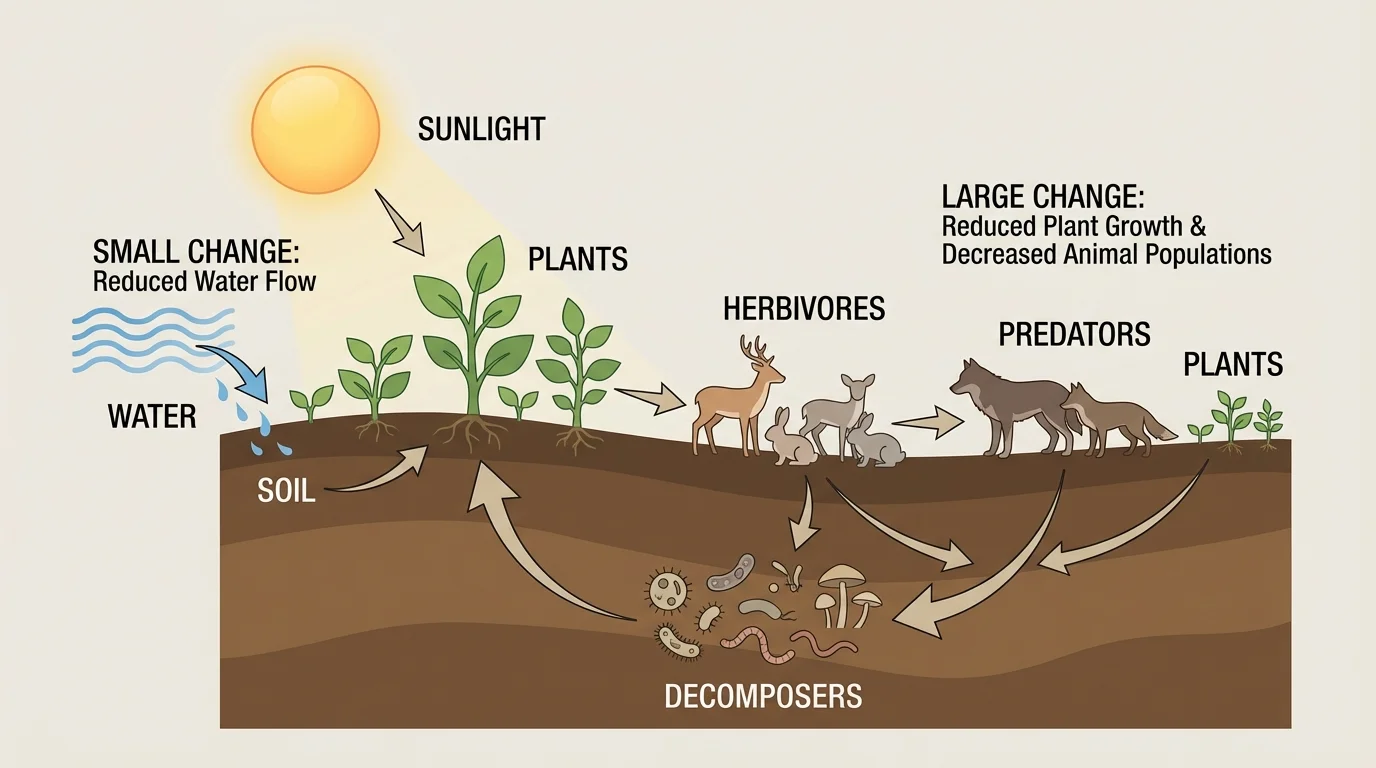
Scientists often study populations, which are groups of the same species living in one area. A change in the ecosystem does not affect every population in the same way. A drought might hurt frogs because their eggs need water, but it might help some insects that do better in warmer, drier conditions. The same environmental change can create winners and losers.
Ecosystem is a community of living things and the nonliving environment they interact with.
Population is all the members of one species living in the same area.
Abiotic factor means a nonliving part of an ecosystem, such as water, temperature, or sunlight.
Biotic factor means a living part of an ecosystem, such as plants, animals, fungi, or bacteria.
One reason small changes matter is that many organisms already live close to their limits. A slight drop in temperature, a little less oxygen in water, or a small reduction in food can lower survival or reproduction. When reproduction changes, populations can change quickly because population size depends on births, deaths, immigration, and emigration.
[Figure 2] A food web is a network of feeding relationships, and it is one of the clearest ways to see how one change can spread through a system. In a pond, algae may be eaten by insect larvae, insect larvae may be eaten by small fish, and small fish may be eaten by larger fish or birds. If one part changes, many other parts may respond.
Suppose pollution kills some insect larvae. Small fish now have less food, so their numbers may drop. Larger fish and birds that eat those small fish may also drop. At the same time, the algae that insect larvae used to eat may increase. A change in one population has now led to changes in several other populations in different directions.
This kind of ripple effect can be seen in many habitats. The important idea is that feeding relationships are not simple straight lines. Most organisms have more than one food source and more than one predator, so ecosystem responses can be complex.
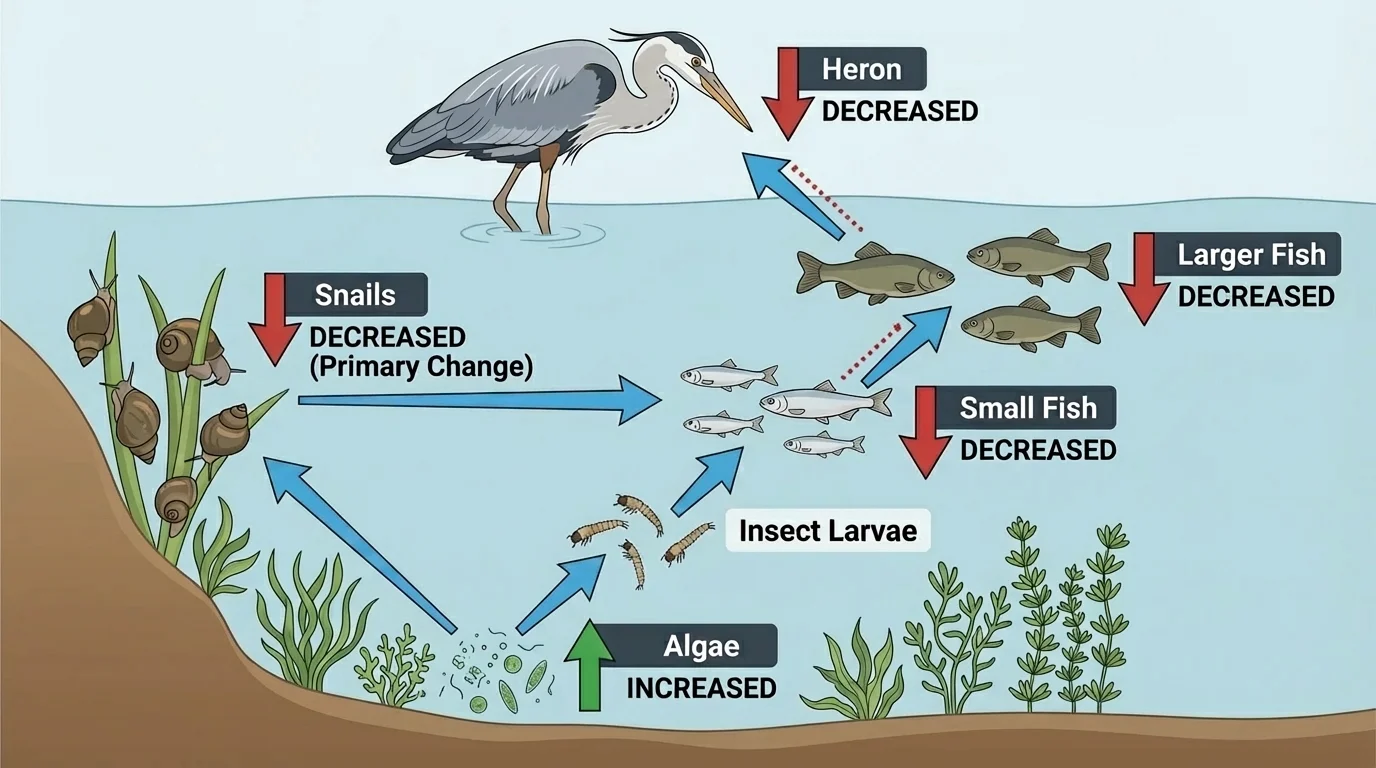
Food webs also explain why removing just one species can create surprises. If a top predator decreases, one prey species may increase a lot and consume more plants or smaller animals. Those changes can spread across the web. Later, we may see reduced biodiversity, more competition, or changes in habitat structure.
Sea stars on rocky shores were once removed in an experiment, and the number of mussels grew so much that many other species lost space to live. One predator had been helping keep the whole community balanced.
Notice that evidence matters. Scientists do not just guess that one change caused another. They compare areas, measure populations over time, and look for patterns that match a cause-and-effect explanation.
Physical components of ecosystems include temperature, rainfall, sunlight, water flow, soil type, and fire frequency. Even modest changes in these factors can alter habitats. A stream that warms by a few degrees may hold less dissolved oxygen, making it harder for some fish to survive. A shorter rainy season may reduce seed germination, which then lowers food for herbivores.
Wildfire is another example. Fire can destroy some habitats, but in certain ecosystems it also clears dead material, returns nutrients to soil, and opens space for new growth. The effect depends on the species involved and the size, timing, and frequency of the fire. A small change in how often fires happen can favor one set of plants over another.
Human-caused habitat loss often begins with what seems like a limited disturbance. Building one road through a forest may split habitat into smaller pieces. Some animals then struggle to find mates, food, or safe nesting areas. Predators may gain easier access to edges, and invasive species may enter. The original change was local, but population effects can spread far beyond the road itself.
Not all important changes are physical. A new species entering an area can transform the system. An invasive species is a species that spreads in a new environment and causes harm there. It may compete with native species, eat them, bring disease, or change the habitat.
For example, zebra mussels introduced into North American waterways reproduced rapidly and filtered huge amounts of water. That changed water clarity, nutrient movement, and food availability for other organisms. One biological change affected many populations and even changed how people used the water.
Disease can also produce large ecosystem effects. If a disease sharply reduces bats, more insects may survive. That can affect crops, forests, and even human comfort. If a disease hits coral, reef ecosystems can lose structure, and fish populations may decline because they lose shelter.
Case study: Pollinators and flowering plants
Many plants depend on insects such as bees for pollination.
Step 1: A small decline in bee numbers means fewer flowers are pollinated.
Step 2: Fewer pollinated flowers means fewer seeds and fruits are produced.
Step 3: Animals that eat those fruits or seeds may have less food.
Step 4: In later seasons, fewer new plants may grow, changing the habitat further.
A modest biological change can therefore affect plant reproduction, food supply, and future population sizes.
These examples show that ecosystem parts are not interchangeable. Some species perform ecological roles that many other species cannot easily replace.
[Figure 3] One of the most powerful examples of small change causing large effects is a trophic cascade. This happens when changes at one feeding level, especially among predators, cause a chain of effects across lower levels. It shows a famous case involving wolves, elk, and plants.
In Yellowstone National Park, wolves were removed long ago and later reintroduced. Without wolves, elk numbers and browsing pressure were high in some areas. Young willow and aspen plants were eaten heavily. After wolves returned, elk behavior and numbers changed in some places. More woody plants survived, and species such as beavers benefited because they use those plants for food and building material.
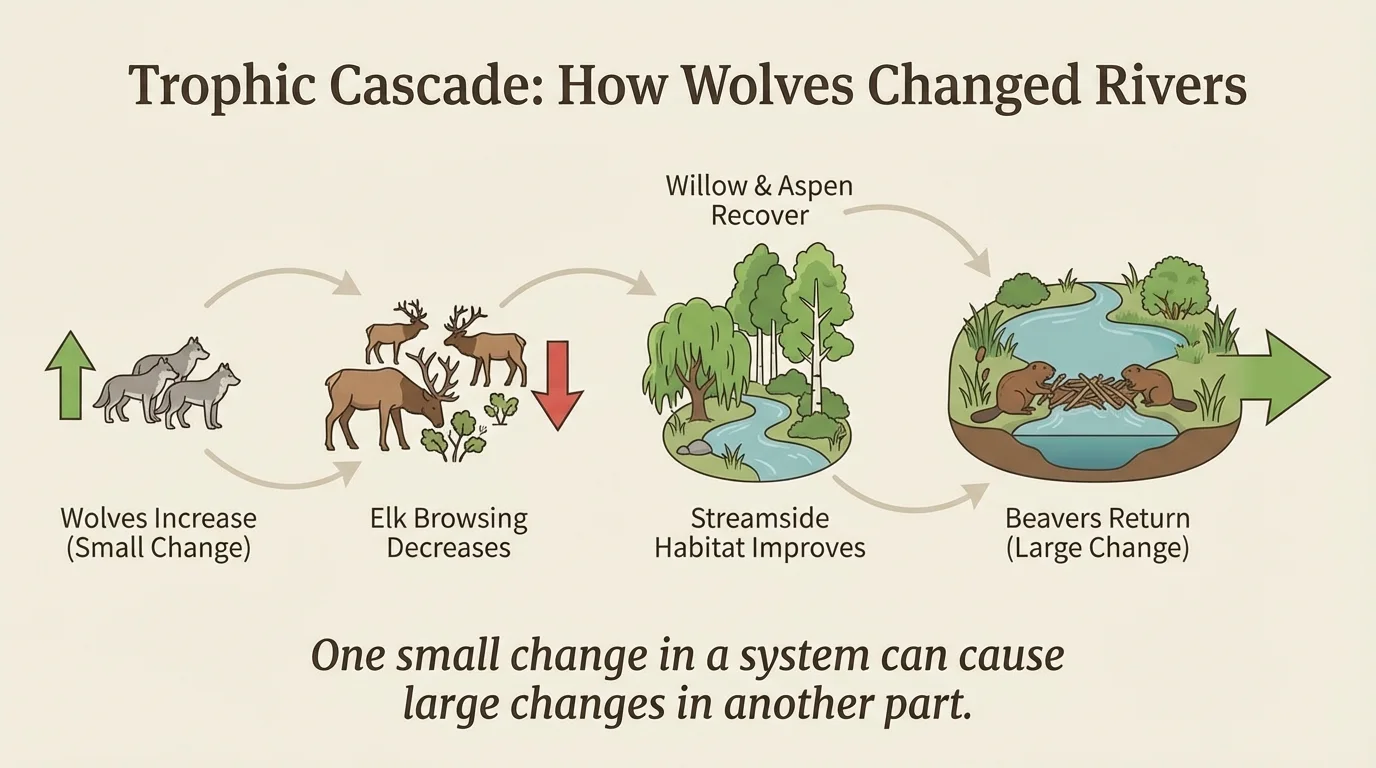
This example does not mean wolves magically fix every problem. Ecosystems are more complicated than a single chain. Weather, human activity, and other species also matter. Still, the Yellowstone case provides strong evidence that one predator can have a much larger effect than its population size alone might suggest.
Species with especially large effects are often called keystone species. Like the center stone in an arch, they help hold the system together. Sea otters are another example. Where otters keep sea urchin populations lower, kelp forests can thrive. Where otters decline, urchins may overgraze kelp, and many fish and invertebrates lose habitat. Later, when kelp forests are discussed again, this same idea still helps us remember that one top-level change can reshape many lower levels.
"Everything is connected to everything else."
— A guiding idea in ecology
When students hear that ecosystems are connected, this is what ecologists mean. Connections are not just interesting details; they explain why prediction and management can be difficult.
Changes spread through ecosystems partly because energy flow is limited. Producers such as plants and algae capture energy from sunlight. Herbivores get energy by eating producers. Carnivores get energy by eating other animals. Decomposers break down dead material and recycle matter, but energy still moves through the system and is gradually lost as heat at each transfer.
Because less energy is available at higher feeding levels, top predators usually exist in smaller numbers than producers. That means a small loss of producers can eventually affect all higher levels. If drought reduces plant growth, herbivores may have less food, and predators may later decline as well. Small changes at the bottom of the system can spread upward.
Energy limits also explain why ecosystems cannot support unlimited population growth. If one prey population increases for a short time, predator numbers may rise later, but only if enough energy and habitat are available. Resource limits are one reason populations often rise and fall rather than growing forever.
Organisms need both matter and energy. Matter such as water, carbon, and nutrients is recycled in ecosystems, while energy mainly enters from sunlight and moves through food chains and food webs.
This is why removing plants, changing water quality, or reducing sunlight with heavy sediment can matter so much. These changes affect the source of energy entering the living part of the system.
Some ecosystems are fairly stable, meaning they can handle small disturbances without changing too much. Others are less stable. [Figure 4] compares two states of a lake to show how a system can cross a boundary. A tipping point is a threshold where a small additional change causes a much larger shift in the whole system.
Consider a lake receiving nutrients from fertilizer runoff. At first, the lake may remain clear because plants and microorganisms use the nutrients. But if nutrient levels keep rising, algae may suddenly grow very fast. The water becomes cloudy, sunlight cannot reach deeper plants, oxygen levels may fall, and fish populations can decline. The lake has shifted into a different state.
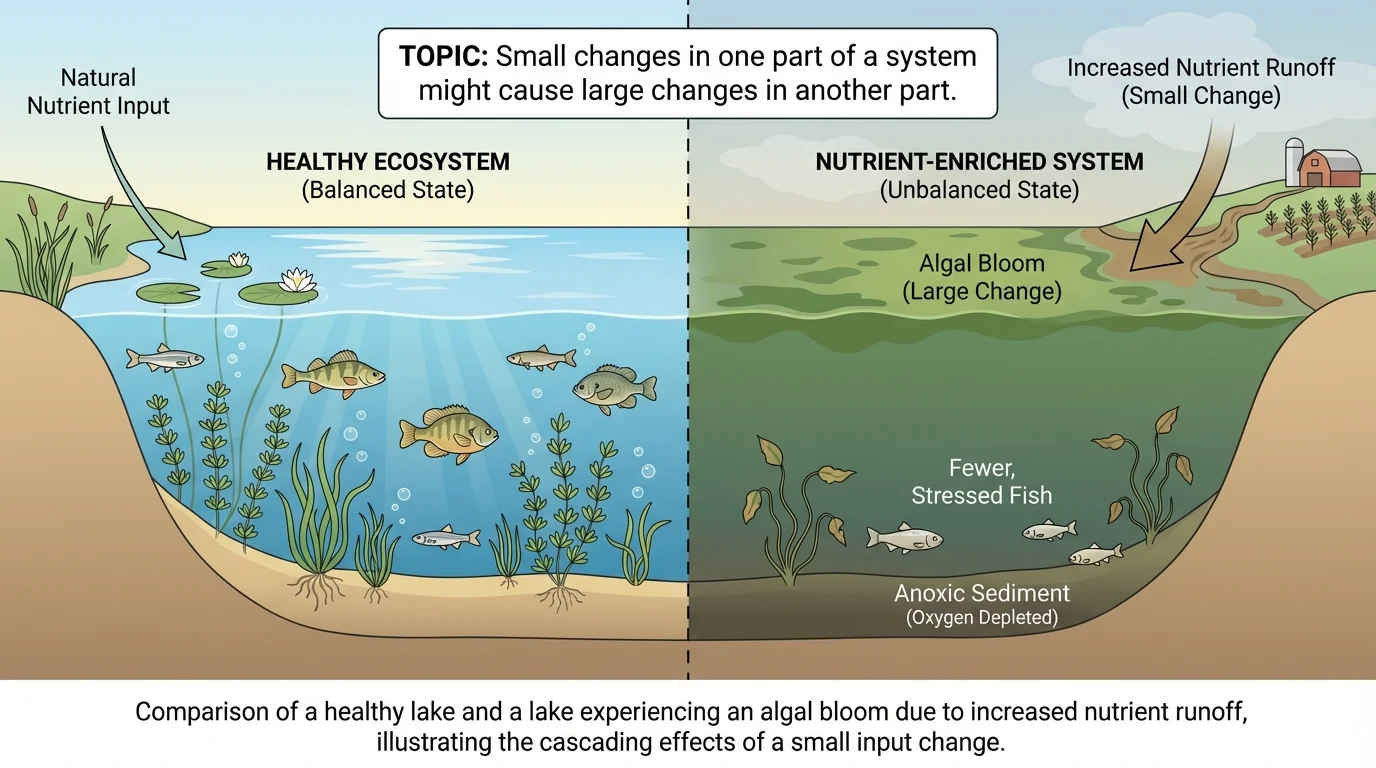
This change can be hard to reverse. Even if nutrient input drops later, the lake may not quickly return to its old condition. That is why prevention matters. Once a system crosses a tipping point, recovery may take a long time or may require major intervention.
Resilience is the ability of an ecosystem to recover after disturbance. Diverse ecosystems often have greater resilience because if one species declines, another may partly fill a similar role. But resilience has limits. If too many linked parts are damaged at once, the system may reorganize in a new way.
| Change | Small initial effect | Possible larger system effect |
|---|---|---|
| Less rainfall | Reduced plant growth | Lower herbivore and predator populations |
| Predator removal | More prey survive | Overgrazing or decline of plants |
| Nutrient runoff | More algae growth | Low oxygen and fish deaths |
| Invasive species arrival | New competitor or predator | Native population decline and habitat change |
Table 1. Examples of small ecosystem changes that can lead to larger population effects.
Notice that all four examples in the table begin with one change, but the outcomes spread through several connected parts of the ecosystem.
People are now one of the biggest sources of ecosystem change. Cutting forests, adding dams, releasing pollution, changing climate, and moving species from one place to another can all alter population sizes. Sometimes these actions are accidental. Sometimes they are done on purpose to manage ecosystems. In both cases, understanding system connections is essential.
Fertilizer runoff into water is a strong real-world example. Fertilizers contain nutrients that plants need, but when too much enters ponds, lakes, or coastal waters, algal blooms can form. Some algae produce toxins, and many blooms reduce oxygen as dead algae decompose. Fish, shellfish, and other organisms may die or move away. A small chemical change in water can become a biological crisis.
Another example involves pollinators in farms and wild habitats. A modest drop in insect populations can reduce pollination, crop yields, and seed production in wild plants. That affects food webs and even human food supplies. Ecosystem changes are not separate from human life; they often return to affect us directly.
Why management is difficult
When people try to fix one problem, they may accidentally create another because ecosystems contain feedback loops and hidden connections. Good decisions depend on evidence, long-term monitoring, and understanding the whole system rather than focusing on one species in isolation.
That is why ecologists often ask not only, "What changed?" but also, "What else depends on it?" and "What might change next?"
To argue that one ecosystem change caused another, scientists gather empirical evidence. That means evidence based on observations and measurements. They may count organisms, test water quality, compare sites, or track changes across time.
Suppose scientists think lower oxygen in a pond caused fish numbers to fall. They might measure oxygen over several weeks, compare fish counts before and after the drop, and check whether algae increased at the same time. If the pattern repeats in more than one place, the argument becomes stronger.
Building a scientific argument
Claim: Extra nutrients changed a pond ecosystem and reduced fish populations.
Step 1: Collect observations. Water tests show increased nitrate and phosphate levels after heavy rain washed fertilizer into the pond.
Step 2: Measure biological change. Algae cover increases, and fish counts decrease over the next several weeks.
Step 3: Connect cause and effect. More nutrients support more algae. When algae die and decompose, decomposers use oxygen, so dissolved oxygen drops.
Step 4: Support the claim. Low oxygen is known to stress or kill many fish, so the evidence supports the argument that a physical change in water chemistry affected populations.
This is how ecologists move from observation to explanation.
Strong arguments usually include multiple kinds of evidence, not just one observation. Scientists also consider other possible causes and test whether the evidence fits them better or worse.
You can observe system change with a safe plant investigation. Grow similar seedlings in two containers with the same soil and light, but give one slightly less water over time. Measure leaf number, height, and soil moisture. The point is not to harm the plants badly, but to observe how a small abiotic change affects growth.
If the watered plant averages height values of \(12 \textrm{ cm}\) and the drier plant averages \(9 \textrm{ cm}\), the difference is \(12 - 9 = 3 \textrm{ cm}\). That simple comparison helps show how even a moderate change in one physical factor can alter a population trait such as average growth. In a real ecosystem, those growth differences might affect herbivores, competition, and reproduction.
Scientists often extend this kind of investigation by adding more replicates, measuring for longer periods, and tracking more variables. Even simple evidence can reveal the basic idea: systems are linked, so small changes can spread.
