Some businesses fail not because the idea is terrible, but because the plan is messy. A person might buy too many supplies, charge the wrong price, or try to serve everyone at once. The good news is that a small offline project or service does not need a giant business plan. If you want to sell baked treats at a community event, offer pet sitting in your neighborhood, wash cars on weekends, or create custom gift baskets for local customers, you can start with a simple plan that helps you make smart choices.
This kind of planning matters because real money, real time, and real trust are involved. When you plan well, you waste less, feel more confident, and look more professional. When you skip planning, you can end up losing money, forgetting important details, or disappointing customers. A basic plan helps you move from "I have an idea" to "I know what I'm offering, who it's for, what it costs, and how I'll tell people about it."
Audience analysis means figuring out who your customers are, what they need, and why they might choose your project or service. A minimum viable product, often shortened to MVP, is the simplest useful version of your idea that you can offer first. Budgeting means planning how much money you will spend and earn. Pricing is deciding how much to charge. Marketing is how you help people notice, understand, and trust what you offer.
A small offline project or service usually works best when it solves a clear problem. People pay for convenience, time savings, comfort, help, or a personal touch. That means your first question should not be "What seems appealing?" but "What do people around me actually need?"
An offline project happens in the real world, not only on a screen. That could be dog walking, car washing, lawn care, birthday card design for local pickup, tutoring younger students in your community, or assembling snack packs for events. Starting small lowers your risk. You do not need to rent a building or buy huge amounts of equipment. You can test your idea on a small scale first.
Starting small also makes it easier to learn. If your first version has only one service, one neighborhood, and one price, you can quickly see what works. If you start with five different services, three pricing options, and a lot of supplies, it becomes hard to tell what is helping and what is hurting your project.
Good beginner ideas usually have three qualities: they solve a real problem, they use skills or tools you already have, and they are safe and realistic for your age. A pet-walking service may be more realistic than opening a full catering business. A yard-help service may be easier to launch than building custom furniture.
Many successful businesses began by offering one very simple service to a small group of people first. Growth often comes after testing, not before.
Before choosing your idea, ask yourself a few practical questions. Can you actually do the work well? Do you have time after your online coursework and responsibilities at home? Will adults in your household support the plan? Do you need permission, transportation, or supplies? A smart idea is not just exciting. It is doable.
Your target audience is the specific group of people most likely to want your service. A broad idea becomes much more useful when you narrow it into one clear group. "People" is too wide. "Busy pet owners in my neighborhood" is much better. "Parents" is too wide. "Parents who want simple birthday treat bags for weekend parties" is more helpful.
Audience analysis starts with observation. As [Figure 1] shows, narrowing from a broad group to a specific customer group makes planning much easier. Who lives near you? What problems do they seem to have? What do they pay for already? If many families own dogs, pet-related services may work well. If your community has lots of older adults, maybe simple yard help or grocery carry-in assistance is more useful. If there are many young families, event favors or babysitting helper tasks might be in demand.
You should also think about what matters to that audience. Some customers care most about low price. Others care more about reliability, speed, friendliness, or quality. A customer hiring someone to water plants while they travel probably cares more about trust and consistency than getting the very cheapest price.
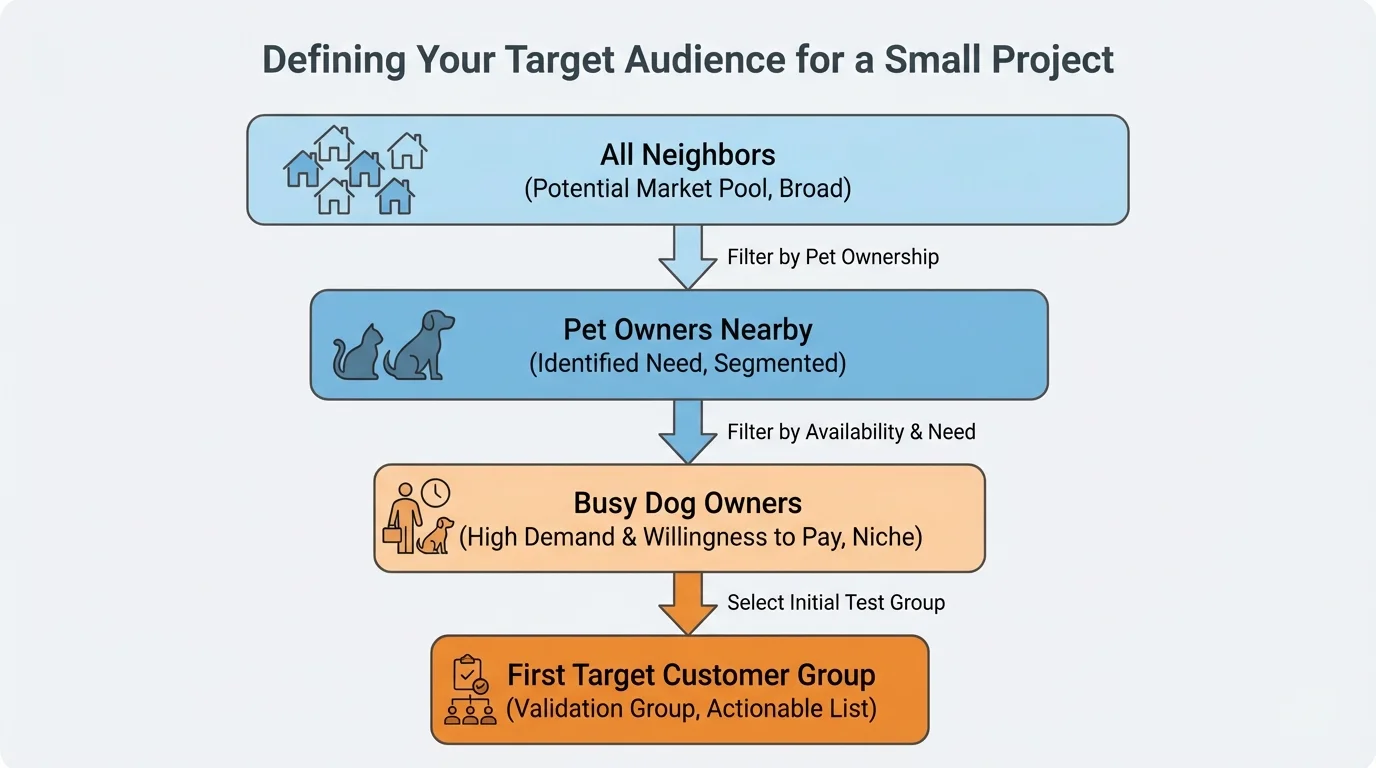
Try to answer these questions: Who is my customer? What problem do they have? When do they need help? How much can they probably pay? Where will I reach them? Why would they choose me instead of doing it themselves?
Here is a simple audience comparison table:
| Possible idea | Possible audience | Main need | What they may care about |
|---|---|---|---|
| Dog walking | Busy pet owners nearby | Help during work hours or trips | Trust, safety, reliability |
| Car washing | Neighbors with limited free time | Clean vehicle without doing it themselves | Price, convenience, quality |
| Gift baskets | People buying for birthdays or holidays | A ready-made thoughtful gift | Appearance, customization, speed |
| Yard watering | Families on vacation | Keep plants alive while away | Dependability, careful work |
Table 1. Examples of small offline ideas matched to likely audiences and their needs.
The better you understand your audience, the easier every other part of your plan becomes. Your MVP, budget, price, and marketing all depend on who you are trying to serve. This is why businesses that try to please everyone often end up connecting with no one.
A minimum viable product is the smallest useful version of your idea. In a service, that means the simplest package that still helps the customer. The goal is not to offer everything at once. The goal is to offer one clear thing well.
Suppose you want to start a pet-care service. As [Figure 2] illustrates, a too-big first version might include dog walking, overnight sitting, grooming, training, treats, and pet photography. That sounds impressive, but it is hard to manage. A simple MVP would be one dog-walking option for nearby customers, available on certain days, with a clear time length and price.
For a product, the same idea applies. If you want to sell handmade bracelets, your MVP might be three styles in two colors instead of twenty designs with full customization. If you want to make snack packs, your MVP might be one standard pack and one allergy-friendly option rather than a giant menu.
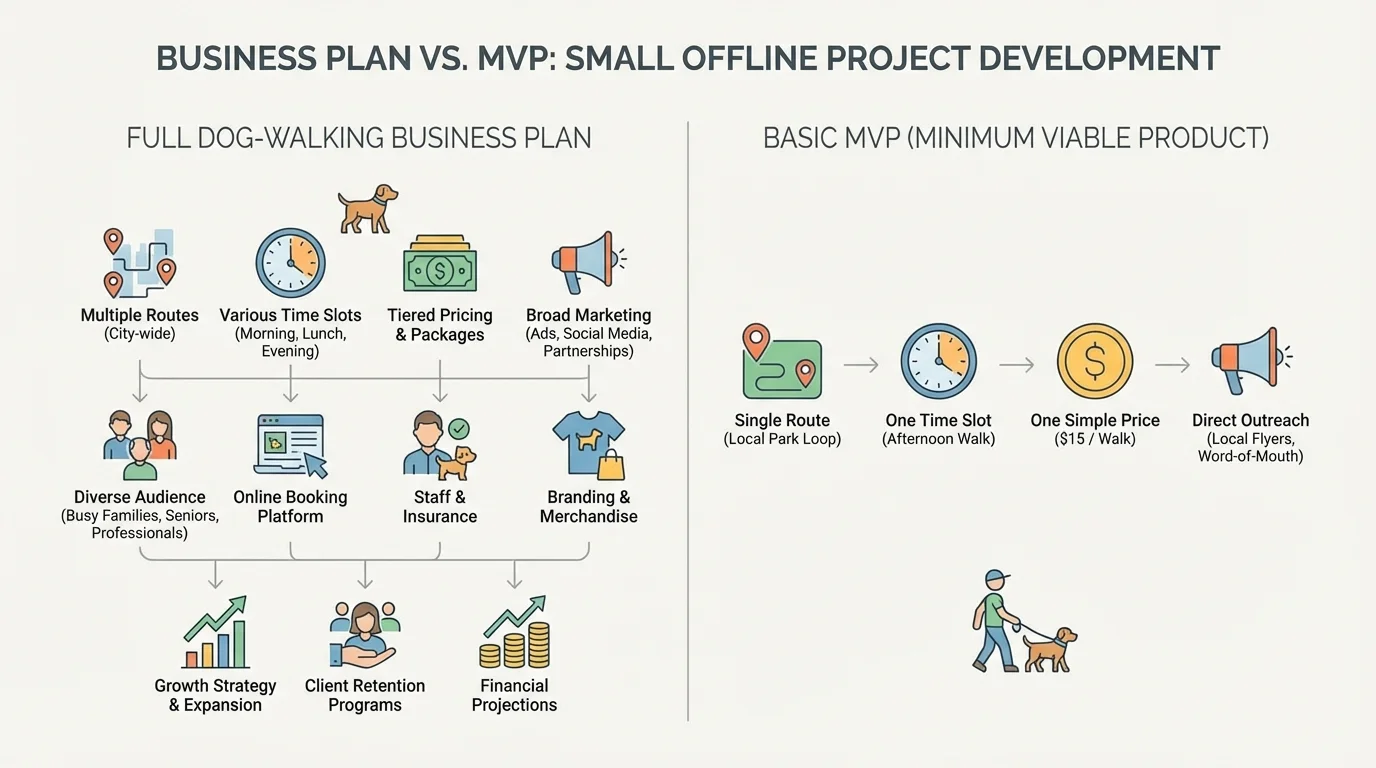
Your MVP should answer five things clearly: what it is, who it is for, what is included, what is not included, and how much it costs. Customers like clarity. Confusing offers make people hesitate.
A good first offer might sound like this: "Weekend dog walking for small and medium dogs in my neighborhood. One service package includes a 20-minute walk, water refill, and quick update message to the owner." That is simple, understandable, and realistic.
Less can be stronger at the beginning. A basic first version helps you test demand before spending too much money or time. If customers love the service, you can add extra options later. If they do not, you can adjust without losing much.
The MVP also protects you from a common beginner mistake: adding extras that customers never asked for. Fancy packaging, too many choices, or extra supplies can raise your costs without increasing sales. When you are starting, usefulness matters more than impressiveness.
As your audience feedback comes in, you can improve. The dog-walking service in [Figure 2] becomes stronger if customers later ask for evening times or longer walks. But first, the simple version lets you test the idea safely and clearly.
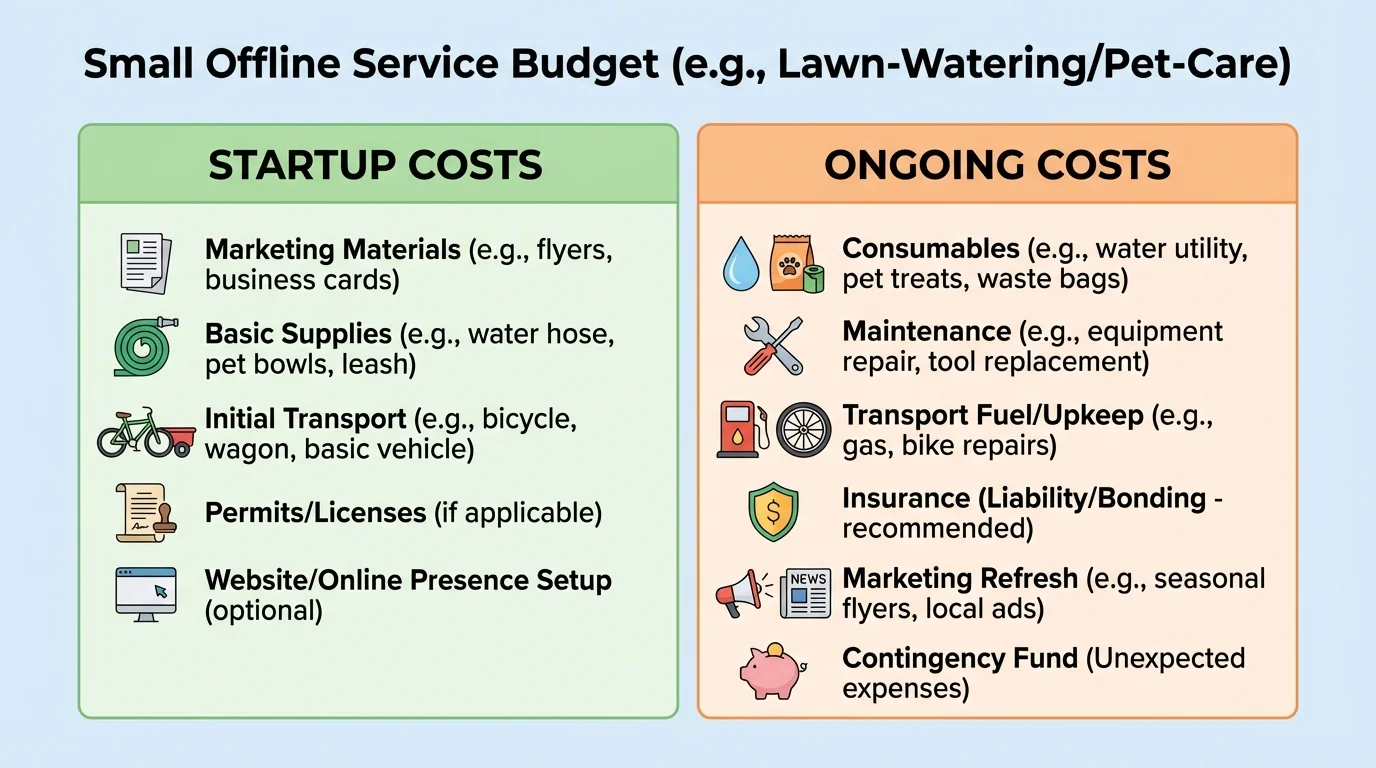
A startup costs budget helps you understand what you must spend before and during your project. In most small projects, costs fit into two groups: startup costs and ongoing costs. Startup costs happen once or mostly at the beginning. Ongoing costs keep happening as you continue.
Startup costs may include flyers, basic tools, containers, gloves, cleaning supplies, or ingredients for your first batch. As [Figure 3] shows, ongoing costs might include replacing materials, transportation, soap, tape, or more ingredients. If you ignore either category, your price may end up too low.
For example, suppose you want to start a simple car-washing service. Your budget might include a bucket for $8, soap for $6, sponges for $4, flyers for $10, and towels for $12. Your total startup cost is $40 because \(8 + 6 + 4 + 10 + 12 = 40\).
Now imagine each wash uses about $1 of soap and water supplies. If you also spend about $1 on transportation or other small expenses per customer, then your ongoing cost per wash is about $2 because \(1 + 1 = 2\).
Budget example for a weekend car-wash service
Step 1: Add startup costs.
Bucket $8, soap $6, sponges $4, flyers $10, towels $12.
\[8 + 6 + 4 + 10 + 12 = 40\]
Step 2: Estimate ongoing cost per car.
Soap and water supplies cost about $1 per car, and other small costs are about $1 per car.
\(1 + 1 = 2\)
Step 3: Estimate cost for the first 10 customers.
Ongoing costs for 10 cars are \(10 \times 2 = 20\).
Total cost after 10 customers is startup plus ongoing:
\[40 + 20 = 60\]
After serving the first 10 customers, you have spent about $60.
This matters because many beginners only think about supplies they buy first, not the money spent each time they serve a customer. That creates a problem: they feel busy, but their profits stay very small.
Budgeting also helps you decide whether your idea is realistic. If your startup cost is too high for what customers are likely to pay, your idea may need to be simplified. A smaller MVP usually means a lower-risk budget.
You do not need advanced math to make a useful budget. Basic addition, multiplication, and careful tracking are enough for a strong beginner plan.
Keep your budget written down. A note app, spreadsheet, or paper chart works. If you guess every time, it becomes harder to see whether you are actually earning money.
Break-even point means the moment when the money you earn matches the money you have spent. After that point, you begin making actual profit. This is one reason pricing matters so much. If your price is too low, you work hard without earning enough. If your price is too high, customers may walk away.
A simple way to think about price is to look at three things: your costs, what similar local services charge, and the value you provide. If your service is convenient, reliable, and well done, customers may be willing to pay more than the cheapest option.
Suppose your car-wash service costs about $2 per customer in ongoing expenses. If you charge $8 per wash, your rough profit per wash after ongoing costs is $6 because \(8 - 2 = 6\). Since your startup cost was $40, you would need about \(40 \div 6 \approx 6.67\) washes to cover that startup amount. Because you cannot sell part of a wash, you need 7 washes to pass break-even.
Pricing example using break-even thinking
Step 1: Find profit per customer.
Price is $8 and ongoing cost is $2.
\(8 - 2 = 6\)
Step 2: Divide startup cost by profit per customer.
Startup cost is $40.
\[40 \div 6 \approx 6.67\]
Step 3: Round up to the next whole customer.
You need 7 customers to move past break-even.
This tells you how long it may take before your project starts earning true profit.
Another example: if a snack pack costs $3 to make and you sell it for $5, your profit per pack is $2 because \(5 - 3 = 2\). If you spent $20 on labels and containers to get started, then \(20 \div 2 = 10\), so you need to sell 10 packs to cover startup costs.
Do not set a price based only on what feels nice. Be fair, but be realistic. Your time has value too. If a task takes a full hour and you barely earn anything after costs, the plan may not be worth continuing.
At the same time, price is not only about math. It is also about trust and quality. A slightly higher price can feel reasonable if customers understand what they are getting: careful work, clear communication, and dependable service.
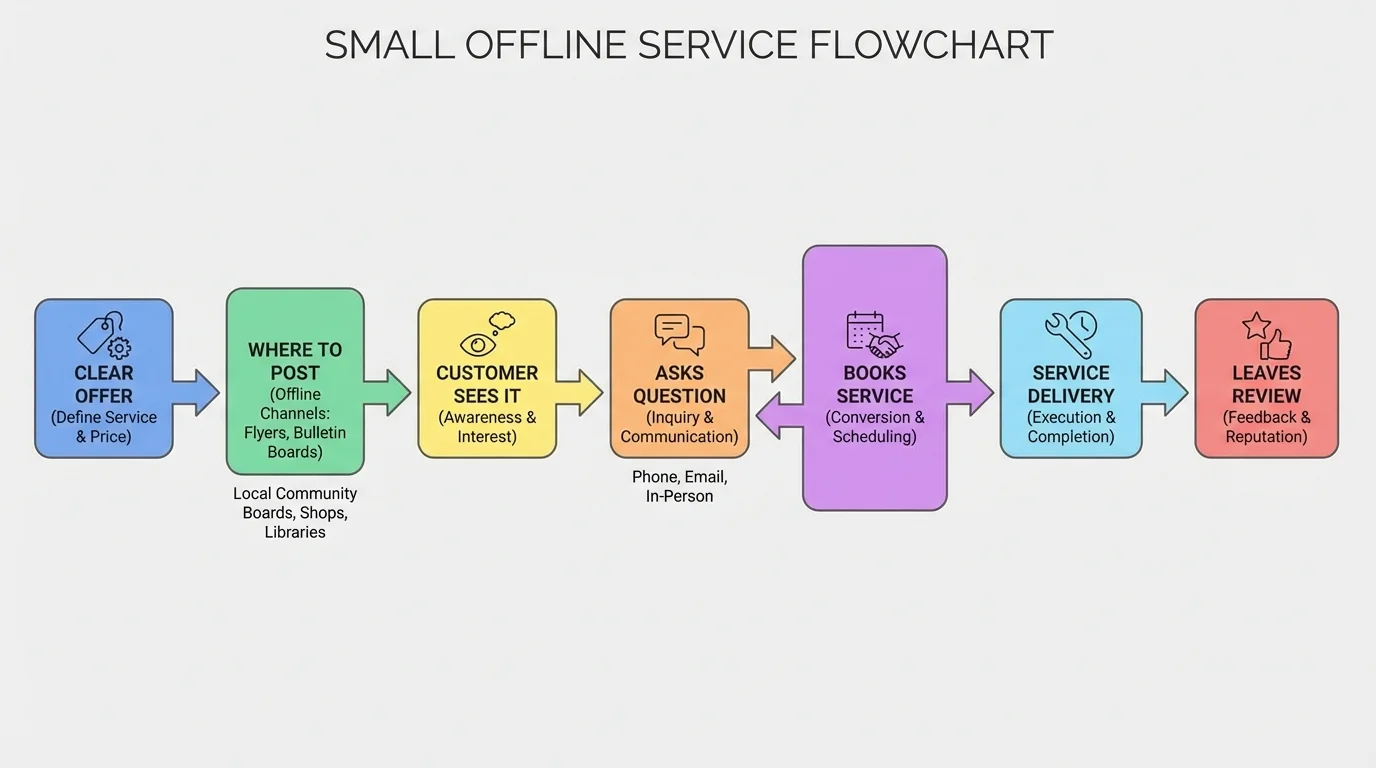
Marketing is not just "advertising." It is the full process of helping the right people notice, understand, and trust your offer. Marketing works best when it moves step by step: clear offer, visible message, customer interest, contact, and booking.
For a small offline project, your best marketing is often simple. As [Figure 4] shows, word-of-mouth matters a lot. If one trusted neighbor is happy with your service, they may recommend you to others. A short social media post, a neat flyer, a message in a local community group posted by a parent or guardian, or a simple sign-up sheet can all help.
Your message should answer basic customer questions fast: What are you offering? Who is it for? Where are you available? What does it cost? How can someone contact you? If that information is missing, many people will scroll past or ignore the flyer.
Here is a weak marketing message: "I do stuff for pets. Message me." It is unclear. Here is a stronger one: "Weekend dog walking in the Oak Hill area. 20-minute walk for $10. Best for small and medium dogs. Friendly updates sent after each walk. Contact by text through parent/guardian." The stronger version tells the customer what to expect.
Offline marketing can include flyers at approved community boards, talking with neighbors you already know, and asking satisfied customers for referrals. Online support can include a simple photo post, a neighborhood group message, or a short digital flyer. Even for an offline service, online communication often helps people ask questions and book more easily.
"People do not buy what they do not understand, and they do not trust what feels confusing."
— A useful rule for small businesses
Trust is a huge part of marketing. Showing up on time, replying politely, being honest about what you can do, and keeping your promises make your marketing stronger than any poster. Your reputation is part of your brand, even if you never use that word.
Later, when you improve your service, the path in [Figure 4] still matters. A better offer only helps if people hear about it clearly and feel confident booking you.
No first plan is perfect. That is normal. The goal is not to predict everything. The goal is to start with a smart first version and then improve it. After your first few customers, ask what went well and what could be better. Did people understand your offer? Was the price fair? Did the job take longer than expected? Did you spend more than planned?
This step is called getting feedback. Feedback can help you improve your service package, your price, your timing, or your marketing message. If several people ask the same question, your offer may not be clear enough. If customers love the work but hesitate at the price, you may need to explain the value better or reduce costs.
Being professional matters even in a tiny project. That means communicating clearly, being respectful, staying safe, and following through. If you cannot do a job, say so honestly. If plans change, inform the customer early. If you say you will arrive at a certain time, aim to be there on time. Reliability makes small projects grow.
Professional behavior is part of the product. Customers are not only paying for the task itself. They are also paying for a smooth, respectful, dependable experience.
Safety also matters. Some services require adult supervision, approval, or limits. Be realistic about transportation, physical demands, neighborhood rules, and your own comfort level. A smart project is one you can run safely and responsibly.
Here is a complete beginner plan for a local plant-watering service during school breaks and vacations. The audience is busy families or older adults in the neighborhood who travel and want someone reliable to water porch plants and small garden beds.
The MVP is simple: one visit includes watering outdoor plants, checking that the soil is moist, and sending a quick update message through a parent or guardian if needed. The service area is limited to homes within walking distance. The offer is available only on certain days.
Case study: plant-watering service
Step 1: Define the audience.
Customers are nearby residents who travel and do not want plants to dry out.
Step 2: Build the MVP.
One simple visit, one neighborhood zone, one clear service list, no extra landscaping work.
Step 3: Estimate costs.
Flyers cost $8, a watering can costs $12, and gloves cost $5, so startup cost is \(8 + 12 + 5 = 25\).
Each visit has about $1 in small ongoing costs.
Step 4: Set a price.
If each visit is priced at $6, then profit after ongoing cost is about $5 per visit because \(6 - 1 = 5\).
To cover startup costs, divide \(25 \div 5 = 5\), so 5 visits cover the startup amount.
Step 5: Market the service.
Post a short neighborhood flyer, ask family friends to spread the word, and use a simple message that explains area, price, and what is included.
This plan is small, realistic, and testable. If it works, the service can later add options like mail pickup or extra watering zones.
Notice what makes this plan strong: it solves a real problem, targets a specific audience, uses a simple MVP, has a clear budget, charges enough to make sense, and uses practical marketing. That is exactly what a good small-project plan should do.
