Why do headlines today still connect to people who lived hundreds or even thousands of years ago? A ruler from West Africa, ancient religious traditions, revolutions in Europe and the Americas, and ideas about class and power still shape the modern world. History is not just a list of dates. It is a way of asking, How did we get here? When we know the background of important events and ideas, we can make better sense of current debates, conflicts, and changes.
Historical context means the conditions that surrounded a person, idea, or event in the past. It includes the time period, geography, beliefs, technology, economics, and political systems. For example, if we study a revolution without understanding poverty, unfair laws, or new ideas about rights, we miss the reasons people acted the way they did.
Context also helps us avoid oversimplifying the past. A leader may seem powerful because of personal talent, but geography, trade routes, or religion may have mattered just as much. A conflict may look sudden, but it often grows from long-term causes. Historians use primary sources, such as letters, laws, speeches, travel records, and religious texts, along with secondary sources, such as textbooks and articles written later, to build a fuller picture of the past.
Historical context is the background of time, place, ideas, and conditions that helps explain why events happened. Primary sources are materials created during the time being studied, while secondary sources are later interpretations based on evidence.
When students study historical context, they are really learning to connect causes and effects across time. That skill matters when looking at current issues such as religious conflict, racism, nationalism, economic inequality, and debates about government power.
In the fourteenth century, the Mali Empire became one of the most important states in West Africa. Its strength depended on control of trade routes crossing the Sahara Desert. Gold from West Africa and salt from the desert were traded across long distances, linking African societies to North Africa, the Middle East, and beyond.
One of Mali's most famous rulers was Mansa Musa, who ruled in the early 1300s. He is remembered for his wealth, but his importance goes far beyond riches. He expanded Mali, supported learning, and strengthened connections with the Islamic world. During his pilgrimage to Mecca in 1324, he traveled with a large caravan and distributed so much gold that, according to some accounts, it affected local economies in places he visited. Writers and travelers in North Africa and the Middle East recorded his journey, making Mali better known far beyond West Africa.
Mansa Musa also helped make cities such as Timbuktu centers of scholarship. Mosques, libraries, and schools grew there. This matters because it challenges an outdated false idea that Africa's past was isolated or lacking advanced learning. West Africa was deeply connected to trade, religion, and education networks.
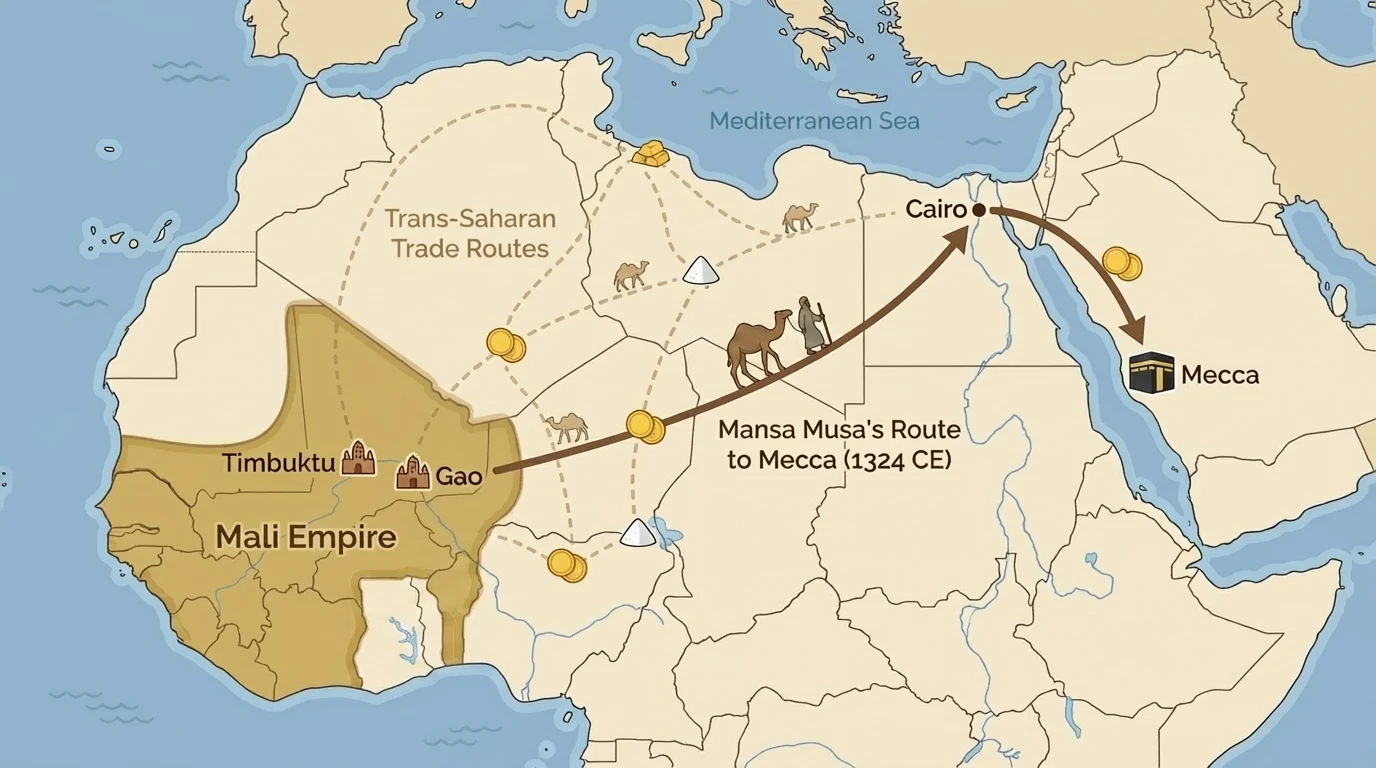
The story of Mansa Musa helps explain current issues in two ways. First, it reminds us that Africa has long been part of global history, not separate from it. Second, it shows how wealth, trade, and religion can increase a region's influence. Today, countries still gain power through control of resources, trade routes, and cultural connections, much as Mali did centuries ago.
Some modern estimates have described Mansa Musa as one of the richest people in history, but historians are careful with exact numbers because wealth from the past is difficult to measure precisely.
Later, when people study colonialism in Africa, they can better understand why outside powers were interested in African regions. Lands with trade networks, valuable resources, and strong states already existed before European colonial rule. As we saw in [Figure 1], Mali's location linked desert and forest zones, making it an important crossroads.
Three major world religions—Judaism, Christianity, and Islam—are often grouped as the Abrahamic religions because they share roots in the Middle East and connect themselves to Abraham. Understanding these shared origins is important because these religions have shaped laws, ethics, culture, art, and political life across the Eastern Hemisphere.
Judaism is the oldest of the three. It developed among the ancient Hebrews and centers on belief in one God and a covenant, or sacred agreement, between God and the Jewish people. Key primary sources include the Hebrew Bible. Christianity began in the first century CE within the Jewish world of the Roman Empire. Christians believe Jesus was the Messiah and the Son of God. The New Testament became a central religious text. Islam began in the seventh century CE in Arabia. Muslims believe the Prophet Muhammad received revelations from God recorded in the Qur'an.
These religions share belief in one God, respect for prophets, and ideas about moral responsibility. They also differ in key beliefs, leadership traditions, and sacred texts. Shared origins do not always lead to unity. In fact, some of history's conflicts grew from competition over holy places, political power, and interpretation of belief.
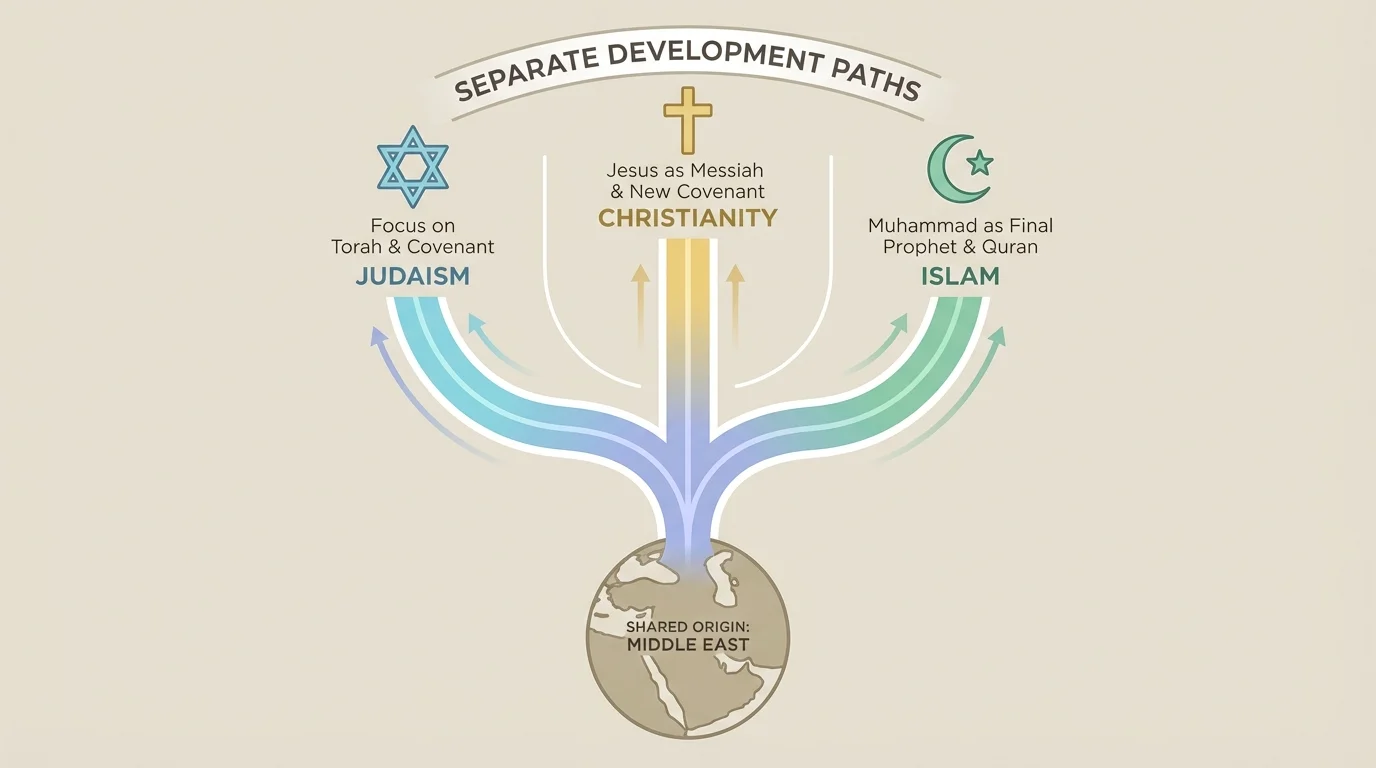
Historical context helps explain why religion is often connected to politics. In many empires and kingdoms, rulers used religion to support authority. Religious identity could unite people, but it could also divide them. The Crusades, for example, were shaped by faith, but also by land, trade, and political power. In the modern world, tensions in the Middle East, debates over religious freedom, and cooperation among faith communities all make more sense when we understand these long roots.
"There is no compulsion in religion."
— Qur'an, often quoted in discussions of religious tolerance
At the same time, the shared roots shown in [Figure 2] also help explain efforts at dialogue and peace. When people recognize common ancestry among traditions, they may better understand both the similarities and the differences that matter so deeply to believers.
Political revolutions changed the world by challenging kings, old social systems, and inherited privilege. Over time, revolutionary movements spread ideas about rights, citizenship, and government. A revolution is not just a protest. It is a major change in political power or social order.
The English Revolution of the seventeenth century limited the power of the monarchy and strengthened Parliament. This mattered because it raised the question of whether rulers should obey laws. The American Revolution later declared independence from Britain and argued that governments get power from the consent of the governed. The French Revolution went further by attacking monarchy and privilege inside France itself. It spread the powerful language of liberty, equality, and fraternity. The Haitian Revolution, led by enslaved and free people of African descent, challenged both slavery and colonial rule.
These revolutions were not all the same. Some expanded rights more than others. Women, poor people, and enslaved people were often excluded even when leaders spoke of equality. That is one reason revolutions are so important to study: they reveal the difference between ideals and reality.
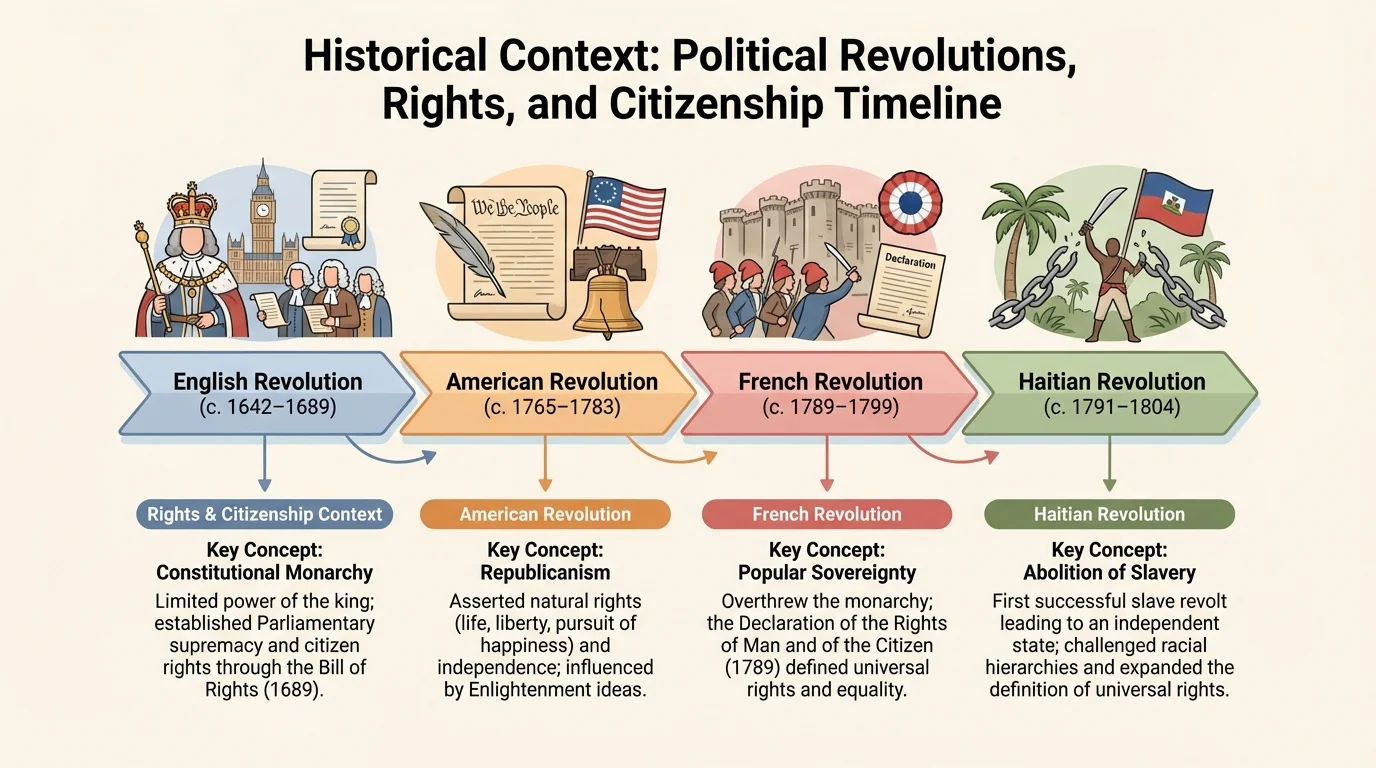
Primary sources from these events include the English Bill of Rights, the Declaration of Independence, the Declaration of the Rights of Man and of the Citizen, and speeches from Haitian revolutionary leaders such as Toussaint Louverture. These documents show that people were beginning to ask big questions: Who should rule? Who counts as a citizen? What rights are natural?
Why revolutions matter
Political revolutions matter because they turned ideas into action. Philosophers such as John Locke argued that people had natural rights. Revolutionaries then tried to build governments around those ideas. Even when they failed or fell short, they changed what people expected from rulers.
Modern democracies still use ideas shaped during this era. Elections, constitutions, civil rights movements, and debates about fairness all connect back to revolutionary thinking. Even current protests often use language first made powerful in earlier revolutions. As [Figure 3] shows, these movements built on each other across time.
The Atlantic Slave Trade was one of the most destructive systems in world history. It linked Europe, Africa, and the Americas in a vast trading network. European traders exchanged goods for captive Africans, who were forced across the Atlantic in brutal voyages known as the Middle Passage. In the Americas, enslaved labor produced crops such as sugar, tobacco, and cotton.
This system developed between the 1500s and the 1800s and enslaved millions of Africans. Families were torn apart. People were treated as property. Many died from violence, disease, and terrible conditions during capture, transport, and labor. African societies were damaged as the trade increased warfare and instability in some regions.
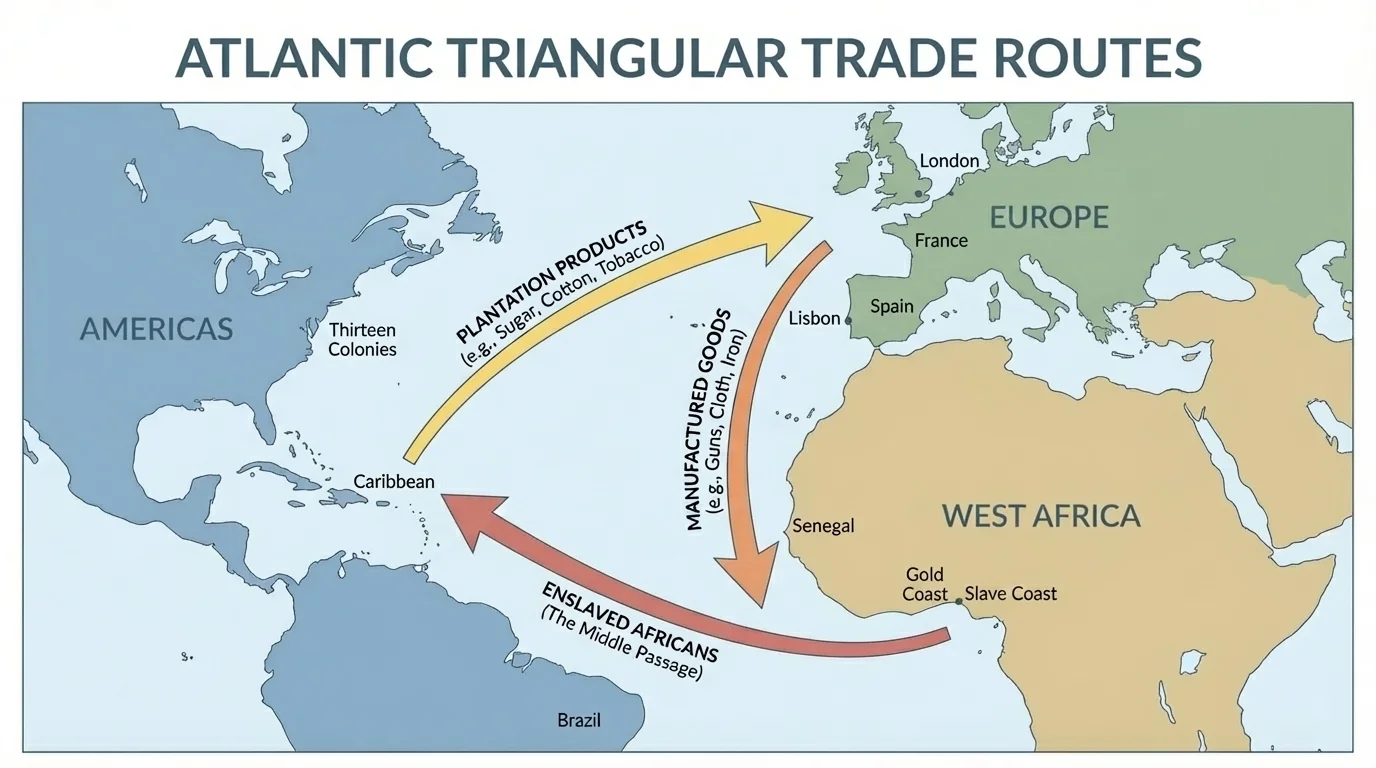
The effects did not end when legal slavery was abolished. The Atlantic Slave Trade helped create enormous wealth for European merchants and plantation owners while causing long-lasting harm to African communities and people of African descent. Racist ideas were used to justify slavery, and those ideas continued after slavery ended. That legacy helps explain modern problems such as racial inequality, prejudice, and economic gaps.
| Region | Major Effect of the Slave Trade |
|---|---|
| West and Central Africa | Population loss, social disruption, increased conflict in some areas |
| Europe | Profits from trade, growth of port cities, investment in industries |
| Americas | Expansion of plantation economies, deep racial inequality, forced labor systems |
Table 1. Major regional effects of the Atlantic Slave Trade.
Historical context also helps students understand resistance. Enslaved Africans resisted in many ways: preserving culture, slowing work, escaping, rebelling, and building new communities. The Haitian Revolution is especially important because it showed that enslaved people could defeat a colonial power and build an independent state. The routes in [Figure 4] were not just trade lines on a map; they were paths of forced migration and human suffering.
Case study: Why the Atlantic Slave Trade still matters
Step 1: Identify the historical system
European demand for plantation crops increased the demand for enslaved labor in the Americas.
Step 2: Trace its effects
Wealth built from slavery helped strengthen some economies, while African regions lost people and stability.
Step 3: Connect to the present
Modern racial inequality and debates over justice, memory, and reparations are linked to this history.
When modern societies discuss racism or memorials to enslaved people and abolitionists, they are not discussing only the past. They are also asking how the past continues to shape the present.
Nationalism is the belief that people who share a language, culture, history, or identity should be loyal to their nation and often should govern themselves. That idea became especially powerful in Europe during the 1800s. It could inspire unity, but it could also create rivalry and conflict.
In places such as Italy and Germany, many smaller states joined together into larger nations. Leaders like Count Cavour and Giuseppe Garibaldi helped unify Italy. Otto von Bismarck used war and diplomacy to unify Germany. For many people, nationalism was exciting because it promised independence and pride.
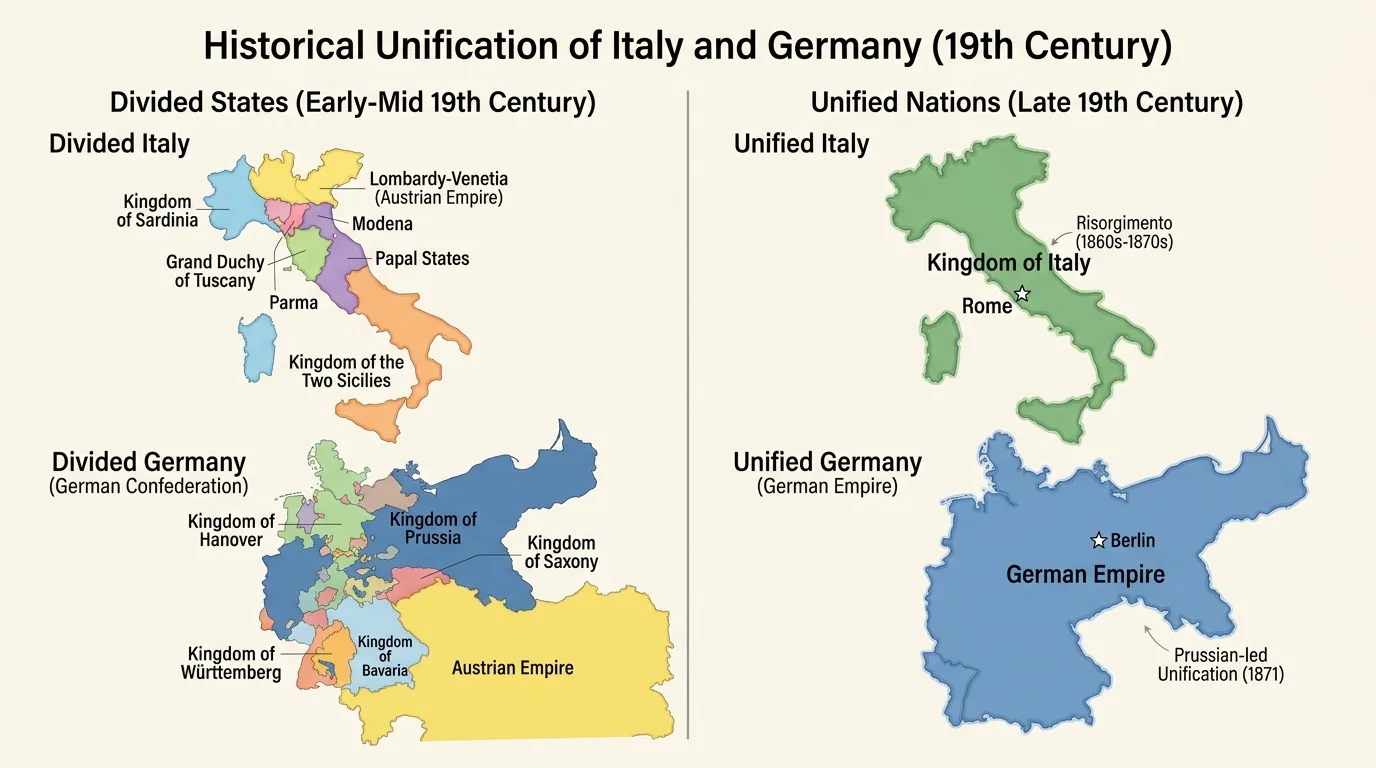
But nationalism had a darker side. People sometimes defined the nation so narrowly that minorities were excluded. National pride could become aggressive. European powers competed for colonies partly because nationalist leaders wanted prestige and resources. Rival nationalism also helped create the tensions that led to World War I.
Nationalism still shapes current issues. It appears in debates over borders, immigration, language laws, independence movements, and ethnic conflict. Some nationalist movements seek self-determination, while others turn against outsiders. The map in [Figure 5] helps explain why unification felt powerful in the nineteenth century and why national borders remain emotionally important today.
Earlier study of empires helps here: empires often rule many peoples, while nationalism encourages people to think of themselves as one nation that deserves its own state.
This is why nationalism can both challenge empires and create new conflicts after empires weaken or collapse. The same idea may support freedom in one case and violence in another.
During the Industrial Revolution, factories changed how people lived and worked. Cities grew quickly, but many workers faced low pay, dangerous conditions, and long hours. In that setting, thinkers began searching for new ways to organize society. One response was Communism, a system that argues that property and the means of production should be owned collectively rather than by private individuals.
Karl Marx and Friedrich Engels argued that history was shaped by class struggle. In their view, the proletariat, or the working class, would eventually rise against the bourgeoisie, or the owning class. Their ideas were explained in works such as The Communist Manifesto, an influential political text and a major primary source for understanding communist theory.
Communism became a major force after the Russian Revolution of 1917. The Bolsheviks, led by Vladimir Lenin, overthrew the existing order and created a communist state that later became the Soviet Union. This was one of the most significant events of the twentieth century because it offered an alternative to capitalism and influenced politics around the world.
Communism is a political and economic ideology that calls for collective ownership and the end of class divisions. Capitalism is a system in which private individuals or companies own businesses and compete for profit.
Supporters of communism believed it could end exploitation and inequality. Critics pointed to loss of freedom, forced collectivization, censorship, and violence under communist governments. In the Soviet Union under Joseph Stalin and later in other communist states, governments often used strong control to maintain power. So when historians study communism, they do not only ask what the idea promised. They also ask what happened when leaders tried to put it into practice.
The rise of communism shaped current issues in many ways. It influenced revolutions in China and elsewhere, helped divide the world during the Cold War, and still affects politics in countries with communist parties or socialist movements. Modern debates about wealth inequality, worker rights, and government responsibility still echo arguments first made in industrial-age Europe.
These topics may seem very different, but they are connected by a common question: how do people organize power? Mansa Musa shows how trade, religion, and leadership can raise a region's influence. The Abrahamic religions show how shared beliefs can unite civilizations while also shaping conflict. Revolutions show people demanding rights and new governments. The Atlantic Slave Trade shows how economic systems can be built on injustice. Nationalism shows the power of identity. Communism shows how people respond when inequality becomes unbearable.
Current events often make more sense when placed in this longer story. Conflicts over holy land, immigration debates, struggles against racism, nationalist movements, and disagreements about economic fairness all have deep roots. Historical context does not excuse harmful actions, but it does help explain them. And explanation is the first step toward thoughtful judgment and problem-solving.
When historians compare past and present, they look for patterns and differences. A modern movement is never exactly the same as an older one, but the past provides clues. It helps us ask better questions: Who benefits? Who is excluded? What ideas are being used? What older events shaped the issue? Those questions turn history into a powerful tool for understanding the world.
