Have you ever seen two people argue about which paper airplane flies farther, or whether plants grow better in sunlight or shade? A scientist does not settle those questions by guessing. A scientist plans an investigation, gathers evidence, and looks for patterns. Careful planning helps us find answers we can trust.
When students investigate the world, they act like scientists. They ask questions, test ideas, measure results, and explain what the evidence shows. Good investigations can be done by one person or by a team. In both cases, the most important idea is the same: make a plan before you begin.
An investigation is a careful way to answer a question. If the plan is messy, the results may be confusing. If the plan is clear, the results are easier to understand. Planning helps us know what to change, what to measure, what to keep the same, and how to record the results.
Investigation is a careful process used to answer a question by gathering evidence. A claim is a statement that answers the question, and it should be supported by evidence from the investigation.
For example, suppose you want to know whether larger paper airplanes fly farther than smaller ones. If you throw different airplane shapes, use different papers, and throw them with different amounts of force, you will not know which difference mattered. Planning helps you test one important change at a time.
Scientists also plan for safety. If an investigation uses water, heat, glass, or sharp tools, students need to know how to work safely. Even simple classroom investigations should include careful behavior, neat workspaces, and clear directions.
A strong investigation plan usually begins with a question. The question should be specific. "What happens to plants?" is too broad. "How does the amount of water affect the height of bean plants?" is much clearer.
Next comes a prediction. A prediction is what you think will happen, based on what you already know. A prediction is not the same as a claim. The prediction comes before the investigation. The claim comes after the data are collected.
What belongs in a plan
A complete plan includes the question, a prediction, the steps to follow, the materials needed, the tools for measuring, the things that will stay the same, and the way results will be recorded. A good plan is detailed enough that another student could follow it and do the same investigation.
A plan should also list the materials. Materials are the objects you need, such as cups, seeds, rulers, timers, soil, water, or paper. When you list materials ahead of time, you are less likely to forget something important.
Another important part of the plan is the procedure, or the step-by-step directions. The procedure should be in order and easy to follow. If the steps are confusing, the investigation may not be fair or repeatable.
[Figure 1] One of the most important ideas in a fair test is understanding variables. In a fair test, you change only one main factor so you can clearly see what effect it has. The factor you change on purpose is called the independent variable.
The result you measure is called the dependent variable. If you are testing how the amount of water affects plant height, the amount of water is the independent variable because you choose it. The plant height is the dependent variable because it changes in response and you measure it.
The things you keep the same are called controls, or controlled variables. In the plant example, you might keep the type of plant, the kind of soil, the size of the pot, and the amount of sunlight the same. That way, the amount of water is the main difference.
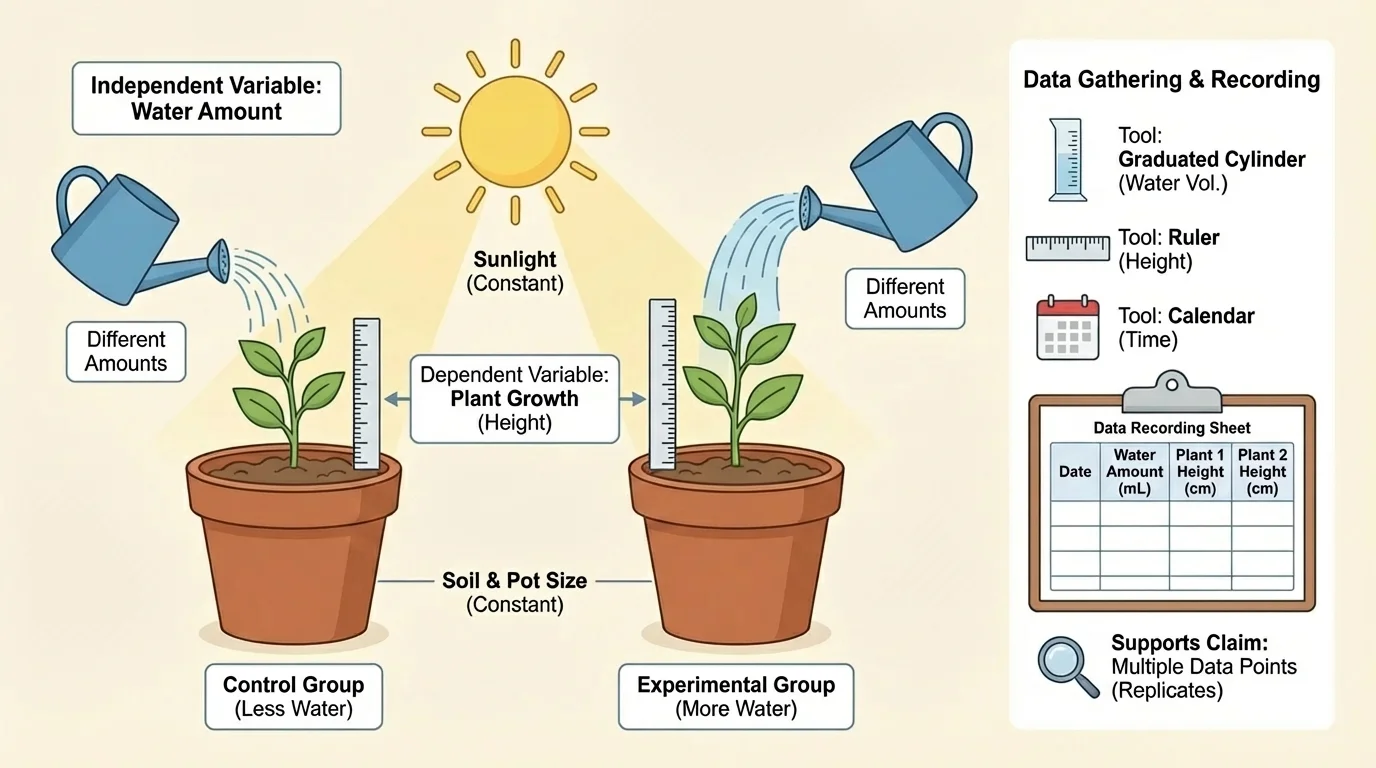
If you change many things at once, you cannot tell which one caused the result. This is why controls are so important. They help make the investigation fair.
Here is another example. Suppose you want to test which ramp angle makes a toy car travel the farthest. The independent variable is the angle of the ramp. The dependent variable is the distance the car travels. Controls might include using the same car, the same ramp surface, the same starting point, and the same floor.
| Investigation | Independent Variable | Dependent Variable | Controls |
|---|---|---|---|
| Plant growth | Amount of water | Plant height | Plant type, soil, pot size, sunlight |
| Paper airplane test | Wing length | Distance flown | Paper type, thrower, throwing spot |
| Toy car ramp | Ramp angle | Distance traveled | Same car, same surface, same start point |
Table 1. Examples of independent variables, dependent variables, and controls in different investigations.
Later, when you explain your results, you can look back at the fair-test idea in [Figure 1]. If too many things changed, your evidence will be weaker. If only one important factor changed and the controls stayed steady, your claim will be stronger.
[Figure 2] Good investigations need good tools. Different questions need different measuring tools. Scientists choose tools that help them gather data carefully and in the correct units.
You might use a ruler to measure length in centimeters, a stopwatch to measure time in seconds, a thermometer to measure temperature in degrees, a balance to measure mass, or a measuring cup to measure liquid volume. The tool should fit the job.
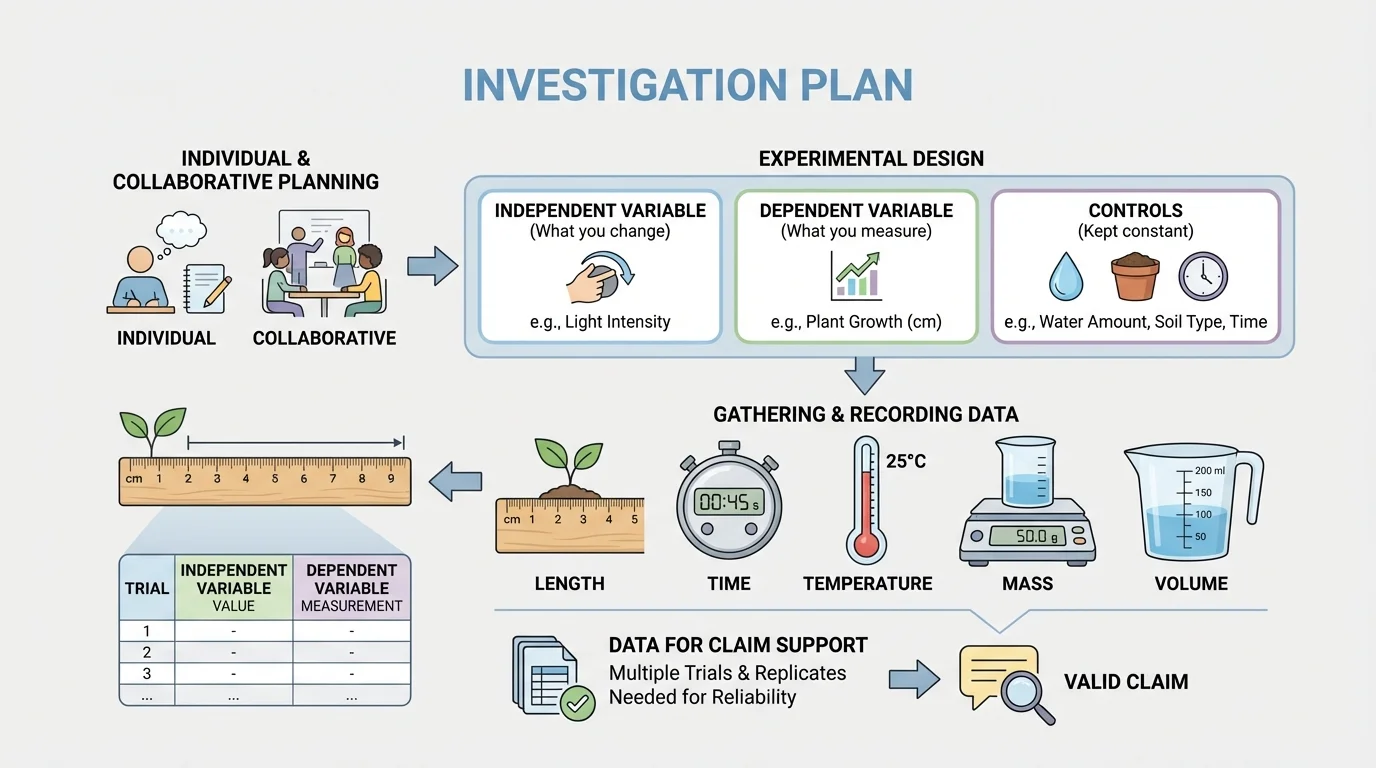
If you are measuring how far a paper airplane flies, a ruler or tape measure is better than guessing with your eyes. If you are measuring how long an ice cube takes to melt, a stopwatch is more accurate than counting in your head. Better tools usually mean better data.
Measurements need both a number and a unit. A plant is not just "tall"; it might be \(12 \textrm{ cm}\) tall. A melting test does not just take "a while"; it might take \(180 \textrm{ s}\).
It is also important to measure the same way each time. If one student measures from the bottom of the pot and another measures from the top of the soil, their numbers may not match. Teams should agree on one method before they begin.
When you read tools, look carefully. On a ruler, use the numbered marks and smaller lines correctly. On a thermometer, wait until the liquid level stops changing. On a stopwatch, start and stop at the right moment. Small mistakes can change your results.
[Figure 3] Scientists do not try to remember all their results. They write them down right away. Organized recording matters because evidence must be clear. A data table helps students keep track of measurements, trial numbers, and notes.
Data are the information collected during an investigation. Some data are numbers, such as height, time, or distance. Some data are observations, such as leaf color, texture, smell, or whether something floated or sank.
A strong data table has clear labels. Each column should tell what is being recorded. Units should also be written. For example, instead of writing "height," write "height \((\textrm{cm})\)." Instead of writing "time," write "time \((\textrm{s})\)."
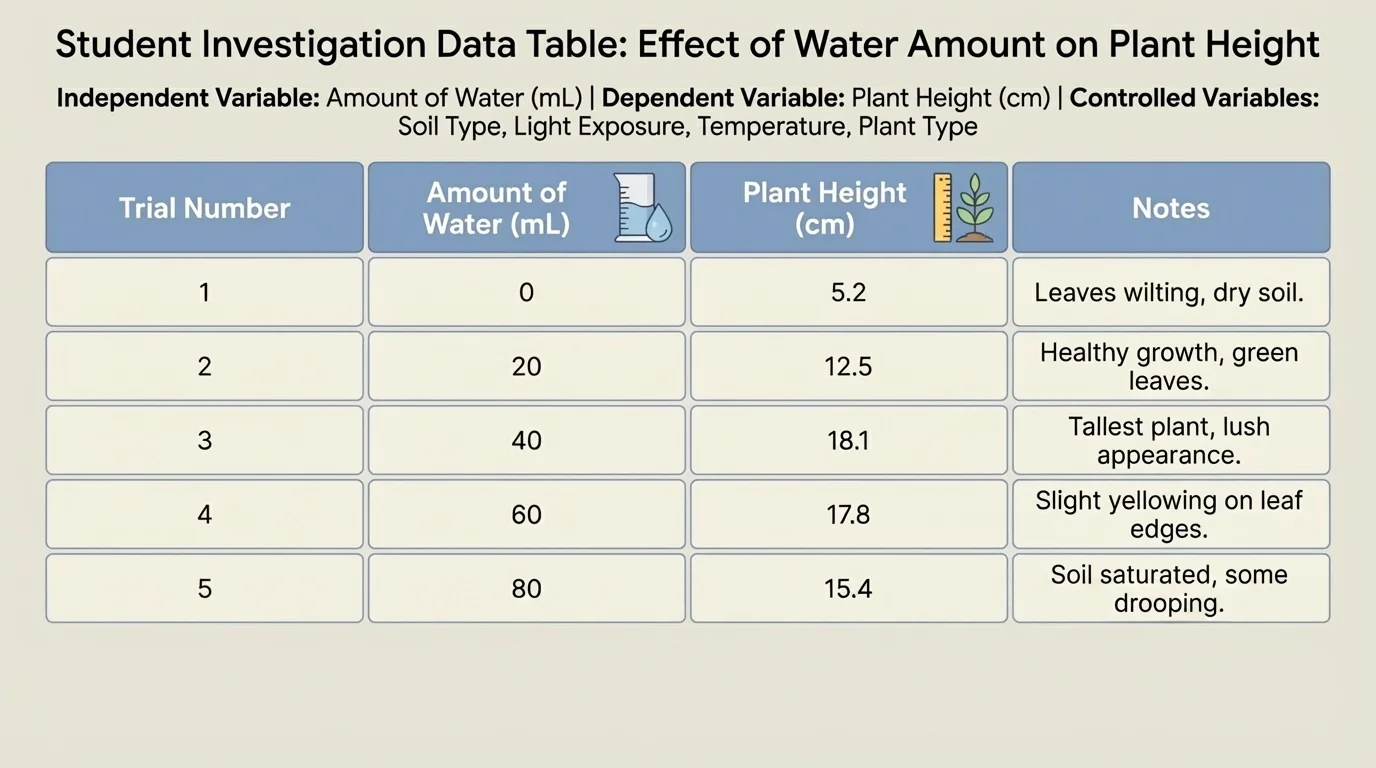
Recording observations is also useful. In a plant investigation, you might record that one plant is green and straight while another looks yellow or droopy. These details can help explain the numbers later.
Example: Recording plant investigation results
A group tests how water amount affects plant height. They use three water levels: \(10 \textrm{ mL}\), \(20 \textrm{ mL}\), and \(30 \textrm{ mL}\) per day.
Step 1: Set clear labels
The table includes water amount, trial number, plant height, and notes.
Step 2: Measure the same way each time
Each plant is measured from the top of the soil to the top of the stem using centimeters.
Step 3: Record immediately
After each measurement, the students write the number right away instead of waiting until later.
This makes the data more trustworthy and easier to compare.
Later in the lesson, the organized layout from [Figure 3] is still helpful when you look for patterns. A messy list of numbers is hard to use, but a clear table helps you see which results are similar and which are different.
One measurement is usually not enough to support a strong claim. Scientists gather more than one piece of evidence because single results can happen by accident. A gust of wind might help one paper airplane. One plant might be bent or damaged. Repeating the test helps check whether the pattern happens again.
Each repeat is called a trial. When you do several trials, you can compare the results. If the same pattern appears again and again, your claim becomes stronger.
Professional scientists often repeat tests many times because nature can be messy. Even when the plan is careful, tiny differences can still happen, so repeated data help reveal the real pattern.
For many elementary investigations, at least \(3\) trials for each condition is a good start. If you test three kinds of paper airplanes, you might throw each airplane \(3\) times. That gives \(9\) total flights. More data can give you more confidence, especially if the results vary.
Suppose one airplane flies \(4 \textrm{ m}\), then \(7 \textrm{ m}\), then \(5 \textrm{ m}\). Another flies \(6 \textrm{ m}\), \(6 \textrm{ m}\), and \(6 \textrm{ m}\). The second airplane shows a more consistent pattern. Repeated data help us notice that.
Sometimes students also calculate an average to describe a typical result. For example, if three throws are \(4 \textrm{ m}\), \(5 \textrm{ m}\), and \(6 \textrm{ m}\), the average is \(\dfrac{4+5+6}{3} = \dfrac{15}{3} = 5 \textrm{ m}\). The average does not replace the original data, but it can help summarize the results.
Some investigations are planned by one student, and some are planned by a group. When you work individually, you make your own plan and take responsibility for each step. This can help you think carefully and build independence.
When you work collaboratively, you plan with others. Teamwork can be powerful because different people may notice different problems or ideas. One student may think of a better way to measure. Another may notice an unfair part of the plan.
How collaboration improves an investigation
Groups can make investigations stronger when they listen to one another, divide jobs clearly, and agree on one shared procedure. If one student records data, another measures, and another checks the steps, the team can work carefully and efficiently.
Good collaboration requires clear communication. Group members should agree on the question, the variable being changed, the controls, the tools, and the way measurements will be recorded. If each student follows different rules, the data may not fit together well.
Teams should also assign roles. For example, one student can be the materials manager, one can be the measurer, one can be the recorder, and one can be the checker. These roles help the group stay organized.
Investigations are not only for science class. People use fair tests in gardening, sports, cooking, engineering, and medicine. A gardener may test whether one spot in the yard grows tomatoes better than another. A coach may compare how different practice drills affect speed. An engineer may test which design holds the most weight.
In everyday life, people also need evidence before making decisions. If someone says a new lunchbox keeps food colder longer, that is a claim. To test it fairly, you would need the same kind of food, the same starting temperature, the same room conditions, and careful time measurements.
Example: Planning a paper airplane investigation
Step 1: Ask a clear question
Which wing length helps a paper airplane fly the farthest?
Step 2: Identify variables
The independent variable is wing length. The dependent variable is distance flown. Controls include the same paper type, same thrower, same starting line, and same room.
Step 3: Choose tools
Use a tape measure to record distance in meters.
Step 4: Decide on data amount
Throw each airplane \(3\) times or more so you can compare repeated results.
This plan gives enough evidence to begin making a careful claim.
Another example is testing melting ice. You might ask, "Does an ice cube melt faster on metal, plastic, or wood?" The independent variable is the surface material. The dependent variable is melting time. Controls include same ice cube size, same room, and same starting time.
After collecting data, students look for patterns and decide what the evidence supports. A claim should answer the original question. It should not be a guess. It should be based on the data.
For example, if plants given \(20 \textrm{ mL}\) of water each day were taller than plants given \(10 \textrm{ mL}\) in most trials, you might claim that more water increased plant height in this investigation. But you should say exactly what your data show and avoid making the claim too broad.
"A strong claim needs strong evidence."
Sometimes the data do not show a clear pattern. That is still important. If the results are mixed, the honest claim may be that the investigation did not show a clear effect. Scientists do not force the data to fit what they hoped would happen.
A careful claim often includes both the result and the evidence. For instance: "The airplane with longer wings flew farther because in \(3\) out of \(4\) trials it had the greatest distance." That is much stronger than saying, "I think the long one is best."
When students use the ideas from fair tests, careful measurement, repeated trials, and organized tables, they can build claims that are believable. That is what planning and carrying out investigations is all about: asking good questions and answering them with evidence.
