A satellite dish points toward the sky, a phone screen lights up with moving images, and a tiny microphone picks up a whisper from across the room. These objects do very different jobs, but they all reveal the same big idea: structures are designed for functions. In science and engineering, that means the shape of something, the materials it is made from, and the way its parts are arranged all help it do a certain task well.
When scientists talk about structure, they mean the way something is built. That includes its size, shape, parts, pattern, and materials. Function means the job that structure performs. A bridge must hold weight, a helmet must protect a head, and a cup must hold liquid without leaking. If the structure changes, the function often changes too.
Think about a spoon and a fork. Both can help you eat, but their structures are different because their functions are not exactly the same. A spoon has a curved bowl to hold soup. A fork has pointed tines to lift pieces of food. The design fits the purpose.
Structure is the way an object or system is built, including its shape, materials, and arrangement of parts.
Function is the job or purpose that the structure carries out.
Design is the process of planning and building something so that its structure matches its function.
This idea applies not only to tools you can hold, but also to technologies that use waves. Waves carry information through sound, light, and electromagnetic signals. Devices that send, receive, or display wave information must be carefully designed so they work clearly, quickly, and safely.
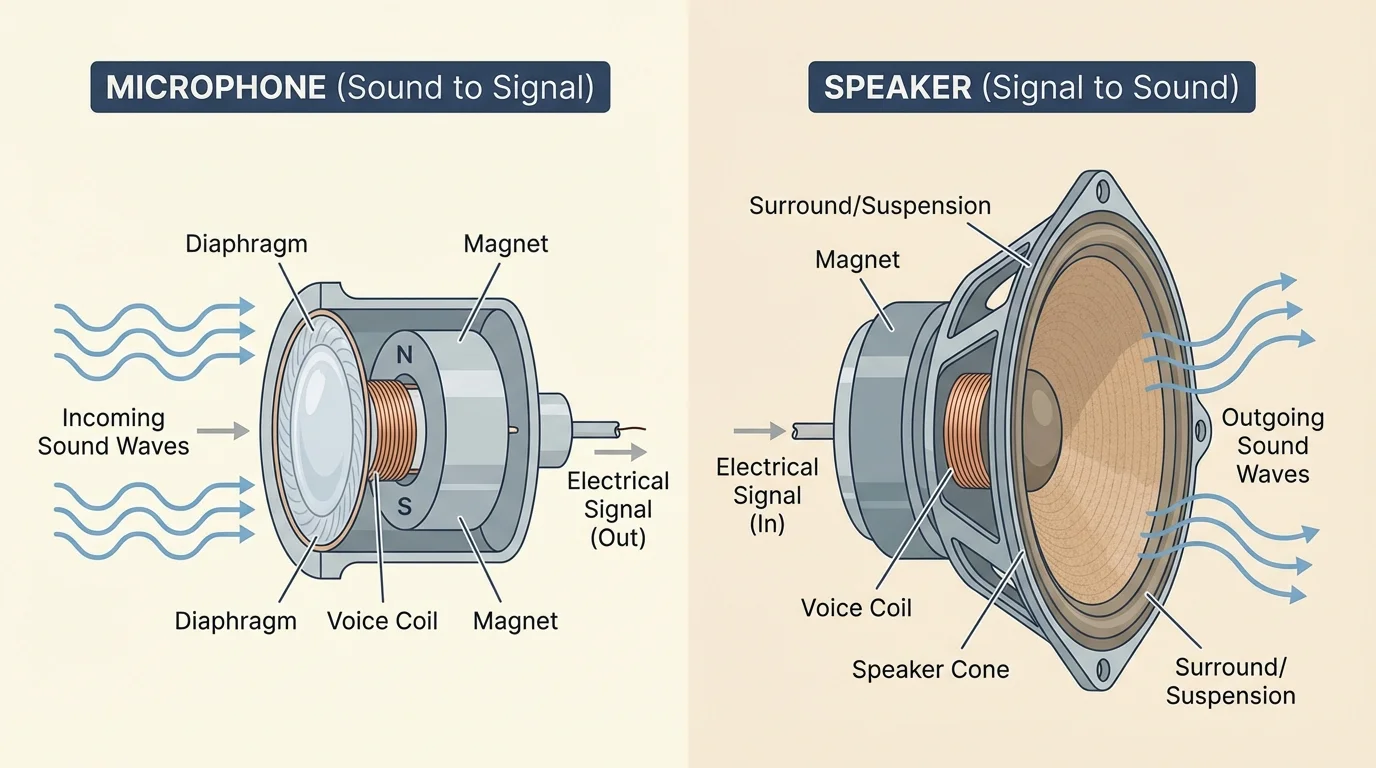
A wave is a repeating disturbance that transfers energy from one place to another. Some waves, like sound, need matter to travel through. Others, like light and radio waves, can travel through empty space. Engineers build devices differently depending on which kind of wave they need to use. As [Figure 1] illustrates, microphones and speakers have different internal parts because they perform opposite jobs. A microphone receives sound waves and turns them into electrical signals, while a speaker receives electrical signals and turns them back into sound waves.
A microphone often contains a thin membrane called a diaphragm. When sound waves hit it, the diaphragm vibrates. Those vibrations are turned into an electrical signal that a device can store or send. A speaker has a cone-shaped surface that vibrates when electricity passes through it, pushing air to create sound waves. Their structures are not random. Each part is built to respond to motion in a useful way.
Antennas are another strong example. An antenna on a radio, router, or phone is shaped and positioned to send or receive electromagnetic waves efficiently. A long straight antenna works well for some frequencies, while a dish-shaped antenna collects waves from a specific direction. The structure affects how well signals are picked up.
A screen also has a special function. It must turn electrical information into visible light patterns. Tiny structures inside displays control color and brightness. In a digital device, millions of small pixels work together to show pictures, video, and graphs. Their arrangement lets the device communicate information clearly to human eyes.
Some microphones are designed to pick up sound mostly from one direction. This helps filmmakers record voices clearly while reducing background noise.
Even a simple flashlight shows the connection between structure and function. The bulb or light-emitting part produces light, the reflector helps direct it forward, and the lens can spread or focus the beam. If the reflector were removed, the flashlight would still shine, but it would do its job less effectively.
Many waves are hard or impossible to see directly. Sound waves move through air, radio waves move through space, and even light contains patterns that our eyes cannot fully detect. Digital tools make these hidden patterns visible and measurable, as [Figure 2] shows through waveforms and sensor displays. This is one reason digital devices improve our understanding of how waves transmit information.
For example, a tablet or computer can use software to display a sound wave as a waveform. The graph changes when a sound becomes louder, softer, higher, or lower in pitch. A very basic relationship is that wave speed equals frequency times wavelength:
\[v = f\lambda\]
Here, \(v\) is speed, \(f\) is frequency, and \(\lambda\) is wavelength. If a wave travels at \(340 \textrm{ m/s}\) in air and has a frequency of \(170 \textrm{ Hz}\), then its wavelength is \(\lambda = \dfrac{340}{170} = 2 \textrm{ m}\). A digital device can help measure values like these by collecting sound data and displaying the pattern.
Digital cameras and telescopes do something similar with light. They capture electromagnetic waves and convert them into images that people can study. Special cameras can detect wavelengths outside visible light, such as infrared. This helps scientists observe heat patterns, stars, weather systems, and even body temperature.
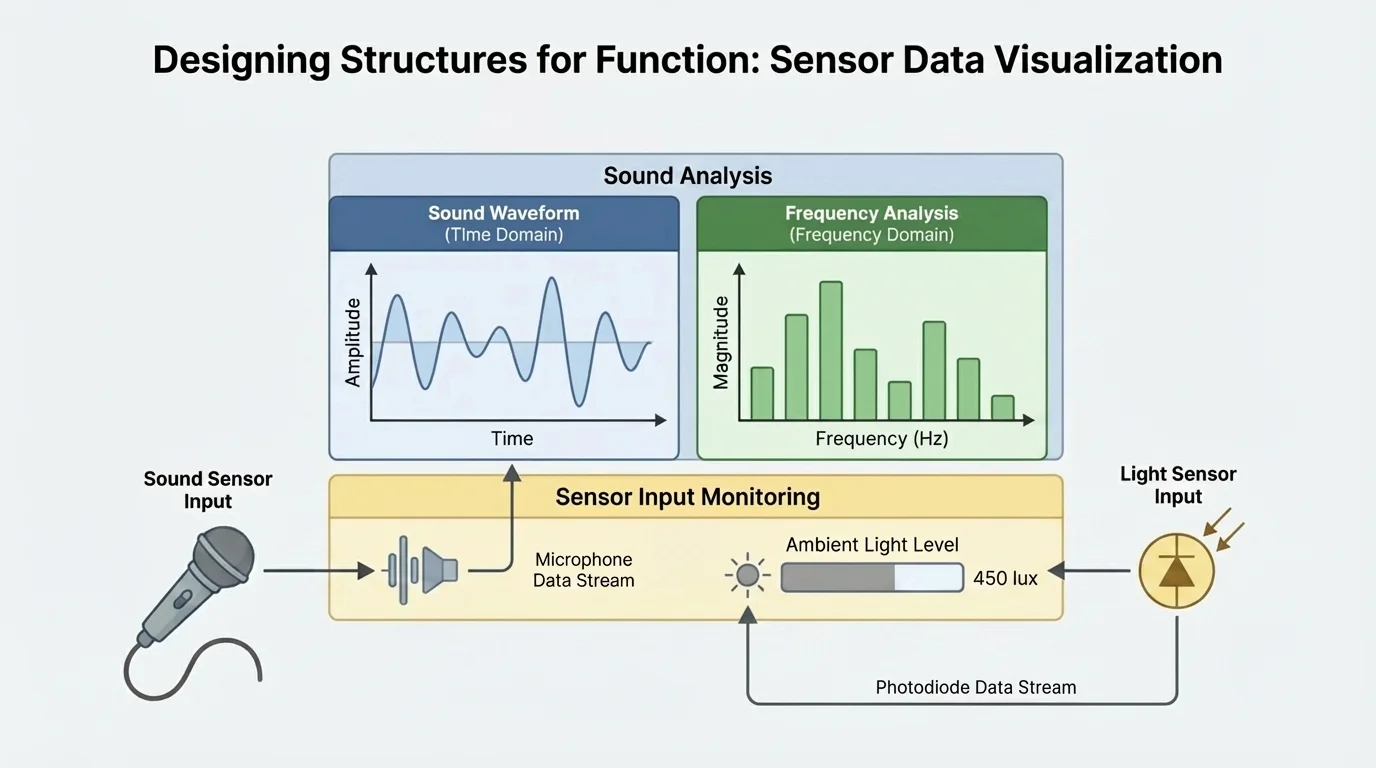
Scientists also use digital sensors to collect data from environments that are too dangerous, too distant, or too fast for direct observation. Seismometers detect vibrations from earthquakes. Ocean buoys measure wave motion and send data by radio. Weather satellites observe cloud patterns and energy from the Sun. These devices do not just receive waves; they help humans understand what the waves mean.
Later, when engineers improve wave-based tools, they often return to the kind of visual evidence seen in [Figure 2]. Seeing a signal as a graph or image makes it easier to compare designs, spot errors, and make better decisions.
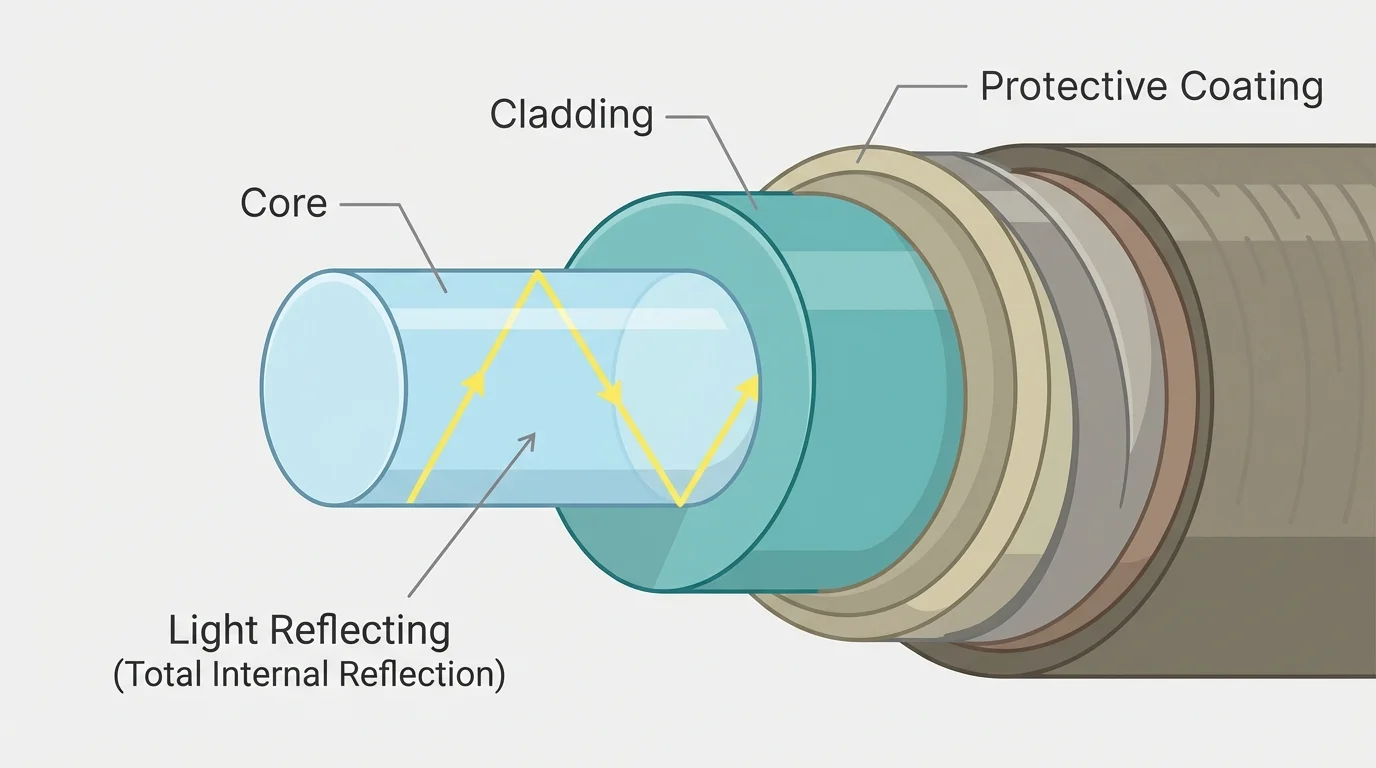
The material of a structure is just as important as its shape. As [Figure 3] demonstrates, a fiber-optic cable is a great example because it is specially built to guide light. It usually has a glass or plastic core, a surrounding layer called cladding, and an outer protective coating. This structure helps keep light traveling through the cable instead of escaping.
Why glass or clear plastic? These materials allow light to pass through with very little absorption. The arrangement of the core and cladding causes the light to reflect inside the cable again and again, guiding it over long distances. That is why fiber-optic systems can carry internet data quickly and clearly.
Metals are often chosen for antennas and wires because they allow electric charges to move easily. Plastics and rubber are useful as coverings because they can insulate and protect. Engineers must match the material to the function. A strong material may not be transparent. A transparent material may not survive heat. A flexible material may not be rigid enough for support.
The same idea appears in everyday safety tools. Safety glasses are transparent so you can see, but they must also resist breaking. Headphones need soft materials for comfort, but also internal components that vibrate accurately to produce sound. In each case, multiple functions must be balanced in one design.
| Technology | Important structural feature | Main function |
|---|---|---|
| Microphone | Thin vibrating diaphragm | Converts sound waves into electrical signals |
| Speaker | Cone and magnet system | Converts electrical signals into sound waves |
| Antenna | Metal shape and orientation | Sends or receives electromagnetic signals |
| Fiber-optic cable | Core, cladding, protective coating | Guides light signals |
| Screen | Grid of tiny pixels | Displays visual information |
Table 1. Examples of structures in wave technologies and the functions they serve.
Real designs often have to do more than one job at once. A phone must be small enough to carry, strong enough to survive being dropped, and sensitive enough to send and receive information. That means engineers make choices and trade-offs. A thicker case may protect the phone better, but it can also make the device heavier. A larger antenna may improve reception, but it might not fit easily inside the phone.
Accuracy matters a great deal in devices that use waves. If a microphone is poorly designed, it may pick up unwanted noise. If a satellite dish is pointed in the wrong direction, it may miss the signal. If a camera sensor is damaged, the picture may become blurry or distorted. The structure must support reliable function.
Trade-offs in design
Engineers rarely get everything they want in one design. Improving one feature can reduce another. A stronger structure may be heavier. A more sensitive sensor may be more fragile. Good engineering means choosing the best balance for the intended job.
Safety is also part of function. Electrical wires need coatings so users are not shocked. Headphones should be shaped to fit well without harming hearing when used properly. Devices that use lasers or strong radio signals need shields, labels, and limits. A useful structure is not truly successful unless it can be used safely.
The same pattern appears in buildings. A concert hall is designed to help sound travel clearly to the audience. Walls, ceilings, and materials affect echoes. In some rooms, sound bounces too much and speech becomes hard to understand. In others, the structure absorbs too much sound and music feels weak. Architects and engineers study wave behavior to design better spaces.
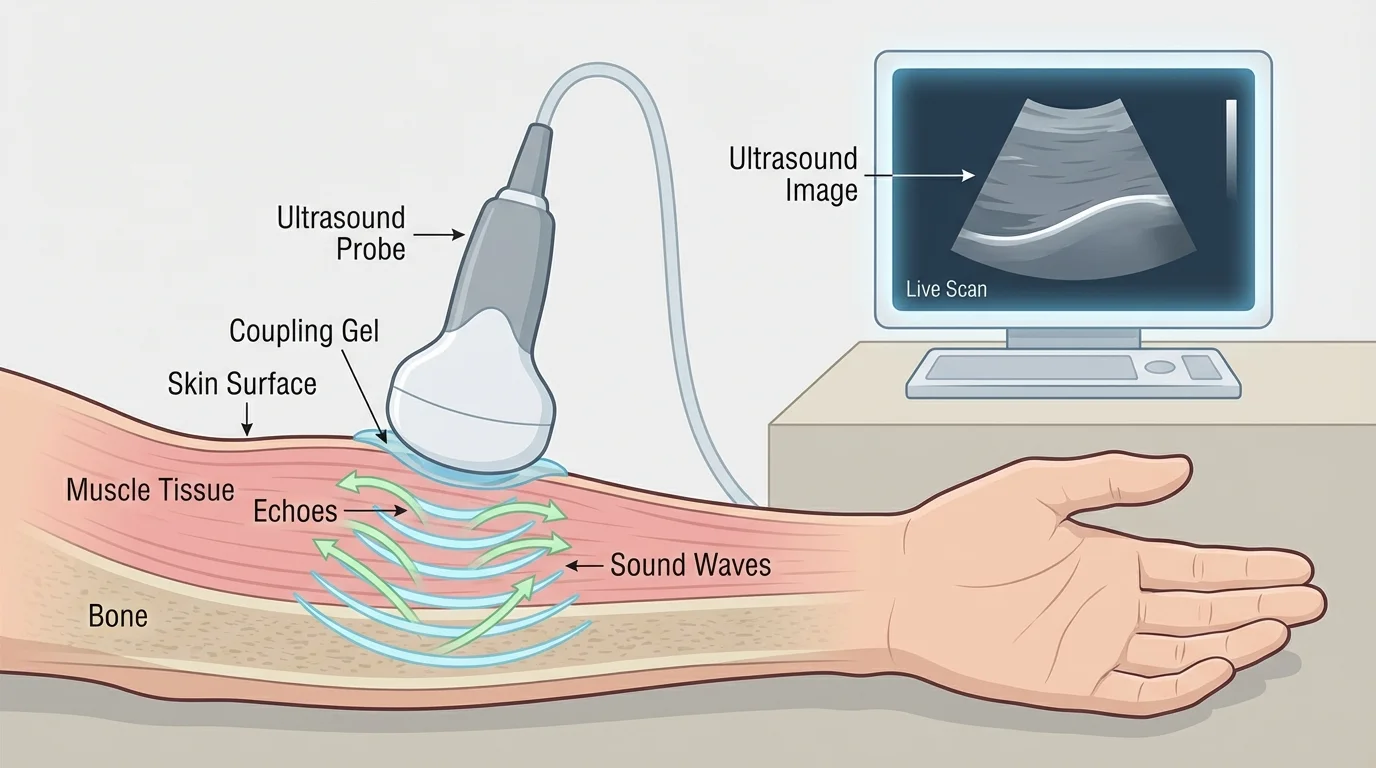
As [Figure 4] illustrates, a medical ultrasound probe is shaped to send and receive high-frequency sound waves efficiently. The probe must fit against the body, send sound into tissues, and detect echoes that bounce back. A computer then turns those echoes into an image. The structure of the probe serves the function of gathering useful information without surgery.
Another example is a smartphone. It combines many wave-related structures in one small device: antennas for wireless signals, microphones for sound input, speakers for sound output, cameras for light detection, and a screen for visual display. The phone is really a system of structures, each serving a specific function and working together.
Scientists who study earthquakes use sensors designed to detect tiny ground vibrations. These instruments must be stable, sensitive, and able to send data digitally. By comparing recordings from many stations, scientists learn about the strength and location of earthquakes. Without the right structure, the instrument would not function well enough to collect clear evidence.
Ocean-monitoring buoys are another example. They float, resist corrosion, survive storms, and carry instruments that detect water movement, wind, and pressure. They then transmit information using radio waves. Here, structure supports more than one function: floating, surviving, measuring, and communicating.
The same idea from [Figure 4] appears in many other systems. A well-designed device often sends out a wave, receives a response, and then uses digital processing to turn that response into meaningful information.
Case study: Why a satellite dish is curved
A satellite dish is not flat by accident. Its curved shape helps collect electromagnetic waves and direct them toward a receiver.
Step 1: Waves from a distant satellite arrive spread out over the dish.
Step 2: The curved surface reflects those waves toward one small point.
Step 3: A receiver placed at that point detects a stronger, clearer signal.
The structure improves the dish's function by gathering more of the incoming wave energy into one useful location.
Design is not a one-time event. Engineers test devices, gather data, and redesign them. Digital tools are extremely important in this process. A computer can compare recordings from several microphones, display differences in signal strength, or show whether a new antenna receives data better than an old one.
Suppose engineers want a sensor to detect a repeating signal more clearly. They might compare two versions and measure how much useful signal each one receives. If one sensor records \(80\) units of signal and another records \(120\) units under the same conditions, the second design captures \(120 - 80 = 40\) more units. That evidence helps guide redesign.
Testing also reveals problems. A structure may work in the lab but fail in rain, heat, or vibration. So engineers ask questions such as: Does the device still function after repeated use? Does it produce clear data? Is it safe? Can it be made at a reasonable cost? Structure and function must be considered together in all these situations.
From earlier science learning, recall that a system is a group of parts that work together. Many technologies that use waves are systems. Their overall function depends on how well each part is structured and how those parts interact.
This is why digital devices matter so much in modern science. They do not only communicate information; they also help people understand the waves carrying that information. Graphs, recordings, images, and sensor readings give evidence that can be saved, compared, and shared.
Once you start thinking about structure and function, you notice it everywhere. Earbuds are shaped to fit ears and direct sound. Window glass lets light in but blocks weather. Bike helmets have foam inside to absorb energy from impacts. A remote control sends infrared signals using a transmitter designed for that purpose.
Good design often looks simple on the outside, but it is based on careful choices. Engineers think about shape, size, material, arrangement, strength, cost, safety, and performance. When the job involves waves, they also think about reflection, absorption, vibration, and signal quality.
The key scientific idea is that function leaves clues in structure. If you study how something is built, you can often predict what it is meant to do. And if a function is not being performed well, changing the structure may improve it. That is true for bridges, tools, buildings, medical devices, and communication technology.
