Two people can work equally hard, make equally smart decisions, and still earn very different incomes over a lifetime. One major reason is that the choices people make about education, training, and skill development often change both how much they earn at the beginning of a career and how much they can earn years later. A short training program might lead to a fast start in the workforce, while a longer degree may delay earnings at first but increase future pay. Understanding those trade-offs is part of strong financial decision-making.
Income is not determined by education alone. Employers also care about the credential a person holds, the field they enter, how difficult the skills are to replace, and how much demand exists for those workers. A welder, nurse, software developer, teacher, electrician, dental hygienist, and graphic designer may all be successful, but their starting salaries, debt levels, and wage growth can look very different.
When people talk about a career being "worth it," they are usually combining several ideas: starting salary, future raises, job stability, benefits, education costs, and personal goals. A smart choice is not always the path with the highest paycheck. It is the path that makes sense when earnings, costs, interests, and opportunities are considered together.
Lifetime earnings means the total amount of money a person earns over an entire working life. Career preparation matters because it affects access to different occupations. Some jobs can be entered right after high school, some require a certificate or apprenticeship, and others require years of college or graduate study. The more specialized the training, the more likely a worker may qualify for jobs with higher pay or greater advancement opportunities.
Starting salary is the pay a worker usually earns when first entering a job or career field. Career preparation includes education, training, internships, apprenticeships, and other experiences that help a person qualify for work. Continuing education means learning after initial training, such as earning new certifications, taking college courses, or updating technical skills.
However, more education does not automatically guarantee more income. The field matters. A person with a bachelor's degree in one major may start at a lower salary than a person with an associate degree or skilled trade certification in a high-demand field. Earnings are shaped by supply and demand: when employers need more workers with a certain skill set and not enough qualified people are available, wages often rise.
Employers also pay for value. If a worker's training helps the business solve costly problems, improve efficiency, meet legal requirements, or provide specialized care, the job may pay more. For example, occupations such as registered nursing and software development often pay more than jobs requiring less specialized preparation.
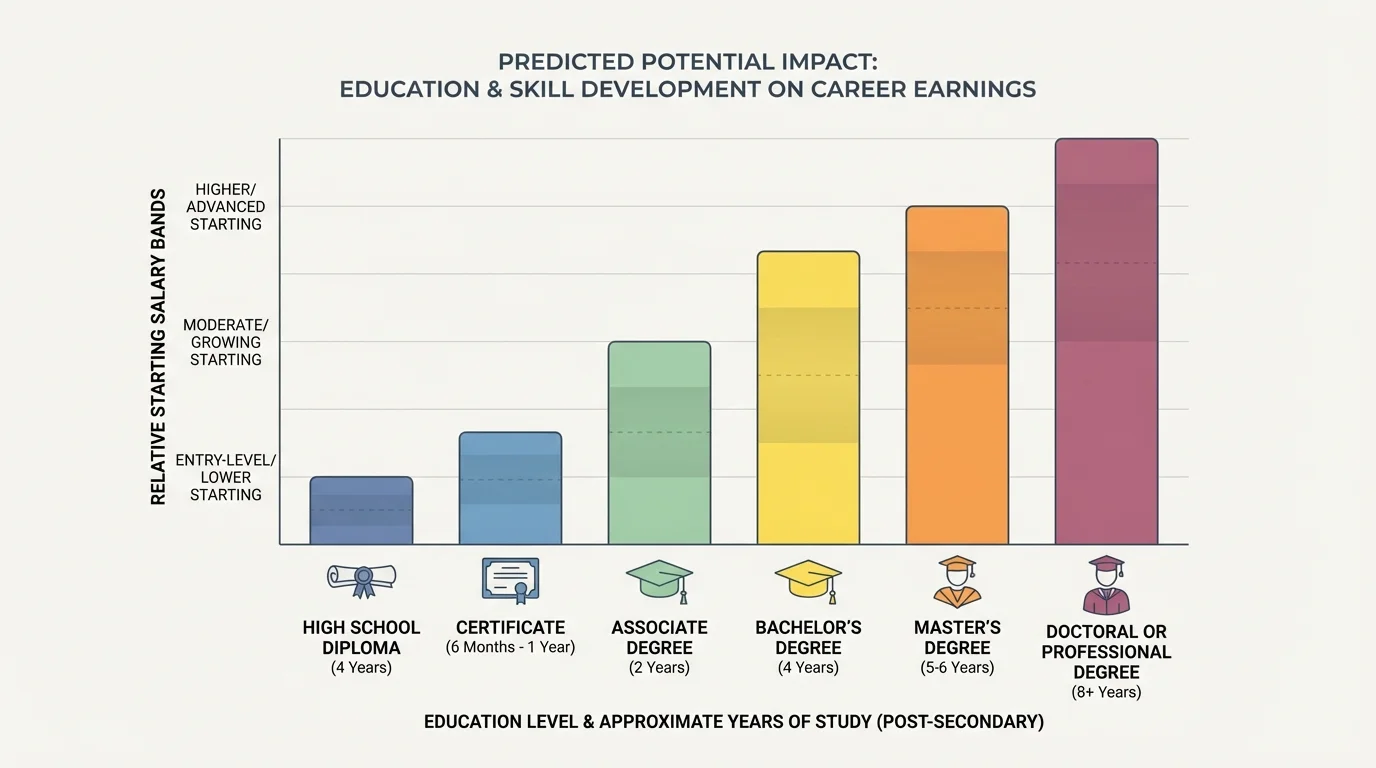
Education pathways form a ladder, as shown in [Figure 1], but the ladder is not only about "more school equals more money." Each step opens access to different jobs, different timelines, and different costs. Students should compare not just the level of education, but what specific jobs that level can unlock.
A high school diploma is the basic credential for many entry-level jobs. Some careers in retail, customer service, transportation, military service, and general labor may begin here. A certificate program usually focuses on a specific skill and often takes less than a year. Examples include phlebotomy, medical assisting, welding, information technology support, or cosmetology. An associate degree typically takes about two years and can prepare students for careers such as radiologic technologist, paralegal, or dental hygienist. A bachelor's degree often takes about four years and is common in fields such as engineering, finance, education, computer science, and business. A master's degree, doctoral degree, or professional degree may be required for advanced roles such as therapist, lawyer, pharmacist, professor, or physician.
Some careers rely on a license or certification rather than a traditional college degree. Electricians, real estate agents, commercial drivers, nurses, and teachers may need state or industry approval to work legally. This matters because employers often pay more when a person has verified qualifications that prove they can meet standards safely and effectively.
As [Figure 1] illustrates, moving up the education ladder usually increases average earnings, but averages can hide important differences. A bachelor's degree in petroleum engineering may lead to a much higher starting salary than a bachelor's degree in a lower-paying field. At the same time, an experienced plumber or HVAC technician may out-earn many college graduates. The key idea is that students should compare specific pathways, not just broad labels like "college" or "skilled trades."
Some of the fastest wage growth can happen in careers that combine formal education with in-demand skills. In other words, employers may pay especially well when a worker has both a credential and abilities that are hard to find locally.
Another important term is apprenticeship. In an apprenticeship, a learner earns money while training under experienced workers. This can be a strong financial option because income begins sooner, and debt may be lower than in a four-year degree path.
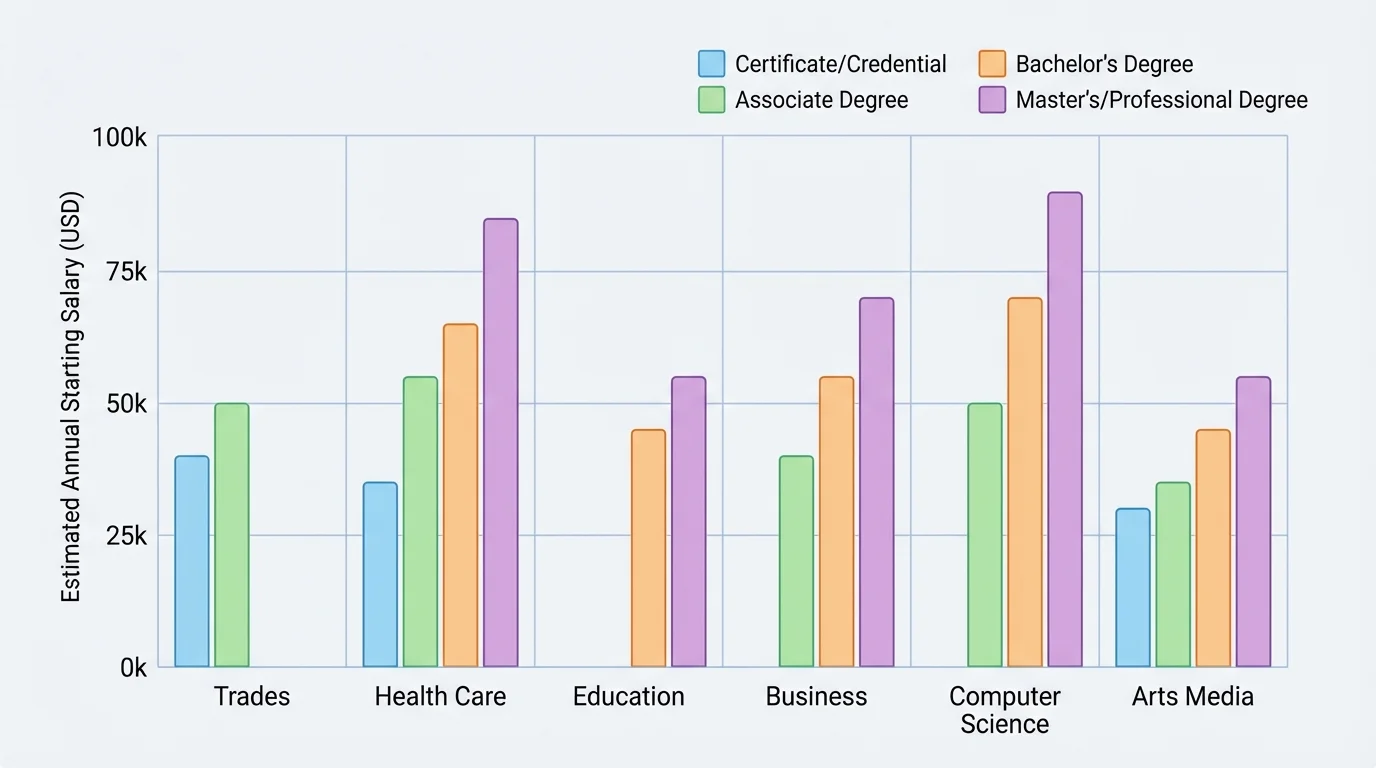
The field a person enters often affects pay as much as the degree level, as shown in [Figure 2]. That is why students should ask two questions together: "What level of education is required?" and "What do people in this field usually earn at the start?" Those questions are related, but they are not the same.
Consider a simplified set of examples. These are not exact national guarantees, because location, experience, and employer type all matter, but they show realistic patterns. Some technical fields such as engineering, computer science, and certain health occupations often start at relatively higher salaries. Education and social service fields may require significant education but begin at moderate salaries. Arts and media careers may vary widely, with some workers earning modest starting pay and others growing income later through reputation, specialization, or entrepreneurship.
| Field | Common Entry Preparation | Typical Starting Salary Range | Notes |
|---|---|---|---|
| Skilled trades | Certificate or apprenticeship | $35,000 to $60,000 | Income can rise quickly with experience and overtime |
| Health care support | Certificate or associate degree | $32,000 to $65,000 | Demand often remains strong |
| Teaching | Bachelor's degree and license | $40,000 to $55,000 | Benefits may be an important part of compensation |
| Business | Bachelor's degree | $45,000 to $70,000 | Wide variation by role and industry |
| Computer science | Bachelor's degree or strong technical portfolio | $60,000 to $90,000 | Skills and location strongly affect pay |
| Engineering | Bachelor's degree | $65,000 to $95,000 | High starting salaries in many specialties |
| Arts and media | Certificate or bachelor's degree | $30,000 to $55,000 | Portfolio and freelance work may matter a lot |
Table 1. Sample comparisons of common entry preparation and approximate starting salary ranges across career fields.
Notice that the ranges overlap. That overlap matters. A highly skilled worker in one field can earn more than a beginner in another, even if the second field has a higher average. Students should think in terms of likely ranges, not one magic number.
Field choice also affects how salary changes over time. Some careers start modestly but grow steadily. Others start high but level off unless the worker moves into management, specialization, or advanced credentials. The pattern in [Figure 2] helps explain starting pay, but long-term planning requires looking beyond the first paycheck.
Starting salary is important, especially when someone first becomes financially independent, but it is only one piece of the picture. A career with a lower starting salary may offer strong retirement benefits, health insurance, job stability, paid leave, or regular raises. Another career may begin with a high salary but include unpredictable work hours, fewer benefits, or greater risk of layoffs.
Total compensation matters
Wages are only part of income from work. Employers may also provide insurance, retirement contributions, tuition assistance, bonuses, or paid time off. Two jobs with the same salary may not be equally valuable if one offers much stronger benefits.
Job security also affects financial planning. Occupations in growing industries may offer more chances for advancement and less risk of unemployment. Rapidly changing industries may reward workers who keep learning, but they may also punish workers whose skills become outdated. This is why education is not a one-time event; it is often part of a longer cycle of skill renewal.
Another factor is geographic location. Salaries in large cities may be higher, but housing and transportation costs may also be higher. A $70,000 job in one city may not stretch as far as a $55,000 job in another area with lower living costs. Students should compare purchasing power, not just the number on a job offer.
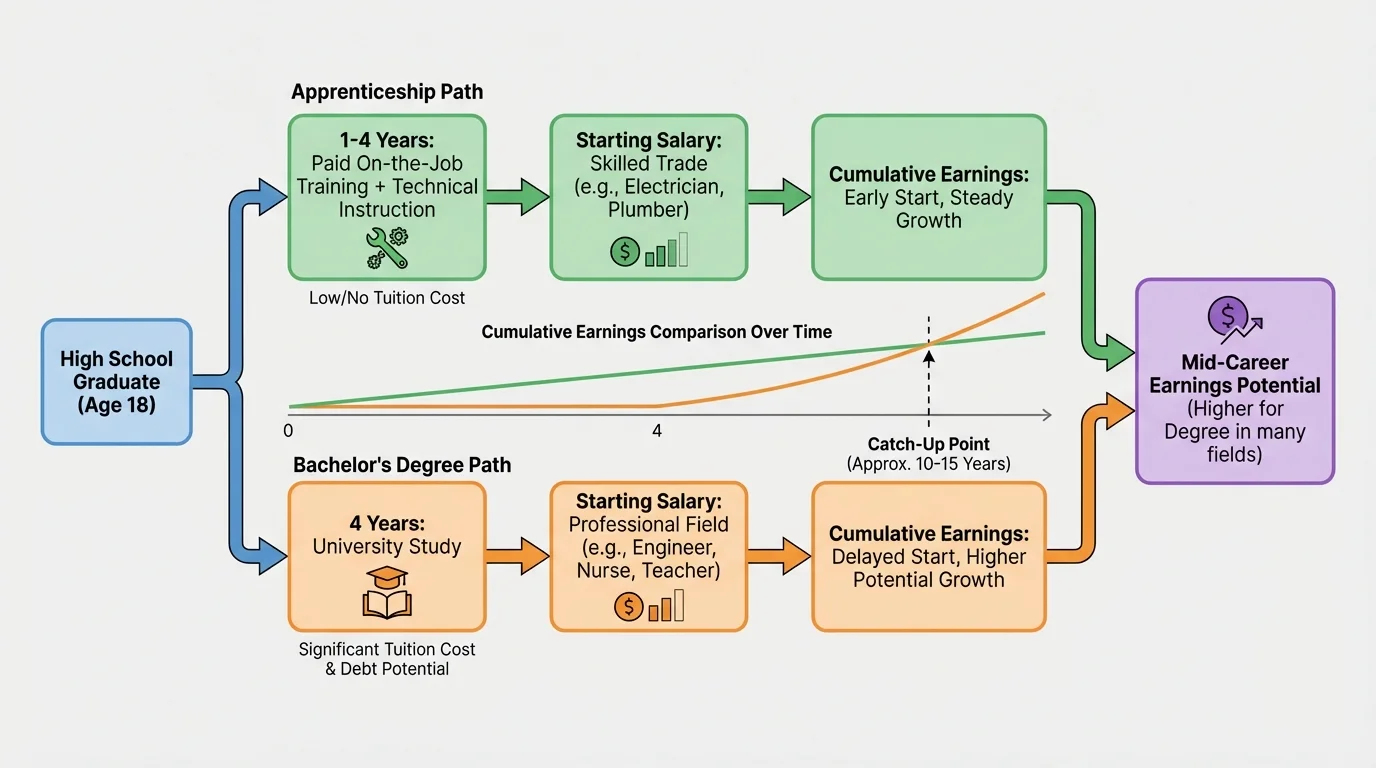
As [Figure 3] suggests, higher earnings can be valuable, but education and training also cost money and time. This is where opportunity cost becomes important. Opportunity cost is what a person gives up when choosing one option over another. If someone spends four years in college, they may gain a degree, but they also give up four years of full-time wages they might have earned in another path.
Tuition, books, fees, tools, transportation, and housing can all affect the true cost of career preparation. Borrowing money can increase that cost further because loans must be repaid with interest. At the same time, a more expensive pathway may still be financially wise if it leads to much higher earnings over many years.
The main financial question is often return on investment, or return on investment. In career planning, this means comparing what a person spends on education with what they may gain in future earnings. A simple way to think about it is:
\[\textrm{Net gain from education} = \textrm{Higher lifetime earnings} - \textrm{Total education and training costs}\]
If the higher earnings greatly exceed the cost, the investment may be strong. If debt is very high and salary gains are small, the financial return may be weak. That does not mean the path is wrong, but it does mean the student should understand the trade-off clearly.
Worked example: comparing short-term and long-term earnings
Suppose Path A is a one-year certificate leading to a $40,000 starting salary. Path B is a four-year degree leading to a $60,000 starting salary. Assume Path B costs $24,000 more in tuition and fees than Path A.
Step 1: Find the annual salary difference.
\[60{,}000 - 40{,}000 = 20{,}000\]
Step 2: Compare the extra education cost to the yearly earnings advantage.
If Path B earns about $20,000 more per year, then a simple payback estimate is:
\[\frac{24{,}000}{20{,}000} = 1.2\]
So the extra direct cost is roughly recovered in about \(1.2\) years of work after graduation.
Step 3: Notice the hidden issue.
Path B also includes extra years in school. During those years, the person in Path A may already be earning income. That lost income is part of opportunity cost.
This example shows why students should look at both tuition cost and the time required before earnings begin.
As [Figure 3] shows, two paths can cross over at different times. One path may produce earlier income, while the other may catch up later. Predicting earnings requires looking at the timeline, not just one salary number.
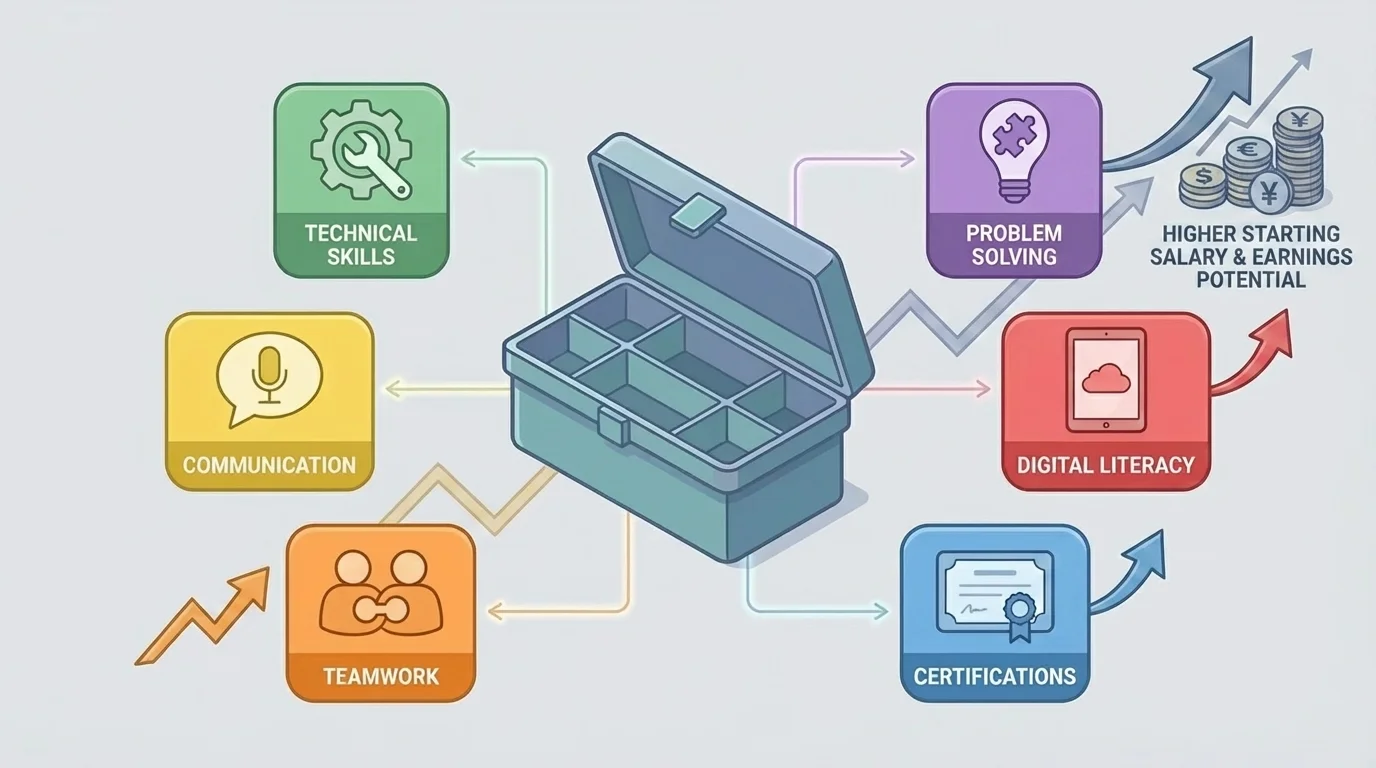
Degrees matter, but employers also reward skills they can use right away, as shown in [Figure 4]. Skill development includes technical abilities such as coding, welding, accounting software, medical procedures, machine operation, and data analysis. It also includes communication, teamwork, punctuality, problem solving, and professional behavior.
Workers who keep updating their skills are often more competitive for promotions and higher-paying jobs. A person may begin with one credential and later increase income through additional training, a specialized certificate, or employer-sponsored education. For example, someone in information technology might start in support services and later earn cloud or cybersecurity certifications that increase earning potential.
In many careers, the fastest route to higher earnings is not necessarily an entirely new degree. Sometimes it is targeted upskilling. A medical assistant may add billing or laboratory skills. A welder may gain advanced certifications. A teacher may earn a graduate degree or specialized endorsement. A business employee may learn data visualization tools. These added skills can make a worker more productive and more difficult to replace.
Employers pay for what workers can do, not only for what schools they attended. A diploma or degree opens the door, but verified skills often determine who gets hired, promoted, or paid more.
The key takeaway from [Figure 4] is that earning potential often rises when formal education and practical skill development work together. Students who build both are usually in a stronger position than students who focus on only one.
Comparing pathways becomes clearer with specific cases. These examples are simplified, but they show how financial choices can lead to different earning patterns.
Case study: apprentice electrician and four-year graduate
Student A enters an electrician apprenticeship after high school and earns $38,000 in the first year. Student B attends college for four years and then starts a business career at $58,000.
Step 1: Estimate Student A's earnings during Student B's college years.
If Student A earns about $38,000 each year for four years, the total is:
\[4 \times 38{,}000 = 152{,}000\]
Step 2: Compare with Student B during the same period.
Student B may have little or no full-time earnings during those four years and may also have tuition costs.
Step 3: Think long term.
If Student B later earns more each year and moves into management, Student B may eventually catch up. But Student A may avoid debt and build savings earlier.
Neither path is automatically better. The better choice depends on goals, costs, and long-term wage growth.
A comparison like this is useful because it shows the difference between early cash flow and later earning potential. For some families, beginning to earn sooner may be essential. For others, delayed earnings may make sense if long-term salary growth is likely to be strong.
Case study: associate degree versus bachelor's degree in health-related fields
Suppose one student earns an associate degree and begins a job at $52,000. Another continues for two more years and enters a related field at $68,000. The extra two years cost $18,000.
Step 1: Find the salary difference.
\[68{,}000 - 52{,}000 = 16{,}000\]
Step 2: Estimate payback based only on direct cost.
\[\frac{18{,}000}{16{,}000} = 1.125\]
The added direct cost is recovered in a little over \(1.1\) years after starting the higher-paying job.
Step 3: Add the opportunity cost.
If the first student could have earned $52,000 during those two years, then the full gap is much larger than tuition alone. That changes the decision.
This example shows why career predictions should include both direct expenses and income delayed by staying in school longer.
Students should also notice that not every decision is about maximizing income. A person may accept lower pay in exchange for meaningful work, a flexible schedule, or service to the community. Personal finance helps people understand the consequences of choices; it does not decide what they must value.
A good career earning prediction starts with research. Students should compare specific occupations, not just broad majors or degree labels. They should ask: What credential is required? What is the starting salary range? What do workers earn after five or ten years? What is the unemployment risk? What licenses or certifications are needed? How much will preparation cost?
Another smart step is to examine whether a field is growing. High demand can improve both job opportunities and wages. Internships, job shadowing, and conversations with professionals can provide information that websites alone cannot. Students can also compare local conditions, because salaries and hiring needs vary by region.
Finally, students should think of career preparation as a financial plan. Education is not just a school decision; it is also an income decision. The strongest choices usually balance four things: interest, ability, cost, and earning potential. If a student understands those four, they are far better prepared to choose a pathway that supports both personal goals and financial stability.
"The best investment you can make is in yourself."
— A common principle in personal finance and career planning
That investment works best when it is informed. Students do not need to chase the single highest salary, but they do need to understand how credentials, field choice, and skill growth can shape income over time. Careful planning turns education from an expense into a strategy.
