Should the class read a story first or go outside? Sometimes everyone gets to help choose. Other times, one adult must decide right away. Knowing the difference helps us understand school, home, and our community.
A decision is a choice. We make decisions every day. You might choose a red crayon or a blue crayon. A class might choose a song to sing. A grown-up might choose when it is time to clean up.
Some decisions are small. Some decisions are very important. Important decisions help people learn, stay safe, and get along with others.
Democratic decision-making means people in a group share ideas and help make a choice, often by voting. Authority means a person has the power and job to make certain decisions and rules.
There are different ways to make a decision. Sometimes people choose together. Sometimes a person in charge decides for the group.
[Figure 1] When a group helps make a choice, that is a simple example of democracy. In a classroom, children may vote for a game or a book. Everyone may share an idea, listen, and then choose.
When a group helps make a choice, it can be a simple democratic way to decide. Each person gets a turn to choose. Then the group sees which choice gets more votes. This helps people feel included.
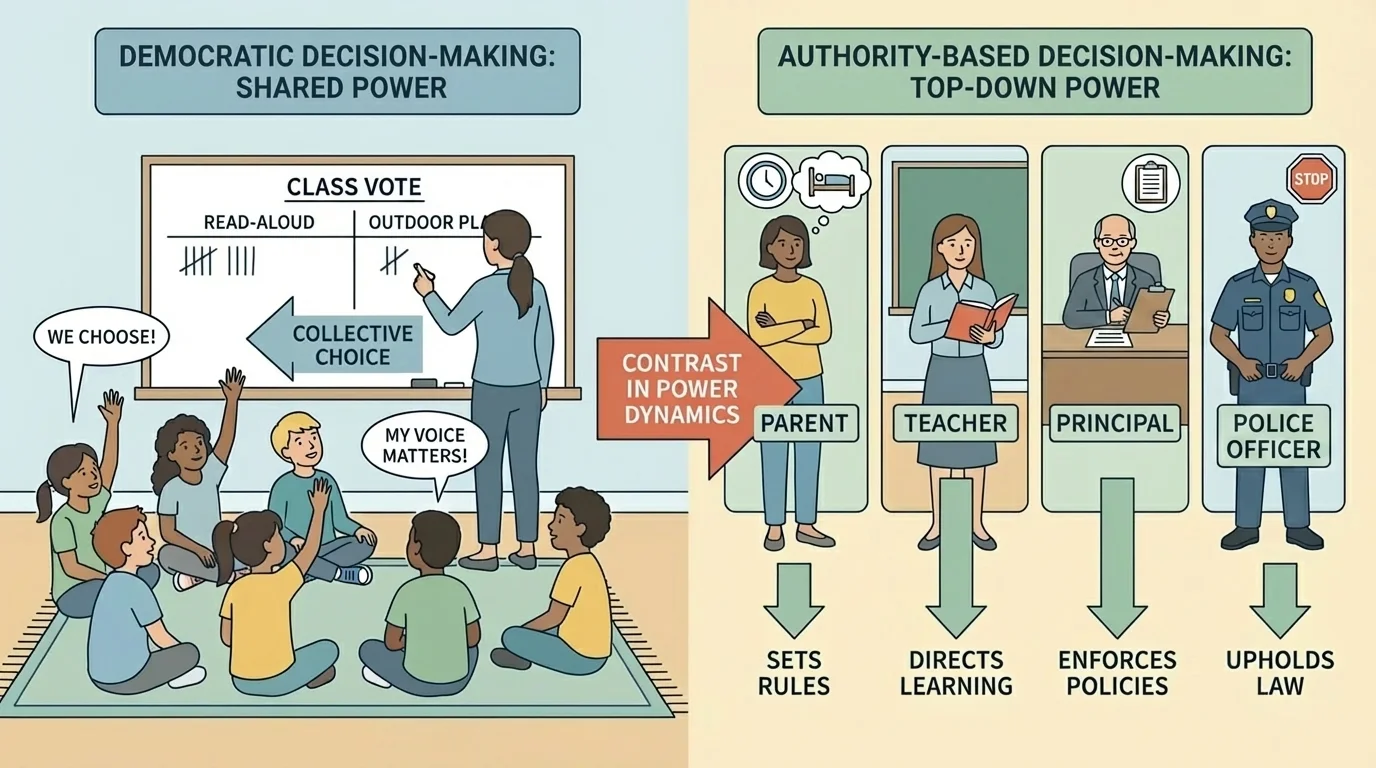
A democratic choice does not mean every person gets exactly what they wanted. If most children vote for the story, then the class reads the story first. Even children who wanted outdoor play can still listen and take part kindly.
Example: Choosing a class song
Step 1: The teacher gives two choices: Song A or Song B.
Step 2: Each child votes for one song.
Step 3: The class counts the votes and picks the song with more votes.
This is a group choice. The children help decide together.
Democratic decision-making works well when people need to choose among fair choices. It teaches listening, patience, and respect. Later, when the class makes another group choice, the same idea from [Figure 1] still matters: everyone can have a voice.
[Figure 2] Some adults have authority. That means they have the responsibility to make certain choices for others. It shows examples of a parent, a teacher, a principal, and a police officer, all of whom make important decisions.
A parent may decide when it is bedtime, what food is safe to eat, or when it is time to leave the park. A teacher may decide when the class lines up, where children sit, or when it is time to be quiet. A principal may set school rules. A police officer may direct traffic or help keep people safe at a crosswalk.
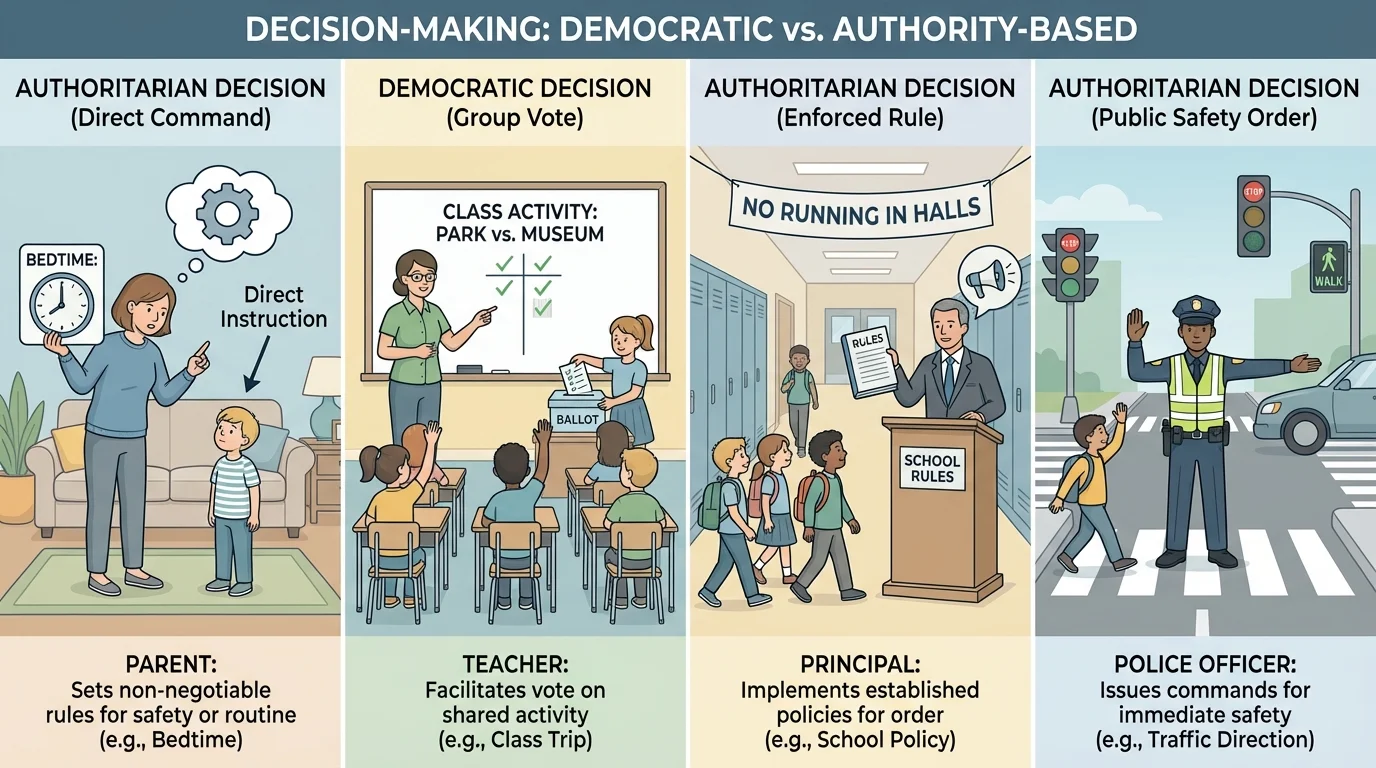
These adults do not always ask everyone to vote first. They often need to make a decision because it is their job. Their decisions can protect people and help things run smoothly.
For example, a teacher usually does not let the class vote about running in the room. The teacher says, "Walk inside." That rule keeps everyone safe. A police officer usually does not ask drivers to vote on whether to stop at a crosswalk. The officer gives directions so people do not get hurt.
Why authority decisions matter
Authority decisions are important when someone must act quickly, keep order, or protect others. Adults in charge are expected to think about safety, fairness, and responsibility.
At home, school, and in the community, children learn that some rules must be followed even when they are not voted on. The adults shown in [Figure 2] each have a special job that gives them decision-making power.
Democratic decisions and authority decisions are different, but both can help people. A class vote helps everyone join in. A teacher rule helps everyone stay safe. A principal rule can help the whole school be fair. A parent decision can protect a child. A police officer decision can protect many people at once.
One way to think about it is this: democratic decisions are often used when a group can help choose, and authority decisions are often used when a person in charge must lead.
| Who decides? | How the decision is made | Example |
|---|---|---|
| Group | People share ideas or vote | The class chooses a game |
| Parent | Adult in charge decides | Bedtime at home |
| Teacher | Adult in charge decides | When to line up |
| Principal | School leader decides | School safety rules |
| Police officer | Authorized official decides | When cars must stop |
Table 1. A comparison of group decisions and decisions made by adults with authority.
Sometimes both ideas work together. A teacher may let the class vote on which story to hear, but the teacher still decides when story time begins. That means some parts are shared choices, and some parts are authority choices.
Many classrooms use both kinds of decision-making every day. Children may vote for a class activity, but they still follow safety rules from the teacher.
Being fair does not always mean doing the same thing in every situation. Fairness means making good choices that help people and respect rules.
Children can be good helpers in both kinds of decisions. When a group is choosing, children can listen, wait for a turn, and speak kindly. When an adult in charge makes a decision, children can follow directions and ask respectful questions if they do not understand.
If the class vote does not go your way, it is okay to feel disappointed. You can still be respectful. If a parent, teacher, principal, or police officer gives a direction or sets a rule, you should listen because that adult is helping keep order and safety.
"We can share our ideas, and we can also follow good rules."
Learning the difference between choosing together and listening to a person in charge helps children become thoughtful members of a classroom, a family, and a community.
