Colorado did not grow all by itself. Every time something important happened here, something important was usually happening across the United States too. When miners rushed into Colorado, the nation was expanding west. When workers protested in coal fields, people across America were fighting for fair jobs. When families in Colorado suffered through dust storms, millions of Americans were living through the same hard years. Learning Colorado history is like looking through a window into the bigger story of the country.
History is the story of people, places, and events over time. A state's history is part of the nation's history. Colorado's mountains, plains, farms, cities, and mining towns gave it a special story, but that story was always linked to bigger events in the United States. New roads, railroads, wars, laws, protests, and ideas moved across the whole country and changed Colorado too.
When historians study the past, they often look for connections. A era is a long period of time with important features or events. Colorado has different eras, such as the territorial years, the mining years, the Great Depression, World War II, and the civil rights era. Each one matches a larger national era in U.S. history.
Statehood means becoming an official state in the United States. Massacre means the killing of many people, usually in a violent attack. Conservation means protecting land, water, plants, animals, and historic places. Civil rights are rights that protect people from unfair treatment and help make sure everyone is treated equally.
Sometimes Colorado events were caused by national decisions. Sometimes Colorado events helped the whole country think differently. That is why it is helpful to ask two questions: What was happening in Colorado? and What was happening in the United States at the same time?
Colorado's path to becoming a state was part of a national story of growth and change, as [Figure 1] shows with Colorado's place in the West during the 1800s. In the mid-1800s, many Americans moved west looking for land, gold, and new opportunities. This movement is often called westward expansion. People came to the Colorado region after gold was discovered near Pikes Peak in 1858. This brought miners, merchants, and settlers.
At the same time, the United States was dealing with huge problems, including arguments over slavery and then the Civil War from 1861 to 1865. Even while the nation was at war, the federal government continued organizing western lands. In 1861, Colorado became a territory. A territory is a region controlled by the United States that is not yet a state.
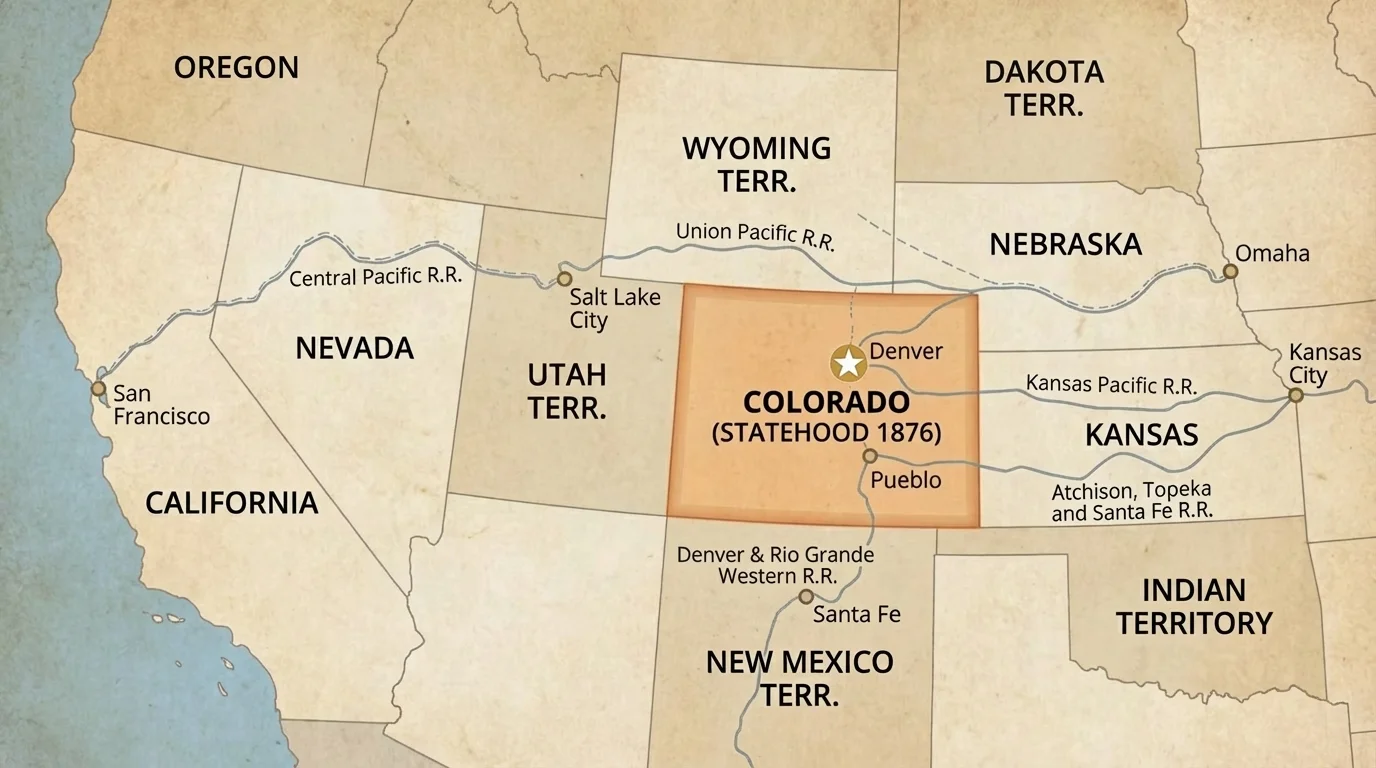
Railroads were also changing the country. Tracks connected places more quickly than wagons could. Railroads helped Colorado grow by bringing in people, supplies, and business. Towns became larger. Farms, ranches, and mines sent goods to other states. Colorado became more important to the country's economy.
In 1876, Colorado became a state. That year was special because the United States was celebrating its 100th birthday. Because of this, Colorado is sometimes called the Centennial State. Colorado statehood connected to national pride, westward growth, and the building of a larger nation after the Civil War.
Looking back at [Figure 1], we can see that Colorado was not isolated. It sat in the middle of routes, resources, and railroad growth that mattered to the whole country.
Colorado history also includes painful events. The Sand Creek Massacre happened in 1864, during a time when the United States was fighting the Civil War and also pushing farther west, as [Figure 2] explains through a short sequence of events. As more settlers moved into lands used by Cheyenne and Arapaho people, conflict grew. The U.S. government made treaties with Native nations, but those promises were often broken.
At Sand Creek in southeastern Colorado, a village of mostly Cheyenne and Arapaho people was attacked by Colorado soldiers led by Colonel John Chivington. Many people killed were not warriors. This event is remembered as a massacre because it was a violent attack on people who were vulnerable, including women and children.
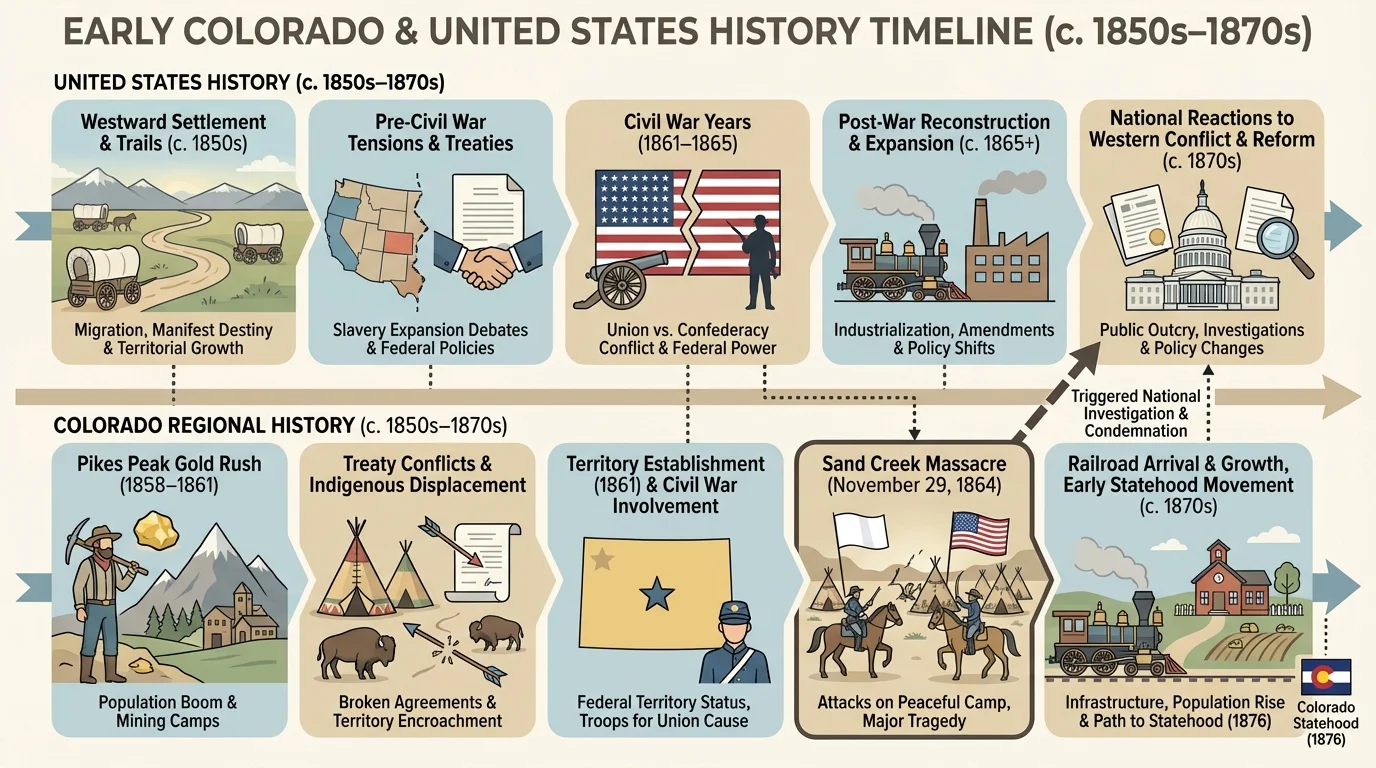
Sand Creek connects to U.S. history because it was part of a larger national pattern. Across the country, Native American nations were being forced off their lands as settlers, railroads, and the U.S. Army moved west. This period is often called the Indian Wars era, though many Native communities understood it as a fight to survive and protect their homes.
The massacre also led to national reaction. Some people in the United States were shocked when reports described the violence. Investigations were held, and Sand Creek became known beyond Colorado. This shows that a Colorado event could affect how Americans thought about justice, war, and government actions.
"Nothing can bring back the lives that were taken, but remembering the truth matters."
— Idea reflected in Sand Creek memorial work today
Today, the Sand Creek Massacre National Historic Site helps people remember what happened and why it matters. When students study this event, they see how westward expansion brought not only growth, but also deep harm and unfair treatment.
By the late 1800s and early 1900s, Colorado was a place of mines, factories, railroads, and growing towns. This matched a national era called industrialization, when machines, large companies, and factories changed how people worked. In Colorado, coal mining became very important. Coal helped power trains, heat homes, and power industries across the country.
Many coal miners in Colorado were immigrants from other countries. They often worked long hours in dangerous places. Some lived in company towns, where the mining company owned the houses and stores. Workers wanted safer conditions, better pay, and more freedom. Across the United States, workers were joining labor unions, groups that organized to ask for fair treatment.
The Ludlow Massacre took place in 1914 after miners in southern Colorado went on strike. As [Figure 3] illustrates, families lived in a tent colony after leaving company housing. Fighting broke out between strikers and the Colorado National Guard. The camp was attacked, and men, women, and children died. Colorado's labor conflict was not just about one camp. It was part of a bigger national struggle over who had power: workers or large companies.
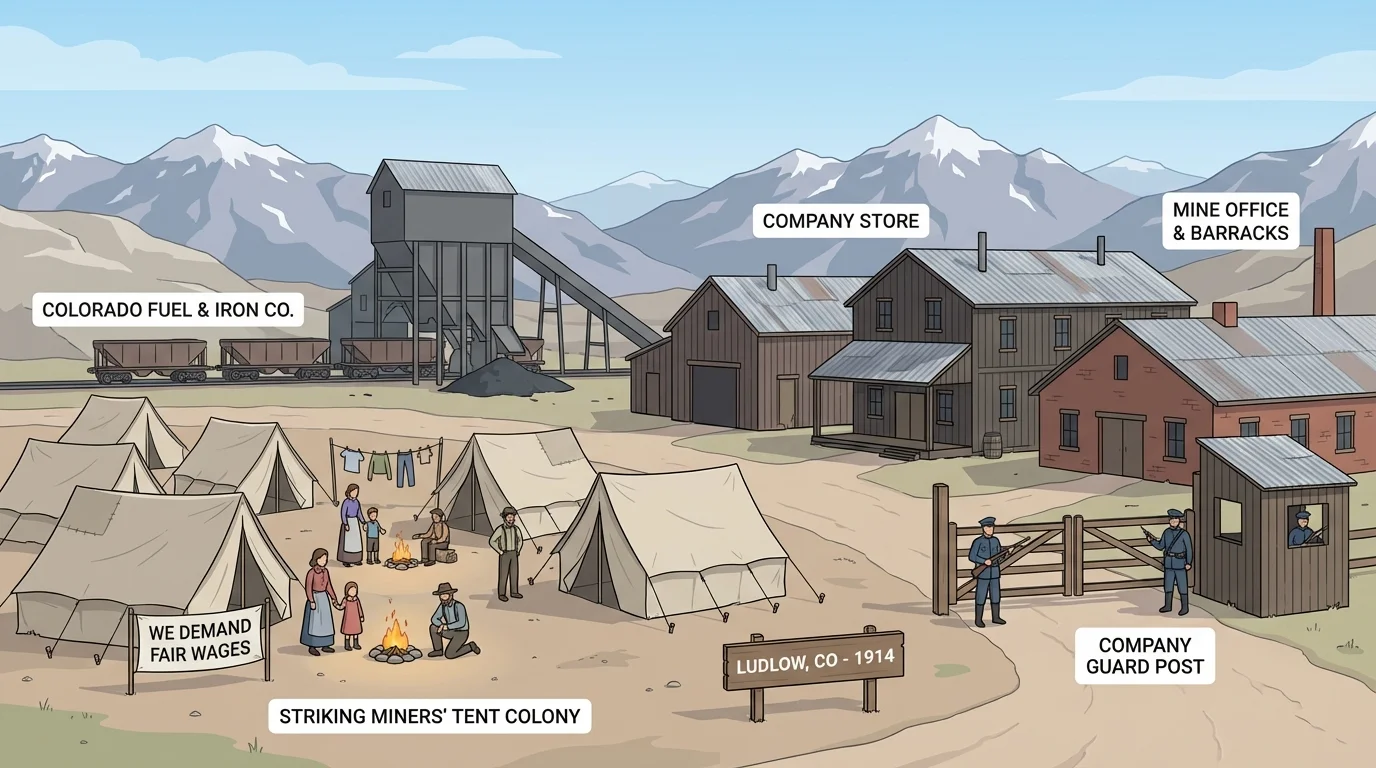
Ludlow connects to U.S. history because workers in many states were striking and protesting in the same era. Across America, labor disputes led people to debate child labor, mine safety, wages, and the rights of workers to organize. Colorado became one of the places where this national problem turned deadly.
Important figures connected to Ludlow include labor leader Louis Tikas and the Rockefeller family, whose company interests were tied to the mines. After events like Ludlow, more Americans paid attention to labor rights. Change did not happen all at once, but the nation slowly moved toward stronger worker protections.
Some Colorado coal miners spoke different languages and came from many countries, yet they still worked together during strikes. Their story shows how immigration and work history connect in Colorado.
Later labor movements across the United States built on these struggles. When we look again at [Figure 3], we can see that families were part of labor history too, not just miners underground.
Not every major Colorado event was a conflict. Some were about protecting beauty, wildlife, and history. During the late 1800s and early 1900s, many Americans began to worry that forests, animals, ruins, and scenic places were being damaged. This helped start the national conservation movement.
Colorado became an important part of that movement. Mesa Verde National Park was created in 1906 to protect Ancestral Puebloan cliff dwellings and other archaeological sites. Rocky Mountain National Park was created in 1915 to protect mountain landscapes, plants, animals, and watersheds. These places mattered to Colorado, but they also belonged to the whole country.
The creation of national parks in Colorado connects to U.S. history because the federal government was creating parks and protected lands in several states. Leaders such as Theodore Roosevelt supported conservation. Americans were beginning to say that some land should be saved for everyone, not only used for business or settlement.
Why parks matter
National parks protect both nature and history. In Colorado, one park helps preserve mountain ecosystems, while another protects human history from long ago. This shows that conservation can mean saving beautiful land, important buildings, and cultural treasures.
There is also an important question here: protected for whom, and how? Some national park lands were places Native peoples had long lived in, traveled through, or cared for. So even conservation history is linked to larger U.S. questions about land, memory, and fairness.
In 1929, the stock market crashed, and the United States entered the Great Depression, a long period of economic hardship. As [Figure 4] shows, Colorado felt these problems as part of a national emergency. People lost jobs, banks failed, and many families struggled to buy food and clothing. In cities and small towns, people looked for work and worried about money. On farms and ranches, life grew even harder.
At the same time, parts of Colorado were hit by the Dust Bowl. The Dust Bowl was a period in the 1930s when drought and poor farming practices helped create huge dust storms across the Great Plains. Southeastern Colorado was one of the affected areas. Soil blew away, crops failed, and families had to make hard choices about staying or moving.
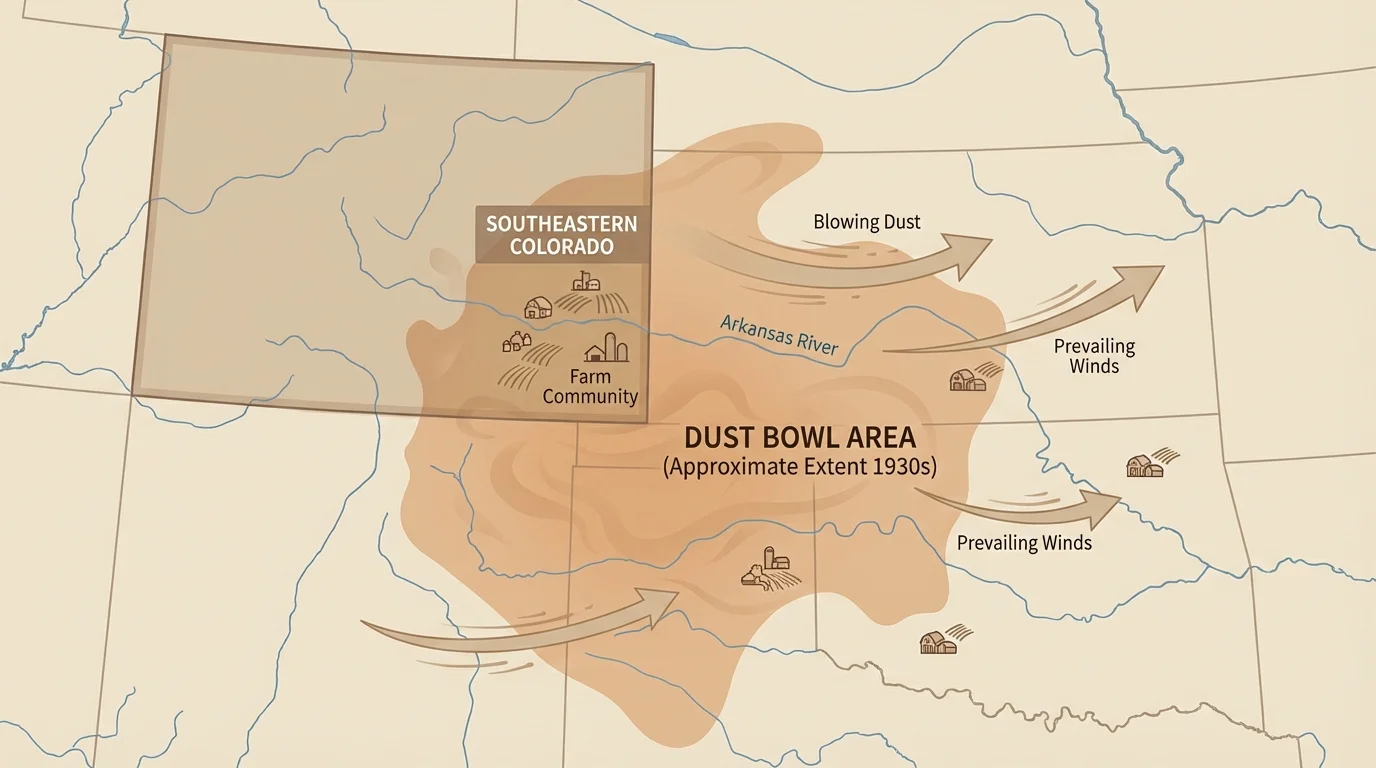
This event connects strongly to U.S. history because farmers in several states suffered in similar ways. It also led the federal government to take action. Under President Franklin D. Roosevelt's New Deal, programs were created to help people find jobs, build roads and parks, conserve soil, and support struggling communities. Colorado received help from these national programs too.
The Great Depression and Dust Bowl show how economic and environmental problems can happen at the same time. They also show how local communities and the national government can both shape recovery. Looking back at [Figure 4], we can understand why Colorado was tied so closely to the wider Great Plains crisis.
| Colorado event | United States connection |
|---|---|
| Job loss in towns and cities | Nationwide unemployment during the Great Depression |
| Crop failure in southeastern Colorado | Dust Bowl across the Great Plains |
| Public works projects | New Deal programs across the country |
Table 1. Examples of how Colorado experiences during the 1930s matched national events.
During World War II, the United States fought enemies overseas, but fear and prejudice also affected people at home. After the attack on Pearl Harbor in 1941, the federal government forced many Japanese Americans to leave their homes and move to incarceration camps. One of these camps was Amache, near Granada, Colorado.
Amache connects Colorado history to national history very clearly. It was created because of a U.S. government decision, not a Colorado-only decision. Families from the West Coast were sent there even though many were American citizens. They lived behind fences and under guard. This happened because fear and racism shaped government policy during wartime.
Amache shows that even while the United States was fighting for freedom abroad, it failed to protect freedom equally at home. That is a hard but important part of history. Students can compare this with other times when people's rights were limited because of fear, unfair ideas, or war.
Case study: Why Amache matters
Step 1: Look at the national event.
World War II caused fear after Pearl Harbor.
Step 2: Look at the government action.
The federal government ordered Japanese Americans to leave their homes and move to incarceration camps.
Step 3: Look at Colorado's role.
Colorado was one of the places where an incarceration camp was built.
Step 4: Think about the lesson.
A national decision changed the lives of people in Colorado, and Colorado became part of a major U.S. story about rights and injustice.
Today, Amache is remembered so people can learn how wartime fear can lead to unfair treatment. It connects Colorado to the national history of World War II, citizenship, and civil liberties.
In the 1950s, 1960s, and 1970s, the United States went through the civil rights movement, when many groups worked for equal rights and fair treatment. African Americans fought segregation. Native Americans, women, people with disabilities, and Latinos also organized for change. Colorado was part of this national movement, and [Figure 5] places Colorado events on the same timeline as major U.S. civil rights changes.
In Colorado, the Chicano movement pushed for better schools, political power, fair treatment, and respect for Mexican American identity and culture. The word Chicano was used by many activists with pride. Leaders and students in Colorado challenged unfair treatment in education, jobs, and public life.
One important event was the 1968 West High School walkouts in Denver. Students protested because they believed their school experience was unequal and disrespectful. They wanted better classes, more representation, and more fairness. This connects to the larger national story of student protests and civil rights activism in the 1960s.
Another major issue was busing in Denver. Busing means using buses to help students attend schools outside their neighborhoods in order to reduce segregation. Segregation means keeping groups apart, often unfairly by race. Denver became part of a national debate about school equality after the Supreme Court had already ruled in Brown v. Board of Education in 1954 that segregated schools were unconstitutional.
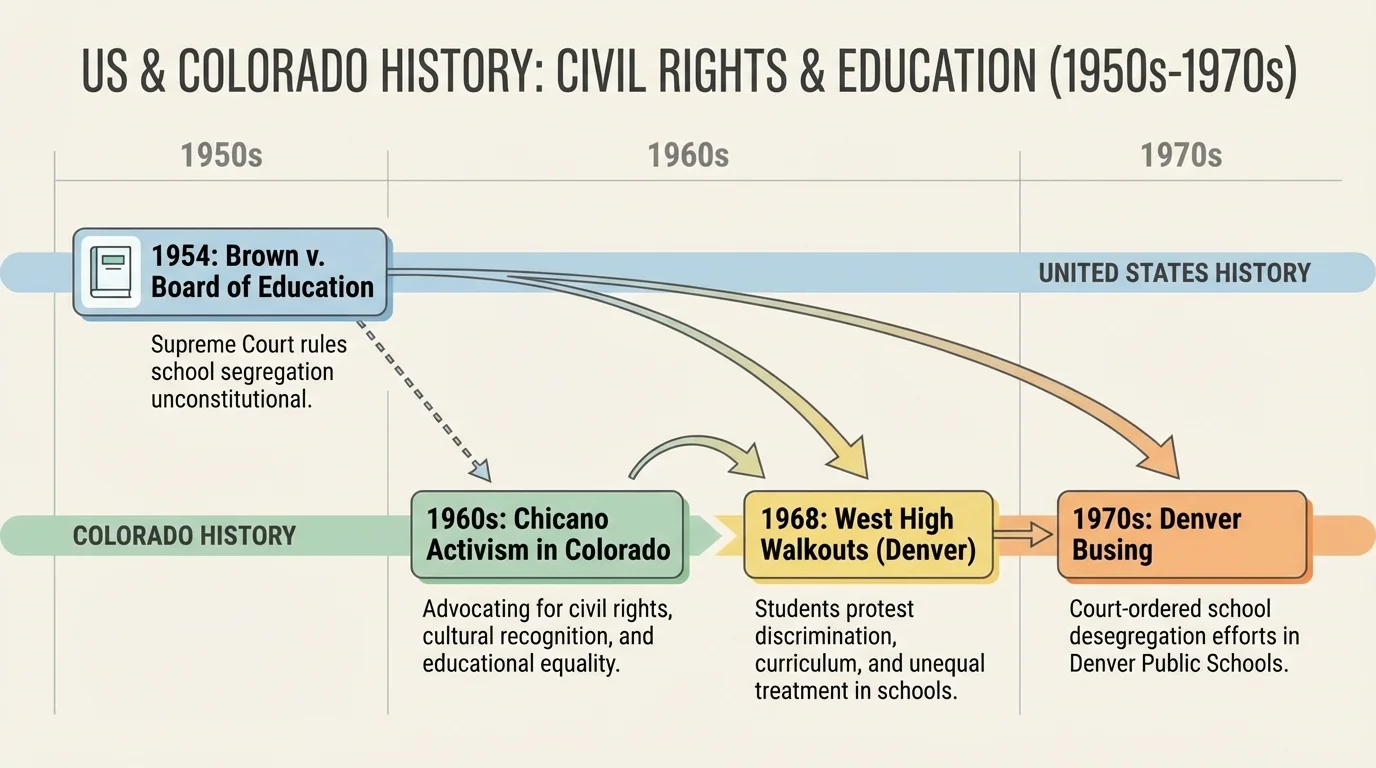
Denver's busing story shows how Colorado cities faced some of the same questions as cities across the country: How can schools be fair? What should governments do when neighborhoods and schools are divided by race? These were not easy questions, and people strongly disagreed. But the debate in Denver was part of the nationwide push to make education more equal.
When we return to [Figure 5], we can see that Colorado's Chicano activism and school battles did not happen separately from the nation. They grew during the same years as larger civil rights struggles across the United States.
When we compare these events, patterns appear. Colorado statehood connects to westward expansion and the growth of the nation. Sand Creek connects to broken treaties and violence against Native peoples during U.S. expansion. Ludlow connects to labor struggles during industrialization. National parks connect to conservation. The Great Depression and Dust Bowl connect to economic crisis and environmental disaster. Amache connects to World War II and civil liberties. The Chicano movement and busing in Denver connect to the civil rights era.
These connections help us understand an important idea: state history and national history move together. Colorado is one state, but its people experienced many of the same hopes, problems, and debates that shaped the United States.
Historians use both primary sources and secondary sources to learn about these events. A primary source is something from the time being studied, such as a letter, newspaper, photograph, speech, or diary. A secondary source is something made later by someone studying the past, such as a textbook or history article. Both kinds of sources help tell Colorado's story and connect it to the larger U.S. story.
When you study any historical event, ask: Who was involved? What changed? What was happening in the country at the same time? These questions help you connect local history and national history.
Colorado history includes pride, struggle, beauty, injustice, courage, and change. Understanding how it fits into U.S. history helps us see the past more clearly and think more carefully about fairness, citizenship, and community today.
